
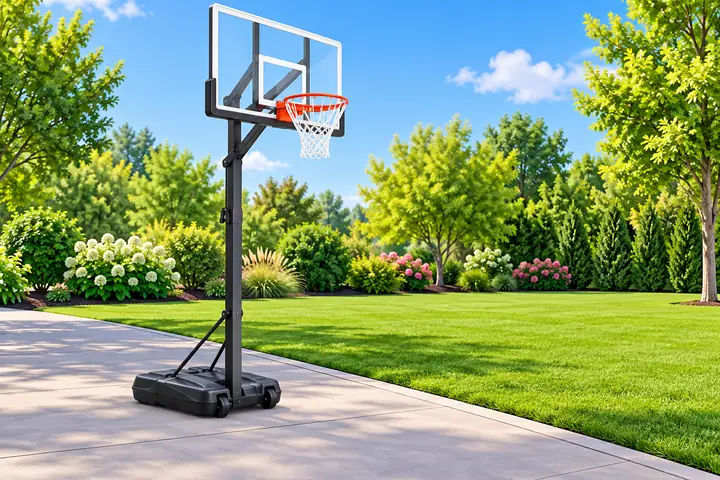
Put the complete base on pavement
Start with a wide photo showing the goal, driveway, curb or walk and adjacent turf. The entire weighted base and all wheels should rest on the agreed hard surface, not half on soil where the edge becomes uncertain.
Happy Grass does not fill, drain, assemble, stabilize or inspect a portable goal. The property owner remains responsible for the equipment and for following its manufacturer instructions.
Record one mowing-day position
Choose a repeatable spot that preserves the lawn route, household travel and vehicle access. Photograph a fixed visual reference such as a driveway joint rather than making a new mark in the grass.
The property contact should move the goal before service if movement is needed. A lawn crew should not roll a heavy base, handle a damaged wheel or decide where play equipment belongs.
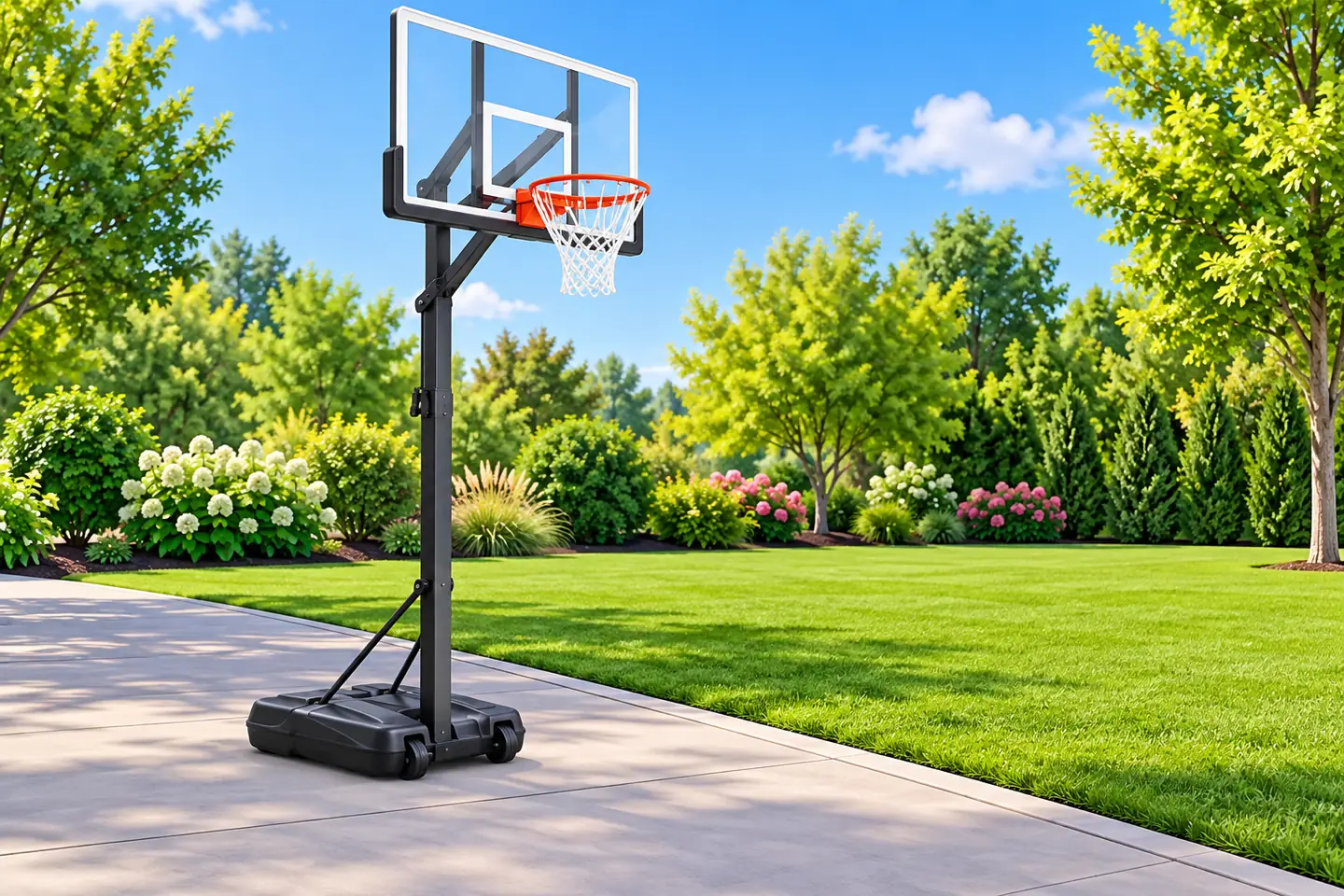
Include the backboard overhang
The base may be on pavement while the pole, backboard or rim projects over grass. View the structure from the side and mark the full overhead footprint, not only the wheels.
Low or angled hardware can interfere with a turn even when the grass below looks open. Keep equipment outside any place where the operator could contact the pole, support arms, rim or net.
Clear loose play items
Remove basketballs, cones, portable lights, water bottles and toys from the driveway and lawn. Store them somewhere that does not block the gate or become a hidden object near the curb strip.
Do not place loose items in the hoop base recess or behind a wheel if that creates an obstacle. Mowing-day preparation should make the edge visible from both directions.
Define the true driveway edge
Identify where concrete or asphalt ends and grass begins. A settled, cracked or buried edge may need a conservative finish, while a clear sound border may support routine edging.
The goal base itself is never the edging guide. Do not cut a trench around wheels or scrape a pole in pursuit of a sharper grass line.
Protect the net and hanging parts
Secure or replace a loose net before service if it hangs into the work zone. Do not tie, cut or tuck netting on the owner’s behalf.
Wind can change the net’s position between the planning photo and the visit. If any part reaches active equipment height, expand the no-contact area or pause that segment.
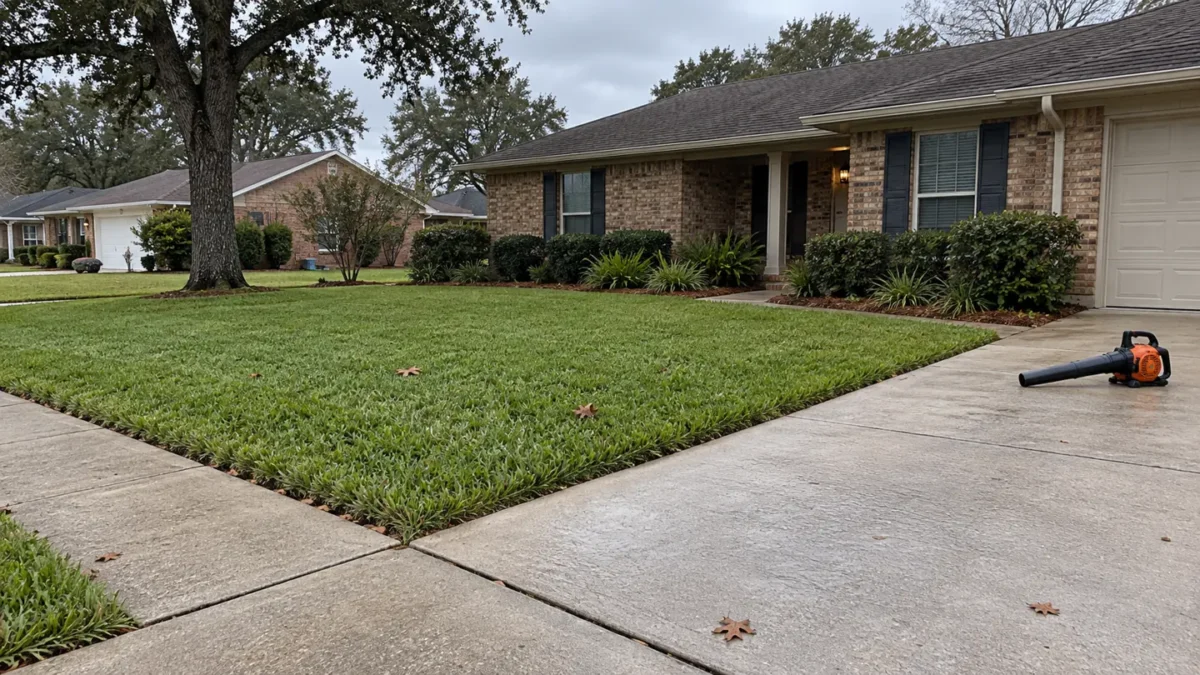
Keep the driveway route understandable
Show which direction equipment enters and exits. A goal can leave enough straight-line width but block the turn between a parked vehicle, fence and lawn.
Move vehicles and owner-managed equipment according to the agreed plan before arrival. Never rely on a crew to navigate through a last-minute corridor that was not part of the quote.
Separate play time from work time
No one should shoot baskets, retrieve balls or cross the driveway while lawn equipment is active nearby. Use a simple household notice so children and visitors know when the work zone is closed.
If someone needs to pass, pause and secure equipment first. A clear travel route matters more than finishing one strip without interruption.
Check for leaks or damaged wheels
Look for water, sand or plastic fragments around the base and for a wheel that no longer supports the frame. Record the condition without attempting a repair.
A leaking or unstable goal should be handled by the owner before the lawn visit. Do not move it onto grass to investigate or create room.
Keep clippings off the court area
Routine blowing can clear fresh lawn residue from the named driveway section. Direct material toward an appropriate lawn area, not toward the goal, street, storm drain or neighboring property.
Existing gravel, oil, broken plastic and heavy debris require separate cleanup. A final blow is not pressure washing or court-surface restoration.
Plan the curb strip separately
Where the hoop sits near the street, distinguish the main yard from the narrow grass between walk and curb. Vehicle traffic, collection carts and public travel can change access to that strip.
Do not place equipment in the road or block a required route. If the curb strip cannot be reached from the property side under suitable conditions, record the limit before service.
Watch irrigation heads and sleeves
Portable goals sometimes stand near sprinkler heads, drain grates or pole sleeves. Make every visible ground feature part of the map so the lawn edge is not treated as an empty straight line.
Happy Grass does not test irrigation or insert the goal into a permanent sleeve. The owner should identify low features and keep the agreed position free of new hoses or cords.
Recover grass from an old position
If the base previously sat on turf, clear the footprint and inspect for compressed soil, dead grass and plastic pieces. Do not promise that ordinary mowing will restore the surface.
Trim or mow reachable living growth conservatively. Soil repair, reseeding and turf replacement are different decisions, and Happy Grass does not offer overseeding.
Photograph the side profile
One front image rarely shows base, pole angle and backboard overhang together. Add a side view with the driveway joint and lawn edge visible, while excluding people, license plates and house numbers.
Update both views after the goal moves or the driveway layout changes. Current pictures prevent a former position from becoming an accidental instruction.
Use weather-aware preparation
Strong wind, storms or flooding preparation may require owner action on the goal. If it is laid down, tied off or moved into the yard, pause the affected lawn instead of working around a temporary emergency position.
Resume after the property contact restores a stable agreed location and confirms the route is clear. Lawn service does not determine safe storm storage for play equipment.
Write the quote around the edge
List the lawn sections, actual hard border and named driveway area included for routine blowing. Exclude moving the goal, repairing it, handling the net, clearing toys and restoring damaged turf beneath an old base.
Happy Grass does not provide fertilization, aeration, overseeding or pest control. Keeping those exclusions visible prevents a thin or worn base footprint from becoming an implied renovation promise.
Use a quick pre-visit check
Confirm the base is fully on pavement, the goal is in its photo-matched position, loose items are stored, vehicles are placed as agreed and the driveway turn is open.
The check should take a minute and remove ambiguity. If the position cannot be corrected safely, send a photo and leave the affected edge for a new plan.
Ask Happy about the driveway border
For a portable-goal yard in Harvey, Marrero, Gretna, Algiers, Belle Chasse or Westwego, call 504-339-3571 and ask for Happy. Share front and side views plus the desired vehicle plan.
An agreed paved position can preserve play equipment, keep the driveway usable and give the adjacent grass a consistent finish without asking the crew to move a heavy base.
Account for nighttime lighting
Portable work lights or extension cords used for evening play should be removed before lawn service. A cord that is obvious after dark can disappear against a bright driveway or grass edge during the day.
Mounted house lights remain fixed features. The owner should identify any low transformer, wire or stake that sits near the driveway border.
Keep parking instructions compatible
Write the goal position and vehicle plan together. Moving the hoop to clear one car can block the mower turn or place the backboard over the only grass route.
If an unexpected vehicle occupies the agreed lane, leave the affected edge rather than moving either the car or goal. Update the plan before the next visit.
Review after driveway work
Sealing, patching or replacing the driveway may alter joints, edge height and the safe place for the weighted base. Wait until the surface contractor releases the area.
Then photograph the new border and confirm that wheels sit flat. Lawn service does not judge pavement curing or the stability of repaired play equipment.
Show the position you will actually prepare
Use a side view and a wider driveway view to explain the agreed parked position of the goal. Identify the base, any overhang and the lawn edge beside it without exposing people or vehicle details unnecessarily. The photographs should describe the prepared arrangement rather than an ideal position the household has not decided to use.
If moving the goal is not practical for the owner, say so before the quote assumes that edge is clear. Discuss the reachable lawn under the fixed arrangement instead of leaving an open instruction for the crew to relocate sports equipment. Review the note when parking patterns or the play area change. That makes the position repeatable and helps distinguish an unfinished edge that needs discussion from a section everyone already agreed would remain outside normal access.