
Ask for Happy.
Need the lawn off your list? Start with the address, what you want done and the best way to reach you. Call or text Happy at (504) 339-3571. We’re happy to hear about your yard.
info@happygrasslawncarellc.com
Harvey · Marrero · Gretna · Algiers · Belle Chasse · Westwego

Let’s talk about your yard
Get your lawn quote
By submitting, you’re asking Happy Grass to contact you about this request. Privacy details.
For a new lawn request
Share the property address and a couple of recent photos if possible. Describe whether you want mowing alone or the full mowing, edging, trimming and blowing combination.
Let Happy know whether this is recurring maintenance, a one-time request or a lawn that has gotten ahead of you.
Point out access limitations, pets, soft ground and areas that should be left alone. Keep private gate codes out of the general form. A request starts a conversation; the scope, price and availability still need to be confirmed directly.
For an existing service question
Use the same phone number and explain the property and the question clearly.
If something has changed since the last conversation, such as a new fence, blocked entrance, construction or a wet patch, mention it before the next planned visit. Photos can help show the current condition.
If you need to discuss timing, weather arrangements or an upcoming deadline, contact Happy directly. Submitting another quote request does not automatically amend an existing agreement or reserve a different date.
For a question about a service
Visit the lawn services page to see how mowing, edging, weed-eating and blowing differ. If the issue is hard to describe, explain the result you want and show the affected area. Happy can clarify whether it fits the available work.
Our work focuses on lawn maintenance. Fertilization, aeration, overseeding and pest control aren’t services we offer. The easiest way to reach us is by phone, text or the form above. Ask for Happy!
Make the first message useful without making it complicated
You can contact Happy in ordinary language. Tell us where the property is, which grass areas need attention and the part of the job you most want help with. There is no need to know equipment names or decide on every finishing detail before saying hello. A straightforward description gives the conversation a useful starting point.
If you are looking for lawn service for someone else, explain your role and who can confirm the work or provide access. Do not assume that the person sending the message, the person at the property and the person agreeing to the quote are the same. A clear contact arrangement helps prevent instructions from getting lost between people.
Choose the way you want to hear back
The quote form lets you indicate a preferred contact method. Choose text, call or email based on what you are most likely to see and answer. Check the number you enter, and include a working email address if email is your preference. A detailed message is difficult to follow up on when the contact information has a small mistake.
If you leave a voicemail, include your name, property location and a number for the reply. If you send a text, a short introduction can make the pictures easier to place. You do not have to repeat the whole request through every contact method. One clear version, followed by an update when something changes, is easier to understand than several different versions of the same job.
Give each photograph a little context
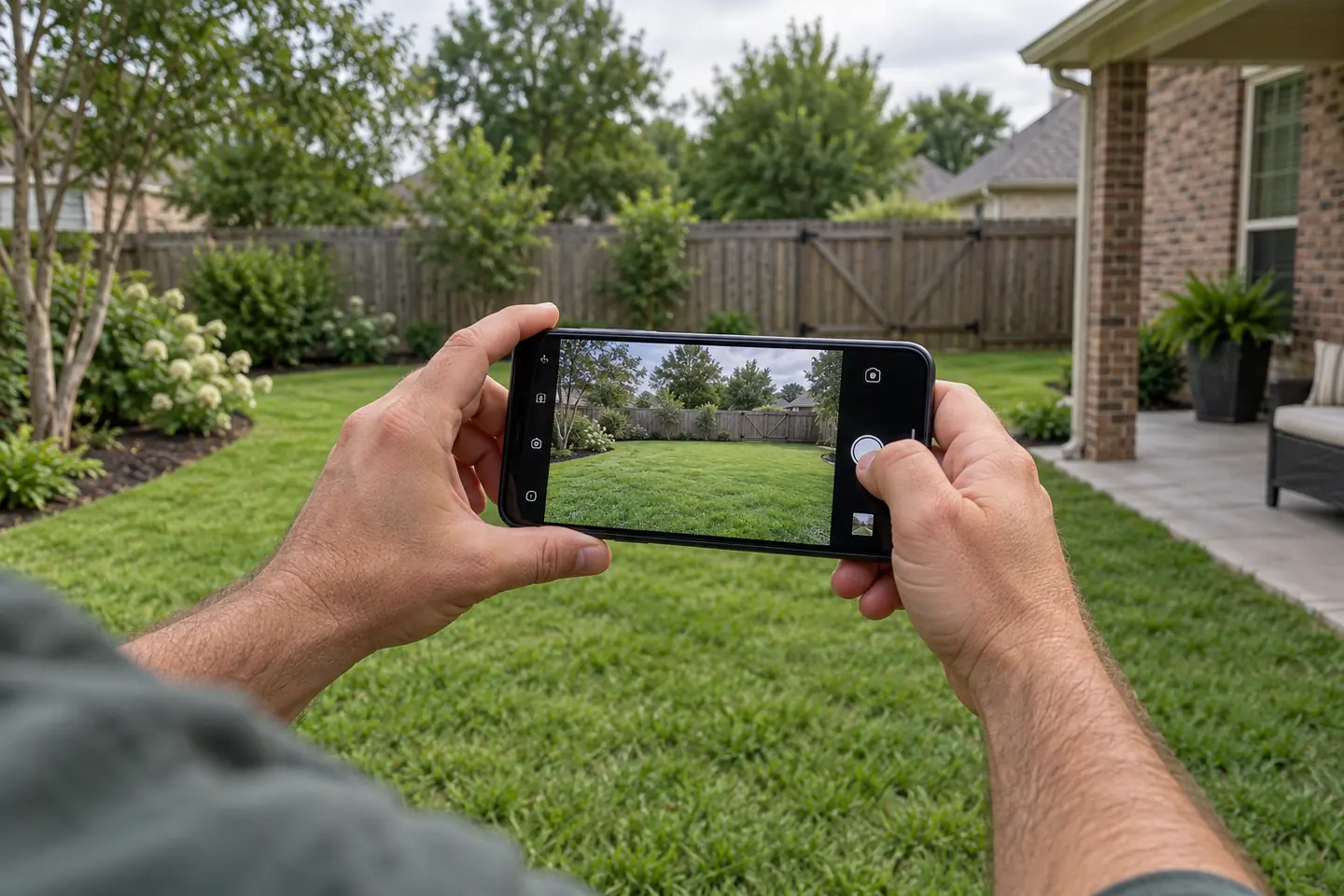
A wide front-yard view, a wide backyard view and an open-gate picture answer different questions. The first views explain the areas you want maintained. The entrance picture helps explain access. Close views of tall growth, a fence corner or a damaged path edge add the details that a wide picture may miss.
Say which area each photograph shows if that is not obvious. A short label such as back fence or left side of driveway is enough. Current pictures are best for describing current work. If you send an older image, identify it as older and explain what has changed since it was taken.
Include the areas you do not want serviced
It is just as useful to explain what should be excluded as what should be included. A newly planted patch, a garden border, a neighboring strip or grass behind a building might be outside your request. Identify those boundaries directly instead of relying on someone to guess from the appearance of the yard.
If responsibility for a section is uncertain, raise that before service. A mowing request should describe the work you can authorize for the property. It should not become an on-the-spot decision about a shared area or a boundary that has not been settled. Clear instructions help keep the actual lawn visit focused and useful.
Tell Happy about access before discussing a visit
Show any gate and explain the route to the agreed mowing areas. Mention steps, a narrow turn, a difficult latch or a section that stays soft after rain. If a vehicle, storage item or piece of furniture normally blocks the route, explain what arrangement can be made before service.
Pets need a separate plan to be secured away from the work area. Put away loose toys, hoses and small belongings where practical. If you will be away from the property, discuss access directly with Happy rather than assuming the gate can be left in a particular position. The instructions should fit the arrangement you can actually provide.
Make the timing request clear
If you are hoping to prepare for a gathering, travel or another event, mention the date early as a preference. Happy still needs to review the property, the work and route availability. A date written in a form is useful planning information, but it is not a service reservation by itself.
If a visit is already being discussed and conditions change, follow up directly. Rain, a locked gate or a lawn that someone else has partly cut can change the picture. Describe what is different now instead of relying on the first photographs to explain a property that no longer looks the same.
Separate a quote question from a confirmed arrangement
Asking for a quote starts a review. Happy needs to understand the included areas, mowing and finishing tasks before the price and available timing can be confirmed. A form submission, text or voicemail is not the same thing as a completed agreement about the visit.
When you receive the quote discussion, check that it covers the work you intended. If clipping collection, leaves or another extra request matters to you, ask about it clearly. Do not compare a mowing-only request with a more complete set of tasks as though the two describe the same service. A little clarification at this stage can prevent a much less useful conversation later.
Follow up with the detail that changed
You do not have to rewrite everything when you have an update. Identify yourself, the property and the new information. For example, you can say that the gate is now available, the backyard is still soft or the grass has been cut since the original request. That keeps the important change easy to recognize.
If you are uncertain whether an arrangement is confirmed, ask Happy directly. Do not treat an assumed time as booked simply because a message was sent. The same applies when you want to change or cancel something already discussed: contact Happy and make sure the revised understanding is clear rather than leaving it to inference.
Keep the lawn request within the right scope
Happy Grass focuses on grass cutting, edging, weed-eating, blowing and lawn weed-control requests that can be discussed for the property. Fertilization, aeration, overseeding and pest control are not offered. A mowing visit also does not by itself diagnose or repair a different lawn or drainage problem.
You can still describe a concern without diagnosing it. Explain that an area looks thin, stays wet or is growing differently, and keep that observation separate from the maintenance you are requesting. Useful contact begins with accurate information and sensible expectations. Call or text 504-339-3571 and ask for Happy, or use the lawn quote form when you are ready to share the details.
Keep a changing request easy to follow
A good conversation can become confusing when the yard changes between the first message and the reply. Perhaps the original photographs showed furniture on the patio, but the furniture now occupies the side passage. Send the changed view with a plain explanation of what moved. Identify which earlier picture it replaces. You do not need to retell the entire property history; the goal is to make the current condition unmistakable.
If two household members are helping with the request, choose whose description is current before adding more details. One person might mean the whole backyard when saying “the back,” while another means only the grass behind the garage. Naming those areas separately prevents a small wording difference from becoming a different quote. State whether the new information changes the area requested, the access route, the desired timing or simply the appearance you hope to discuss.
Keep unanswered questions together so that a reply can settle them. For example, a question about including a narrow grass strip is different from a question about whether a proposed day is available. Resolve the strip first if it changes the work being considered, then confirm the timing against that scope. A requested day remains a preference until an arrangement is actually made.
Before treating the conversation as complete, reread the latest description from the other person's point of view. It should identify the current lawn areas, the preparation you will handle and any remaining uncertainty. If something is still unknown, say so directly. An honest open question is more useful than an answer inferred from an old photograph.