
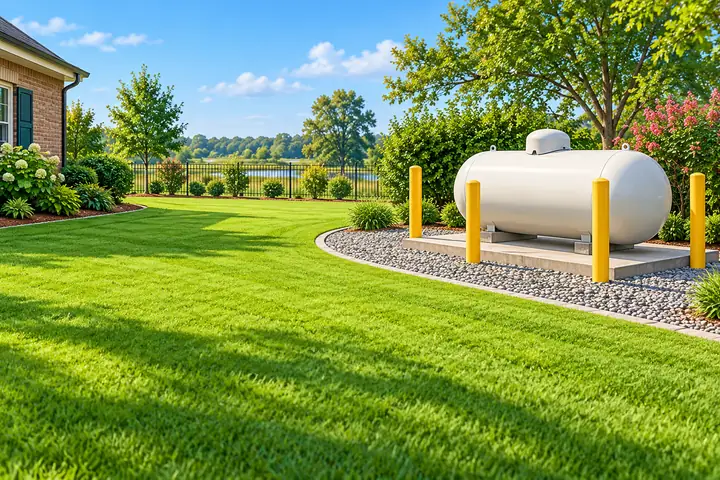
Treat the tank as fuel infrastructure
The tank, valves, regulator, piping, protective posts and base form one system. Happy Grass does not touch, inspect, paint, clean or operate any part. The homeowner and propane supplier control all fuel questions. Lawn work starts only outside a clearly visible boundary.
Send wide photographs from a safe distance showing the gate, tank and surrounding grass. Do not climb on the pad or move a cover for a picture. Tell Happy which side the supplier uses and whether a vehicle needs access for delivery.
Preserve supplier access
Keep the established path free of lawn bags, furniture, trailers and temporary fencing. A neat edge cannot block a fill connection or service approach. If a delivery is scheduled, stagger it from mowing so vehicles and equipment do not compete for space.
Happy Grass will not unlock supplier equipment or guide a fuel truck. The property owner must coordinate service. If supplier access crosses a soft lawn, discuss that separately with the supplier rather than assuming mowing establishes a vehicle route.
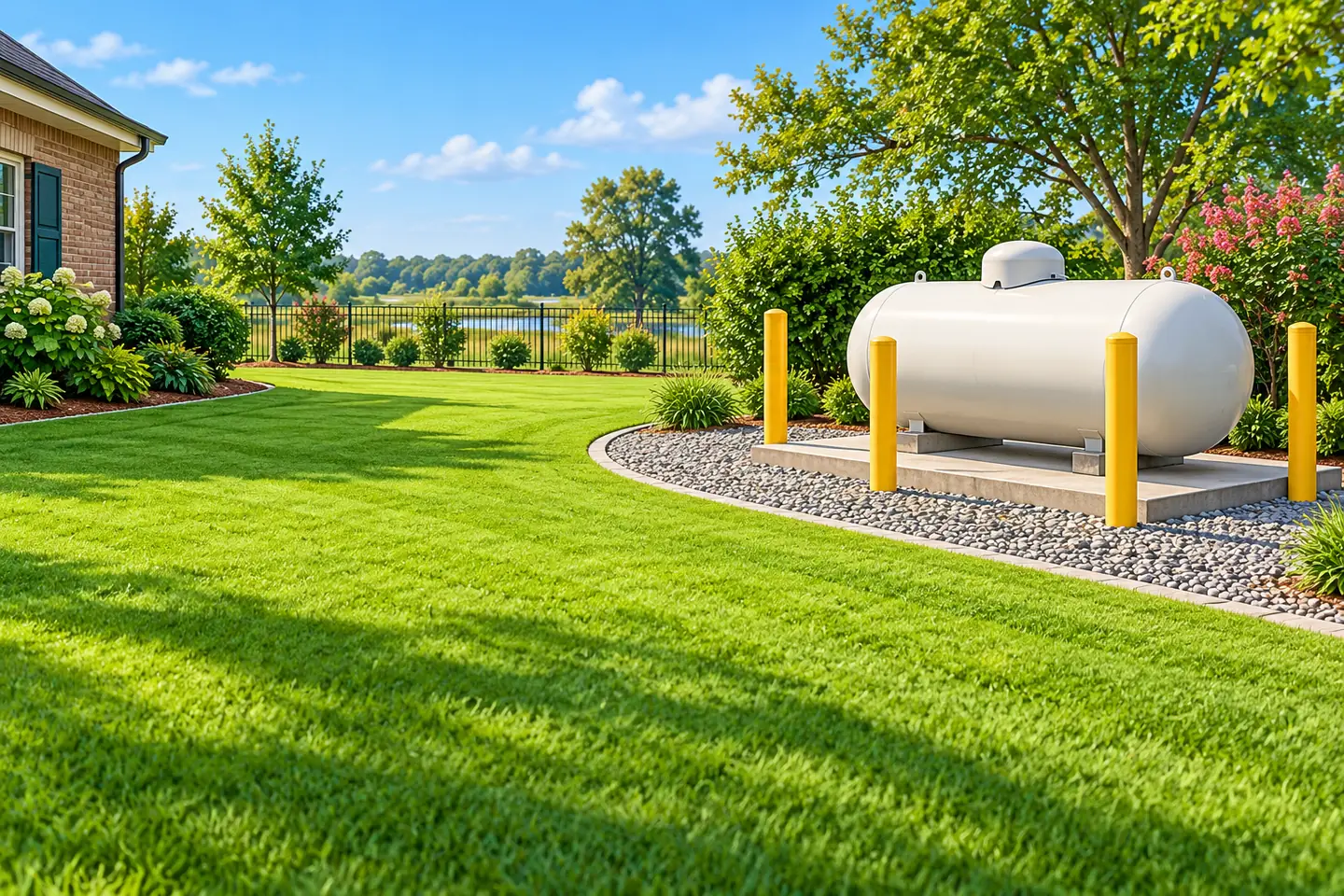
Use the outermost component as the boundary
The concrete or gravel pad may be smaller than the tank overhang. Piping can extend toward a wall, and protective bollards can sit beyond the base. Measure clearance from the outermost fixed component. Do not weave equipment between posts or beneath a tank.
Keep grass, mulch and stored items from hiding low piping. If vegetation has wrapped around hardware, contact the propane provider for the appropriate next step. Happy will not pull plants from valves or trim by contacting fuel equipment.
Know the stop conditions
Gas odor, hissing, frost, visible damage or a shifted tank requires immediate attention under the propane supplier’s and emergency authority’s guidance. Do not enter the area to investigate for lawn service. Move to a safe location and follow the appropriate instructions.
Happy Grass does not diagnose leaks. The adjacent lawn remains out of scope until the responsible provider has addressed the condition. A scheduled visit never takes priority over a fuel-safety concern.
Keep ignition sources away
No smoking, open flame, hot ash or active fire feature should overlap the tank-side work area. The homeowner should also keep portable grills and fuel-powered personal items in their proper locations. Lawn equipment follows the agreed no-contact path; it is not used inside the equipment zone.
Manufacturer, supplier and fire-code requirements control actual clearances. This guide does not replace them. Happy can keep a wider lawn boundary when the property layout calls for caution without claiming to certify the installation.
Protect visible piping
Above-ground lines and regulators must remain visible. Do not hang hoses, cords or garden tools from them. A loose or unsupported line needs the qualified propane provider, not an improvised brace. Exclude nearby grass until repair is complete.
Before digging for edging, landscaping or drainage near a tank, use applicable locating processes and coordinate private fuel lines with the supplier. A public locate may not identify every private line. Happy Grass does not locate buried piping.
Check the base and surrounding ground
Pads can shed water into a low grass arc, while gravel can migrate into turf. Return loose stone to the owner-managed equipment border before mowing. After rain, test the outside route for softness without stepping into the tank zone.
A cracked pad, displaced block or leaning protective post needs provider review. Lawn service cannot correct structural support. Happy may work elsewhere on the property while leaving the entire tank perimeter untouched.
Plan after storms
Falling branches and floodwater can change the site. Inspect from a safe distance and contact the supplier about any suspected damage. Do not clear a limb resting on the tank or move debris entangled with piping.
Once the provider has confirmed the area is appropriate and the route is dry, send new photographs. The former lawn map should not override storm-related changes.
Keep decorative screening separate
Fences, shrubs and screens sometimes hide a tank from view. They must not erase supplier access or conceal system parts. Tell Happy which boundary is landscaping and which is fuel equipment. Do not ask the crew to enter a narrow screen enclosure.
If plants need substantial pruning or a screen needs repair, complete that separately. A lawn quote does not certify that screening meets supplier requirements.
Prepare without manipulating the system
Use a simple outside-perimeter check. – Remove toys, hoses, furniture and loose branches from the lawn route. – Keep the supplier’s service side unobstructed. – Return gravel or mulch inside its intended border. – Identify visible piping and protective posts. – Check the outside grass for saturation. – Report odor, sound, damage or changed hardware through the proper safety process.
Never test a valve or lift a cover as part of mowing preparation. The owner should rely on the propane provider’s instructions.
Keep pets and children away
Secure children and animals away from both the tank and lawn equipment for the whole visit. Do not use the tank enclosure as temporary pet containment. Gates needed for fuel service may not be suitable as pet barriers.
After the visit, the homeowner should inspect and secure the yard before normal activity resumes. Happy Grass is not a fuel-site monitor or pet supervisor.
Keep turf expectations realistic
Shade, gravel migration and restricted access can make the tank-side grass different from the open lawn. Happy can mow suitable reachable turf but does not offer fertilization, aeration, overseeding or pest-control services. Mowing alone is not promised to restore thin areas.
If the owner wants to enlarge the non-turf boundary, coordinate the design with the propane supplier and confirm private lines before work begins. Update the lawn scope only after the project is finished.
What Happy needs for a quote
Share the tank footprint, outer overhang, pad type, supplier-access side, visible piping route and the nearest gate width. Note wet ground and protective posts. Wide views should show space, not equipment labels or private property numbers.
Those details let Happy maintain an ample no-contact margin. The propane provider retains responsibility for fuel infrastructure, and the lawn visit remains limited to accessible grass.
Record the supplier boundary
Ask the propane supplier which approach and service area the property must keep open, then maintain that space without paraphrasing it into a lawn guarantee. Happy can note the visible supplier side and stay farther away when the layout is tight. The authoritative fuel instructions remain with the supplier and applicable rules.
Keep supplier tags, warning labels and access covers unobscured. Do not paint over them or hide them with decorative fabric before a lawn visit. If landscaping has grown across the required view, arrange the appropriate trimming or provider guidance first. The crew should not reach between a tank and screen to discover what is concealed.
Coordinate refills with ground conditions
A delivery vehicle may require a route different from the mower path. After prolonged rain, discuss access with the supplier rather than treating ordinary lawn traffic as proof that a heavy vehicle can enter. Happy Grass does not evaluate soil bearing capacity for fuel delivery.
After a refill, walk the outer lawn boundary from a safe distance. Remove ordinary packaging only if it belongs to the homeowner and is clearly separate from the system. Any cap, seal, part or unfamiliar item near the tank should be left for the supplier to identify.
Protect the emergency approach
Do not build a locked decorative enclosure that prevents the responsible provider or emergency personnel from reaching the equipment. Gate and access decisions should follow supplier and local requirements. Happy’s quote can respect that approach but cannot approve the enclosure.
At night, never rely on a lawn crew to discover a changed tank condition. The homeowner should report known issues in advance and cancel the nearby work when necessary. Clear communication is part of the no-contact boundary.
Separate supplier instructions from lawn preferences
Keep any boundary or access instruction supplied for the tank attached to its source. A preference for a tidier grass edge should not be written as though it overrides the supplier’s requirements. For the quote, identify the lawn area outside the owner-confirmed equipment zone and the authorized approach that will be available.
If a delivery or service appointment changes the layout, update Happy with the practical lawn consequence: a route is blocked, an area remains uncertain, or the visit needs review. Avoid sharing private account information in photographs when a wider layout view will answer the question. Once the other work is finished, check the current arrangement before carrying the old note forward. This keeps tank service and lawn maintenance coordinated without blending their responsibilities or treating a familiar installation as an ordinary garden ornament.