
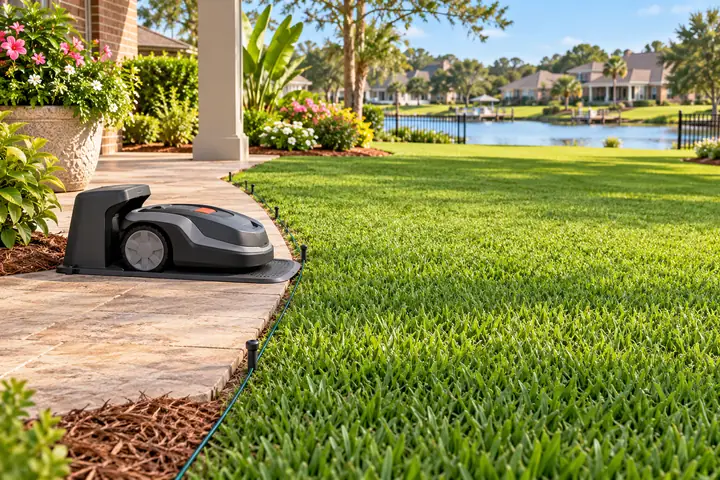
Identify the exact system before planning the visit
Some robots follow a buried or surface-pinned boundary wire, some use guide wires, and newer systems may use virtual boundaries. The charging dock may be on turf, paving or a small pad. Ask the owner which pieces are present, where the power supply is connected and how the machine is stopped. Do not assume that lifting the robot disables it. Happy does not install, program or repair robotic mowers; the information is only used to separate a conventional lawn-service route from the homeowner's automated equipment.
Park and disable the robot before arrival
The robot should be in its dock or another secure location, powered down according to its manufacturer instructions and unavailable to restart on a schedule while people are working. App controls, rain delays and automatic calendars differ by model, so the owner is responsible for confirming the safe state. A machine that unexpectedly leaves its dock can enter a trimming lane or approach another mower. Send a visit-day reminder if automation is normally active, and do not begin until the equipment is accounted for.
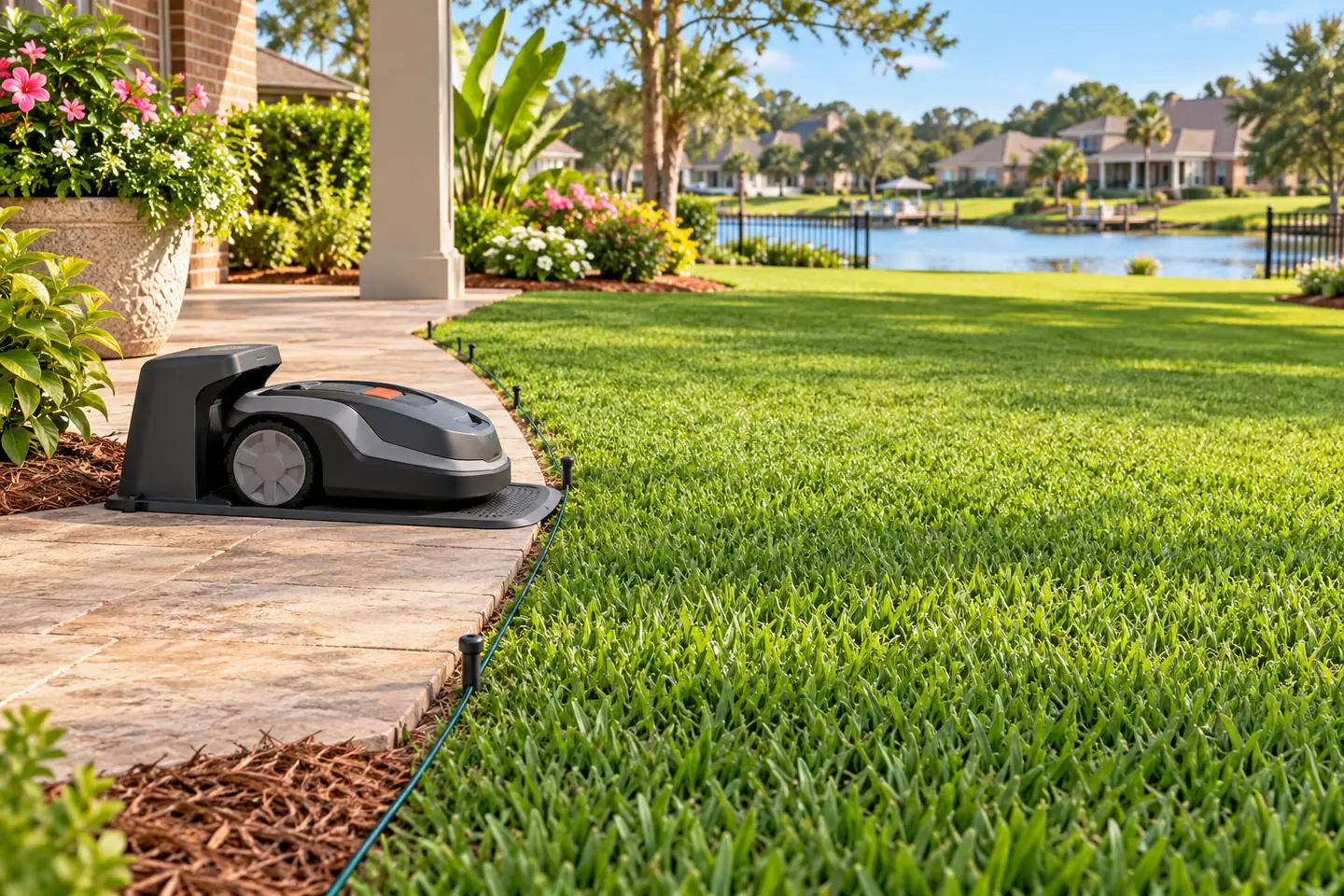
Give the charging station its own no-contact zone
Manufacturer guidance commonly calls for level placement and open space in front of a dock so the robot can align. That same approach should not become a turn pad for heavier equipment. Mark the dock footprint, its base plate and cable exit. Keep wheels away from mounting screws and avoid blowing dense clippings into charging contacts. If the dock sits loose, tilted or waterlogged, photograph it and ask the owner to correct the installation. Happy should never straighten, rewire or relocate an energized station.
Boundary wire can be shallow even when invisible
Physical loop wire may be pegged on the surface, tucked beneath thatch or buried only far enough to disappear. Aggressive edging, aeration, digging and hard vertical trimming can cut it. Happy does not provide aeration, and ordinary mowing should still use a mapped border where the wire crosses gates, beds, sidewalks or repair splices. Ask for the owner's installation sketch. If the route is unknown, avoid ground-penetrating work and keep routine trimming conservative until the system owner or installer identifies the line.
Treat recent wire repairs as temporary work zones
A new splice may have extra cable, connectors, pins or a small disturbed patch. Bright flexible flags can protect the location during establishment, but loose wire and rigid tools must be removed from the mowing area. Do not bury a coil under clippings or pull slack to make the surface look neater. Photograph the repair corridor, trim around it and let the installer finish the approved placement. When the flags are eventually removed, update the property map so future crews still know where the crossing lies.
Power leads need more than a visual glance
The low-voltage cable between a power supply and dock may follow a wall, edge or narrow side yard. Confirm that it is secured as designed and not stretched through grass, wrapped around a gate or joined to an outdoor extension cord that crosses the route. Happy will not unplug, test or modify electrical equipment. If a loose cable lies where blades or wheels could reach it, pause and ask the owner to make the system safe. Wet grass adds another reason not to improvise around unknown connections.
Plan overlap rather than competing patterns
Robots often maintain a work area with frequent random or mapped passes, while conventional mowing may follow deliberate lanes. The owner should decide whether the robot is handling the whole yard, a fenced section or only maintenance between visits. This avoids repeatedly cutting a zone that should rest and clarifies which edges Happy is expected to finish. Use photos to define excluded islands, transport paths and narrow passages. A clear scope is more valuable than trying to make two machines operate at the same time.
Check for small robot accessories in the grass
Wire pegs, reference markers, antenna mounts and temporary setup stakes can be difficult to see. Before starting blades, walk the perimeter and remove only loose ordinary debris that the owner has authorized. Do not pull a peg simply because it is proud of the soil. CPSC mower guidance emphasizes clearing debris because thrown objects can cause serious harm. An unfamiliar component should be flagged and left for the robot owner or installer, not tested by contact with lawn equipment.
Use a safe visit-day sequence
- Owner parks and disables the robot before the scheduled window.
- Confirm the dock, power lead and any visible boundary repairs.
- Keep children, pets and bystanders away from both machines.
- Mark loose, raised or recently repaired wire before mowing.
- Maintain a no-contact buffer around the dock and accessories.
- Owner restores automation only after the lawn crew has left.
Keep clippings out of docking and sensing areas
A thick drift can cover charging contacts, block a guide corridor or hide small cable anchors. Direct discharge away from the station and blow the adjacent paving without aiming into vents or connectors. Do not wash the dock, scrape contacts or use a blower as a diagnostic tool. The goal is a clean surrounding surface, not robot maintenance. If the unit reports an error after the visit, the owner should follow the manufacturer troubleshooting process rather than asking the lawn crew to open the machine.
Rain and soft ground can change the arrangement
The robot may leave shallow tracks, stop on wet turf or pull at a surface-laid wire when the soil softens. Happy should review those conditions before using larger equipment on the same lane. If the dock sits at the bottom of a slope or near irrigation spray, note standing water and defer the affected strip. Drainage, electrical protection and dock siting remain owner or installer responsibilities. Lawn service can work around the presented condition when it is stable, visible and safe.
Do not mix troubleshooting with lawn decisions
A broken-loop message, flashing dock light or stranded robot does not authorize Happy to trace wires, open connectors or bypass safety systems. Record the visible state, keep equipment away and notify the owner. Likewise, a robot that leaves uncut tufts may need programming, blade or installation service; it does not automatically mean the lawn should be cut shorter. Conventional service follows the agreed grass condition and scope, while the robotic system follows its own qualified support path.
Protect the installation during edging
The highest-risk places are often where boundary wire parallels a driveway or crosses beneath an edging line. Identify those segments in advance and use shallow, controlled finishing methods. Never chase an invisible line with a metal tool. If the owner wants a sharper edge than the existing installation allows, the robot installer should first confirm or relocate the wire. This preserves the loop and keeps Happy from turning a cosmetic request into an electrical repair.
A shared calendar keeps the yard happy
Record robot operating days, irrigation windows and Happy's service window in one simple note. The robot should not be scheduled to resume based on a guessed departure time. The owner can restart it after confirming the gate is closed, tools are gone and no temporary markers remain. With a current boundary map, safe shutdown and separate responsibilities, automation can support the lawn without surprising the people working in it.
Review gates and transport passages
Some robotic systems travel through a narrow opening or follow a guide wire between front and rear work areas. That passage may not fit Happy's equipment, and an automatic gate arrangement can change while the robot is moving. Record the human-access route separately from the robot path. The owner should secure gates in the agreed position before arrival and verify them again before restarting automation. Happy should never wedge a gate open with the dock, robot or cable, and should not cross a wire-marked passage until its clearance is understood.
Write a handoff that distinguishes the two routines
Keep the owner-managed robot routine and Happy’s proposed visit on separate lines of the property note. State the prepared arrangement for the robot and its associated equipment, then describe the lawn areas being discussed for the human-operated visit. Avoid an open instruction to make both systems work together, which leaves operation and troubleshooting responsibilities undefined.
If a robot installer or service provider changes the setup, update the lawn-side reference before the next visit. Name the practical consequence, such as an altered exclusion or a changed entrance, without asking Happy to interpret an unfamiliar system map. After the visit, any owner decision to resume the robot’s routine belongs in that owner-managed process. A clear handoff describes what will be presented for lawn maintenance and preserves a separate role for the people responsible for operating and maintaining the robot.