
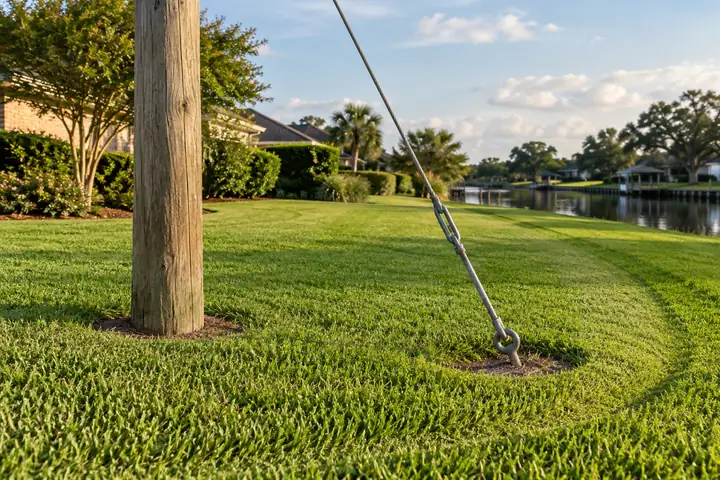
Recognize the entire feature, not just the wooden pole
A utility pole may carry power, communications or other equipment. Its guy wire runs diagonally to an anchor in the ground, sometimes several feet away and low enough to cross a person’s line of travel. Hardware, grounding conductors, warning markers and buried facilities may surround the base. Happy Grass does not climb, move, brace, inspect or repair any utility structure. Before service, walk around the pole and locate every anchor and wire from a safe distance. Keep the grass low enough that the anchor remains visible, but do not touch a wire to see whether it is tight. OSHA warns that guy wires can present severe electrical hazards if they contact energized lines. Any loose, broken, fallen or newly displaced wire requires an immediate call to the responsible utility and a wide exclusion area. Lawn work should wait until the utility declares the area safe.
Give each anchor its own no-contact circle
The mower path should curve around both the pole base and the anchor rather than thread between them. A guy wire can be difficult to see against grass, especially in shade or at dusk. Keep decorations, vines, pet leashes and garden edging away so the line remains obvious. If the anchor has a protective guard, leave it in place. Do not paint, pad or modify utility equipment yourself. Reachable grass may be trimmed carefully from a stable position, but the string or blade should not strike metal, wood, grounding material or cable. A small hand-finished buffer is preferable to a collision. Tell Happy Grass if the anchor lies inside a normal turning area; a wide photograph showing the pole, anchor, gate and nearby fence helps us plan equipment movement before arrival.
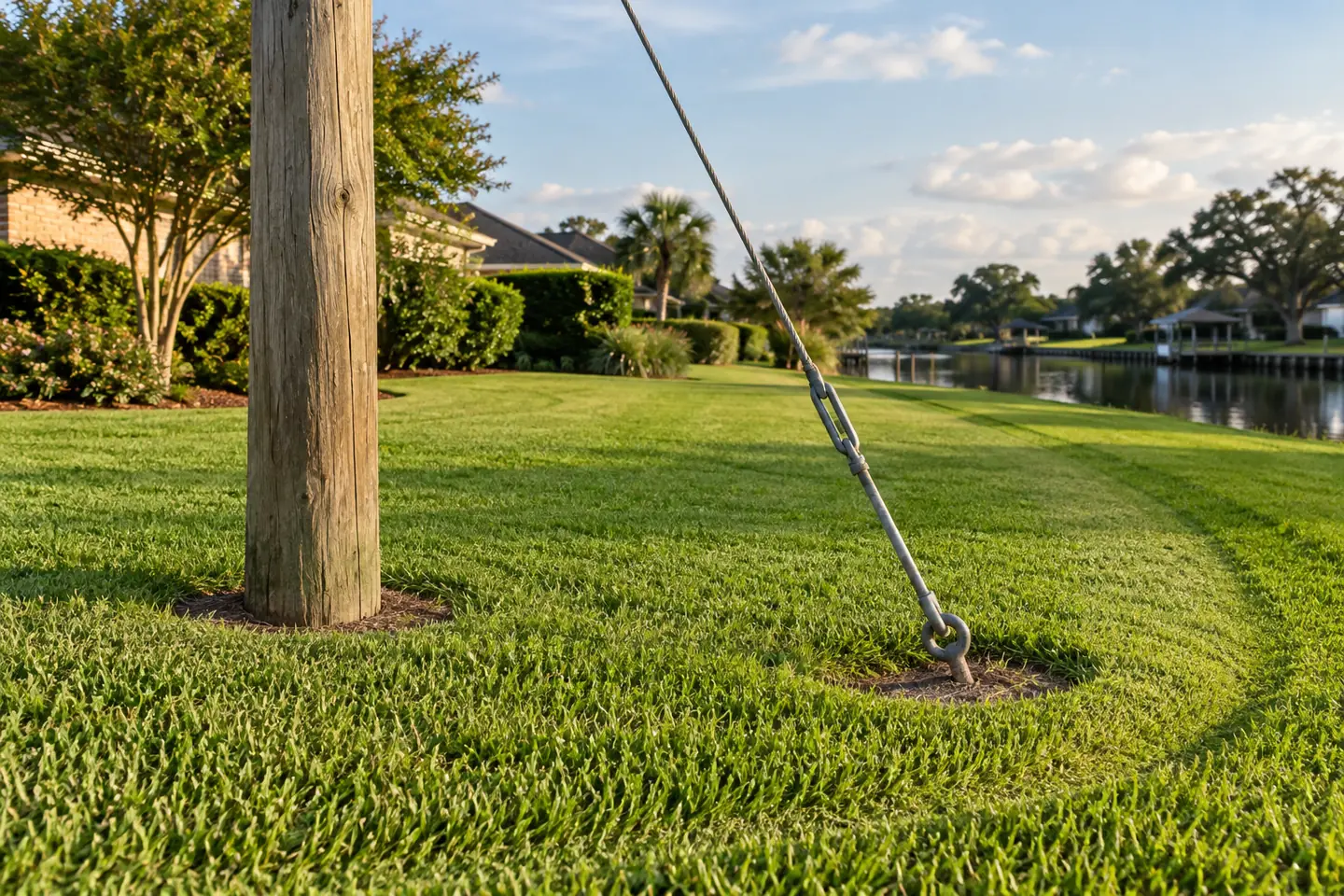
Separate routine mowing from digging and excavation
Mowing the surface does not normally require excavation, but installing edging, driving stakes, planting or repairing ruts may break ground. Louisiana 811 instructs homeowners to request utility markings before digging and notes that not every customer-owned line will be marked. Do not ask a lawn crew to add stakes or cut a new trench during routine mowing. If a landscape project is planned near the pole, make the required locate request and use qualified contractors. Preserve official marks and flags until the project is complete and valid under the locate instructions. A pole’s presence does not reveal the path of every buried line. Happy Grass follows visible lawn boundaries and does not interpret utility colors, expose lines or decide where digging is safe.
Keep the approach free of stored items and vehicles
Poles often sit near rear property lines, driveways or side gates—the same places used to store trailers, boats and trash carts. Clear a continuous route that does not force equipment toward the pole or beneath a guy wire. Move vehicles before the appointment and keep gates fully open. Do not park a trailer tongue against an anchor or drape hoses over the wire. If the utility corridor crosses a shared yard, coordinate with neighbors so the route and stopping point are understood. Happy Grass should not move another person’s property or enter an adjoining parcel to avoid an obstacle. When access is blocked, we may service the reachable portion and leave the unsafe pocket. Predictable access protects both the utility feature and the lawn.
Watch for storm changes before the crew arrives
High wind, falling limbs and saturated soil can alter a pole area even when the pole still looks upright. After a storm, look from a safe distance for leaning, sagging conductors, a loosened guard, exposed anchor hardware or soil pulled up around the anchor. Never approach a downed line or anything touching it. Call the utility or emergency services as appropriate and keep others away. Do not schedule mowing as a way to clear access for utility repair unless the utility has first made the area safe and specifically coordinated the work. Once repairs are complete, inspect the ground for wire scraps, cut branches, stakes and ruts. Freshly disturbed soil may need time or professional restoration before it can support equipment. Send updated photos because the former mower path may no longer be suitable.
Manage vegetation without using the wire as a trellis
Vines and woody plants can climb poles and guy wires, but removing them may bring a person into contact with utility equipment. Happy Grass can cut ordinary grass at a safe exterior boundary; we do not pull vegetation from a pole or work overhead. Do not attach birdhouses, lights, signs, clotheslines or landscape wire to a utility pole or guy. If vegetation is interfering with lines or equipment, contact the utility for direction. For shrubs planted near an anchor, maintain enough open space that the hardware and grass edge remain visible from the route. A clean sight line reduces the chance that someone backs into the anchor while turning. The aim is not a bare utility corridor at any cost; it is a maintainable lawn boundary that does not require contact.

Protect nearby meters, pedestals and service lines too
A pole area may also include a transformer, communications pedestal, meter, grounding wire or service line to the house. Treat each item as a separate obstacle with its own clear access. Do not pile clippings, mulch or trash against equipment. Keep flexible cords and temporary cables out of the grass. If a service line appears low, damaged or disconnected, stop and call the responsible provider; do not lift it for a mower. Louisiana 811 explains that lines on the customer side of a meter may require special attention because utilities may not know their location. Lawn service cannot certify private wiring or plumbing. A site sketch that marks the pole, guy anchor, meters and gate is valuable on complex lots.
Choose a stable finish at the base
The soil around poles and anchors may be depressed, eroded or covered with gravel. Avoid scalping a mound or dropping a wheel into a hidden hole. Remove loose stones and litter before service, but do not dig at the pole base or add soil against utility components. If a protective marker is faded or missing, report it to the owner rather than improvising a replacement. Where grass grows in a tight metal assembly, a slightly wider trimmed ring can keep the feature visible without repeated contact. If the ground remains wet, mark the whole soft zone and postpone equipment traffic. Happy Grass can maintain accessible turf; correction of grade, erosion or equipment foundations belongs to the utility or property professional.
Communicate the boundary in one clear instruction
Use precise directions: “Enter through the right gate, remain outside the two orange owner flags, and turn before the guy anchor.” Avoid instructions that ask the crew to decide whether a cable is abandoned or whether a pole is on your property. If a survey or easement question affects the service line, resolve it with the appropriate professional. For a quote, include daylight photos from two angles and mention pets, locked gates and narrow clearances. On the service day, remove temporary obstacles and leave official utility markings untouched. A brief, consistent plan lets Happy Grass work around the feature without pretending to provide electrical, utility-locate or right-of-way advice.
Seasonal growth can make the same route feel different. In summer, fast turf and vines may hide the anchor sooner; in winter, fallen leaves can cover hardware at ground level. Recheck visibility before every visit instead of relying on an old photograph. If a new provider adds a cable, marker or pedestal, update the route immediately. Never assume an unused-looking line is abandoned. Only the responsible owner can identify and remove utility equipment. The lawn plan stays conservative until that work is complete.
Label the route on each side of the fixed feature
A wire-supported pole may divide what looks like one lawn strip into different approaches. Describe the authorized route to each accessible area and show the visible fixed feature from an existing safe viewpoint. Leave an obscured or uncertain portion marked for review rather than treating the shortest line on a sketch as an approved equipment path.
When the owner receives new information from the utility or another responsible professional, update the lawn note with the practical consequence and its source. Do not copy account numbers or unnecessary identification details into the quote photographs. Keep the finish goal separate from the equipment boundary: a preference for a tidy base is not permission to move, cover or reinterpret the installation. A clear route description lets the lawn conversation stay grounded in the area that can actually be considered.