
Separate three different measurements
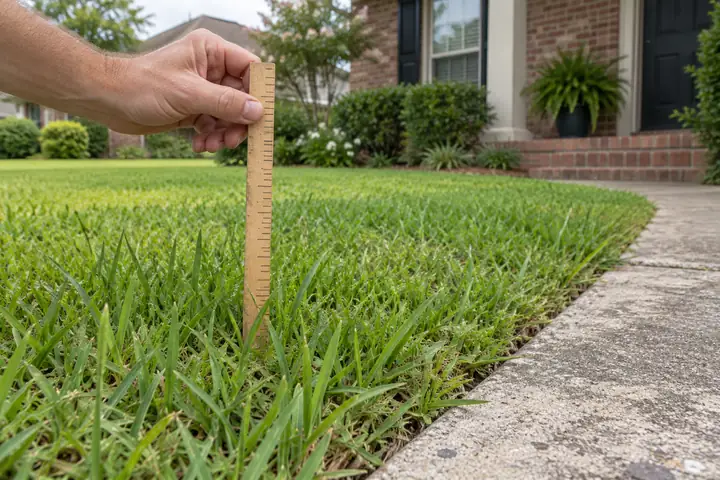
The grass height you see today, the finished height you are considering and the number printed beside a mower lever are three different things. Start by naming which one you mean. If you tell Happy the lawn is four inches tall, explain whether that is a recent measurement of standing grass or the height you would like after mowing. That small distinction prevents a surprising amount of confusion in a quote discussion.
You do not need a technical specification for every blade. The point is to make a rough condition description more useful and repeatable. If you are not able to measure comfortably, send clear photos and say the height has not been measured. An honest observation is still helpful. A precise-looking number guessed from a distant picture is less useful than a straightforward explanation of what you can actually see.
Choose a normal patch of grass
Find a representative spot you can reach from a safe, firm position. Avoid choosing only the tallest isolated stem or the flattened route where someone just walked. If the yard has visibly different sections, plan to check them separately. The sunny front strip and a shaded backyard corner should not be forced into one number just because they share the same mailing address.
For your own comparison notes, use a recognizable location such as the grass beside the front path. You can return to that area later without marking the whole lawn. Keep the location consistent enough to understand what has changed, while remembering that one point cannot describe every condition across the property. When you contact Happy, include a wide view of the section as well as any measurement picture so the number stays connected to the layout.
Read from the ground to the standing leaf tips
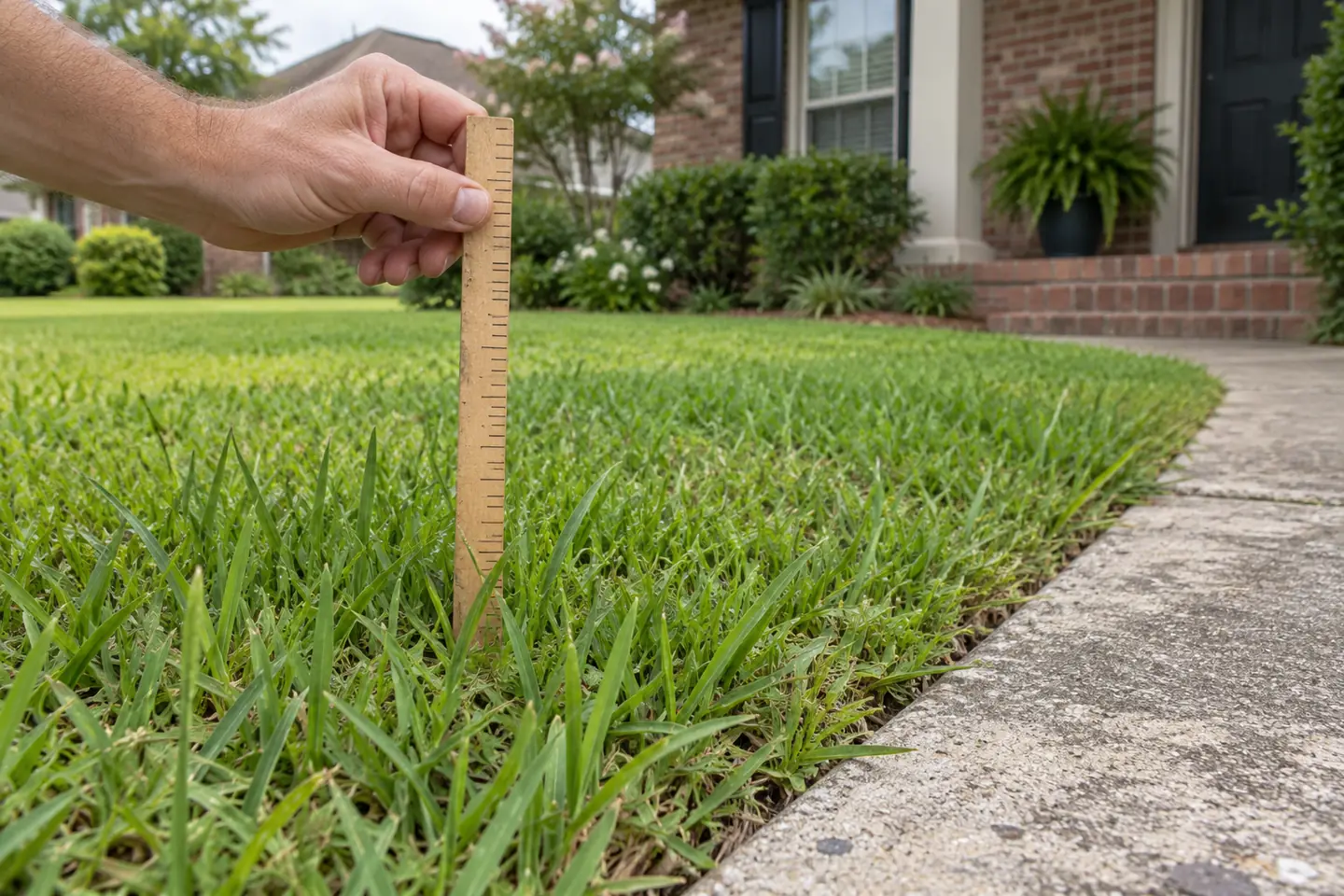
Use an ordinary ruler or another suitable measuring tool. Hold it upright at the local soil surface beside the grass and read the height of representative standing leaf tips without pressing them flat. You are checking the vertical height of the lawn canopy, not stretching a detached blade to its full length. Take a few observations nearby if the tips are uneven, and describe the range rather than pretending the grass forms a perfectly level shelf.
Keep your body and the tool clear of equipment; this is a lawn observation, not a mower inspection. There is no reason to reach beneath a machine to get this information. Write down the approximate height, the location and the date. If a photograph helps, make sure the tool and grass can be seen together. A small, understandable record is enough to improve the next conversation.
Understand the one-third guideline
LSU AgCenter presents the one-third mowing rule as a general guideline: avoid removing more than roughly one-third of blade height in one mowing. It emphasizes regular, appropriate mowing rather than treating an exact fraction as the only thing that matters. The suitable finished height still depends on the grass and its condition. The guideline does not tell you to keep every lawn at the same height.
For a simple planning example, compare a current height with a proposed finished height and calculate how much would be removed. This can reveal that a requested cut is much more drastic than the phrase tidy up suggests. It does not authorize a particular cut on your property. Use the example to ask a clearer question, then let Happy review the current lawn and the practical next step before the work is agreed.
Work through a clear numerical example
Suppose an illustrative patch stands four and a half inches tall, and a proposed finished height is three inches. The difference is one and a half inches. Divide that removal by the current four-and-a-half-inch height: the result is one-third. The example is about the relationship between the two measurements. It does not mean three inches is the correct finished height for every grass type or every yard.
Now keep the same starting height but imagine asking for a two-inch finish. That removes two and a half inches, which is more than half of the original standing height. The words only one inch lower can hide a large difference in the amount removed. Showing both the current condition and the desired result makes the request easier to review. If the example does not fit your lawn, use your own measured figures and leave the species-specific choice to the actual assessment.
Reverse the calculation for a planning conversation
If an appropriate finished height has already been established for an identified lawn, multiplying that height by one and a half gives the current-height threshold corresponding to the simple one-third example. For a hypothetical three-inch finished height, the arithmetic gives four and a half inches. This is a planning illustration, not a guarantee that growth will reach that point on a particular weekday.
The calendar and the measurement answer different questions. One tells you when a visit is planned; the other helps describe the condition as that date approaches. If the lawn is repeatedly growing beyond the comfortable stage before the next visit, show Happy the observations and discuss the routine. You do not need to measure every morning. A useful check near the end of the interval can help explain why you are asking about a change.
Record differences without averaging away the problem
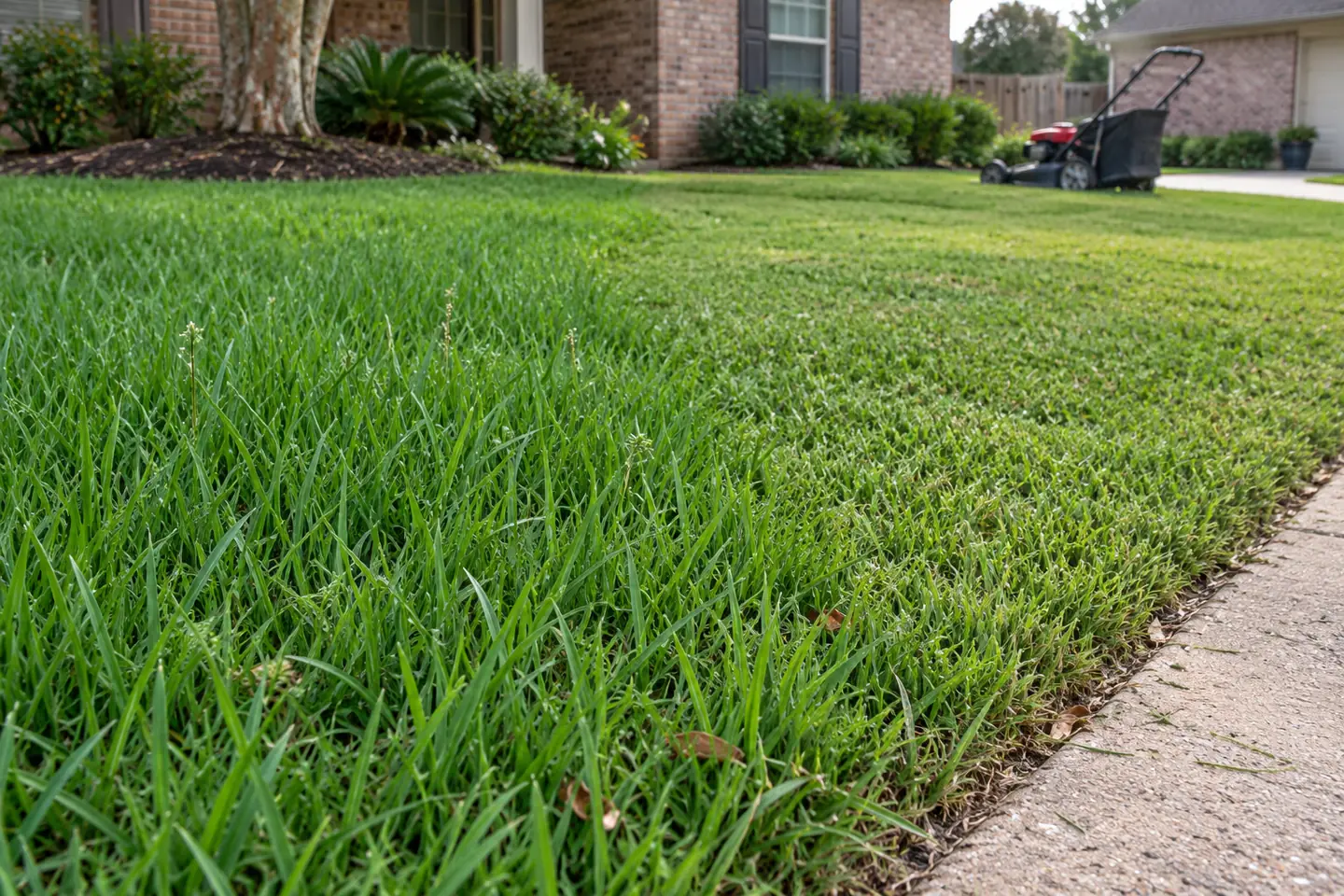
Imagine three sections with different appearances: a moderate front lawn, a taller sunny curb strip and a shorter shaded side area. A single average could make the taller strip disappear from the description. Instead, keep a short note for each section and show how they connect. Happy needs the actual layout and condition to discuss the work, not an apparently precise whole-property average that hides the part causing concern.
- Name the section you observed.
- Record the approximate standing height and date.
- Say when that section was last cut if known.
- Pair the detail with a wide layout photo.
This is also useful after a partly completed household cut. If the front was mowed yesterday and the back has not been touched for weeks, make that clear. The address is one property, but the next visit is being asked to address two different current conditions.
Turn an overdue measurement into a realistic request
A number can show how much growth is present, but it cannot tell you everything hidden underneath. Mention known obstacles, access limits, soft ground and areas that have not been checked. If the yard has missed several cuts, ask about the first visit back separately from the ongoing routine. The measurement should support a conversation, not become an instruction to take every area directly to a preferred low finish.
Ask what clipping handling and hard-surface cleanup are included. Collection or bagging needs confirmation when requested. If you are comparing quotes, keep the same measured condition, areas and tasks in each request so the comparison stays meaningful. A current photograph can also explain a change after the original message. Tell Happy if growth, access or partial household mowing has altered the condition before the visit is expected.
Send the useful result, not a spreadsheet full of guesses
A short message can do the job: “Today the front grass is roughly this range at the path. The backyard is taller and was last cut at a different time. I have attached wide views and a measurement photo. Please review the next cut, finishing tasks and an interval that fits the actual growth.” Add your real observations, service address privately and preferred contact method.
Happy can then discuss the lawn without confusing standing height, finished height and machine settings. The same approach helps a small Westwego front yard or a property with several separate grass sections in Belle Chasse. If you are in Harvey, Marrero, Gretna, Algiers or another listed area, ask about the property details rather than guessing from a generic chart. A little useful information can take a lot of mow worries out of the next step.