
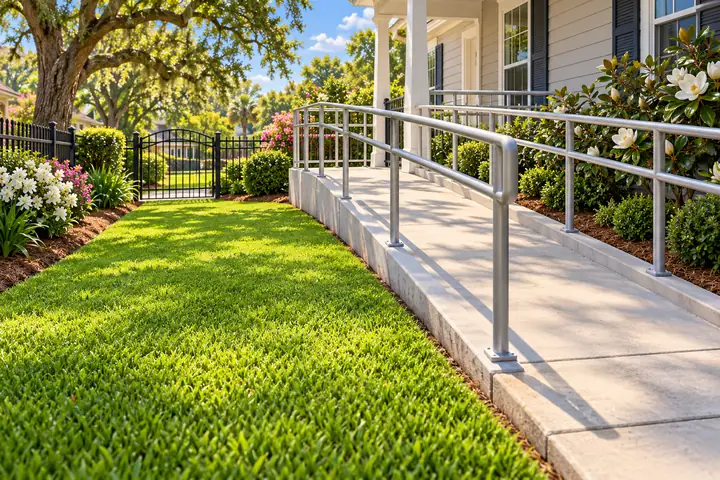
Put the route before the finish
A residential ramp exists so someone can reach a home or yard. Lawn planning begins by preserving that route, not by asking how close equipment can get. Identify the ramp, landings, handrails, gate and connecting walk as one access system.
The property owner and appropriate accessibility professionals handle technical compliance. Happy Grass does not certify slope, width or construction. The service plan records where vegetation meets the route and how work can occur without blocking it.
Ask the person who controls the property
Use the authorized contact and, when appropriate, the route user’s preferences. Do not assume what assistance a person needs, and do not request medical information. The useful questions concern timing, entrances, temporary closures and visible obstacles.
Keep messages respectful and practical. “Which entrance must remain open?” is relevant. A diagnosis or explanation of why the ramp exists is not.
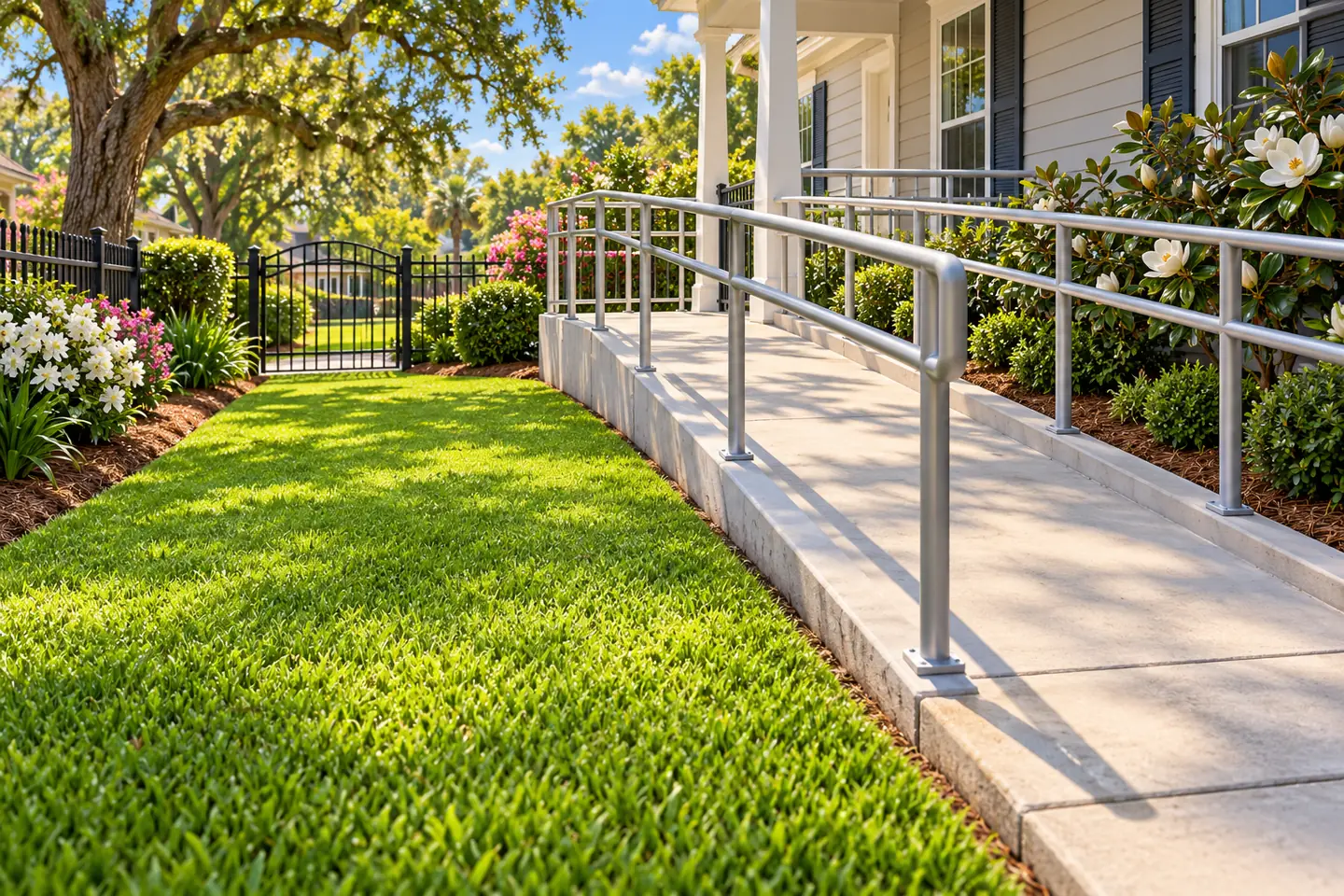
Map the full travel path
Show the sidewalk or driveway approach, lower landing, ramp run, upper landing and door area. Include gates that must swing and any lawn crossing between paved segments. A narrow focus on the rail posts can miss the route someone actually uses.
Use broad zone labels and avoid publishing exact household routines. Update the map after construction, furniture changes or a different entry arrangement.
Never stage equipment on the ramp
The ramp, landings and approach are not parking spots for mowers, blowers, bags or cords. Keep equipment on an agreed service surface where it does not narrow the route. Do not lean tools on handrails.
If the property lacks a suitable staging point, discuss another access plan or leave the adjacent zone out. Convenience does not justify obstructing a route.
Keep gates fully functional
A gate near the lower landing must open through its required arc without hitting equipment or lawn debris. Confirm who unlocks it and whether it needs to remain open or closed during the visit. Never prop it in a way that affects pets or security.
If access to the lawn requires crossing the ramp, decide whether that crossing is permitted and how conflicts will be avoided. An alternate gate may be the better route.
Define the grass edge precisely
State whether grass meets concrete, wood, metal, pavers or a bed. Edging applies to agreed hard borders; reachable vegetation may be handled by weed-eating where appropriate. Do not scrape, strike or alter the ramp structure.
Where the border is broken or hidden, use a conservative leave-alone strip. Construction repair and drainage correction remain outside recurring maintenance.
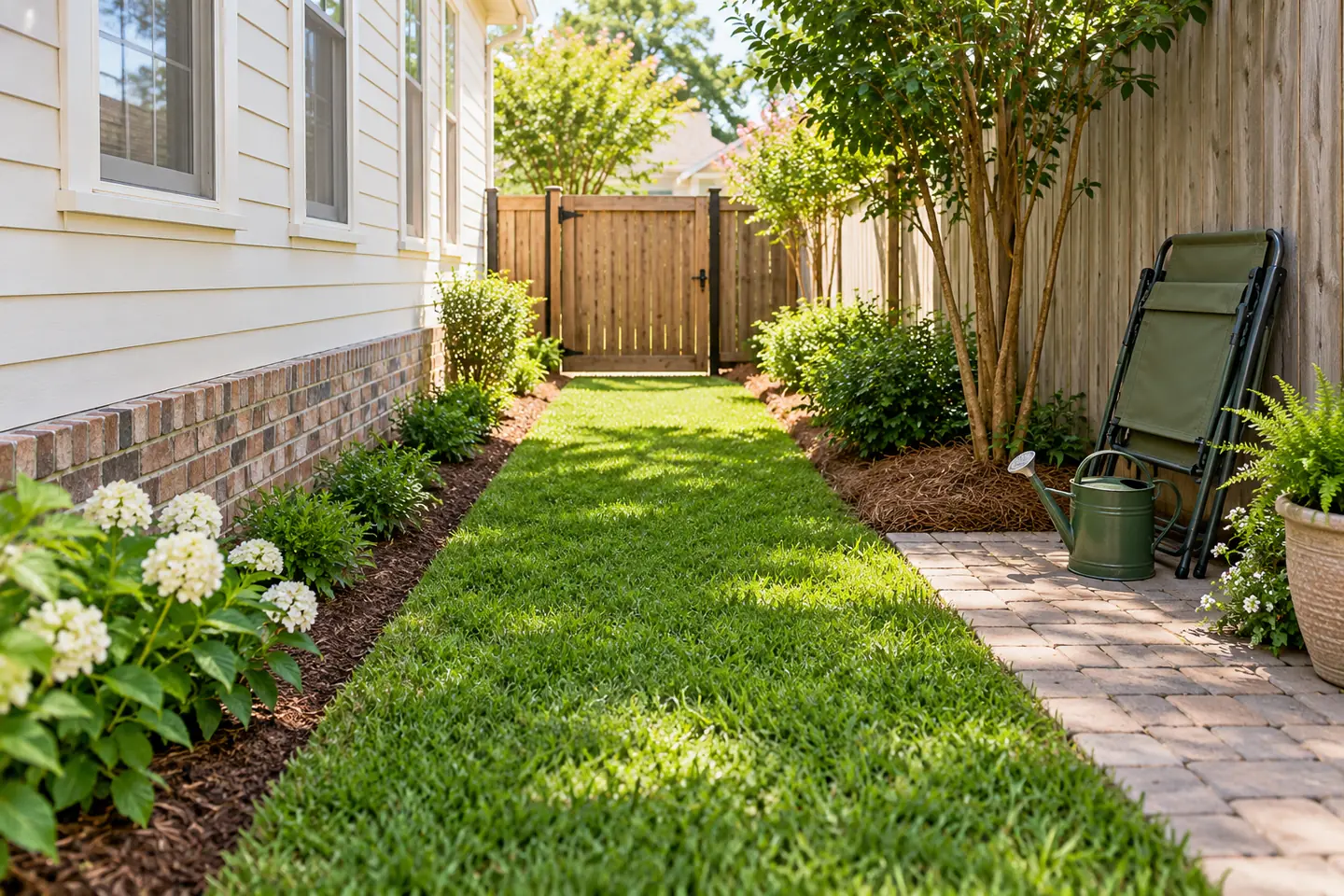
Treat posts and supports as fixed features
Ramp supports can create tight grass pockets. Photograph the posts and any low cross-bracing from the lawn side. Do not reach under a ramp where visibility or clearance is poor, and do not remove stored items to gain access.
If the owner wants vegetation managed beneath an elevated ramp, define only the safely reachable portion. Enclosed or inaccessible areas need another solution.
Control clippings on the travel surface
Finish included hard surfaces so fresh clippings do not remain where people roll or walk. Direct debris away from doors, drains and neighboring property. Blowing addresses routine lawn residue, not mud removal or pressure washing.
Check the full landing after the grass work, not only the section next to the mower route. A small clump at a threshold can matter more than a cosmetic line in the lawn.
Coordinate timing without closing access
Ask whether the route will be in active use during the visit. Work in a sequence that keeps an entrance available, or pause while a person passes. Do not tell a resident to wait indoors solely for lawn convenience.
If the property cannot maintain safe passage while a narrow zone is serviced, skip that zone and arrange a better plan. The lawn can wait.
Keep hoses, cords and decorations away
Move garden hoses, seasonal décor and planters through the property contact before service. Do not relocate mobility devices or personal aids. They are not lawn obstacles to be shifted without direct permission.
Use a designated storage point that remains outside the travel path. A tidy-looking ramp is not genuinely clear if a hose crosses the lower landing.
Consider wet and shaded edges
Ramp-side grass may stay shaded, and roof runoff can create a damp strip. Observe firmness and standing water without diagnosing the cause. Do not blow wet clumps onto the surface or push equipment through a soft approach.
Name the affected section and leave it untouched when access is questionable. Drainage repair and slip-resistance evaluation belong with appropriate providers.
Follow authoritative accessibility guidance
The U.S. Access Board publishes accessibility standards and guidance for accessible routes. Those technical materials support the principle that routes and clear spaces matter, but a lawn estimate is not an accessibility inspection.
When the owner has compliance questions, direct them to the appropriate authority or qualified professional. Happy Grass should follow the property’s approved route plan, not improvise technical answers.
Photograph without photographing people
Take wide views of the ramp, landings, grass edge and alternate lawn entrance when the route is empty. Avoid people, medical equipment, house numbers and neighboring interiors. Images should document geometry, not identity.
Store them as internal service context and update them after any ramp alteration. Do not use a property photo publicly without separate permission.
Plan for emergency access
Never place equipment where emergency personnel or an urgent exit could be hindered. Keep doors, landings and the connecting path open. If an alarm, medical need or other urgent situation occurs, stop lawn work and clear the route.
Emergency response comes first. The visit can be resumed or rescheduled through the ordinary contact only after the situation is fully handed back.
Build a visit-day checklist
Confirm the required entrance, clear staging area, unlocked lawn gate, empty landings, firm grass edge and preferred contact method. Note any temporary delivery or repair that changes the route.
This checklist should be easy to answer without sharing private health information. It creates a reliable access plan from observable property facts.
Write a narrow service scope
List the named lawn zones, reachable ramp-side trimming, hard borders and included surfaces for blowing. Exclude ramp repair, compliance evaluation, handrail work, pressure washing and personal-property movement.
Happy Grass does not provide fertilization, aeration, overseeding or pest control. Weed control, when discussed, must be specific and must not be assumed appropriate beside every route or planting.
Review after alterations
When a ramp is repaired, extended or replaced, inspect the lawn relationship before restoring the old scope. New supports, drainage and landings may change what is reachable. Retire previous photos and maps.
Do not assume a contractor’s completed work means the surrounding soil is firm or free of debris. The property contact should confirm cleanup first.
Call Happy with the route facts
For a home in Harvey, Marrero, Gretna, Algiers, Belle Chasse or Westwego, call 504-339-3571 and ask for Happy. Share the entrance that must stay open, the lawn gate and the ramp-side border.
The conversation should make access simpler, not more personal. A respectful plan protects the route, keeps lawn expectations realistic and gives the finish appropriate attention only after people can move freely.
Finish with a route-clear check
At the end of the visit, look from the street or driveway through the full approach. Verify that no clipping pile, tool, moved planter or open gate changed the route described at the start. Return the approved contact point to its agreed condition without handling personal mobility equipment.
Record any recurring conflict, such as a sprinkler that reaches the landing or a low branch over the lawn gate. A specific follow-up question is more useful than a vague note that access was difficult, and it can improve the next visit without asking anyone to disclose personal circumstances.
Give route users a simple signal
Agree on a nonintrusive way to pause equipment when someone needs to pass, such as a visible hand signal or a message through the property contact. Do not require a person to shout over machinery or explain a disability. Stop, secure the work area and allow the route to clear at an ordinary pace.
The signal belongs in the service note without names or medical detail. Review it if the preferred entrance changes. Respectful coordination is a normal access practice, not a special favor added to the quote.
Confirm the route with its actual user
Where a ramp is part of everyday access, an empty photograph cannot explain all the movements that matter to the person using it. Ask that person or the responsible household contact which approach and turning areas need to remain available. Describe those locations in the lawn request without making a claim that a maintenance arrangement certifies accessibility compliance.
Keep the work boundary and the usable travel route visible in the same description. A grass edge may be well defined while an item staged nearby still interrupts the approach. State who will handle household preparation and how a changed need will be communicated. This allows the requested lawn finish to be considered alongside the actual use of the route, with unresolved access questions addressed before they become assumptions.