
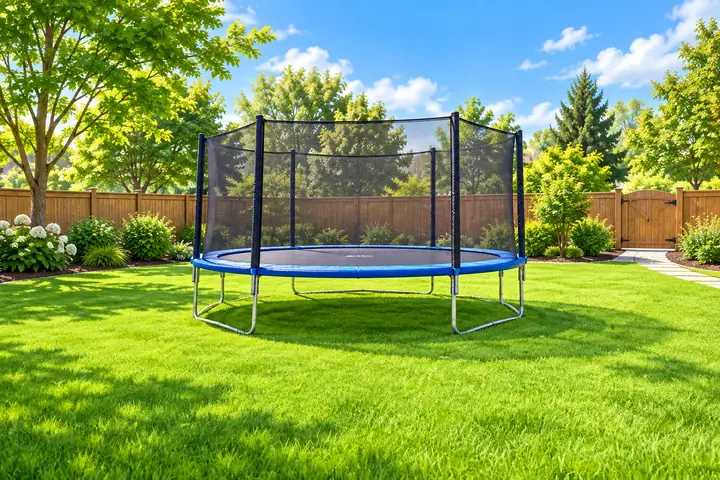
Treat the trampoline as owner-managed equipment
Start by recording its complete diameter, leg positions, enclosure poles, ladder and any anchors. The lawn plan can define reachable grass, but Happy Grass does not assemble, inspect, move or certify recreational equipment.
The CPSC provides safety guidance for trampoline use; property owners remain responsible for placement, condition and supervision. Lawn service should never be described as making a trampoline safe.
Choose a move-or-leave approach
Decide before quoting whether the trampoline will remain in a fixed position or be relocated by the owner. Do not depend on a lawn crew lifting one side, dragging the frame or guessing where it belongs afterward.
A fixed position creates a permanent exclusion or limited trimming plan. An owner-moved position creates two dated footprints, and both need to be clear before equipment arrives.
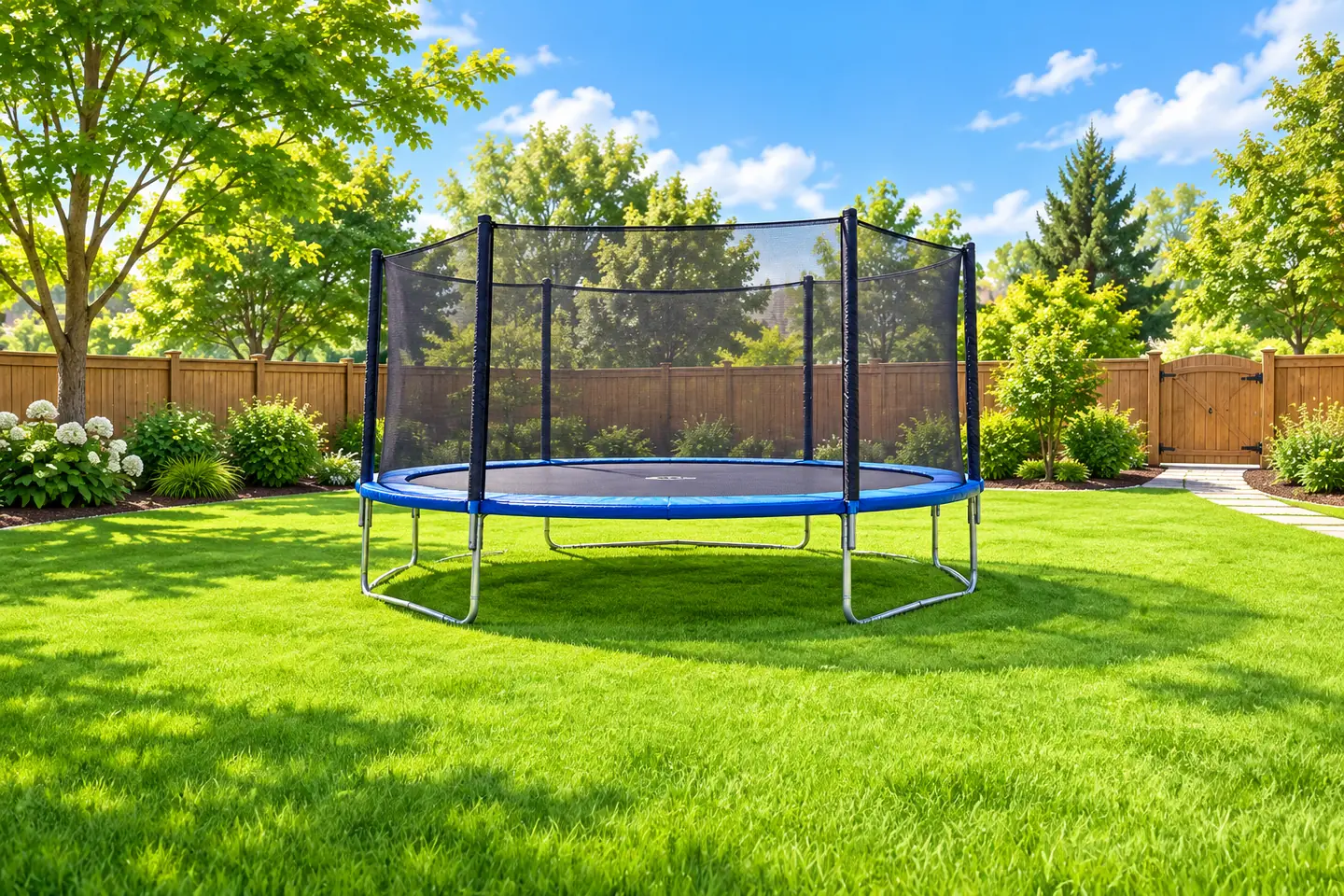
Show every leg and anchor
Walk the perimeter and make sure support legs, stakes, straps and tie-down lines are visible above the grass. Vegetation can hide metal near the soil, especially beneath a wide mat where light is uneven.
Do not trim by feel around a concealed anchor. The owner should expose and identify the hardware, then define a no-contact margin that remains understandable as grass grows.
Clear the play zone completely
Remove balls, shoes, toys, covers and portable steps from both the trampoline and surrounding turf. Small plastic pieces and metal clips can become dangerous debris when hidden in grass.
Choose a paved or indoor storage spot rather than piling belongings against a fence or gate. The mowing route must remain open from the entrance to the agreed working area.
Separate under-mat grass from open lawn
Shade, foot traffic and limited rainfall can make the interior grow differently. Name it as its own zone instead of promising it will match the sunny perimeter on the same schedule.
If the center is unreachable without moving the frame, exclude it. Reaching under a low mat with equipment creates poor visibility and unnecessary contact risk.
Mark the outside turn
Measure the clearance between the frame and nearby fences, beds, trees or patios. The widest apparent gap may narrow at a curved rail, angled leg or enclosure pole.
Leave enough space for an ordinary controlled turn. If the route requires brushing the net or forcing equipment over an anchor, the perimeter is not a practical mower lane.
Keep the enclosure closed and undisturbed
The owner should place ladders, zippers and enclosure openings in the planned condition. A lawn crew should not enter, unlatch or adjust the enclosure simply to reach grass.
Hanging netting, torn straps or loose padding should be handled before the visit by the responsible property contact. Those are equipment matters, not lawn-maintenance tasks.
Coordinate children and pets
No one should use the trampoline while nearby lawn equipment is operating. Keep children, pets and visitors indoors or in a separate secure area until the work zone is clear.
Do not leave a pet tether attached to the frame or place a pet bowl beneath it. The complete equipment footprint needs to remain predictable throughout the visit.
Check ground firmness beneath the shadow
Soil under a mat can stay damp after exposed turf dries. Observe the center and leg pockets rather than assuming the whole backyard has the same condition.
Skip soft ground that could rut or shift equipment. Happy Grass does not level the trampoline, reset supports or diagnose why one leg appears lower.
Recover tall grass conservatively
When an owner moves the trampoline after a long interval, inspect the old footprint for clips, toys, insects and uneven ground. Do not immediately run equipment through a newly revealed patch.
Apply LSU AgCenter’s general one-third mowing principle as a cautious reference. The shaded grass may need staged reduction or may be thin enough to require an owner’s separate turf decision.
Avoid blowing into the equipment
Direct routine residue away from the mat, springs, padding and enclosure. Clippings trapped in a net or beneath edge pads are not a clean finish.
Do not use a blower to clear toys, leaves mixed with hardware or debris inside the trampoline. The owner should clean recreational equipment with methods suitable for that product.
Photograph without showing users
Take a wide empty-yard view showing the trampoline, gate, lawn perimeter and nearby borders. A second angle can document the closest leg or anchor without including children, faces or private activity.
Update the images whenever the frame moves, the enclosure changes or a new bed reduces clearance. Retire the old map so the visit plan never mixes two positions.
Plan for storms and temporary disassembly
High-wind preparation and equipment anchoring belong with the owner and manufacturer instructions. If the trampoline is folded, tipped or partly dismantled, pause the surrounding lawn rather than treating the temporary shape as normal access.
After the event, request a clear current photo before resuming the old route. Look for displaced stakes, straps and lawn debris that could remain hidden near the former footprint.
Define nearby edges honestly
List real concrete, paver or metal borders that can be edged. Grass against a trampoline leg, ladder or anchor is a close-trimming decision, not a new hard edge.
If a mulch bed meets the equipment perimeter, preserve the owner’s existing border and keep stones or loose material away from moving equipment. Do not relocate bed material to create temporary clearance.
Use a visit-day position marker
For an owner-moved trampoline, identify a simple repeatable paved reference or photo angle. Avoid spray paint, stakes or strings in the lawn unless they are separately appropriate and clearly managed.
The marker should reduce guesswork, not create another obstacle. Record who restores the frame position and when the grass area is considered ready.
Write the scope around observable access
Include open-lawn mowing and specifically reachable perimeter trimming. Exclude lifting the frame, handling anchors, entering the enclosure, equipment inspection, toy cleanup and inaccessible under-mat grass.
Happy Grass does not provide fertilization, aeration, overseeding or pest control. An insect concern beneath the mat belongs with the owner and an appropriate provider, not an improvised lawn treatment.
Use a short trampoline checklist
Confirm the yard is empty of users, toys are stored, anchors are visible, netting is secured, the gate route is open and the soil is firm. Send a new photo if the position changed.
This checklist protects a repeatable work boundary. It does not replace manufacturer instructions, supervision or the property owner’s responsibility for recreational equipment.
Ask Happy about the reachable grass
For a trampoline yard in Harvey, Marrero, Gretna, Algiers, Belle Chasse or Westwego, call 504-339-3571 and ask for Happy. Share the fixed or owner-moved plan and two wide photos.
Clear expectations can keep the play equipment undisturbed while giving the accessible lawn a neat finish. Some shaded interior grass may remain different, and the quote should say so plainly.
Keep nearby beds outside the play footprint
Identify mulch, flowers and low borders that curve behind the frame. Do not move an anchor into a planted bed or blow clippings through flowers simply because the open-lawn route narrows.
If the trampoline overlaps a bed edge, the owner should resolve its position before the visit. Lawn care follows the current visible grass, not an assumed circle beneath landscaping.
Review ladder and entrance placement
Record whether the ladder sits on turf, pavement or a removable mat. Its steps and braces can create a second low obstacle that is easy to miss from the opposite side.
The owner should place or remove the ladder according to the chosen plan. Happy Grass does not climb it, detach it or enter the trampoline to reach vegetation.
Keep the recurring note simple
Use one current diagram with the fixed footprint, no-contact margin, open gate and excluded center. Remove outdated arrows after the owner changes the location.
A concise note helps different visits follow the same boundary. It should never contain children’s names, play schedules or unnecessary household details.
Keep the equipment decision with the owner
Record whether the trampoline will stay in its normal position or whether its owner has separately arranged an appropriate change before service. Do not leave the note at move it if necessary, which gives no clear starting arrangement and may imply work that was never discussed. Include the location of associated pieces that remain in the yard.
Once that decision is made, describe the accessible grass as it will be presented. If the underside or a narrow perimeter pocket is outside the request, name that exclusion directly. Keep a later layout change separate from the original quote so it can be reviewed on its own facts. A clear owner decision gives Happy a stable lawn boundary and avoids treating a large play installation as ordinary portable clutter that the crew is expected to sort out on arrival.