
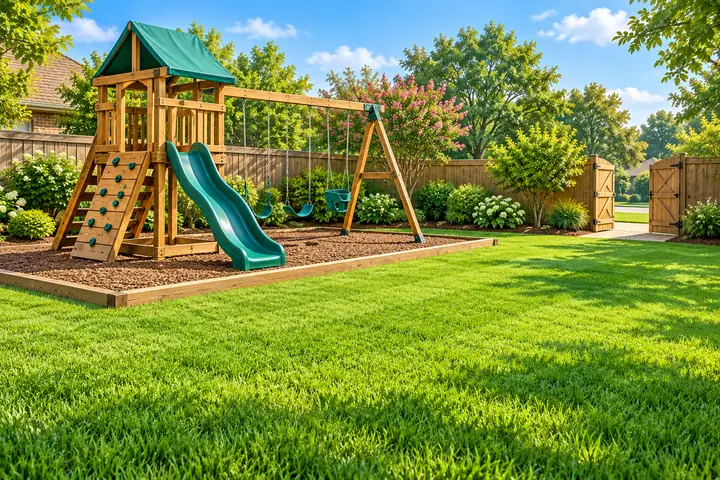
Draw the play zone before discussing the grass
Stand far enough away to see the entire structure, including the slide exit, swing arc, ladder side and any border around the play surface. That full footprint is the play zone. The lawn boundary begins outside it, even if a few tufts grow through mulch or beneath a platform. Happy Grass can quote reachable turf; it does not enter the role of playground inspector, installer or equipment mover.
Photograph the approach from the normal gate and the narrowest corner between the structure and fence. A playset that appears open from the patio may create a dead end on the back side. Identify which grass can be reached without walking under swings, ducking beneath beams or crossing a loose border. The best plan has a continuous route in and out.
Keep the surface distinction honest
Wood chips, rubber mulch, sand, turf and bare soil all behave differently from lawn. If the play area has a framed border, name the material inside it and keep that material contained. Scattered chips on the grass can become projectiles or hide toys and fasteners. Rake them back into the play zone before mowing rather than expecting equipment to blend the edge.
When grass grows inside the play footprint, decide whether it is intentionally maintained or simply volunteer growth. Narrow patches under platforms and beside climbing walls may be inaccessible. List them as exclusions. Changing the play surface, adding mulch or installing edging is a separate homeowner project and not part of routine lawn service.
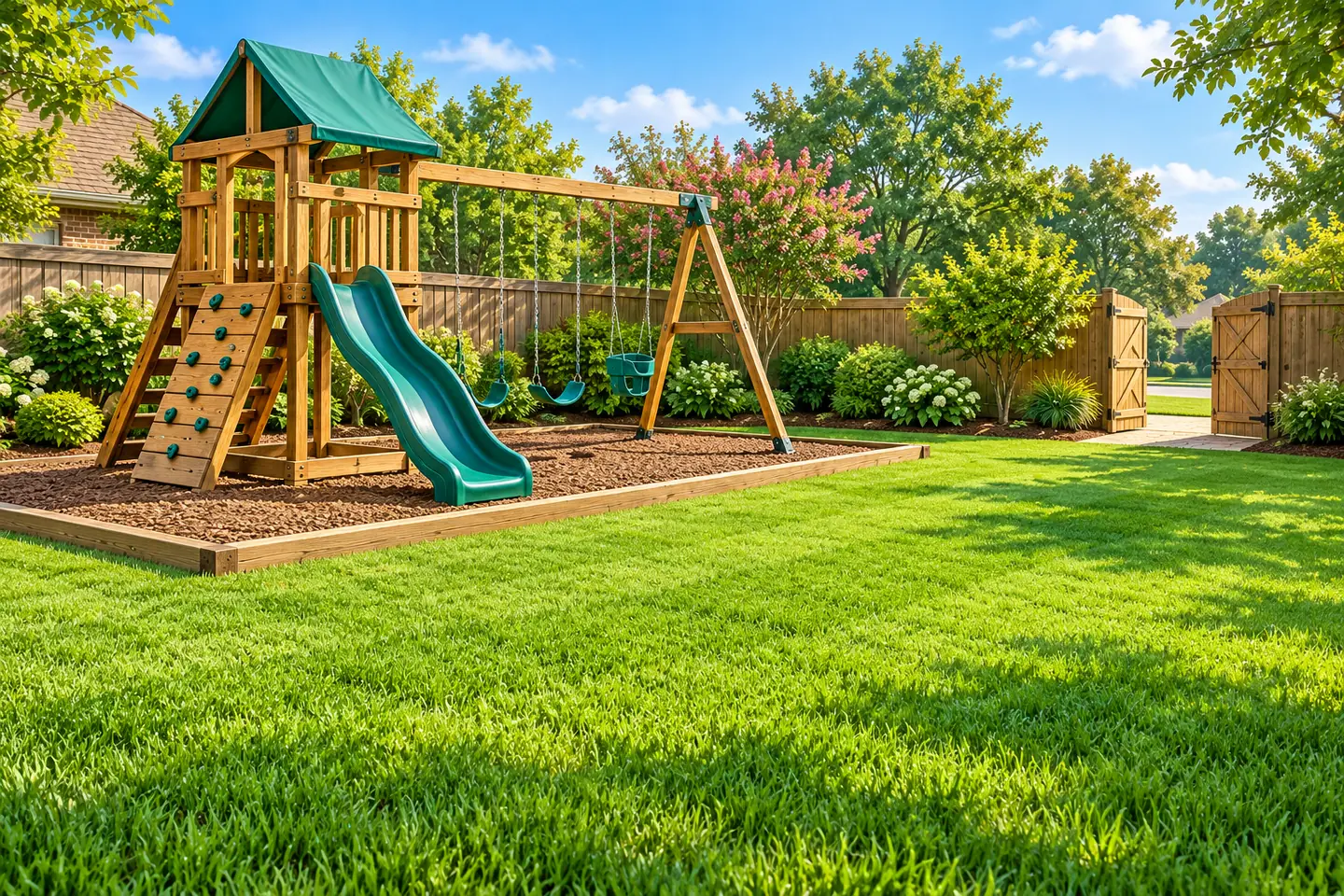
Treat every anchor as fixed hardware
Anchors, stakes, brackets and concrete footings may sit close to the soil surface. Walk the perimeter slowly and reveal each visible connection without loosening it. Do not cover metal with grass clippings or push mulch over a protruding part. Any questionable connection needs attention from the owner, manufacturer or appropriate installer before lawn work occurs nearby.
Happy Grass will not test whether a swing set is stable or certify that its clearances are safe for play. The lawn boundary can respect the structure while leaving equipment decisions to the proper source. If an anchor location changes after repairs or relocation, send a fresh photograph and update the service notes before the next visit.
Empty the swing and slide paths
Swings can move in wind even when no child is present. Secure them according to the owner’s normal method, keeping chains and seats out of the grass route without improvising knots that could damage the equipment. Clear balls, ride-on toys, scooters, jump ropes, chalk pieces and small plastic parts from the full yard, not just the play border.
Inspect the slide exit and the space under it. Toys often collect where they are hidden from the patio. A mower should never have to enter beneath a slide to discover what is there. Store everything in a closed container or on a finished surface outside the service path. Happy Grass does not sort, sanitize or relocate play equipment.
Decide what happens under platforms
The shadow under a raised deck or playhouse can hold thin grass, mud, toys and wildlife. If the opening is not a normal upright route, mark it out of scope. Reaching under a structure with powered equipment is not a reasonable way to capture a few blades. A clean visible boundary is safer and easier to repeat.
Low headroom is not the only concern. Cross-braces, climbing ropes and suspended accessories can narrow the space unpredictably. Do not remove structural parts for mowing. If the owner wants a different ground treatment below the platform, complete that separate project before asking Happy to work to the new edge.
Keep children and visitors away from active work
The playset should be empty for the entire visit, and children should stay indoors or in another secure area away from gates and equipment. A window view is fine; entering the yard to retrieve a toy is not. Tell visiting family members and caregivers about the schedule so they do not reopen the play area unexpectedly.
The rule continues during cleanup. Wait until the equipment has left and the homeowner has checked the yard before play resumes. The household controls the play environment and should verify gates, return swing seats and put toys back where they belong. Lawn service does not include supervising a reopening routine.
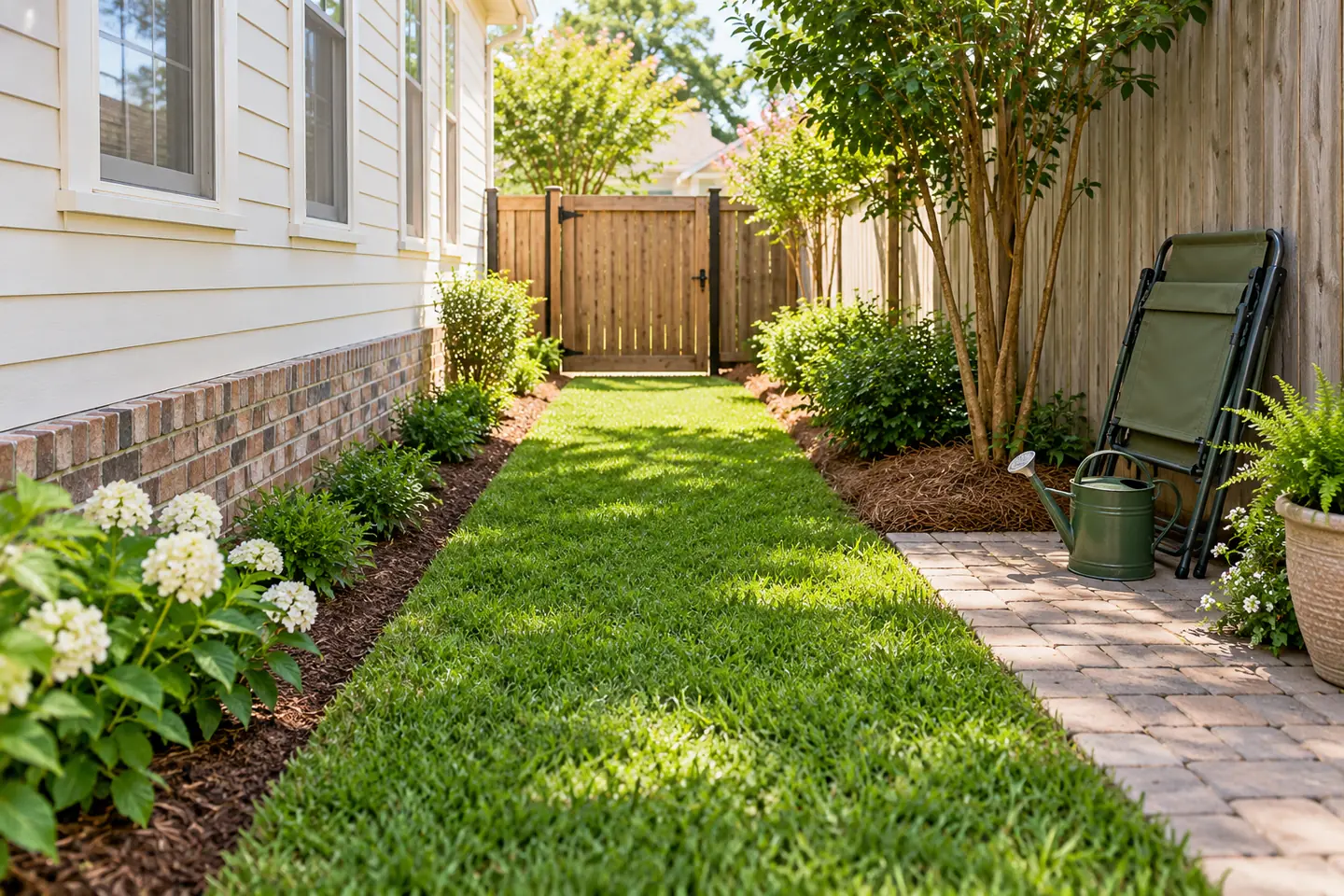
Account for shade, wear and water
Grass beside a playset may be thicker on the sunny side and sparse along the favorite running path. Those differences are clues about use, light and drainage, not a reason to promise identical color. After rain, check the slide exit, swing bays and the path from the gate; repeated foot traffic can leave soft pockets under a dry-looking surface.
If the boundary is muddy, the adjacent lawn section may be postponed even when other parts of the property are ready. Do not add sand, seed or soil moments before mowing to disguise the condition. Happy Grass does not offer fertilization, aeration, overseeding or pest-control services. The honest choice is to describe the current turf and protect it from avoidable ruts.
Make seasonal changes visible
Canopies, toddler swings, climbing accessories and portable splash toys can appear as the season changes. Every addition can alter the route. Take updated wide photos after assembly, birthday gifts or storm repairs. A quote based on an empty winter structure should not silently carry over to a crowded summer layout.
Before each visit: – Clear every loose toy from the play zone and lawn. – Secure children and pets away from all service gates. – Return scattered surface material inside its border. – Expose visible anchors, footings and edging. – Keep swing chains and seats out of the lawn route. – Report mud, repairs or newly added accessories.
Keep repairs and lawn care separate
Cracked boards, loose bolts, frayed ropes and leaning supports call for the owner, manufacturer or an appropriate repair professional. Do not ask a lawn crew to tighten, prop or judge them. Exclude the immediate area until the structure is sound. This keeps the lawn visit focused and avoids implying a playground-safety opinion.
Likewise, pruning branches above the playset may involve height, structure and falling-limb risk beyond ordinary lawn care. Describe overhangs in the quote request, but schedule specialized tree work separately when needed. Happy can plan around a stable, clear footprint; the business is not promising construction or arborist services.
What Happy needs for a clear quote
Share the playset dimensions, ground-surface type, border, gate width and the narrowest lawn passage. Identify fixed anchors, under-platform exclusions and any section that remains wet. A simple overhead sketch with the house, fence and structure can be useful when one photograph cannot show the route.
The final scope should say which surrounding lawn is reachable and which play-zone patches are not. That clarity is friendly to everyone: the homeowner knows what to prepare, children keep their equipment in a defined place, and Happy can maintain the agreed grass without moving a structure or inventing access on arrival.
Review the boundary after ordinary family use
The best time to check the playset edge is after a normal weekend, because that is when jump ropes, digging tools and portable goals reveal where they actually travel. Return each item to storage and notice whether mulch or sand escaped into turf. That real-use review produces a better mowing map than a staged photo taken immediately after installation.
Keep the play zone recognizable to babysitters and guests. A small household checklist near the storage bin can remind adults to clear the grass and secure children before the scheduled visit. Happy does not need private family details; it only needs confirmation that the yard will be empty, the gate route will be open and the fixed boundary has not changed.
Compare the installed footprint with the play footprint
The area children use can extend well beyond the posts and platform visible in a photograph. For the lawn discussion, show the installed playset and identify which surrounding grass is part of the request. Keep any owner-defined play or exclusion boundary visible in the same note so the crew does not have to infer it from scattered toys.
After the household has prepared portable items, check whether the presented layout matches that note. If a new accessory changes the entrance or the accessible margin, describe it as an update rather than assuming the old scope covers the change. The point is not to redesign the play area. It is to give Happy a recognizable lawn boundary around owner-managed equipment, with fixed hardware and any unresolved condition clearly outside ordinary moving and cleanup assumptions.