
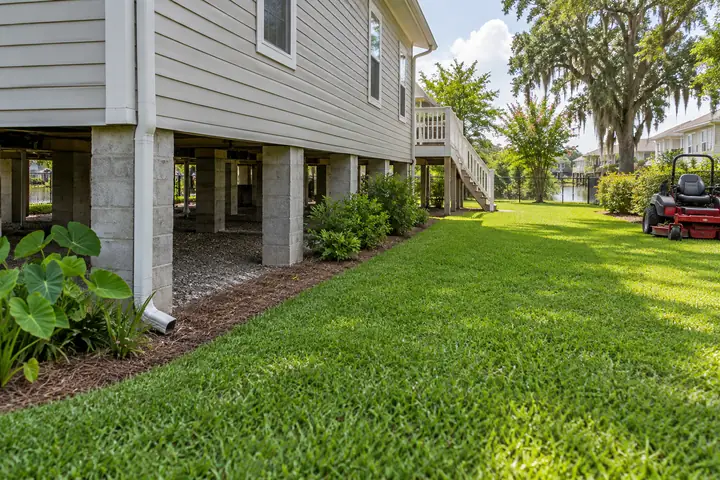
Start with the ground, not the height of the house
An elevated home changes where lawn equipment can travel. The important question for routine service is not how high the living floor sits; it is where solid, open turf begins and ends. Walk the property at ground level and notice the pier line, stair landings, ramps, air-conditioning equipment, hose connections, drain outlets and stored items. A mower needs a continuous path with enough room to enter, turn and leave without brushing a post or crossing loose material. The shaded strip under an overhang may stay damp longer than the sunny yard, so a route that works on a dry afternoon may be soft after a West Bank shower. Happy Grass handles mowing, trimming and ordinary lawn cleanup. We do not inspect foundations, diagnose movement, crawl under structures or decide whether a pier is safe. If you see cracking, leaning, exposed reinforcement, washout or a new gap at a connection, keep people and equipment away and call the appropriate building professional. Separating structural questions from lawn questions keeps both conversations honest.
Draw a conservative line around piers and bracing
Concrete, masonry or timber supports can be damaged by repeated impacts, and lawn equipment can be damaged by unseen blocks, bolts or brackets at their bases. Leave the pier line visible before the visit. Pull toys, planters and loose edging away rather than stacking them between supports. If grass grows beneath an elevated portion of the house, decide whether that area is truly part of the service route. Low clearance, diagonal bracing, wiring, plumbing and uneven fill can make under-house mowing impractical even when grass is present. A conservative edge outside the support line is better than squeezing equipment into a space that was not designed for it. FEMA guidance emphasizes that elevated foundations and their connections must resist significant loads; routine lawn work should never alter, strike or use those components as anchors. Happy Grass can trim reachable turf from a stable exterior position when conditions allow, but hidden corners and inaccessible patches should be discussed before the first cut. A photograph taken from the yard is often enough to explain the boundary.
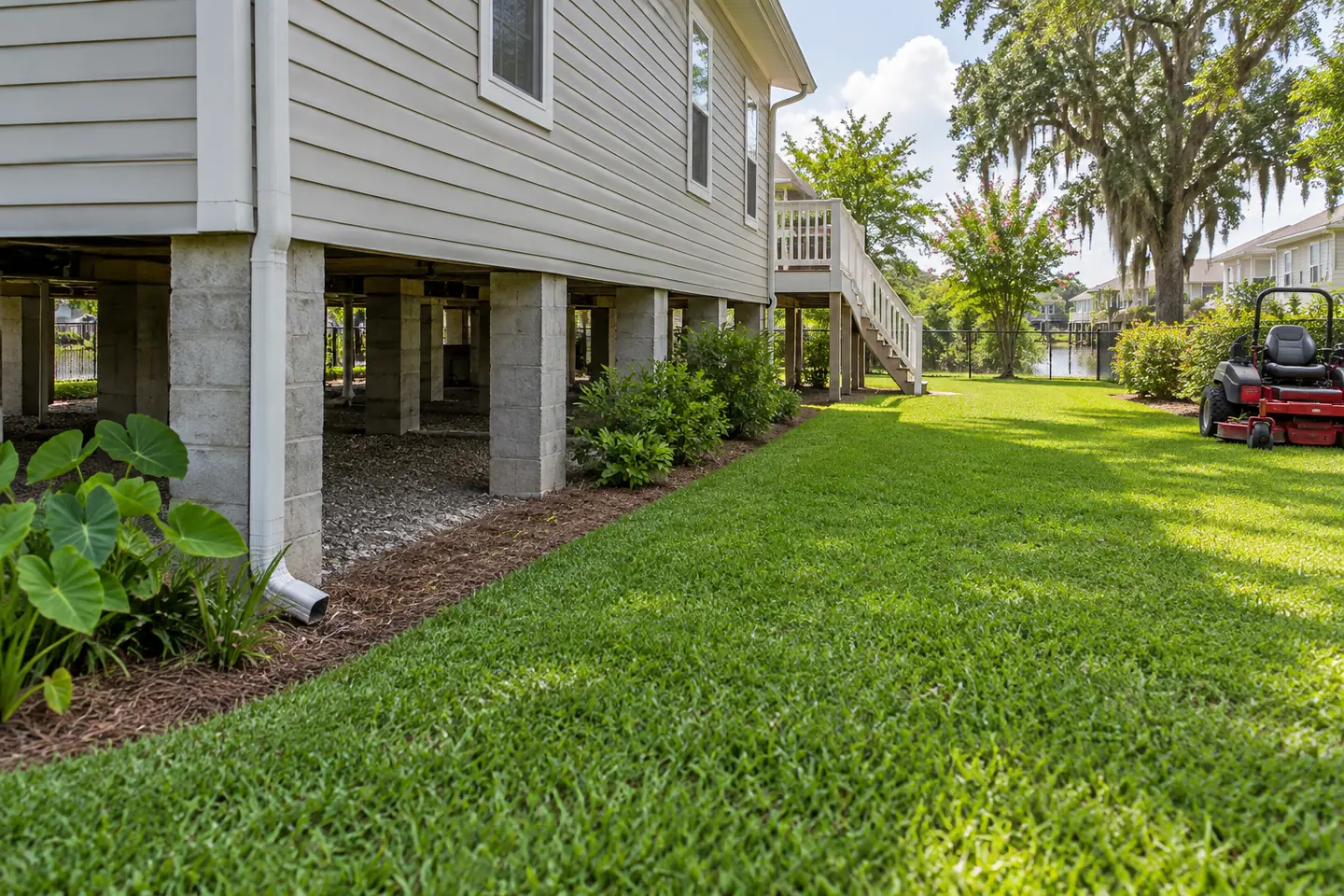
Treat stairs, ramps and landings as fixed traffic controls
Exterior stairs create narrow pockets where a mower can be trapped between a stringer, a pier and a fence. Ramps can create long shaded lanes with handrail posts along both sides. Landings may hide short downspout extensions or electrical conduits. Before service, clear the bottom of every stair and keep the approach free of bicycles, folding chairs, delivery boxes and pet supplies. Do not move a ramp, remove a handrail or disconnect a brace for lawn access. Instead, choose a stable stopping line that respects the structure. Where turf is too narrow for the normal mower, it may be handled with a smaller tool if the surface is firm and the operator has a safe position. Decorative gravel directly beside a landing should be contained so it cannot become thrown debris. If steps or ramps were recently built, confirm that the work and ground restoration are complete before scheduling normal service. Fresh fill can settle, and scraps or fasteners can remain below the grass.
Watch drainage patterns beneath an elevated footprint
Rainwater coming from a raised roof can concentrate at downspouts, splash blocks and low points around the supports. One strip may be dry while the next holds water. Soil that looks level under shade can hide ruts or erosion channels. Walk the route after rain and mark soft spots that should not carry equipment. Keep downspout extensions visible and positioned as intended before the crew arrives; do not cover them with clippings or slide them beneath the mower path. LSU AgCenter guidance for landscaping an elevated home encourages planning for future maintenance, which includes realistic access and edges. Lawn service does not correct grading, foundation drainage or erosion. If runoff is washing soil away from a pier, carrying mulch across the route or leaving persistent standing water, pause that area and consult the right drainage or building professional. Mowing around a problem is not the same as solving it. A stable route protects the lawn surface and avoids adding compaction where the ground is already stressed.
Make the arrival route obvious from the driveway or gate
Raised-home yards often have more than one apparent entrance: a side strip beside the stairs, a path beneath a carport, or a gate leading behind the house. Choose one normal equipment route and keep it predictable. The opening should be wide enough, the latch should work, and low limbs should not force an operator toward a pier or railing. Remove hoses, extension cords and temporary drainage tubes from the route. If vehicles block the usual approach, arrange their position before the appointment rather than expecting equipment to pass under steps or through a planted bed. Dogs should be secured away from the work area. A simple message such as “use the left gate; stop at the rear stair landing” gives more useful direction than “do whatever you can.” For properties with tenants or shared access, make sure the person authorizing service can actually provide entry. Happy Grass can work efficiently when the route is settled before arrival, and can avoid improvising around structural elements.
Separate under-house storage from the lawn service area
The open area below an elevated home is tempting storage, but loose lumber, ladders, fuel cans, garden tools and storm supplies can migrate into the grass edge. Keep stored material on a defined, stable surface and away from any turf expected to be mowed. Do not lean objects against piers or place sharp items where vegetation can hide them. After a storm preparation period, recheck the entire perimeter; tie-downs, straps and temporary panels may remain in unexpected places. If an item cannot be moved safely, make it visible and establish a no-service buffer. Lawn crews should not rearrange personal property or enter an under-house storage zone to hunt for obstacles. The same rule applies to crawlspace doors and flood openings: keep them accessible for their intended purpose and do not block them with bags of clippings or landscape materials. A clean boundary lets the crew focus on grass while leaving building access undisturbed.
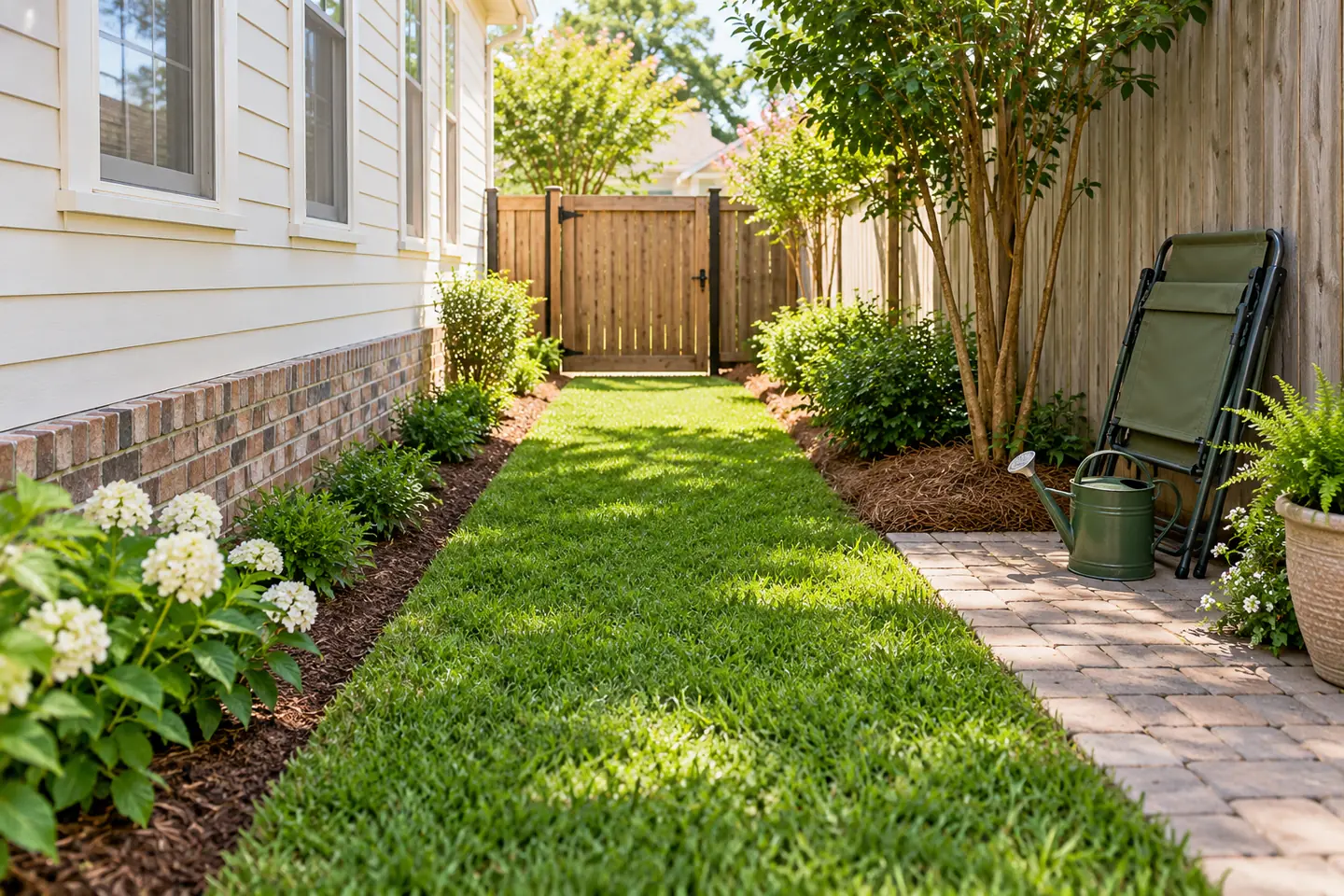
Use trimming as a finish, not a way to test the structure
String trimming can clean the turf line beside a stable support, but the line should not repeatedly strike paint, masonry corners, cables or flexible skirting. It also should not be used to discover hidden metal. Remove rocks, wire pieces and construction debris before grass grows over them. Where a pier base is surrounded by mulch or gravel, keep that material contained and tell the crew where the hard edge lies. Near exposed pipes or conduits, an intentional hand-clearance zone may be safer than a close cosmetic cut. The best finish is one that can be repeated without gradually wearing a component. If vines or woody growth are attached to the foundation area, that is a separate removal question; routine mowing is not permission to pull vegetation from a building. Happy Grass can explain the reachable lawn edge, while the property owner remains responsible for structural maintenance and specialty vegetation work.
Recheck the plan after construction, storms or elevation work
A route is not permanent just because it worked last month. Contractors may add fill, relocate stairs, trench utilities or leave temporary fencing. Storms can move panels, expose hardware and drop branches into shaded spaces. Before the next visit, walk the yard in daylight and compare it with the normal service path. Photograph important changes and send them with your update. If the house has recently been elevated or repaired, wait until the contractor has released the ground area and removed debris. Do not ask a lawn crew to work inside an active construction zone. If a new ramp or stair reduces clearance, agree on a revised stopping point. This short review is especially useful in Harvey, Marrero, Gretna, Algiers, Belle Chasse and Westwego, where drainage and access conditions can change quickly after heavy weather. Consistent service comes from a route that is open, firm and clearly separated from work that belongs to a licensed trade.