
Recognize what the mower is approaching
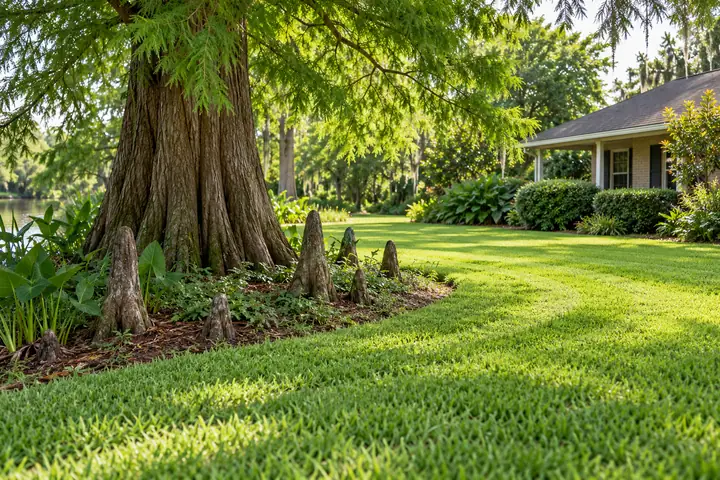
Cypress knees are woody projections associated with the tree's root system. LSU AgCenter notes that bald cypress grown in wet conditions may form knees, although their appearance varies by tree and setting. In a lawn, those projections can range from small rounded points to tall, hard forms that resemble weathered stumps. They may be hidden by long grass, leaves or flood debris. Before Happy arrives, send a wide photo that shows the tree and the spread of visible knees, then add low-angle views of the smallest ones. Do not expect equipment to drive over them. A knee is not a soft mound that will flatten under a tire; it is part of a living tree system and a solid obstacle in the route.
Build one boundary around the whole cluster
Trying to weave between individual knees creates tight turns and leaves uncertain pockets of turf. A more maintainable approach is often a continuous mulched or planted zone that includes the trunk and the densest knee cluster. The boundary should sit outside the outermost visible projection and remain easy to see when grass grows. This is a landscape decision for the owner, not something the mowing crew should redesign during a visit. If you keep grass among widely spaced knees, identify a safe lane and accept that conservative trimming may leave a small margin. Happy Grass can follow a clear established line; we do not cut, grind or remove cypress knees.
Search for the small knees after growth and rain
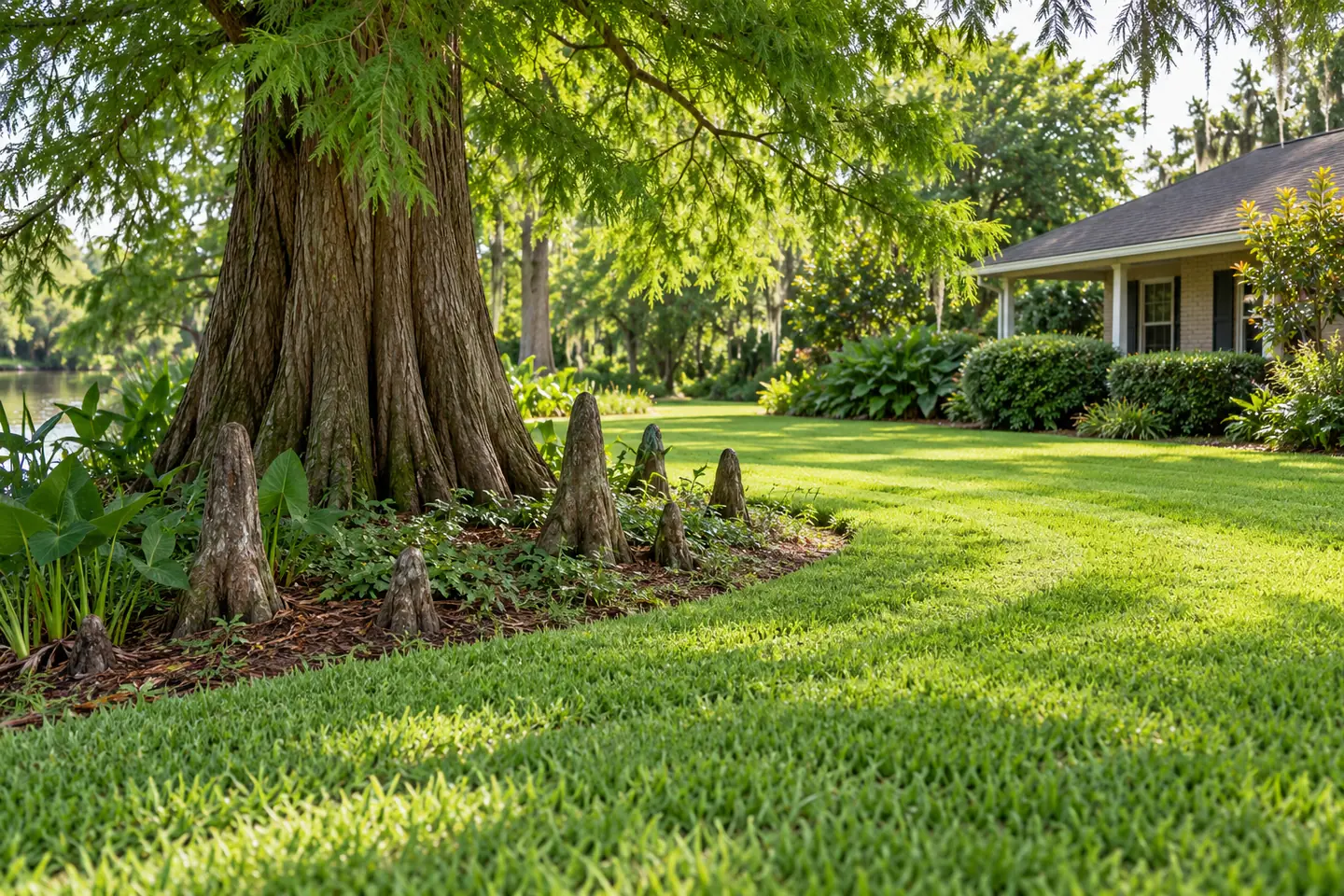
New or previously hidden projections can become noticeable over time. Walk the area after heavy rain, a mowing gap or seasonal leaf fall. Look from several directions because a dark knee can blend into wet soil. Remove loose branches and ordinary debris without digging around roots. Temporary flags can help identify a newly noticed knee, but tell Happy what the flags mark and remove them when the permanent border is updated. Never cover a knee with a bucket or pile of mulch so deep that its location becomes uncertain. Visibility is the first protection.
Keep the trunk and root zone out of tight turns
Repeated equipment turns close to a trunk can wear grass, compact soft soil and force wheels against roots or knees. Give the tree zone enough room for a smooth path around it. The route should avoid low branches, hanging moss and wet depressions at the same time. If a section is too narrow between knee cluster, fence and water edge, exclude it rather than forcing a pass. Happy does not diagnose tree health or soil compaction, but we can avoid obvious fixed features when the usable lane is clear. A broad curve usually looks more natural than a series of close cuts around each projection.
Do not make tree-work decisions on mowing day
LSU AgCenter has published homeowner guidance discussing removal methods for unwanted knees, but any decision to cut a knee should be made deliberately and separately from routine lawn service. Happy Grass does not prune roots, saw knees, apply herbicides or determine what a particular tree can tolerate. If you are considering removal, consult a qualified arborist or appropriate horticultural source and account for underground utilities before digging. Until that work is complete, the knee remains part of the no-contact boundary. This separation protects the tree and keeps the lawn visit within its proper scope.
Account for wet soil and water edges
Bald cypress often occupies damp settings. The ground near the tree can be softer than the open lawn, and knees may appear where water collects. Check the route after rain with ordinary footwear. If the surface smears, holds water or sinks underfoot, keep equipment out until it firms. Do not assume a mower can use a knee as a stepping point across wet ground. Drainage work, shoreline management and soil correction are outside routine mowing. Send a current photo if conditions differ from the quote, because a dry-season route may not be suitable after a storm.
Keep other materials away from the knees
String lights, irrigation tubing, pet leads and landscape wire can become tangled around a knee. Remove temporary lines from the tree zone before service. Do not stack firewood, stones or yard tools against the projections. If a low-voltage lighting system runs through the area, mark every fixture and keep the cable installed according to its instructions. Cypress knees are already complex obstacles; adding hidden hardware makes the boundary harder to read. A simple mulched zone with visible features provides the clearest handoff between garden care and lawn care.
Decide what an acceptable finish means
The grass immediately beside a knee may not be reachable without striking wood or scalping uneven soil. A neat finish may therefore include a small natural margin or a continuous bed edge. Tell Happy whether the priority is preserving a soft natural tree zone, maintaining a defined curve or trimming accessible grass between a few isolated knees. No responsible plan promises that every blade can be cut to the same height around a jagged root feature. Review the first visit and adjust the visible boundary rather than asking equipment to get progressively closer.
Update the map as the yard changes
Take a reference photo from the same location a few times a year. It can help you notice new knees, expanding mulch and changing access. After a landscape project or flood event, inspect the tree zone for exposed roots, displaced edging and debris. Tell Happy if the route changed. Keep private property details out of public photos; a simple yard view is enough. With an honest map, generous clearance and a stable edge, a cypress can remain a striking Louisiana feature while the surrounding lawn receives careful routine service.
Keep vehicles and heavy storage away
A dry-looking area around a cypress can still contain shallow roots and soft soil. Do not park trailers, lawn equipment or storage containers among the knees to create more open grass elsewhere. Remove portable items before service and keep vehicle access on established hard surfaces. Happy does not assess the load-bearing capacity of the root zone. If previous traffic left ruts, mark them and exclude the area until the grade is safely addressed. Protecting the route from extra weight also keeps the knees visible instead of burying them under displaced soil.
Coordinate with irrigation and drainage work
Before installing a drain, irrigation line or new landscape bed near the tree, contact Louisiana 811 as required and consult an appropriate professional about roots. Temporary paint and flags must remain in place and may change the mowing boundary. Happy does not dig, trench, move utility marks or choose a route for new pipe through the tree zone. After the project, provide fresh photos showing the final surface, exposed roots and any new covers. Do not resume the old mowing path merely because construction equipment has left the yard.
Respect neighboring property and water boundaries
Cypress roots and knees may extend toward a fence, canal edge or shared landscape area. Do not ask a lawn operator to decide ownership from the tree's location. Identify the grass included in your service request and provide access only on property you control. If a knee sits beyond a fence or on an uncertain boundary, leave it outside the scope until the responsible parties clarify the area. No precise GPS point or informal assumption is needed; a plain marked photo and a conservative stopping line are enough.
The marked boundary can then be repeated without reopening a property question during every visit.
Keep the visible projections on the same reference map
Use fixed yard features to label the area containing visible cypress knees, then show that area in an ordinary wide photograph. Record what can actually be seen rather than assigning an exact count to a partly obscured patch. If grass or leaves hide part of the area, say so and keep the uncertain section visible in the discussion.
A reference map is for orienting lawn work, not for authorizing cutting, grinding or changing tree structures. Keep any separate tree question with an appropriate qualified source. When the owner clears unrelated loose material or the view changes with the season, update the photograph from the same position. This lets Happy review the presented grass margins while the location record remains consistent. It also avoids confusing a newly visible projection with evidence that the earlier lawn note covered every hidden part of the area.