
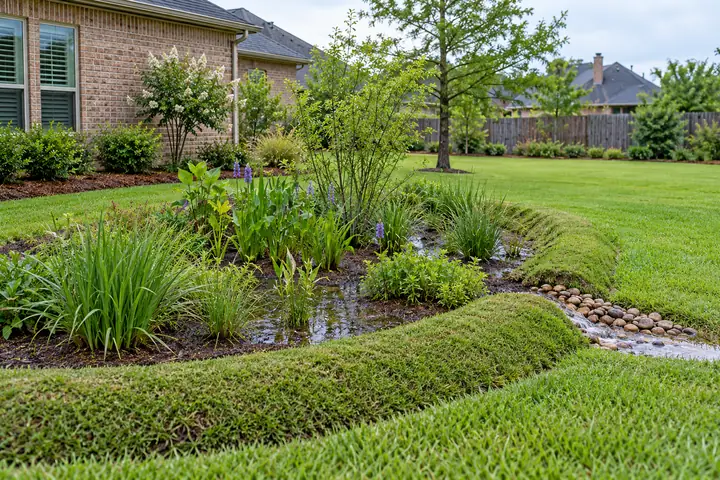
Read the whole shape before choosing a route
Rain gardens use a shallow depression, planted bottom and low edge or berm to receive runoff. Penn State Extension describes them as planted depressions that collect water from roofs, drives, walks or compacted lawn. From a mower, the important detail is not the plant list but the change in grade. Walk the upper lawn edge, low basin and overflow side while conditions are dry enough to see. Happy maintains accessible turf; rain-garden sizing, soil mix, drainage and plant care remain with the owner or landscape professional.
Keep the berm’s profile visible
The berm may look like an ordinary grassy hump, yet cutting across it at the wrong angle can scalp the crown or rut the lower side. Mark where the intentional rise begins and ends. A broad pass parallel to the contour is often easier to repeat than a tight turn on top. Do not shave the berm down to make equipment sit level, and do not add soil during lawn service. Its shape is part of the stormwater feature, so any repair or redesign needs the responsible installer.
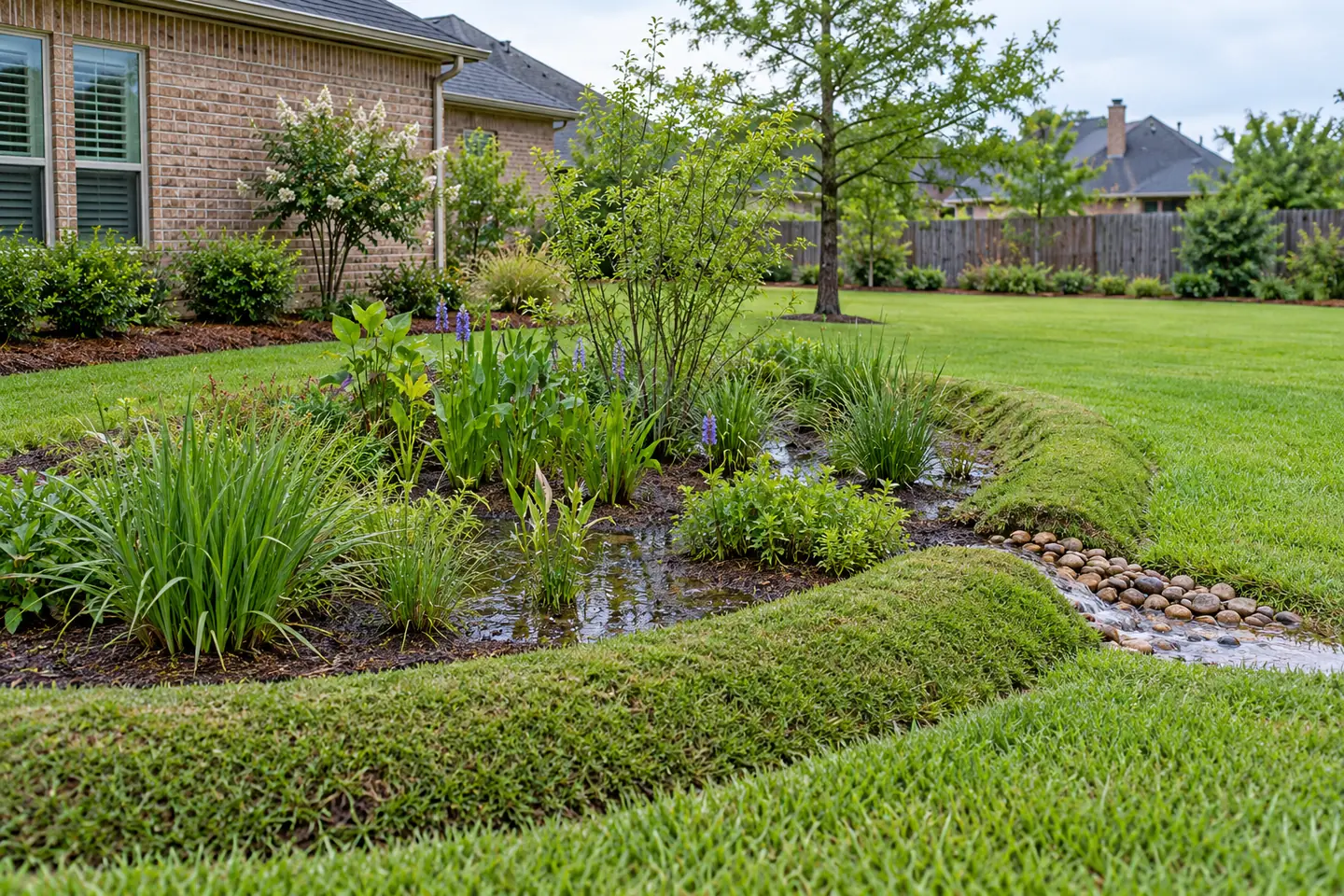
Separate turf from planted basin
Moisture-tolerant plants can lean into the lawn, while turf runners creep down the slope. Establish a readable boundary chosen by the owner. Happy can trim accessible grass to that line but should not identify, prune or remove rain-garden plants. A mulched edge may help when it is stable and free of loose rock, pins or exposed fabric. The goal is one clear stopping point that protects both the mowing deck and the planted area.
Wait for water to drain before close work
After rain, the basin is supposed to hold or absorb water for a period. Do not enter standing water to test depth, and do not drive on the saturated side slope. Even after the center looks dry, the berm’s lower toe may remain soft. Tell Happy how long the area usually takes to recover after an ordinary storm. A wider bypass or delayed small section prevents ruts that could redirect future runoff.
Protect the inlet and overflow
The inlet may be a downspout outlet, stone apron or shallow grass channel. The overflow may be lower and less obvious on the opposite side. Keep both visible and free of packed clippings. Do not aim mower discharge into the basin or blow mulch into the water path. EPA and LSU guidance both support keeping yard waste out of drains and waterways. Surface cleanup should preserve openings without moving stone or reshaping flow paths.
Use equipment that matches the slope
A small berm can still exceed comfortable side-slope clearance for a riding mower. Judge traction, deck angle and turning room rather than assuming the whole lawn uses one machine. A push pass or careful trimming may suit the narrow strip between berm and fence. Happy can select a conservative tool for accessible turf; the estimate should not promise that every planted or saturated surface will be mechanically cut.

Watch for erosion without repairing it on the fly
Bare soil, a cut channel, displaced stone or exposed fabric means runoff has altered the feature. Photograph the condition and keep equipment away. Filling the channel with clippings or pressing it closed with a tire can hide the symptom and worsen drainage. The owner or installer should evaluate why the surface changed. Happy’s useful contribution is noticing the difference and preserving the surrounding lawn until the repair plan is clear.
Give new gardens an establishment period
Fresh plants, seed and mulch need time before nearby equipment follows a normal route. Temporary flags can mark the outer limit if they are visible and placed away from moving parts. Update the property photo as vegetation fills in. Do not count the planted basin as ordinary turf simply because grasslike plants are present. The service plan can expand only after the owner confirms which areas are intended for mowing.
A rain-garden service checklist
- Mark the lawn edge, berm crown, inlet and overflow.
- Keep people and equipment out of standing water.
- Remove toys and loose debris from the outer route.
- Direct clippings away from the planted basin and stone openings.
- Report erosion, exposed fabric or unusual prolonged saturation.
- Leave plant, soil and drainage changes to the responsible specialist.
Coordinate with downspouts and neighboring surfaces
One rain garden may receive several sources. A downspout can make one corner wet while driveway runoff reaches another. Photograph the entire contributing edge rather than one pretty plant grouping. If a hose, extension or splash block crosses the lawn route, address that separate obstacle before service. Happy needs a repeatable path around the complete feature, not a guarantee that runoff from every source is correctly managed.
Seasonal growth changes visibility
Summer foliage can hide the inner slope, and dormant plants can make the basin look empty in winter. Fallen leaves may cover the overflow. Refresh the route notes when the feature looks materially different. Do not use the mower to mulch a deep leaf layer inside the basin; plant-bed cleanup is distinct from accessible lawn mowing. A visible edge through every season helps protect the garden without requiring it to look identical year-round.
Keep the service boundary honest
Happy Grass can mow, edge, trim and blow the surrounding accessible lawn. It does not design rain gardens, choose plants, excavate basins, modify berms or promise drainage performance. That narrow boundary still provides real value: the lawn can frame the feature cleanly while its water path remains unobstructed. Send a wide photo after rain and another when dry so access decisions reflect actual conditions rather than guesswork.
Reading the basin after a Gulf Coast downpour
The useful question is not whether every drop disappears immediately. A rain garden is meant to receive runoff and release or absorb it over time. The mowing question is whether the turf route has recovered enough to carry equipment without rutting, slipping or pressing soil toward the low point. A shallow sheen, footprints that fill with water, or grass that stays laid over after a shoe passes are all reasons to wait. The basin may look green while the approach remains too soft.
Observe where water entered, where it paused and whether any mulch, stone or soil shifted onto the mowing strip. A storm can change the edge even when the planted center looks unchanged. If water is standing far longer than the garden's normal pattern, the owner should ask the designer or a qualified drainage professional to evaluate it. Happy can note visible conditions, but lawn service is not drainage diagnosis.
A handoff that stays useful all season
Keep one simple record of the intended grass line. A wide photo from the normal mower approach is often more useful than a close-up because it shows the basin, berm and escape route together. Add a close photo when a cleanout, overflow notch or small plant is easy to miss. After planting changes, construction or a large storm, update the record before the next visit.
The owner can also mark temporary no-go areas with a visible stake that is removed before mowing begins. Do not use loose wire, string or tiny flags that can disappear into grass. The best handoff says what changed and what the crew should preserve: “new sedges at the north lip,” “soft soil beside the overflow,” or “use the outer pass until the berm firms.” That is clearer than asking a crew to guess from appearance.
Keep the planted shape and overflow route visible through every season, even when surrounding turf grows quickly and the basin itself appears settled.
Label the planting boundary and the lawn boundary separately
A rain garden can include planted areas, an ordinary lawn edge and an owner-defined area that should remain undisturbed. Show those limits separately rather than outlining the whole feature with one broad line. A close view helps explain the material transition, while a wider view makes the approach understandable.
If seasonal growth obscures the edge, keep the uncertainty visible and ask the person responsible for the planting to clarify the intended lawn boundary. Do not use a desired tidy appearance as a reason to redraw it. Record any confirmed change with the date and retain the prior view as background. This makes the maintenance request useful across seasons without presenting mowing as rain-garden management, plant identification or an assessment of how the feature handles water during a storm.