
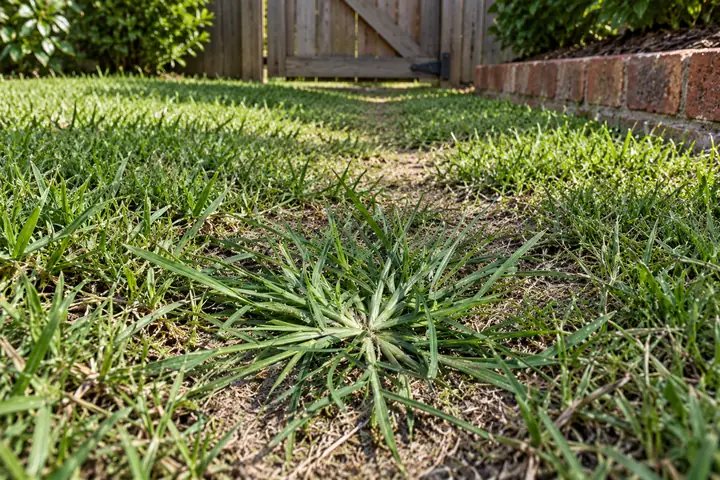
Start at the pale center
A narrow grassy rosette near the gate can be easy to call crabgrass and move past. Goosegrass deserves a closer comparison at its base. LSU AgCenter describes flattened stems radiating from a whitish center in a wagon-wheel pattern. That central structure is often more useful than the longest blade or the overall green color. Look down at the plant's base before assuming that a coarse grassy patch is simply the lawn growing unevenly.
Goosegrass is a warm-season annual grassy weed. Its low spreading form can remain conspicuous along worn routes even when nearby turf has been cut. The useful maintenance question combines two observations: what plant is present and what the route looks like around it. Neither observation should replace the other. A pale-centered rosette can suggest an identification, while the bare strip, gate clearance and repeated footpath describe the working landscape.
Compare the flattened base with a spreading crabgrass stem
Goosegrass tends to present a compressed pale base with leaves and stems extending outward. Crabgrass commonly shows a different spreading jointed architecture. Seed heads on both can have finger-like branches, so their general outline is not a complete identification. Trace the head back to the base of the same plant. A detached seed head beside a pale rosette may belong to another grass altogether.
University of Missouri's weed identification resource also emphasizes the white or silver center and flattened stems. Use those clues together with the whole plant. If the center is obscured by mud, debris or recent cutting, explain the limitation rather than guessing. A careful uncertain description is more useful than confidently naming every grass in a worn strip goosegrass. The right target matters before any weed-control method is considered.
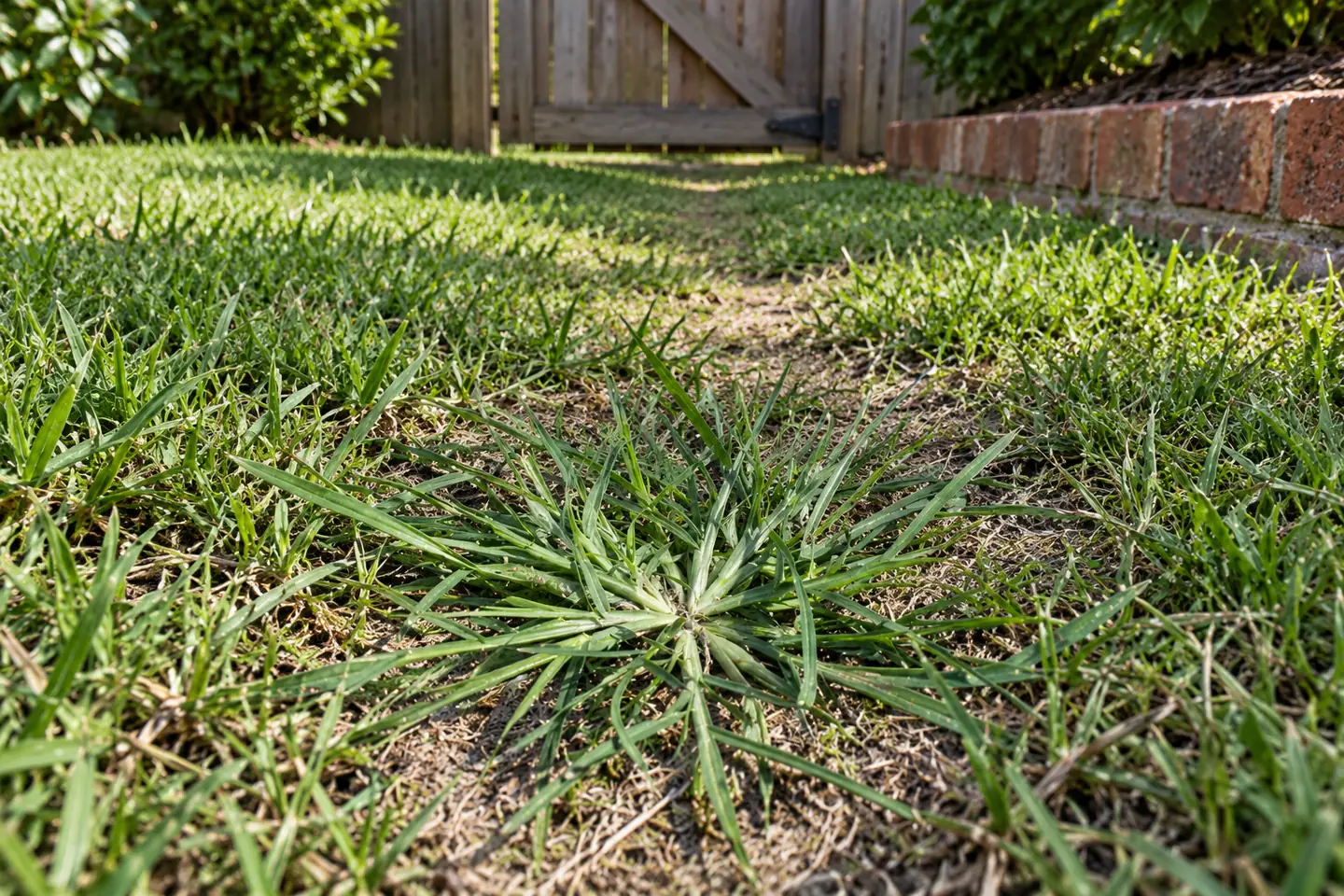
Draw the route before interpreting the weed
Mark where people actually walk: through the gate, around a parked object, toward a hose or along the shed. Then mark the visible rosettes. Are they concentrated in the route, beside it or scattered more widely? A route map helps identify a repeated-use pattern without claiming that the weed has measured compaction. It also shows whether ordinary access is concentrated into a narrow place because of the landscape layout.
For example, a gate that opens onto one small turf landing may funnel every trip across the same patch. A storage box may push the route against a lawn edge. These are concrete layout observations. They can be discussed even before a soil assessment is available. Do not conclude that one person's recent equipment pass caused the entire pattern simply because the path and weed occur together. Record the longer use history where it is known.
Association with traffic is not a soil test
Goosegrass is often associated with heavily used or compacted areas, but its presence alone does not diagnose soil structure. A bare strip can involve several conditions, including repeated wear, site exposure and poor turf continuity. If compaction is a concern, seek an appropriate assessment rather than prescribing a soil practice from the plant's name. The weed gives you a place to look, not a complete explanation of what happened underground.
Keep the observations in plain language: soil is visible between rosettes, footprints repeatedly follow the gate line, or the desired turf is more continuous away from the route. These statements are useful without pretending to measure density or infiltration. They also keep the maintenance request honest. Happy Grass does not offer aeration, and a discussion of worn ground should not imply that aeration is included or automatically the right answer.
Look for the desired turf between separate rosettes
A series of goosegrass plants can make a worn strip appear more fully vegetated than it really is. Inspect the spaces between their bases. Is the intended grass continuous, scattered or absent? That observation affects expectations for weed removal. If the unwanted plants supply much of the green cover, reducing them can expose an existing gap. A clear lawn edge and a fully recovered traffic strip are different outcomes.
Distinguish one large rosette from many smaller ones. The size of the whole green area may hide that difference. A count does not need to be exact to be useful: several separate pale centers across the gate landing communicates more than one clump by the gate. It also gives a later inspection a starting point for comparing surviving plants and newly observed smaller ones without assuming they all belong to one original center.
Gate movement and mowing access are practical details
Check whether the gate can open fully without catching plants, stored items or uneven ground. Describe any threshold, exposed edge or known obstacle before the visit. A request to tidy the goosegrass strip should not require someone to discover an obstructed gate while maneuvering equipment. The vegetation issue and access issue can be reviewed together, but the plant should not distract from the actual clearance needed for safe ordinary work.
Avoid placing small hard markers beside each rosette in a narrow equipment route. Use a marked photograph or fixed landmarks instead. If the area needs to be left for identification, show the boundary clearly without adding trip or mowing hazards. You do not need to turn the yard into a survey grid. The aim is a recognizable location and an instruction that remains understandable when the plants look different after rain or cutting.
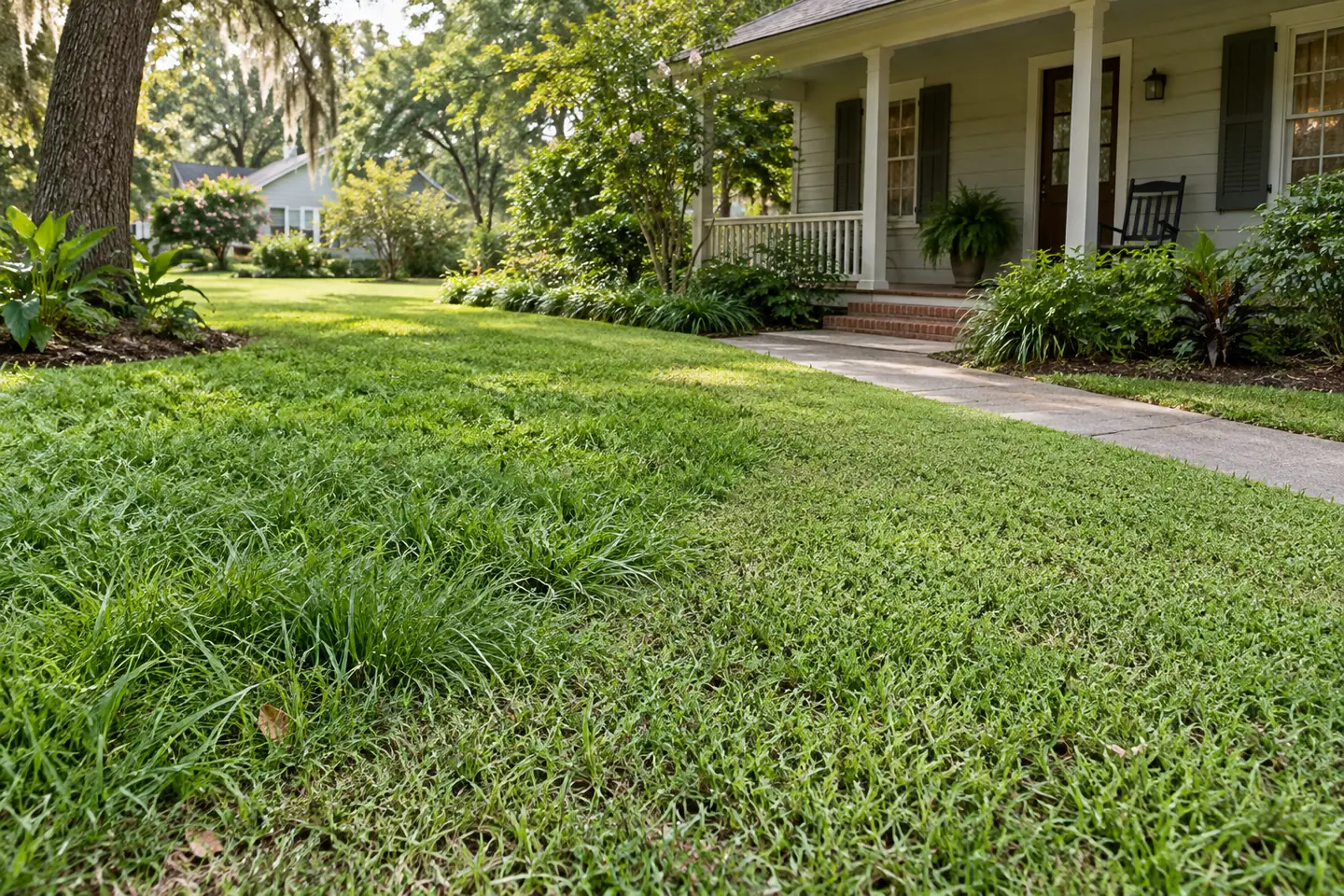
Mowing can tidy the route without removing the base
The pale flattened center may remain after taller leaves and seed heads are shortened. Review it directly rather than deciding from standing-height smoothness alone. If the grass cut is even and the rosettes persist, both observations can be true. Another lower pass is not automatically the right response. The intended turf's needs and the separate weed question should guide what happens next.
Likewise, a hand-removal discussion needs a defined area and endpoint. Work on several plants in an open strip differs from managing rosettes tangled through desirable turf. Do not assume that visible removal will also repair the route's wear pattern. If people must continue crossing the same narrow landing, that use remains part of the landscape even after the current plants are gone. The work plan should acknowledge the continuing route rather than promise a permanent visual reset.
Review recurrence as a route question and a plant question
When small plants are noticed later, record whether they occur in the same worn corridor or beyond it. Look for new pale centers rather than judging every green blade as goosegrass. An annual weed can recur through seed, so one cleared visit does not establish permanent absence. At the same time, a recurring worn route is not proof that every plant is the same species or that the previous maintenance task failed.
If the household can change the location of a movable object that funnels foot traffic, consider that layout separately from weed work. Do not block an essential exit or send people into a less suitable route to protect a patch of grass. The practical question is how the yard is used and whether the desired turf expectation fits that use. A plant map can support this conversation without pretending to design an engineering solution.
Compare a gate landing with a nearby unused edge
A useful route inspection includes a comparison place outside the main footpath. If both contain pale-centered rosettes, the issue may be broader than the narrow gate route alone. If rosettes are concentrated at the landing while desired turf is more continuous nearby, the distribution is worth recording. Neither result establishes a soil diagnosis, but both sharpen the question for an appropriate assessment.
Also distinguish where a person steps from where the gate swings. A worn arc may reflect clearance or repeated turning rather than a straight walking line. Describe the actual use pattern instead of assuming every bare patch is a mower track. The aim is a route-aware lawn plan, with no unsupported blame or automatic soil prescription.
- Landing center: record separate flattened bases and the turf between them.
- Gate-swing arc: note clearance limits and objects that funnel movement.
- Nearby comparison: record whether similar rosettes occur outside the regular route.
- Exit path: preserve necessary access when considering any layout change.
These distinctions remain useful after the current plants are addressed. A gate that still channels every trip through a small turf opening continues to shape the site's use. Plant removal can change what occupies that opening, while the access pattern needs its own realistic expectation.
Ask for a route-aware lawn visit
Tell Happy about the whitish flattened centers, the number of separate groups and the route they occupy. Mention gate movement, obstacles and the amount of desired grass between plants. If weed-control options are requested, confirm identification and available scope separately from mowing. This guide does not select a product or diagnose compaction, and it does not promise that removal of one annual weed will rebuild a worn landing.
Happy Grass takes requests around Harvey, Marrero, Gretna, Algiers, Belle Chasse and Westwego. Call 504-339-3571 and ask for Happy. Fertilization, aeration, overseeding and pest control are not offered. A useful goosegrass conversation keeps the pale rosette, the intended lawn and the real gate route in view together. That makes the requested finish specific enough to review without asking a simple mowing visit to solve every condition in a heavily used strip.