
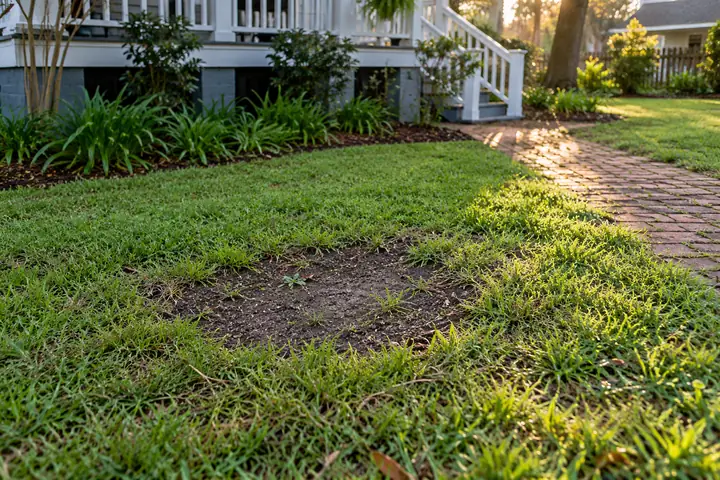
A small circle deserves more than a quick label
You may first notice a little bare circle beside the porch because the surrounding grass is still standing. On another evening, you see a dark caterpillar near the same part of the yard. It is reasonable to ask whether those observations belong together. It is less useful to decide immediately that one proves the other. Start by describing the circle as you found it: where it sits, what remains in it and whether its edge is easy to distinguish from the nearby lawn.
The black cutworm question concerns feeding on grass, not simply the existence of a round opening. Happy Grass needs to understand the physical condition of an area when discussing maintenance. An insect specialist needs suitable evidence to identify a caterpillar and assess its significance. Keeping those needs separate helps you prepare a better question for both. You can ask for a careful lawn review without pretending you have already solved the cause of the missing grass.
Why the time of observation matters
LSU AgCenter describes black cutworm larvae as caterpillars that emerge from soil burrows at night and chew grass leaves and stems. The adult stage is a moth. LSU notes that affected turf can show small, sunken dead patches and that caterpillars may curl when disturbed. Those background facts explain why a daytime glance may fail to reveal the insect. They do not establish that a bare circle, a moth or a curled caterpillar is enough for identification.
Write down when you observed each feature rather than filling in a story about what happened while you were asleep. If the grass looked different in the morning, say that it was first noticed then. If a caterpillar was actually seen feeding, describe that separately from finding one on paving. A record that distinguishes direct observation from inference is much easier for a professional to interpret. The porch-side lawn image used here is an editorial setting, not a photograph of confirmed cutworm activity.
Describe the plant material inside the patch
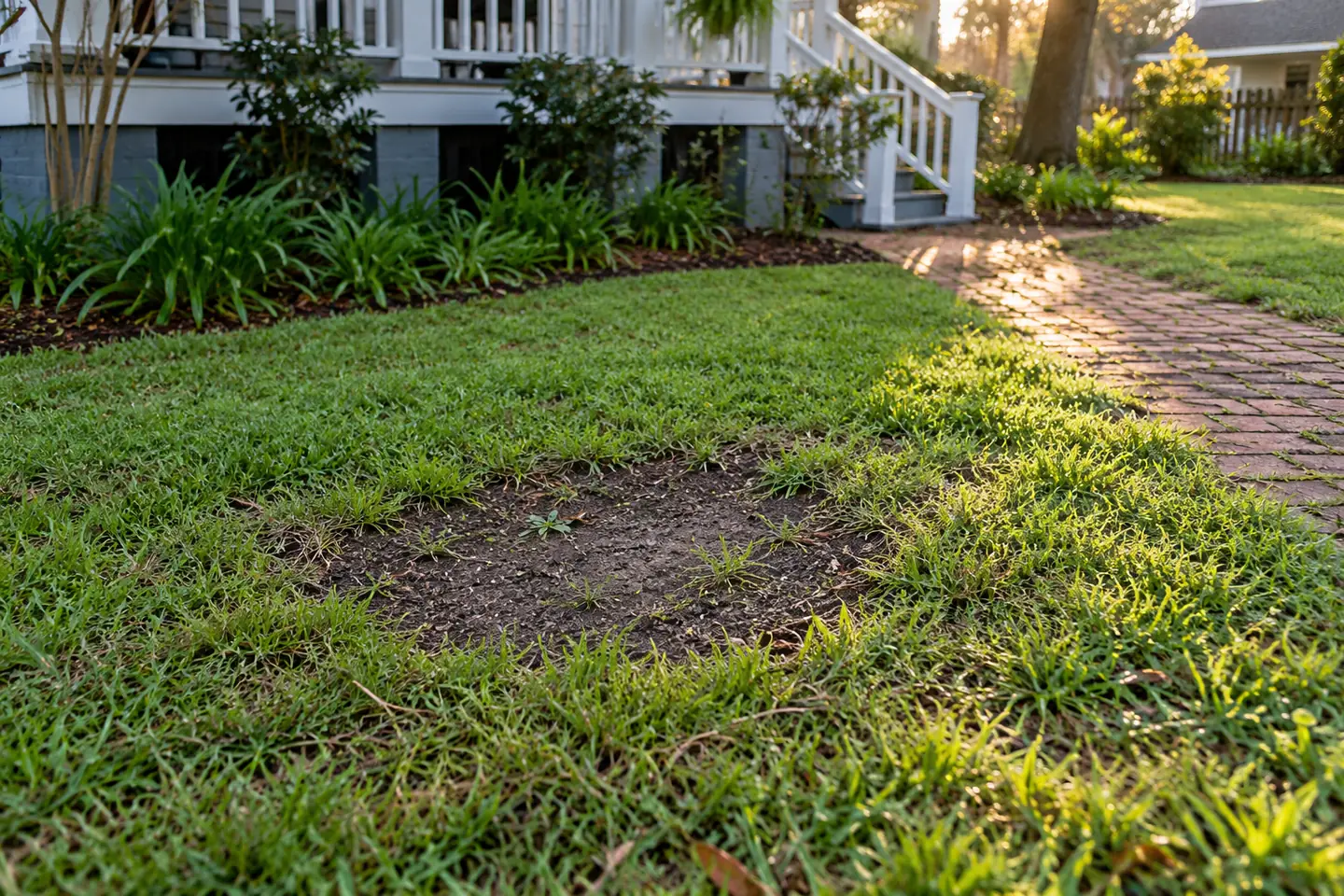
From a safe standing position, look at whether the area contains short grass pieces, standing pale leaves, exposed soil or a mixture. Use those ordinary words if you are unsure how to name the plant parts. A close photograph may show whether leaves look shortened, but it cannot necessarily reveal how they became that way. Avoid cutting or rearranging material to make the image match a reference picture. The unmodified condition is the evidence you want to preserve.
Add a wider view with a fixed landmark, such as a porch post or the end of a garden border. This helps the reviewer understand the patch's setting and helps you return to the same place. A detail image with no location is difficult to compare later, particularly if several small spots are present. Number the spots if necessary and keep each set of photos together. The system can be very simple as long as it does not confuse one location with another.
Keep a moth sighting in its proper place
A moth near a porch light can be an interesting observation without explaining the lawn. Photograph it if you can do so comfortably, and record that it was at the light. Do not relabel that image as an insect found feeding in a bare patch. If a caterpillar is seen on the ground elsewhere, give it a separate location note. Related life stages are a biological question for identification, not something a homeowner needs to assume from proximity alone.
Preserve the original insect photograph and include as much of the body as the camera can clearly resolve. A heavily enlarged crop may make the creature look larger without supplying more detail. If the image is unclear, acknowledge that limitation. Ask whether the receiving specialist can use it or would prefer another view. You do not need to catch an unfamiliar animal, enter a dark area or stage a handling photograph just to make a lawn maintenance inquiry.
An evening look should remain an observation
If you choose to look from a well-lit patio or walkway, check the route in daylight first and stay where you can see your footing. Darkness does not improve a photograph enough to justify crossing unfamiliar ground. Stop if the area cannot be viewed comfortably. A note that no evening observation was made is perfectly acceptable. The absence of a night photograph does not prevent you from requesting professional help with a changing lawn.
Do not pour household mixtures onto the grass or set up a trap simply because an online page mentions a testing method. A specialist may have a reason to request a particular procedure, and that request should include the relevant details. This guide is about recording what is already visible. It does not provide a flush-test recipe, a trapping plan or a treatment recommendation. Keeping the observation simple preserves the distinction between watching the yard and performing an intervention.
Compare the patch before changing the cut
A bare-looking area can be hard to evaluate immediately after the surrounding grass is shortened. If you can safely record the original condition before a scheduled visit, do so and explain the date to Happy. Ask whether the area needs review before mowing, rather than assuming that cutting the entire lawn lower will make the issue easier to solve. A change in appearance after a cut is not the same as evidence that a feeding problem has ended.
If the rest of the lawn still needs ordinary maintenance, identify that part of your request explicitly. A small flagged concern should not leave the scope of the whole property to guesswork. Likewise, if a particular patch is to be left undisturbed for inspection, describe its boundary and confirm the arrangement. Avoid placing a loose object in the grass as an unexplained marker. Use a photograph and a clear private message so the intended instruction is understandable.
Build a timeline that allows uncertainty
Use short dated entries: first bare spot noticed, second photograph taken, insect seen on walkway, professional contacted. Add actual maintenance or other yard work between those observations. Do not fill gaps with assumptions about rapid feeding, an expanding population or a successful cure. The timeline is strongest when it shows exactly what you know and where information is missing. That honest record gives the next reviewer room to reach a conclusion different from your first guess.
If a patch changes shape, use the landmark photo to explain which edge changed. If it looks unchanged, record that too. A sequence of identical-looking photographs may still be useful, provided the viewpoint and conditions are clear. Do not repeatedly disturb the center to make a more interesting picture. Later inspection may need the grass and soil relationship that remains at the edge. Ask the specialist before collecting material or altering the area for demonstration.
Use the answer to refine the next request
When you receive an identification, ask what the evidence actually supports. Identifying a caterpillar does not automatically determine how much of the lawn change it caused. A professional may want additional information about the grass, the location or the timing. Save that request and respond with the missing detail if you can obtain it safely. Treat an inconclusive answer as a reason to improve the evidence rather than as permission to select a treatment by guesswork.
For the maintenance conversation, share the conclusion that affects work and keep the unresolved technical issue with the specialist. You might need to discuss access around an inspection area or confirm which section remains in the ordinary mowing scope. A clear division of responsibility makes the process easier for everyone. The yard can receive an appropriate maintenance review while the biological question is handled by someone equipped to assess it.
Keep round patches separate from actual holes
A circle of missing-looking grass and a hole below the surrounding soil surface are not interchangeable descriptions. If there is an opening, explain that physical feature separately without probing it. A photograph taken at a low angle from an accessible position may help show whether the surface is depressed, but do not put your foot into the spot to demonstrate depth. The maintenance discussion needs to account for the ground as well as the plants. An insect hypothesis does not replace that site information.
If a patch sits near a porch step, note whether it lies in the normal approach or off to one side. The same small feature can have different implications depending on the route. Include a second wider image if the first hides that relationship. Keep the description modest: apparent depression is acceptable when the depth is unknown. Asking someone qualified to review an uncertain surface is more useful than declaring it harmless because the suspected cause sounds familiar.
Ask Happy about the lawn visit
Call Happy Grass at 504-339-3571 and ask for Happy to discuss mowing, edging, weed-eating or blowing. Explain the porch-side patch and any agreed inspection boundary. Happy Grass does not provide cutworm treatment or pest diagnosis. The goal of the maintenance conversation is a clear work plan, with no promise that a particular cut will resolve the underlying concern.
A short record to bring to the conversation
- Differentiate a bare circle from a hole in the ground.
- Record a caterpillar sighting independently of a porch-light moth.
- Keep the viewing time with the actual activity observed.