
A recurring thin patch needs a longer view
Some lawn questions begin with a sudden change. Others begin when you realize that the same area has looked disappointing through several rounds of ordinary maintenance. A sparse section beside a tree or border may have become so familiar that you no longer remember when it first appeared. Start by rebuilding the history you can actually support. A dated house photograph, a saved yard message or your own recent record can be useful. Do not invent an exact starting date just because the problem feels old.
Ground pearls are one possible subject to discuss with an appropriate turf professional when persistent thinning raises questions below the surface. They are not a label to attach to every stubborn bare patch. The point of this guide is to help you avoid spending effort on a repair whose underlying conditions have not been evaluated. Happy Grass can discuss the maintenance around the area while a separate investigation addresses why the grass is struggling and what evidence is needed.
Understand why this insect question is unusual
LSU AgCenter describes ground pearls as root-feeding scale insects whose immature stages form tiny pearl-like coverings in the soil. They can be difficult to observe, and affected turf may thin in irregular patches. LSU also warns that the insects can persist in soil for long periods and that replacing grass in an affected area can expose the replacement to the existing problem. Those facts explain why a diagnosis matters before assuming that new turf will settle a recurring concern.
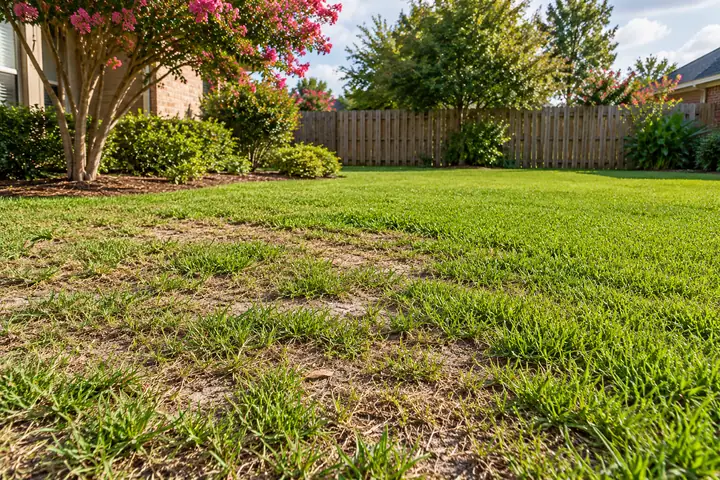
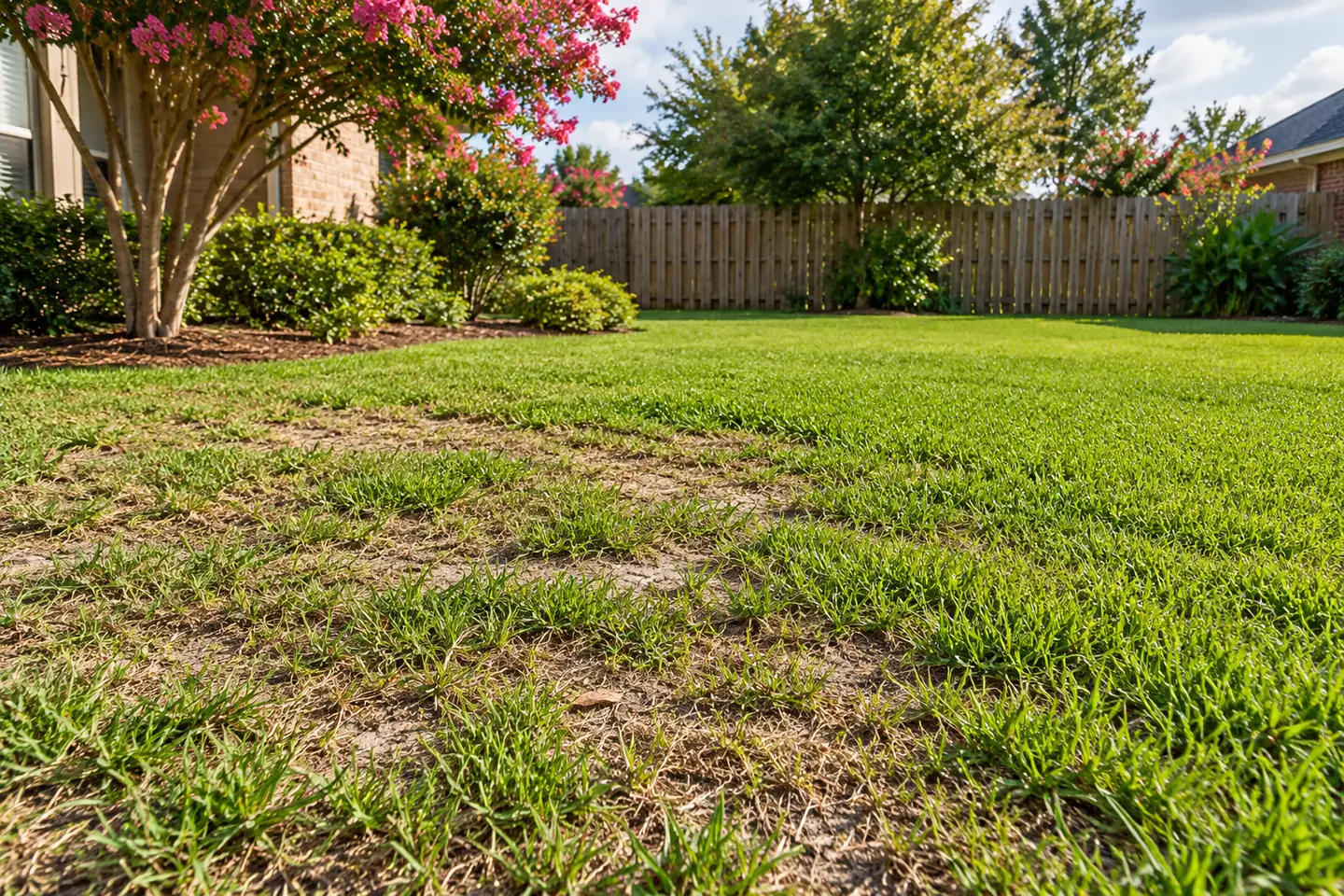
They do not mean that a pale granule, a bead of material or a thin patch proves ground pearls are present. Save the distinction between what was seen and what it might be. If a specialist asks to examine soil and roots, obtain the collection instructions before disturbing the site. The sparse lawn beside the flowering tree in this page's illustration is a general editorial scene. It does not identify a host grass, show ground pearls or document a diagnosed property.
Write the repair history before discussing the next repair
List what you know was done in the thin area and when: grass replaced, a large object removed, an edge changed or a previous investigation requested. Include the size and location in terms you can verify. If someone else arranged the work, ask for the record rather than guessing at the material or method. A note saying grass was put here sometime last year is still useful when that is the limit of your knowledge. Precision should come from evidence, not confident wording.
Keep the outcome separate from the work description. New grass looking green on installation day is one observation; its condition several weeks later is another. If the record jumps from installation to a much later thin patch, acknowledge the gap. Do not describe a repair as having failed immediately unless you actually observed that sequence. A specialist can work with an incomplete history more honestly than with a smooth story assembled from assumptions.
Compare the boundary, not only the empty center
Photograph where sparse grass meets denser growth, along with a wider view of the whole section. The center of a bare area may look dramatic but contain little context about the transition. Keep a fixed landmark in the wider frame so you can compare the same boundary later. If a tree canopy, bed edge or paving changes the setting across that boundary, include it in the image. Showing the context does not declare which feature caused the difference.
Use separate descriptions for nearby areas that look unlike one another. A thin strip at the walk and a broad sparse section beyond the tree may not be the same problem simply because both contain exposed soil. Give them different location names until evaluation supports connecting them. This keeps sample discussions and future work instructions from blending unrelated parts of the property. A simple hand sketch can make those distinctions clearer than a long paragraph of lefts and rights.
Do not make pearl-like objects into a home diagnosis
If something unusual is already exposed, photograph it in place and note how it became visible. Material revealed by unrelated construction has a different history from material deliberately removed from the thin patch. Keep any original image and describe the scale as well as you can without handling an unfamiliar organism. Do not classify every round particle as an insect. Many small objects look similar once a phone camera loses focus or the image is enlarged.
Ask the receiving professional whether a specimen is needed and what it should include. Avoid digging a series of holes to search for a match to an internet picture. Unplanned disturbance can leave the lawn harder to evaluate and create a maintenance issue of its own. If you have already disturbed a spot, record exactly where and when. That information helps the next person distinguish the original condition from the condition created during your search.
Separate a diagnosis from a renovation proposal
Before considering another replacement, ask what evidence supports the proposed explanation and whether that explanation accounts for the earlier history. A repair proposal should be clear about what it is expected to change. Covering exposed soil, improving appearance and resolving a persistent biological problem are different goals. They may require different expertise. Do not assume that paying for one automatically delivers all three, especially while the cause of repeated thinning remains uncertain.
If a professional confirms ground pearls, retain the written conclusion and discuss the implications with that professional before arranging new grass. This guide does not supply a product recommendation or promise an eradication method. A confirmed finding can affect planning, but it should not be converted into a blanket instruction for every patch in the yard. Keep the identified area, the evidence and the proposed response together in the record so later decisions remain traceable.
Give maintenance a practical boundary while the question is open
A persistent sparse section may still sit within a larger lawn that needs a clear maintenance agreement. Tell Happy which part is under investigation and what you want discussed for the surrounding grass. If an inspection location needs to be left alone, define it with a photograph and recognizable landmarks. Confirm the arrangement before the visit. An unexplained bare patch does not tell anyone whether you want it avoided, evaluated or included in the ordinary request.
Also identify any disturbance left by a previous inspection. A loosened edge, open hole or displaced object needs its own access discussion regardless of the eventual diagnosis. Do not cover it with long grass or assume it will be obvious from a distance. The maintenance decision concerns the physical condition of the work area. It should not depend on a lawn provider accepting an unconfirmed insect theory in order to understand where the ground has changed.
Use later photographs to test the story
Return to the same wider viewpoint after significant events, such as an inspection or an agreed maintenance visit. Keep each image dated and note what actually happened between views. If the thin boundary appears stable, record that. If a different section now looks sparse, give it a new note rather than enlarging the original diagnosis automatically. The record should help determine whether observations remain connected, not force every later change into the first explanation.
An unanswered question can be frustrating, particularly when the lawn has looked thin for a long time. A useful next step is one that reduces uncertainty: locating the earlier repair record, obtaining an appropriate sample instruction or clarifying a professional finding. Repeating the same unsupported repair is not the only way to make progress. A careful history can save the next conversation from starting over with the same bare-ground photograph and none of the information behind it.
Compare the repair proposal with the evidence you have
When a proposal arrives, put it beside the actual diagnostic record and check which question each document addresses. A description of square footage and installation materials may define a repair task very clearly while saying nothing about the unresolved cause. Ask the proposed repair provider to explain that distinction. Do not insert an eradication promise into a proposal that only describes replacing grass. Clear expectations are valuable even when you decide to wait for more information before selecting any work.
Retain the limitations along with the quoted scope. If no organism has been identified, the record should continue to say so after the estimate is saved. If a professional has identified a concern in only one location, keep the location visible when considering a larger project. This prevents the scale of a proposed job from quietly expanding the scale of the diagnosis. Decisions about additional areas can then be based on additional evidence rather than the convenience of one combined estimate.
Keep Happy's maintenance role clear
For mowing, edging, weed-eating and blowing questions, call Happy Grass at 504-339-3571 and ask for Happy. Describe the sparse section and any inspection boundary. Ground pearl diagnosis, pest treatment and a promise of renovation success are outside Happy Grass's maintenance offer. A clear lawn plan can coexist with a specialist's investigation without claiming that either one substitutes for the other.
A short record to bring to the conversation
- Recover the previous grass-replacement record if one exists.
- Keep pale soil particles unclassified until properly assessed.
- Ask what the repair proposal addresses before assuming a cure.