
The route matters before the mower arrives
A new mound beside the garden border can be easy to overlook from the house and impossible to overlook when it sits in the route to the back lawn. Start with that practical detail. Is it beside the gate, at the edge of a path or within a section people usually cross? A maintenance request should explain the location before anyone approaches it. There is no need to kick the mound open or run equipment across it to demonstrate that it deserves attention.
An ant concern can involve more than the appearance of the lawn. It may affect where you want people to walk and which part of the yard can be discussed for the next visit. Give those instructions directly rather than relying on someone to interpret a soil photograph. Happy Grass can discuss the proposed maintenance access. Identification and pest management belong with an appropriate professional, and that conversation should remain separate from the agreement for mowing or a tidy paved finish.
What the LSU fire-ant description establishes
LSU AgCenter describes red imported fire ants as mound-building insects that can sting people and pets when disturbed. Its lawn guide distinguishes the mound concern from direct injury to turfgrass and notes that ants can swarm when soil is disturbed. Those points support a simple approach for a homeowner observation: leave the mound undisturbed and communicate its location. They do not identify every pile of soil as a fire-ant nest or establish the species from the color of the soil.
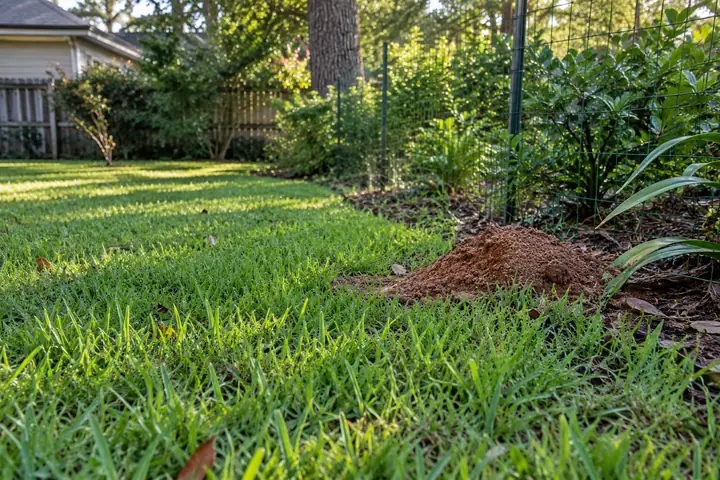
Use suspected ant mound when that is all you know. If ants have actually been seen, describe where you saw them without approaching for a closer look. Do not infer that they are absent because none are visible in one photograph. A pest professional can advise what identification evidence is appropriate. The mound beside the wire border in the editorial image here is a general illustration. It is not a verified colony, a customer property or evidence of work by Happy Grass.
Describe the mound without provoking activity
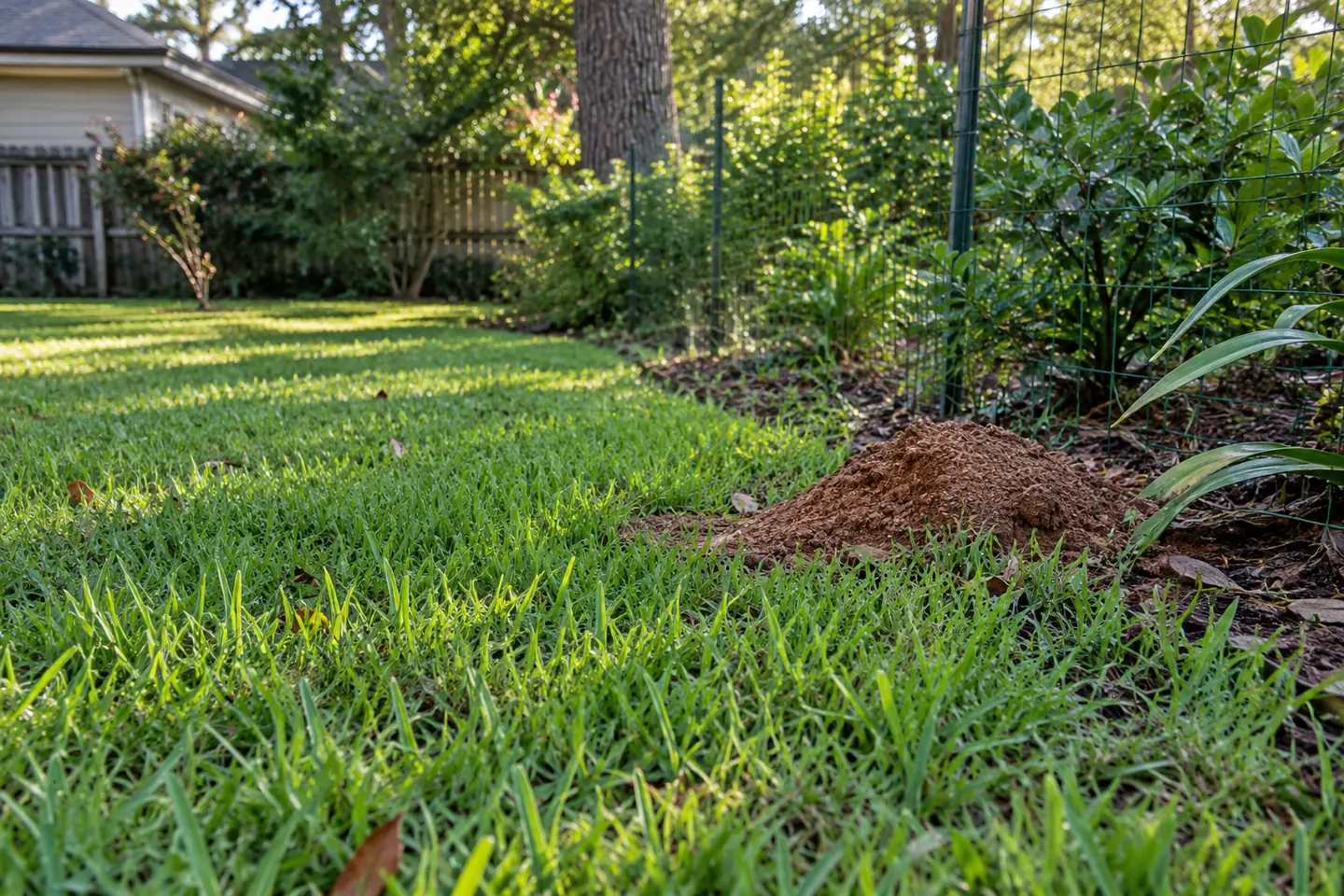
A useful description can be made from a place you already consider accessible. Note whether the soil is raised above the surrounding surface, whether one mound or several are visible and which landmark makes the location recognizable. Avoid probing for an entrance or putting a ruler directly into the soil. You are communicating a work-area concern, not trying to complete an insect examination. If you cannot obtain a clear photograph without approaching, a plain location description is sufficient for the initial discussion.
Do not ask another household member to stand beside the mound as a size reference. Include the nearby fence panel, path edge or planter in the wider image instead. If the camera's perspective makes the dimensions uncertain, say that the image is for location rather than measurement. That honest limitation is much better than a close-up obtained by unnecessary disturbance. The next person needs to know where the concern is, not how close someone was willing to get to it.
Decide whether the usual access route is still part of the request
Look at the proposed route as a whole from an accessible viewpoint. A mound at the only narrow gate may affect the discussion differently from one in an isolated garden corner. Explain whether there is another existing route and what it involves. Do not promise that equipment can use that route simply because a person can walk through it. Happy needs to review the actual access and the requested work before confirming an arrangement.
If no suitable route has been agreed, do not leave the question until the scheduled arrival. Contact Happy with the location and ask how to handle the proposed visit. A possible response might involve changing the scope or reviewing the timing; it should be an explicit agreement, not your assumption. Keep the access concern current if the location changes or another mound is noticed. An old photograph cannot communicate a new issue that appeared near a different entrance.
Keep the grass appearance and the mound observation distinct
A mound can be present beside grass that also looks thin or brown. Record both features, but do not automatically explain the grass color by the presence of ants. LSU's distinction between mound nuisance and direct turf injury is useful here. If the lawn condition itself needs evaluation, give it its own photographs and history. This prevents one visible insect concern from swallowing a separate question about the plants or growing conditions.
For example, describe a pale strip along the walk separately from a raised soil mound at the fence corner. State whether they touch or are several steps apart, using the wider photograph to orient the reviewer. If the grass condition was noticed before the mound, preserve that order in your notes. The sequence does not establish cause, but it helps an appropriate professional assess whether your initial explanation fits the available evidence.
Do not turn a maintenance visit into a treatment experiment
An ordinary lawn request does not authorize anyone to apply an insect-control product, pour a household mixture on a mound or disturb it with equipment. Those actions are outside Happy Grass's ordinary maintenance scope. If you want pest management, discuss it with a professional who offers that service. Ask that person how any proposed work affects access and timing, rather than expecting a lawn provider to infer the answer from an unlabeled container or a verbal guess.
If someone has already treated an area, obtain the actual instructions relevant to people entering or work taking place there. Share the necessary restrictions with Happy before arranging access. Do not invent a waiting period or assume that a dry surface establishes permission to resume activity. The relevant product directions and the responsible professional's guidance should answer that question. This page does not select a product, give an application rate or provide a return-to-area timetable.
Make a location update that survives a busy day
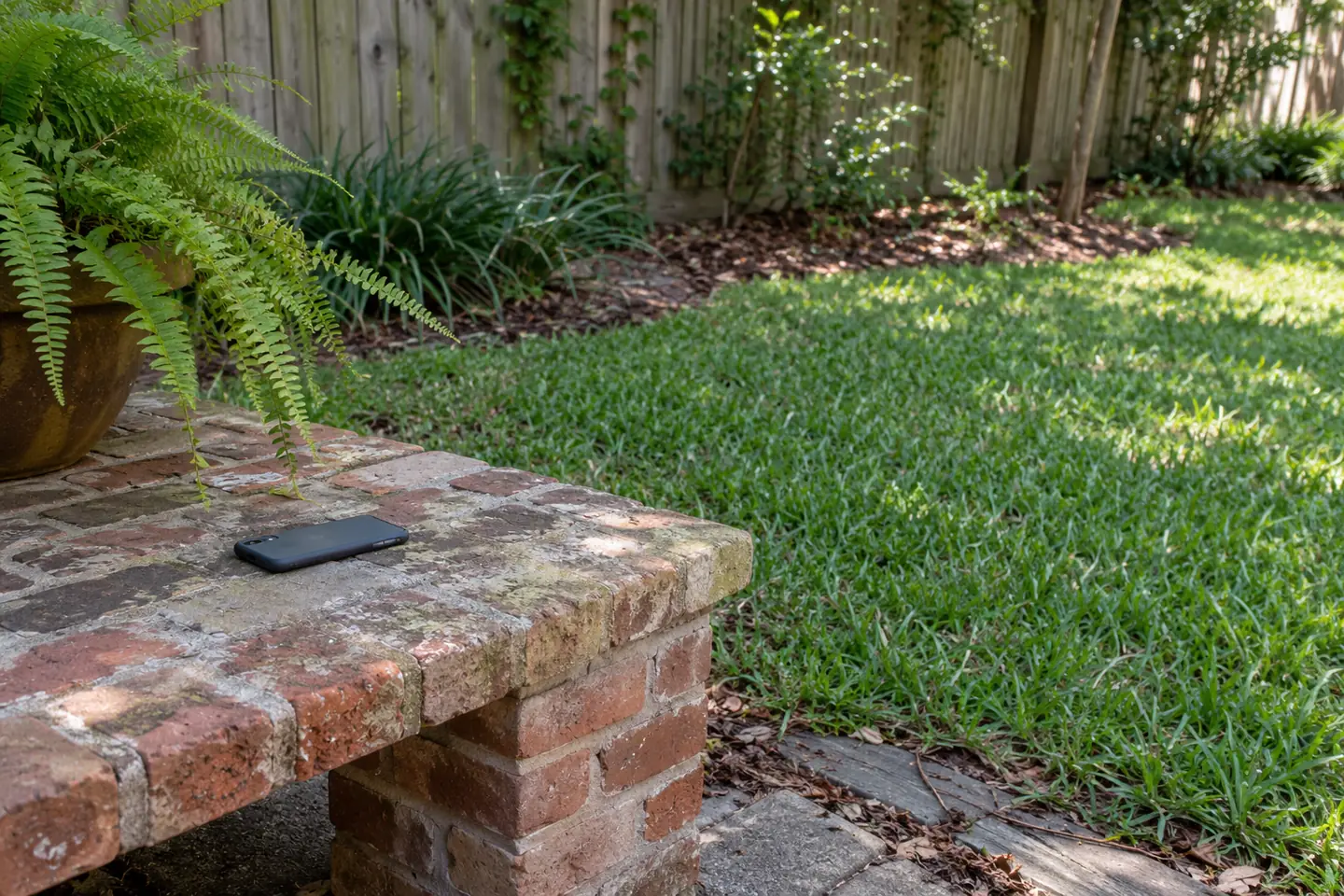
A concise private message might identify the gate, the border side and whether the usual path is affected. Add the date of the photograph and state the action you are requesting, such as reviewing access before the next lawn visit. Avoid sending only a close image with no message. It may be obvious to you which part of the yard it shows, but Happy should not have to match an anonymous patch of soil to the entire property.
Keep household instructions consistent with the maintenance request. If one person asks for an area to be avoided and another later describes the whole yard as ready, resolve the difference before the visit. A single contact can collect the location notes and relay the agreed scope. This is particularly useful for a rental or shared property where the person arranging the work may not be the person who first noticed the mound. Clear responsibility prevents a warning from getting lost between conversations.
Review the situation before saying the area is ready
If a pest professional evaluates the site, ask what has actually been established and what conditions affect the maintenance visit. Keep the finding separate from your own visual impression afterward. A mound looking flatter or less obvious does not by itself tell Happy that access has been cleared. Communicate the relevant guidance and arrange a fresh review of the work area when needed. A changed appearance should produce an updated description, not an unsupported guarantee.
Also check whether the location of the requested lawn work has changed. If the back section was excluded while the concern was addressed, confirm whether you now want that section discussed again. Do not assume the earlier exclusion automatically expires. A maintenance agreement should have a clear current scope. That small piece of communication can save a second round of confusion after the insect issue has already taken time and attention to resolve.
Keep a location inventory when several mounds are reported
For a property with more than one reported mound, use a simple list rather than a single warning about the whole yard. Each entry can name the nearest landmark, the observation date and whether the usual maintenance route passes nearby. You do not need to inspect or measure the mound to make that list. Mark uncertain reports as uncertain, especially if they came from someone who was not at the property recently. The list should communicate the information available, not imply a completed pest survey.
Update an existing entry when there is a genuine new observation at the same location. Create a separate entry for a different place. This keeps a later reader from assuming that one mound moved across the yard or that a cleared access discussion applies to every reported location. Give the appropriate pest provider the relevant record, and give Happy the current access information needed for the proposed lawn work.
Ask Happy about a workable maintenance plan
Reach Happy Grass at 504-339-3571 and ask for Happy. Explain the suspected mound's location and the mowing, edging, weed-eating or blowing work you want reviewed. Happy Grass does not identify or treat fire ants. A clear access conversation lets the maintenance request proceed only on the terms actually agreed, while the insect question goes to the appropriate service.
A short record to bring to the conversation
- Leave the suspected mound undisturbed.
- Identify whether the gate route passes the reported location.
- Relay applicable instructions from the responsible pest provider.