
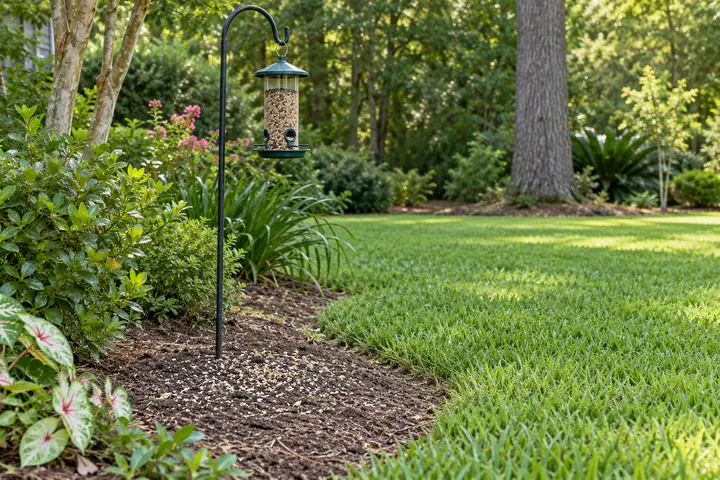
Show the feeder and its ground footprint
Begin with a daylight view of the whole feeding station. Include the support, the feeder's overhang and the ground underneath. Happy Grass needs to see where the lawn ends, where a bed begins and whether there is loose material along that boundary. A close photograph of birds at the feeder can be lovely without showing any of the features relevant to a mowing visit.
Describe whether the feeder hangs from a branch, stands on a pole or sits on a separate structure. Identify trays, braces or other parts that extend beyond the obvious support. Do not assume a slim pole creates a negligible obstacle. The available travel space and the condition of the surface below it determine what can be reviewed for routine maintenance. A useful request makes the feeding corner understandable as part of the yard, with reachable grass and any restrictions shown together rather than hidden behind a description of the feeder alone.
Distinguish seed hulls from unknown debris
West Virginia University Extension notes that some seed mixtures can result in spilled material below feeders. That is a reason to look at what is on the surface, not a diagnosis of every small object beneath your feeding station. The area may also contain stones, broken feeder pieces, garden ties or other household debris. Do not describe an unknown mixed layer simply as seed and assume ordinary mowing will deal with it.
Take a ground-level view from an accessible edge so the texture and distribution are visible. If you know a tray broke or a support was repaired, explain that history. Arrange appropriate cleanup of sharp or unfamiliar material before including the section in a mowing route. Happy should not be asked to use equipment to discover what is hidden in a deposit. Keep any special collection or cleanup expectation separate from the ordinary lawn-cutting quote; an accumulation that predates the visit needs to be understood as an existing property condition.
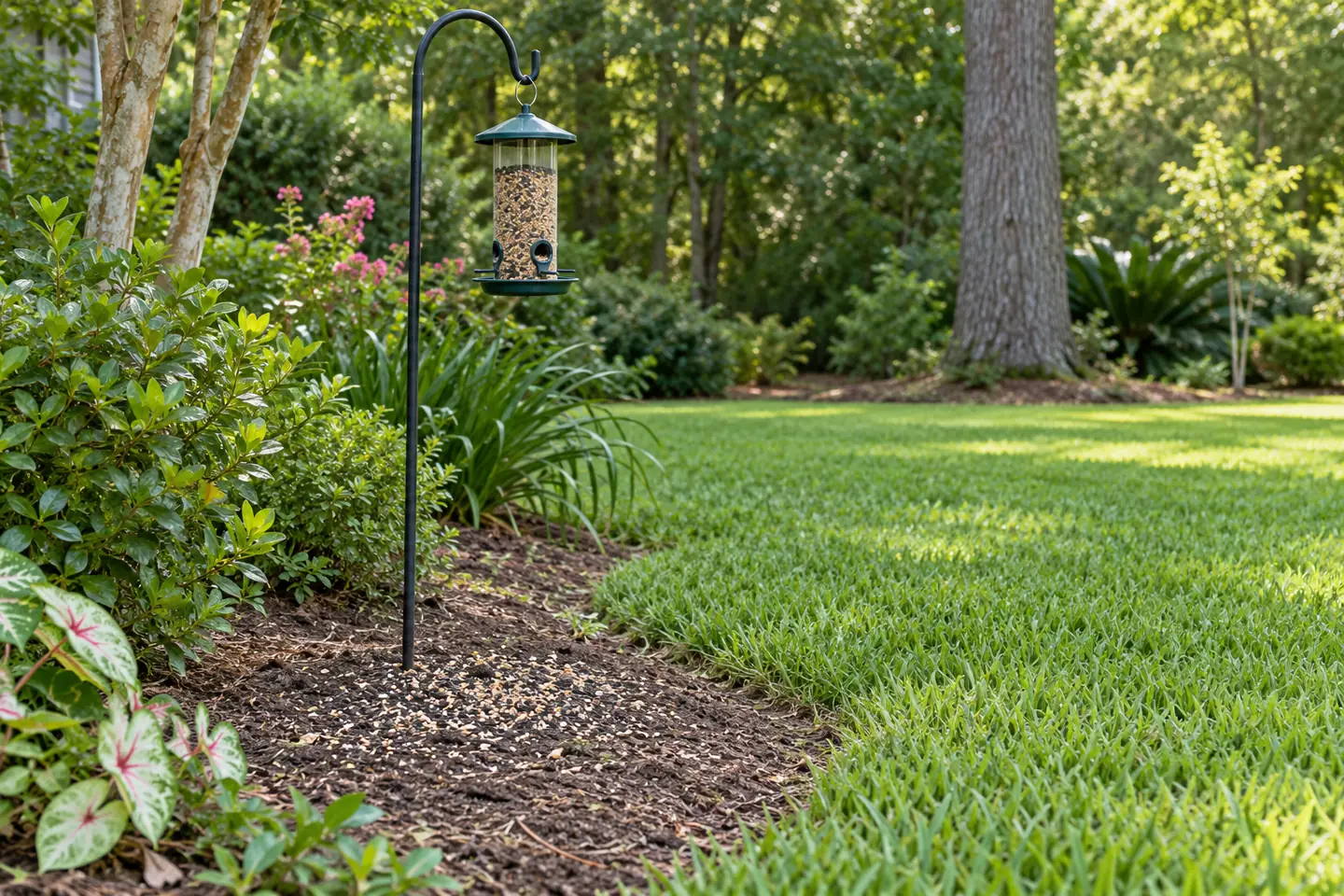
Map the support without moving it by guesswork
An installed feeder support may have a buried base, a visible foot, a brace or a separate hook. Show the parts you can see without pulling at the assembly. If the owner intends to remove a genuinely portable piece, confirm what will remain in the lawn afterward. A pole taken away can still leave a socket or support that needs to stay outside the cutting path.
Do not assume the crew will dismantle a feeder, handle its contents or reposition a hanging assembly. If the support is leaning, loose or otherwise uncertain, identify the condition and arrange the appropriate review. A lawn visit is not an inspection of the feeding structure. The practical maintenance conversation can establish a margin around a stable, understood feature while leaving repairs and changes to the person responsible for it. That keeps the request specific and avoids treating every piece of small garden equipment as an interchangeable object that can be moved anywhere.
Describe the grass independently of the feeding activity
Look at what is actually growing beneath and around the feeder. Is it dense lawn, sparse turf, exposed soil or a planted bed? Do not assume a patch is lawn simply because it lies inside the overall yard boundary. If the owner has deliberately left a bed beneath the station, show its intended edge and identify plants that must remain.
Where grass is thin or mixed with unfamiliar growth, take a closer picture before requesting cutting. A feeder's presence does not establish the cause of a change in the plants below it. Avoid asking Happy to identify every seedling or treat a growth problem as part of routine mowing. The visit can maintain agreed grass without promising that the feeding footprint will become identical to an open sunny lawn. A clear description of the existing surface helps separate an achievable cutting finish from a different garden or ground-cover project that needs its own decision.
Consider the path used to refill the feeder
The household route to a feeder may be as relevant as the pole itself. Tell Happy about a narrow path between plants, a worn grass strip or a damp spot that lies on the only approach to another lawn section. Frequent household use can change how the canopy looks, but a service note should record observations rather than guess at a cause or promise a repair through mowing.
Keep refill containers and other supplies outside the equipment route before the visit. Do not move a seed bucket from beneath the feeder into the gate passage and call the area prepared. If someone else handles feeding, confirm that they know the proposed maintenance arrangement. A routine that changes after your photograph was taken can leave belongings in an area the crew expected to find clear. The aim is a dependable current layout, with the feeding task and the lawn visit coordinated enough that neither depends on the other person improvising a storage location.
Agree how close the finish should be
A feeder beside a bed may allow a clear lawn boundary. A feeder standing within grass can leave a smaller ring that needs a more individual discussion. Ask Happy to review the appropriate margin around the actual support and the material at its base. Do not request a universal tight clearance based on this guide or assume every blade touching a brace can be reached the same way as open turf.
Explain whether ordinary blowing is requested near the station and what surfaces are included. Moving loose material toward the feeder, into planted beds or onto neighboring property is not a substitute for an agreed cleanup plan. If an old deposit needs special attention, describe it before the quote is confirmed. The distinction between maintaining the grass around the station and cleaning the feeding area itself should be visible in the scope. A neat lawn edge can be a useful result without making an undefined promise to collect every seed hull beneath a hanging tray.
Keep wildlife questions separate from the mowing quote
If the feeding area has an active wildlife concern or unfamiliar animal activity, seek guidance from the appropriate source and let Happy know about any resulting restriction. Do not ask the lawn crew to disturb animals or make assumptions about a nest or occupied feature. This guide does not identify wildlife, set feeding practices or offer pest-control work.
For routine coordination, a short preparation list is useful:
- Show the full support and visible ground fittings.
- Identify the intended grass or bed boundary.
- Remove ordinary portable refill supplies from access routes.
- Explain any material, structural concern or wildlife restriction requiring separate review.
Keep the information current when the station changes. A new tray, relocated support or different planted border can alter the working space even if the owner still calls it the same feeder corner. An updated wide picture is often enough to prevent the next visit from relying on an arrangement that no longer exists.
Request maintenance of a clearly described corner
Send the wide station view, a surface picture and a note explaining what stays in place. Identify any accumulation that was present before the proposed visit, and ask whether the reachable grass can be included under the ordinary scope. If another entrance reaches the back lawn without passing the station, show that route too. Access can be reviewed more usefully when alternatives are visible.
After service, photograph any concern before refilling or rearranging the station. Explain what changed between the earlier view and the new one. A fresh layer of material after feeding is not the same condition as the surface immediately following the lawn visit. Call 504-339-3571 and ask for Happy to discuss the yard. With the structure, ground material and intended boundary described honestly, the feeding corner can fit into a realistic maintenance plan without turning a mowing request into an assumed cleanup, wildlife or installation service.
Name the ground area independently of the feeder
Give the grass beneath and around the feeder a location label that still makes sense if the feeder is moved. Include the support and the route used to refill it in a wide view. This helps distinguish a maintenance question about the lawn from a separate question about feeding activity or wildlife.
If the owner changes the setup, update the lawn note with what actually moved and what remains fixed. A hanging feeder being removed does not necessarily mean its support, base or nearby accessories are gone. Keep any accumulated material described by appearance rather than assuming every loose piece has the same origin. The practical question for Happy is the accessible grass and the agreed finish around a visible feature, with bird care and other habitat decisions left outside the mowing scope.