
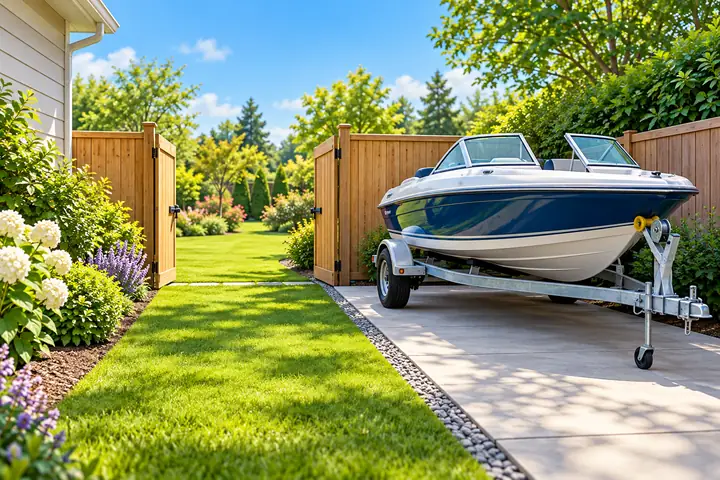
Record the full parked footprint
Take a wide side view showing the boat or utility trailer, tow tongue, coupler, safety chains, jack, wheels and adjacent lawn. The tongue can extend far beyond the body and control the real turning space.
Happy Grass does not tow, roll, hitch, unhitch, stabilize or inspect trailers. The owner remains responsible for parking, transport and equipment condition.
Keep the trailer on the agreed surface
Choose a paved, gravel or other owner-approved position and define where that surface meets turf. Do not leave one wheel or the tongue jack on grass if the recurring plan assumes a clear lawn strip.
The property contact should place the trailer before service. A lawn crew should not move it a few feet and guess whether brakes, chocks or supports were restored correctly.
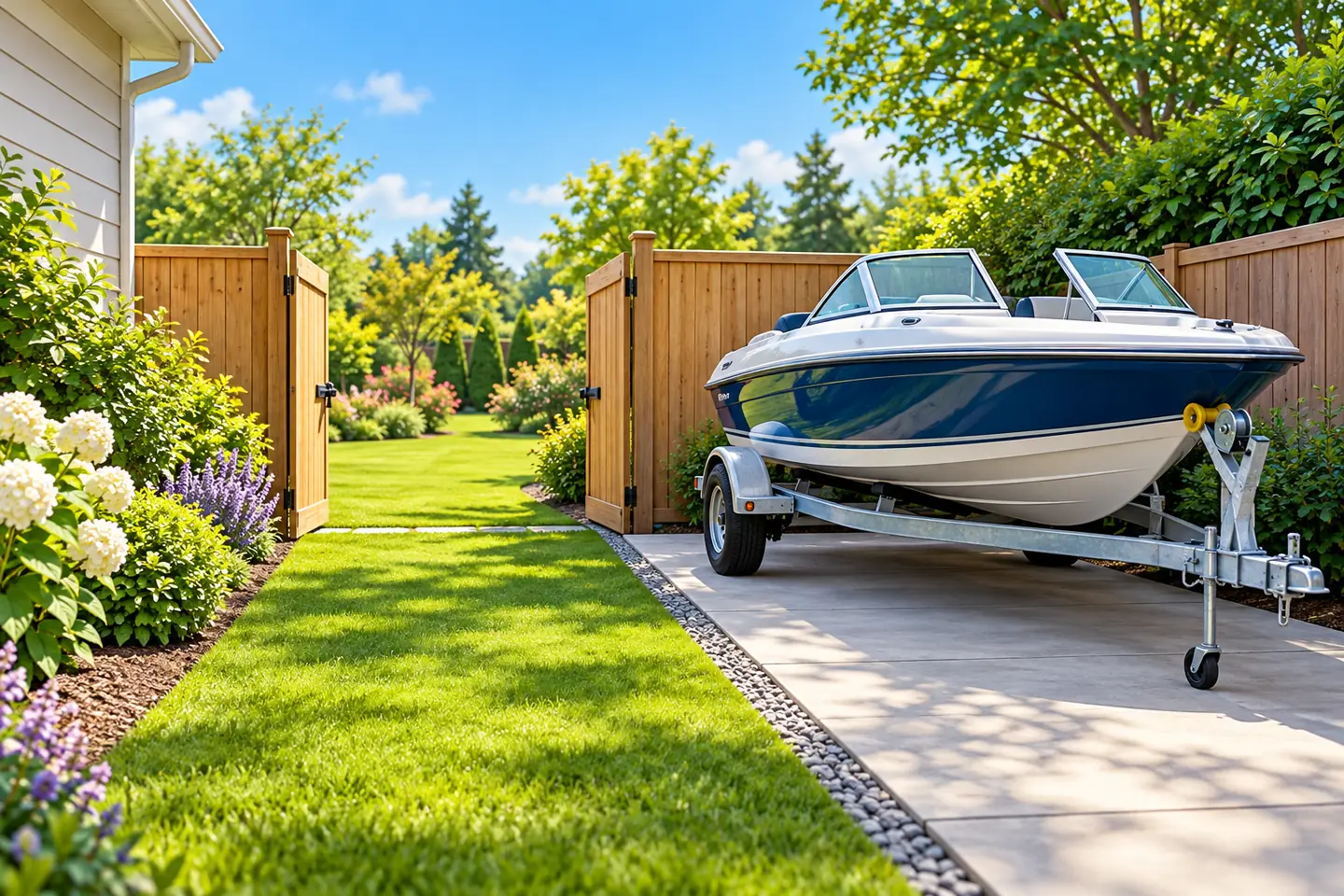
Include the tongue and chains
Mark the entire tow assembly, not just the axle. Low chains, wiring plugs and a jack wheel can disappear in tall grass or lie across the route.
Keep powered equipment outside that footprint. Do not lift a chain onto the frame or wrap a cable around the coupler for convenience.
Show wheel chocks and supports
Photograph blocks, stands, chocks and stabilizers that remain in place. Their shapes and positions matter even when the trailer body is high above the lawn.
Never remove or reposition support equipment. If the grass around it cannot be reached visibly, define a protected leave-alone pocket.
Clear straps, covers and loose gear
Secure boat covers, tie-down tails, ropes, nets and tarps so wind cannot carry them into the grass lane. Store coolers, paddles, tools and cargo away from the gate.
The owner should handle marine and hauling equipment. Mowing-day readiness should not ask a lawn crew to sort or touch expensive property.
Map the gate swing
Open the gate and confirm that it clears the trailer, tongue and lawn route. A parked unit may leave enough straight width while preventing the gate from reaching its safe open position.
Do not rest the gate on the boat, trailer or utility gear. If the normal entrance cannot open, reschedule or use another previously approved route.
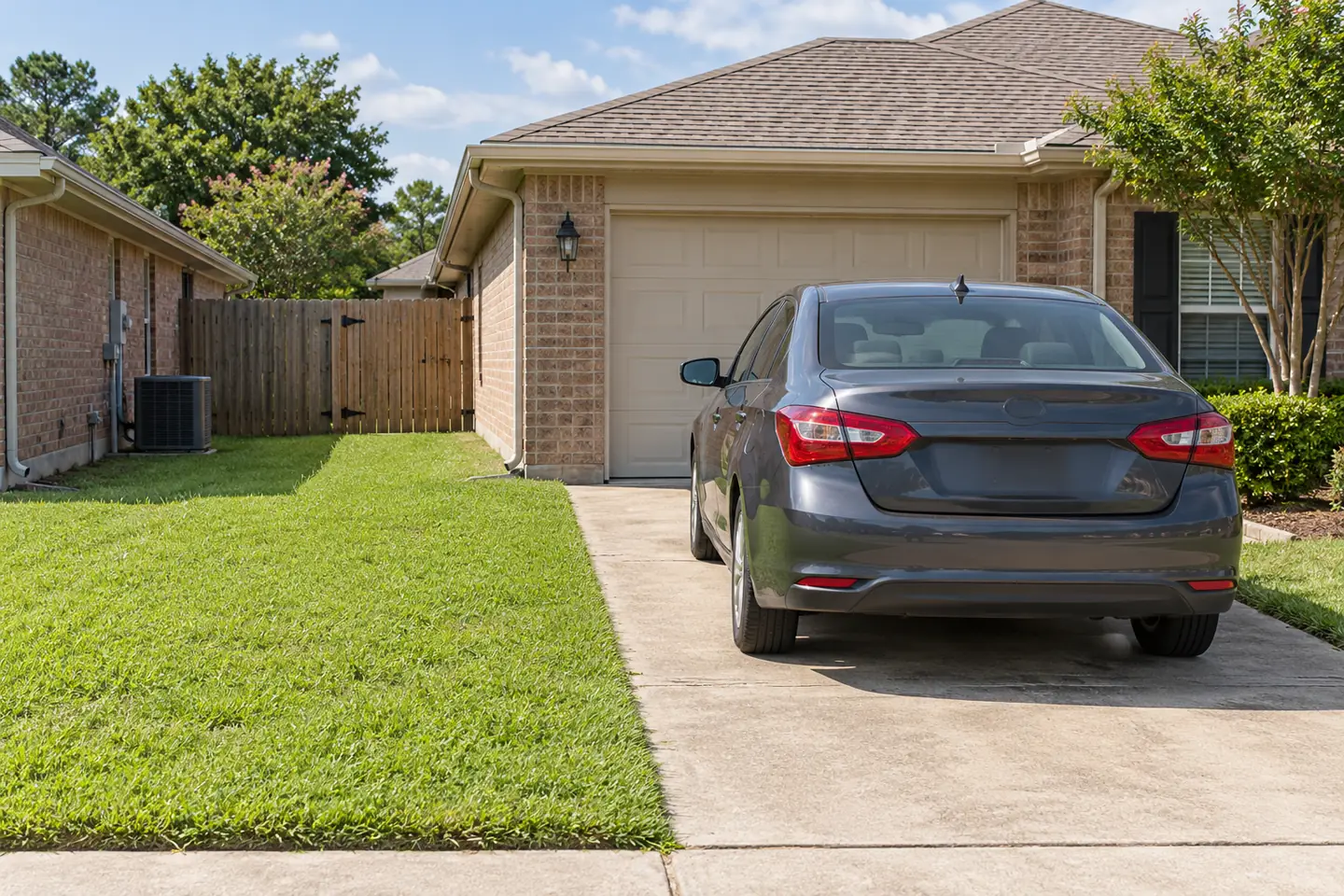
Protect license and identification details
Planning photos need the physical footprint, not readable plates, registration numbers, serial labels or private property identifiers. Choose angles that document access while respecting privacy.
Replace photos when the trailer type or parking direction changes. An old image of a short utility trailer should not control access around a longer boat.
Separate vehicle movement from lawn work
No one should hitch, back or reposition the trailer while lawn equipment is active nearby. Coordinate the parking window so the unit is settled before the visit begins.
If movement becomes necessary, stop and clear the lawn equipment first. A deliberate handoff prevents a rushed conflict between two operating zones.
Define the grass strip by reach
Name the open yard, trailer-side strip, tongue pocket and gate turn. Some grass may accept normal mowing while a narrow area between wheel and fence remains excluded.
Do not promise to reach beneath an axle or boat hull. Poor visibility, sharp hardware and stored gear make that space unsuitable even when grass is present.
Keep clippings away from equipment
Direct fresh lawn residue away from bearings, brakes, vents, covers and boat interiors. Do not use a blower to clean a trailer or force debris from beneath it.
Existing oil, grease, leaves and cargo debris are owner cleanup. The routine finish covers named lawn and paved surfaces only.
Read soft ground at the pad edge
Trailer tires, runoff and shade can make the adjacent turf softer than the main yard. Observe firmness along the wheel-side strip and gate turn.
Skip wet grass rather than rutting near a parked vehicle. Drainage and surface repair are separate property projects.
Recover a former parking footprint
If a trailer moves after months in one place, inspect the old area for blocks, wire, straps, glass, spilled material and compressed soil. Do not assume it is immediately mowable.
Manage visible living growth conservatively. Ordinary mowing does not restore compacted soil or replace dead turf, and Happy Grass does not provide overseeding.
Check overhead and side projections
Boat towers, guide posts, mirrors, ladders and cargo may project beyond the trailer body. Walk the route at eye level and include every extension in the no-contact footprint.
Do not fold or remove a projection to create access. The owner should place equipment in its service-ready configuration before the crew arrives.
Plan for maintenance days
Trailer repair, boat washing and loading can add jacks, cords, water hoses, tools and wet surfaces. Pause the neighboring lawn until the owner confirms the activity is complete.
Mechanical cleanup, washing and haul-away are not routine lawn tasks. Request a fresh map if new supports or storage racks change the position.
Use weather and storm plans carefully
Storm preparation may relocate a boat, add straps or temporarily block the gate. Treat that arrangement as a temporary exclusion rather than continuing the normal route around new tie-downs.
Resume only after the owner restores a stable position and provides a current access photo. Happy Grass does not determine storm storage or trailer security.
Follow a trailer-side checklist
Confirm the unit is parked and secured by the owner, tongue and chains are visible, loose gear is stored, the gate opens fully and the grass lane is firm.
This checklist is about lawn access. It does not certify towing readiness, supports, brakes or boat condition.
Write the quote without transport duties
List open-lawn mowing, reachable trailer-side trimming, approved hard edges and named paved surfaces for routine blowing. Exclude moving the unit, touching supports, cargo handling, mechanical work and blocked undercarriage areas.
Happy Grass does not provide fertilization, aeration, overseeding or pest control. Worn grass beneath an old parking spot should not be mistaken for an included turf-renovation service.
Ask Happy about the parked position
For a boat or trailer yard in Harvey, Marrero, Gretna, Algiers, Belle Chasse or Westwego, call 504-339-3571 and ask for Happy. Share privacy-conscious side views and the gate plan.
A repeatable paved position can protect valuable equipment, keep the entrance usable and give accessible lawn a dependable finish without asking anyone to move a trailer during service.
Keep drainage plugs and equipment owner-managed
Boat plugs, battery leads and washdown hoses may be handled during storage routines. They should never be adjusted by a lawn crew or left across the grass route.
The owner should complete those tasks before service and remove loose accessories. A visible hose or cable makes the neighboring strip temporarily unavailable.
Protect the public-side approach
A tongue near the sidewalk or driveway apron can affect pedestrians and vehicle sight lines. The property owner remains responsible for lawful parking and a safe public route.
Lawn equipment should stay on the authorized property path. Do not work from the street or route around a trailer through neighboring space.
Review different trailer configurations
Folded ramps, raised tailgates and removable guide posts change the footprint. Record the exact visit-day configuration rather than relying on the model’s nominal dimensions.
If cargo or a boat extends beyond the photographed outline, pause the affected grass. Update the map after the owner restores a repeatable arrangement.
Keep tires and turf visually separate
Grass can grow against a pad edge and hide whether a tire is truly on pavement. The owner should make the surface boundary visible before the visit without asking the crew to inspect tire loading.
Do not trim beneath a sidewall or around a jack under tension. Maintain only the clear outer grass line.
Plan around trailer doors and ramps
Enclosed utility trailers may have side doors or rear ramps that swing over turf. Record their complete open area even when they are normally closed.
The owner should secure doors in the agreed visit-day position. Lawn service should never unlatch a ramp or work beneath an open panel.
Separate washing from mowing
Boat or trailer washing can leave hoses, cords, soap and wet pavement across the route. Finish and clear the wash activity before lawn equipment enters.
If runoff softens the adjacent grass, skip it. Happy Grass does not rinse equipment or determine where cleaning water should be discharged.
Make the parked arrangement a confirmed fact
Before describing grass around a boat or trailer, confirm where the owner intends it to remain during service. Show the full parked footprint and the authorized path past it. A promise that it will probably be moved later is different from an arrangement that has actually been prepared.
If the position changes before the visit, replace the old route photograph and say which grass areas are newly available or newly blocked. Keep transport, repositioning and equipment handling out of the assumed lawn task. Where access remains uncertain, ask Happy to review the reachable area instead of proposing a shortcut across an unapproved surface. A confirmed parked arrangement gives the quote a real starting point and prevents the same vehicle from being described as both a fixed obstacle and an absent one in different messages.