
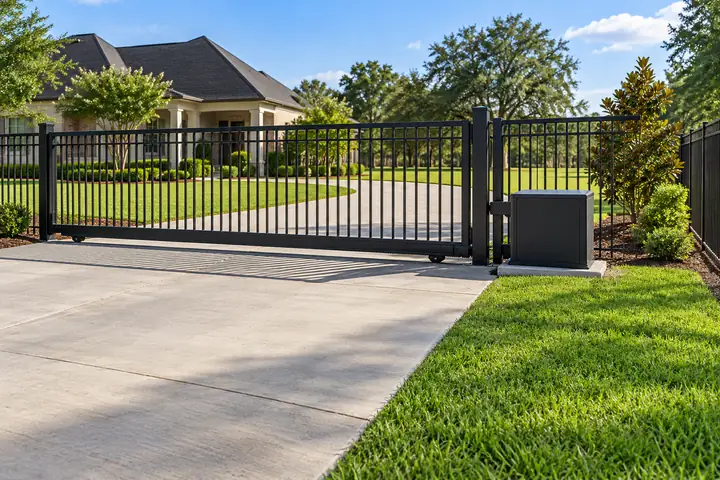
Start with the moving envelope
A sliding gate travels along a fence or rail, while a swinging gate sweeps across a broad arc. That full envelope is different from the opening you see when the gate is parked. Grass, toys and lawn equipment should stay outside every place the gate can move. Before Happy Grass enters, photograph the gate fully closed and fully open only if you can operate it normally and safely. Do not stand in the travel path for the photo. Show the operator cabinet, track, wheels, hinges and grass edge from a distance. Tell us whether the gate will be opened by the owner, a keypad, a remote or a manual procedure. Happy does not service gate mechanisms or test safety devices. We need a safe, predictable entry and a lawn boundary that never crosses the moving zone.
Keep grass from becoming part of the mechanism
Tall grass can hide a ground track, wheel path, stop, chain or lower edge. Define a no-service strip around moving hardware rather than expecting a mower to pass beneath or behind it. A narrow planted or mulched boundary may be appropriate where the property design allows, but installation decisions belong to the gate professional and owner. Do not use loose gravel, landscape timbers or temporary bricks where the gate could strike them. Happy can trim conservatively near a visible fixed edge; we will not place tools inside the mechanism or use the gate as a trimmer backstop. If the finish requires reaching through moving parts, the scope needs to change.
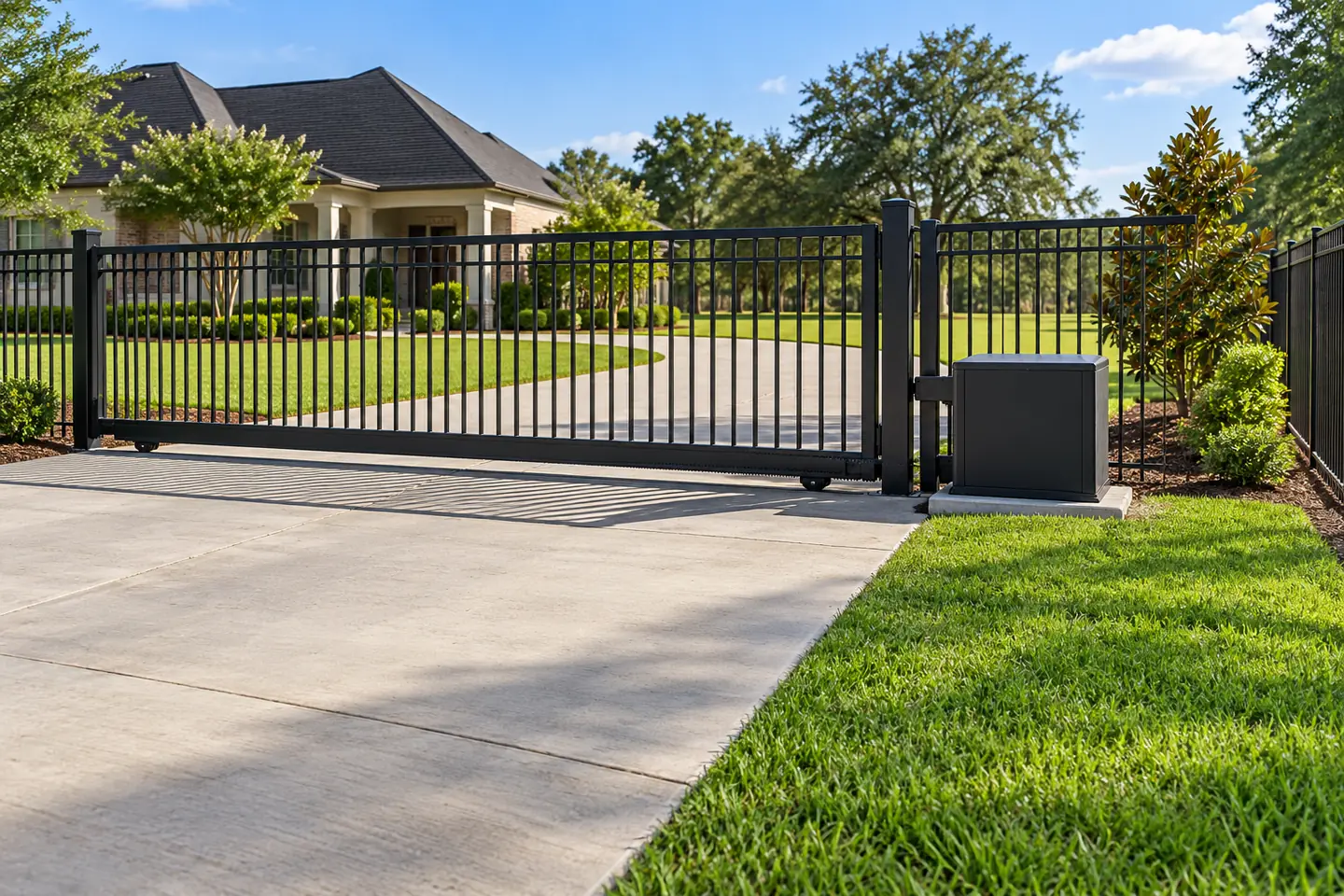
Protect the operator cabinet and controls
Automatic gate operators may include a cabinet, arm, chain drive, control post, photo sensors and buried or low-voltage wiring. Keep the enclosure closed and the surrounding grass route clear. Do not store fertilizer, hoses, toys or hand tools against it. If the cover is open, damaged or missing, close the area and contact the appropriate gate professional. Happy does not reset controls, open cabinets, bypass sensors or move wiring. The CPSC materials cited below discuss gate-operator safety standards; that is a useful reminder that this equipment has a safety purpose beyond ordinary yard access. A lawn visit should never interfere with those systems.
Decide who controls entry
Give Happy one reliable access method that does not require sharing more security information than necessary. The owner can open the gate before arrival, provide an approved temporary code through the agreed business channel or meet the crew. Do not place a remote under a planter or send permanent household credentials in a public note. Explain whether the gate closes automatically and how long the opening remains available. If access fails, the crew should not climb the fence, force the gate or troubleshoot the operator. A clear access plan protects security and prevents a scheduled visit from becoming a gate-repair exercise.
Test the lawn route outside the gate path
When the gate is safely stationary and under the owner's control, walk the grass route that remains outside its travel area. Look for narrow points near posts, curbs, drainage inlets and parked vehicles. Sliding gates often create a long strip beside the fence that appears mowable when the gate is closed but becomes occupied when it opens. Swing gates can cover lawn on both sides of the hinge. Identify those areas as fixed exclusions or plan service only when the gate is secured in the position approved by the owner and manufacturer. Happy will not wedge or tie a powered gate open.
Remove temporary obstacles before arrival
Trash carts, delivery boxes, bicycles, trailers and parked vehicles can block the gate even when the lawn itself is clear. Move them early enough that the gate can complete its normal cycle without contact. Keep pet leashes and extension cords away from tracks and hinges. Remove sticks and loose landscape rock from the wheel path using the property routine while power and safety conditions are appropriate. Do not ask the crew to sweep, repair or realign a track. If storm debris or mud prevents normal operation, update Happy and close the access until the responsible professional addresses it.
Treat unusual movement as a stop sign
Grinding, jerking, incomplete travel, repeated reversing or a gate that will not remain in its normal position are reasons to stop using that entry for lawn service. Do not disable a sensor or ask someone to hold the gate manually while equipment passes. Contact the gate installer or an appropriate professional. If another safe entrance exists, send photos and define the alternate route before arrival. The gate problem may be temporary, but improvising around moving metal creates a risk that does not belong in routine lawn care. Happy can rescope a visit; we cannot certify a gate as safe.
Separate mowing from gate maintenance
Grass clippings and ordinary growth near a gate may be part of lawn maintenance, but lubrication, alignment, welding, electrical repair and sensor adjustment are not. Do not expect blowing to clean internal tracks or cabinets. A conservative exterior finish is possible where surfaces are visible and stationary. The owner remains responsible for the gate's maintenance schedule and inspection. If a professional changes the track, operator or post location, send new photos. The previous mowing boundary should not be assumed to fit the new installation.
Build a quote around real dimensions
For a useful quote, send a broad view of the driveway opening, a side view of the gate fully parked and a photo of the narrowest grass route. Note whether the gate slides or swings, whether it closes automatically and who will provide access. Mention pets, shared driveways and parking patterns that affect entry. You do not need to provide security codes in the quote form. Happy needs the service footprint and arrival process, not the technical programming. If part of the grass lies inside the travel envelope, mark it clearly as excluded or explain the approved safe condition under which it can be reached.
Keep recurring visits predictable
Before each visit, verify normal gate operation, remove obstacles and make the chosen access available. Keep vehicles out of the travel path and tell household members when service is expected. Report repairs, new remotes, code changes or automatic-closing changes before the crew arrives. After service, confirm the gate and lawn boundary look undisturbed. A reliable routine avoids the two bad extremes: leaving a powered gate open without a plan or asking the crew to solve access on the spot. Clear entry and a fixed grass boundary let Happy focus on the lawn.
Account for the full swing and slide zone
A gate needs more than an opening wide enough at one instant. A swinging leaf requires a clear arc, while a sliding gate needs its travel path and receiving area unobstructed. Move bins, hoses, toys and loose landscape material beyond that entire zone. Do not park a vehicle where it forces the gate to stop partway. If grass grows within a slide track or beneath a low gate, identify the reachable lawn boundary without asking Happy to work against moving hardware. The operator's protected entrapment and sensing areas are not lawn staging space. When the complete movement zone remains clear, the owner can operate the gate normally and the crew can use the resulting opening without touching the mechanism.
Set a plan for power or operator failure
An automatic gate may fail because of power loss, battery trouble, storm damage or a control problem. Follow the manufacturer's instructions and use a qualified gate professional for diagnosis. Happy will not use an emergency release, push a powered leaf or bypass a sensor. If the gate cannot be opened by the authorized property contact before arrival, report that access is unavailable and reschedule or limit the visit to reachable lawn. Do not leave a partially released gate where wind or slope can move it. A predictable no-access rule is safer than asking a lawn crew to improvise with security equipment it does not own or service.