
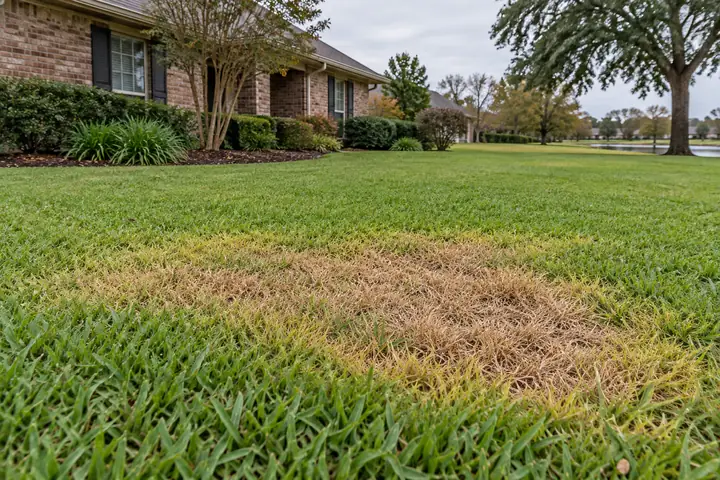
A brown circle is a symptom, not a diagnosis
A discolored area in an otherwise green lawn can be unsettling, particularly when its boundary seems to widen between visits. Large patch is one possible cause in warm-season turf, but a circle alone cannot establish it. The meaningful question combines the grass species, the injured part of the plant, the season and the site's moisture history. Begin with that combination rather than buying a treatment because a photograph on a package resembles the yard from a distance.
LSU AgCenter identifies large patch as a disease affecting warm-season lawns. Its guidance describes irregular or circular patches, thinning turf and injury to the leaf sheath near the soil. That last detail is useful: a lawn is not just a collection of blade tips. Learning which part is affected helps explain why a neat cut may do little to change the patch and why a diagnosis may require more than an overhead photograph.
Why large patch and brown patch are confusing names
Homeowners often use brown patch to mean any brown area. Extension publications use disease names more precisely. The University of Georgia identifies the large-patch pathogen as Rhizoctonia solani AG 2-2 LP and distinguishes it from a different group associated with brown patch on cool-season grasses. You do not need to memorize those letters to maintain a lawn. You do need to avoid assuming that every source using the words brown patch is discussing the same host, season and disease.
When reading a recommendation, check what turf it concerns before considering the advice. An article about summer damage on a cool-season lawn is not automatically a plan for St. Augustinegrass entering a quieter growth period. This is also why a common disease nickname should not replace the actual grass identification in a request for help. Save the publication title and host information alongside its advice so the context is not lost when a short tip is passed along.
Understand the leaf sheath before inspecting the patch
The blade is the flat visible leaf portion. The sheath is the lower portion that wraps around the stem. Large-patch descriptions focus on injury at that lower sheath rather than treating every affected plant as a dead root system. LSU notes that damaged leaves can separate readily from the stem and that the disease does not directly attack roots. These observations help distinguish what to show a diagnostician; they do not turn a casual pull test into laboratory confirmation.
If leaves have already detached, show where they came from and include intact neighboring growth. Do not strip the entire patch to repeat a test or compare only loose blades collected from different parts of the yard. A photograph of one detached brown leaf omits the relationship between blade, sheath and remaining plant. Ask the diagnostic service what material it needs before collecting a sample, especially if another problem could be affecting roots as well.
The edge and center can tell different stories
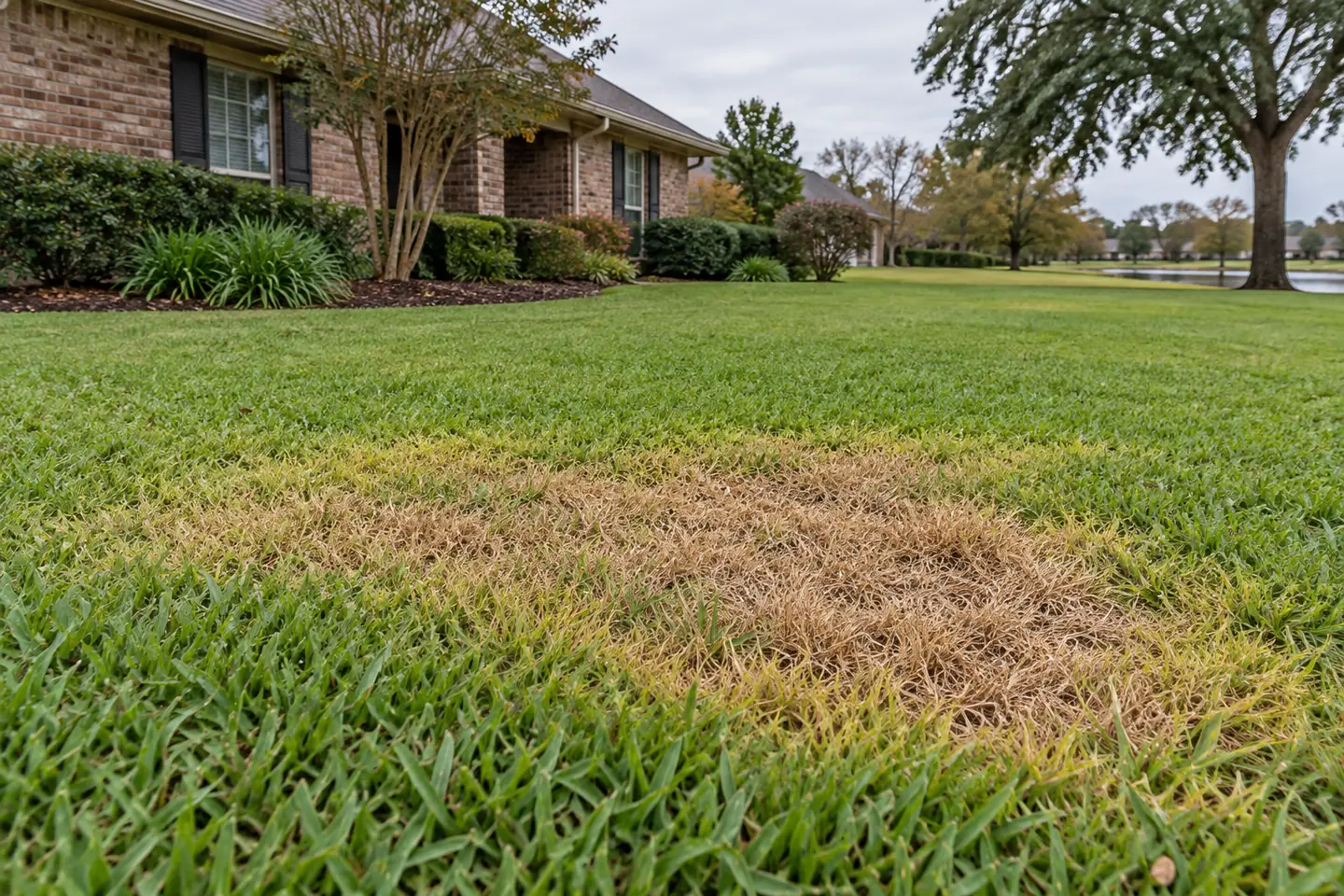
UF/IFAS describes discolored expanding patches whose edges can show active symptoms while the center may contain recovering grass. The practical lesson is to inspect more than the most obviously brown middle. A patch with some green growth inside is not necessarily an all-clear, and a brown center does not by itself show that disease is still expanding. The boundary and the surviving turf need their own observations.
For a useful comparison, choose an affected center, a transition and adjacent apparently healthy turf. Keep their locations distinct. If a sample is requested, follow the diagnostic service's instructions about the appropriate transition material rather than choosing only the oldest dead-looking debris. That choice preserves more of the condition being investigated. Label the location and date clearly; several unlabeled handfuls of grass can erase the very pattern that made the patch worth examining.
Cool, wet conditions can coincide with slow turf growth
Large patch is commonly associated with the spring and fall transitions of warm-season grasses. Georgia's extension bulletin explains how favorable moisture and temperature conditions can coincide with turf entering or leaving dormancy. UF/IFAS likewise discusses the disease during cooler damp periods. This overlap matters because injury may become visible when the desired grass is not growing quickly enough to replace damaged foliage promptly.
Do not turn a regional seasonal pattern into an exact Louisiana treatment date. A Florida calendar is not a property-specific prescription for Harvey or Marrero. The useful observation is the relationship between actual symptoms, recent conditions and the grass's growth stage. Record whether the lawn had slowed, whether the area stayed wet and when the patch was first noticed. Those facts travel better between references than a copied date detached from its climate and host.
Moisture duration matters more than the word wet
Rainfall, dew, irrigation and slow drying can overlap. Describe which events are known rather than writing only that the patch is wet. A lawn watered late in the day presents a different history from one receiving no irrigation during a stretch of damp weather. Shade and restricted air movement may also affect drying. The presence of disease symptoms does not identify a leaking pipe or prove that one recent watering event caused the entire problem.
Keep an irrigation record in practical terms: which zone ran, approximately when it ran and whether rainfall occurred. Do not make large watering changes from the patch color alone. Desired turf still needs appropriate water, and withholding it indiscriminately can add another stress. If the watering arrangement needs assessment, make that a separate question with the appropriate provider. The disease discussion should use observed conditions rather than promise that simply drying the surface will reverse all existing injury.
Disease suppression and visible recovery have different clocks
UF/IFAS explains that managing the disease and waiting for healthy turf to refill injured areas are different parts of the process. Existing brown leaves do not become green just because a pathogen's activity has been reduced. New growth and surviving plant structures determine how the surface changes afterward. This distinction prevents an immediate color comparison from becoming the sole verdict on a management plan.
Agree on the review before work begins. One question concerns whether a mapped boundary is still expanding; another concerns the amount of desired grass growing within the damaged area. The two may change at different rates. Record each separately and use the follow-up guidance supplied by the diagnosing or treating professional. Do not invent a universal recovery deadline from another homeowner's experience, and do not assume summer green-up proves that the underlying recurrence risk has disappeared.
Mowing sequence deserves a specific conversation
LSU's large-patch guidance advises avoiding mowing wet turf, working affected areas last and removing clippings from mowing equipment. These are disease-context recommendations, not proof that a mower introduced a particular patch. If a suspected area is being assessed, identify it before the visit so the mowing sequence and cleanup can be discussed. A person arriving to maintain the grass should not have to infer an unreported disease concern from a faint ring.
Do not ask for repeated lower passes to make discolored tissue blend with surrounding grass. Cutting away the visible contrast is not the same task as addressing a sheath disease, and it may obscure useful symptoms before identification. The maintenance request should preserve the needs of the intended turf while recognizing the affected area. If diagnostic collection is pending, ask whether the necessary plant material should be documented or sampled before the next cut.
Avoid converting general lawn guidance into a fertilizer recipe
Extension references discuss fertility, moisture, thatch and other cultural conditions within larger disease-management programs. Those topics should not be reduced to adding a product whenever a patch appears. The turf species, soil information, recent applications and season all matter. A brown ring cannot tell you which nutrient is missing, whether an earlier application was appropriate or how much of another input should be used.
Keep a factual application history if another provider has treated the lawn. Record actual products and dates from its paperwork rather than guessing from a bag color or a remembered trade name. This history can help a qualified assessment consider interactions and timing. It also avoids duplicate or conflicting work. A lawn-maintenance request should not silently authorize a new disease treatment, and no product should be selected merely to satisfy the desire to do something immediately.
Prepare a useful diagnostic handoff
The strongest handoff combines a whole-area view, a clear transition view, close plant detail and a short history. Include the intended grass if known, the first observation date, whether the boundary changed, irrigation information and previous applications. Keep uncertain items labeled uncertain. A good record does not need to pretend the owner has identified the fungus; it needs to preserve the evidence another person can use.
- Whole area: show the patch shape and its relationship to adjacent turf.
- Transition: show affected and less-affected plants at the same location.
- Plant detail: preserve the blade-to-sheath relationship instead of photographing loose brown fragments alone.
- Timeline: distinguish the first noticed discoloration from later widening or internal green growth.
Ask LSU AgCenter or another appropriate diagnostic service for its current collection and submission instructions. Do not mail random material or assume a soil sample alone answers a leaf-sheath disease question. The service can explain what evidence and sample condition are useful. This step turns a vague patch complaint into a focused assessment while keeping the diagnosis and any treatment decision with the appropriate expertise.
Keep the lawn visit and disease service separate
Happy Grass can discuss the ordinary lawn-maintenance request and the affected area's place in that visit. A disease name in a guide does not establish that Happy Grass offers diagnosis, fungicide treatment or renovation. Fertilization, aeration, overseeding and pest-control services are not offered. Confirm the actual scope before assuming a disease-management program is included with mowing.
For lawn requests in Harvey, Marrero, Gretna, Algiers, Belle Chasse and Westwego, call 504-339-3571 and ask for Happy. Explain the discolored area, any pending assessment and the maintenance result you want. A thoughtful large-patch conversation keeps the grass, the symptom history and the agreed work connected, while allowing an appropriate diagnosis to answer the questions that a freshly cut surface cannot.