
The test name belongs at the start of the conversation
When a lawn stays thin, someone may suggest getting the soil tested. That phrase sounds specific, but it can refer to very different analyses. Before collecting anything, identify the question you want answered and the service that can answer it. A routine soil fertility test is not automatically an examination for plant-parasitic nematodes. Sending a bag under the wrong request can leave you with a perfectly valid report that does not address the concern you meant to investigate.
Begin by speaking with an appropriate Extension contact or the receiving laboratory. Explain the grass condition and ask whether nematode analysis is a suitable next step. Do not use this page to diagnose the lawn from thin growth alone. Its purpose is to help you organize the request so the chosen sample represents an actual area and the result can be connected to that area afterward. Happy Grass does not provide nematode testing or treatment as part of a maintenance visit.
Why location and roots matter to this particular sample
LSU AgCenter's lawn sampling guidance explains that a nematode sample should represent a defined turf area. It advises separating areas with different grass, soil or topography and including roots with the soil mixture. It also emphasizes protecting a collected sample from unsuitable temperature and drying conditions and submitting it promptly. Those principles explain why a random scoop from a convenient bare spot is not an adequate substitute for a planned diagnostic sample.
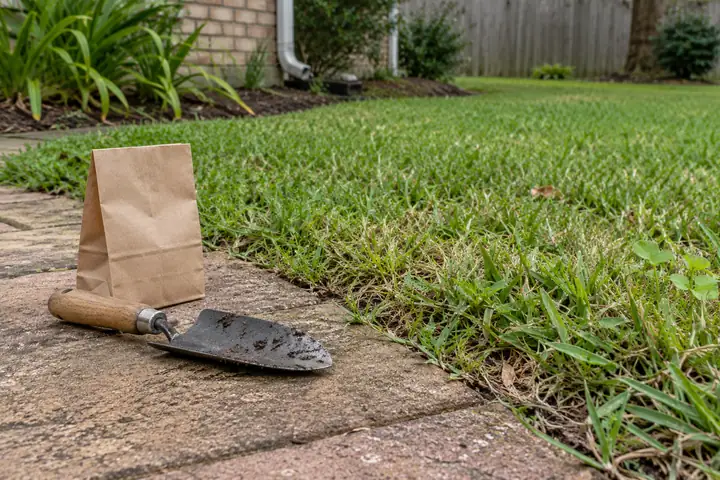
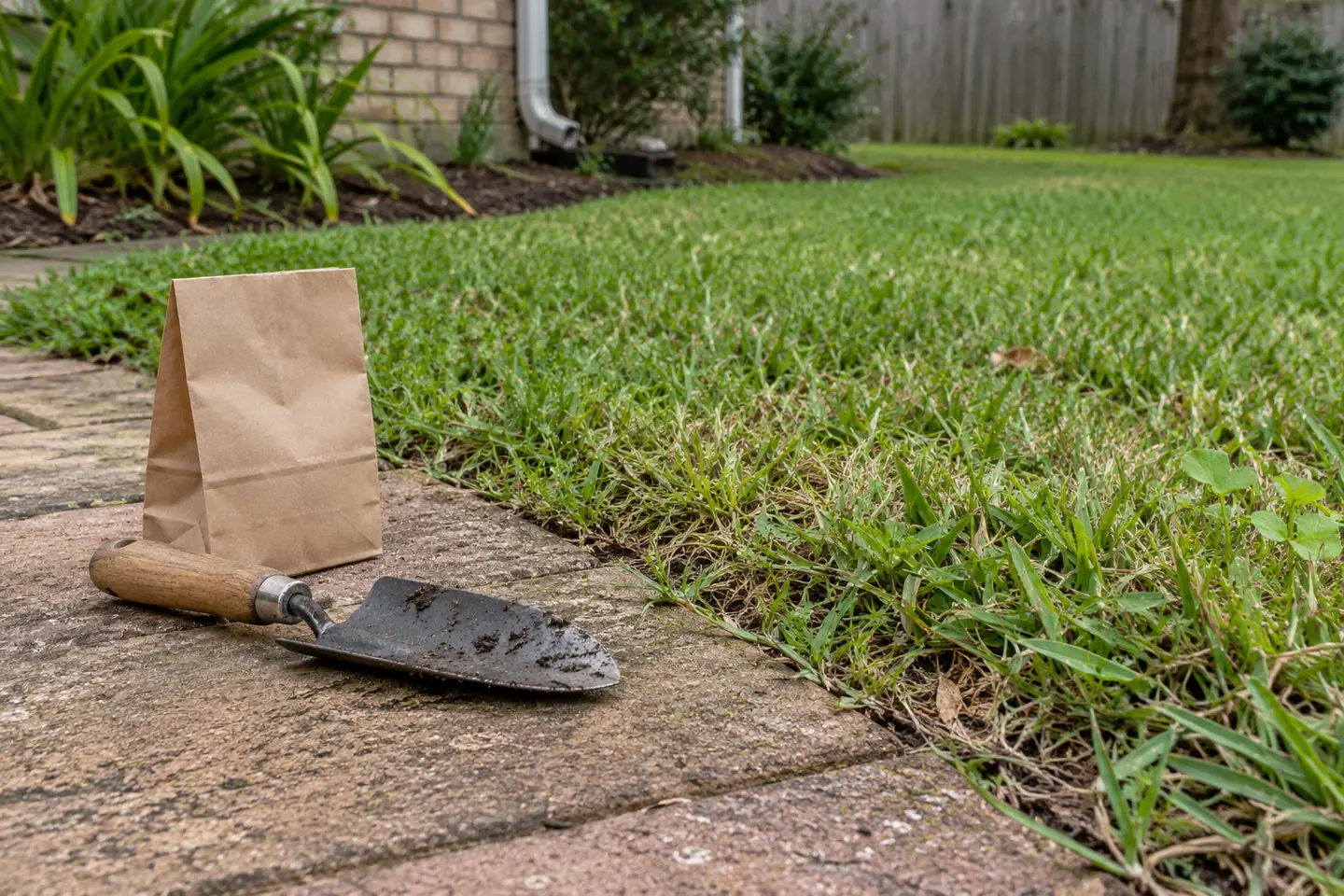
Use the current receiving service's directions for the actual collection depth, number of sampling points, amount, container and handling. This guide deliberately does not reproduce a sampling recipe or an old form's payment details. A generic paper bag and trowel appear in the editorial illustration as a testing-related setting; that image is not a packing instruction for nematode samples. Follow the laboratory's specified container rather than copying the pictured objects.
Define the area before putting anything into a bag
Give the proposed sampling area a simple name, such as rear lawn beyond the patio. Sketch where it begins and ends using stable features. If the front strip and backyard have visibly different settings, do not combine them merely because they belong to one address. Ask the service how those differences should affect the request. A sample label should refer to a real area that you can identify later, not a broad name that hides several unrelated lawn conditions.
Write down why that area was chosen. Perhaps it contains a persistent thin section, or perhaps the professional requested a comparison with denser nearby grass. Record whose instruction you followed. This prevents a later reader from assuming that a comparison sample came from the affected center or that a whole-yard mixture represents a small patch. The value of the result depends partly on knowing what the submitted material actually represented.
Decide who is collecting and who is submitting
For a homeowner, renter or property manager, the person asking the question may not be the person who can reach the yard. Establish those roles before collection. The collector needs the current instructions and the location map. The submitter needs the matching label, form and relevant history. If those responsibilities are split, use the same sample identifier in both conversations. A plain code such as rear-A can work well if its meaning is written down and retained.
Do not assume an ordinary lawn visit includes collecting a diagnostic sample. Ask a qualified service if collection assistance is needed and clarify what that arrangement covers. The maintenance provider should not discover a bag, a loose form and an unspoken expectation on arrival. Keeping responsibility explicit also prevents accidental collection from an area where the property owner did not authorize disturbance. Resolve access and permission for the sampling work with the responsible people before it begins.
Gather history that explains the submitted material
Prepare a short account of the lawn condition: when it was first noticed, whether the affected area is changing and what recent work you can document. Include the grass identification only to the extent you know it. If you are unsure, say that the species is uncertain and ask what evidence could help. A confident but incorrect grass name is not more useful than an honest gap. The laboratory or adviser can decide what additional information is needed.
Keep facts about actual actions separate from interpretations. Record that an irrigation setting changed on a known date rather than reporting that excess water caused the issue. Record replacement turf being installed rather than declaring that a particular organism returned. If you have a prior report, retain its date and sample location. A new analysis can then be considered alongside the earlier one without quietly assuming they represent the same place, test method or question.
Make the label and the map agree
Before sending anything, compare the identifier on the container with the identifier on the form and your private sketch. Check that the date refers to collection, not merely the day you filled out the paperwork. If several samples were collected, give each a distinct entry. Do not rely on remembering which bag was on the left side of a table. A few minutes of careful matching can prevent a result from being assigned to the wrong part of the lawn.
Send personal contact and property information through the laboratory's requested private channel. There is no need to publish a home address, precise coordinates or an identifying photograph to explain the process in a public lawn discussion. Keep the operational map available for the people handling the actual request. A public-facing example can use generic landmarks. The aim is traceability for your sample, not unnecessary disclosure of household details.
Plan handling before collection day
Read the receiving service's instructions in advance so you know what happens after the material is collected. Confirm the submission method and any relevant timing with that service. Do not collect first and leave the sample waiting while you search for the correct form. Ask about transport or delivery arrangements if those are uncertain. A well-labeled sample can still fail to answer the question if its condition is unsuitable when it reaches the people expected to examine it.
If a delay or handling mistake occurs, describe it to the laboratory rather than concealing it. State the actual collection time and the conditions you know, and ask whether the material remains appropriate. Do not attempt an improvised correction by adding water, chilling, heating or repackaging unless the service tells you what to do. A replacement sample may sometimes be the clearer path; that decision belongs with the receiving professional and the actual condition of the material.
Read the report as an answer about a defined sample
When the result arrives, begin by matching its identifier to your map. Then ask the adviser to explain what was detected, what the result means for the submitted grass and what uncertainty remains. A number on a report should not be treated as a universal threshold copied from a different lawn or online chart. The relevant interpretation may depend on the organism, host and sampling context. Let the professional explain those connections before you turn the report into a work order.
Keep the report with the original request and note any follow-up question. If another sample is recommended, ask whether it should represent the same area or a different comparison. Do not assume that a negative or inconclusive finding proves every possible cause has been ruled out. The report answers the analysis actually performed on the material received. A careful next step builds on that answer instead of demanding that one test explain the entire yard.
Keep test records distinct when several reports arrive
A household can receive a soil fertility report, a plant diagnostic reply and a nematode analysis within the same season. Give each document its test name, sample identifier and collection date in the saved record. Do not call them all the soil result. That shorthand can cause someone to cite an acidity measurement as though it answered an organism question, or to assume an insect identification describes the material used for a different analysis. Distinct filenames and a small index help preserve the boundaries between valid but different answers.
If an adviser wants to compare the reports, provide the originals and explain any difference in sample location. A result from the front lawn should not silently be paired with a rear-lawn sample as though both represent one composite. The professional may still find the comparison useful, but should be able to judge it with the correct context. Accurate organization is part of getting value from testing; it does not require the homeowner to interpret the technical results independently.
Connect the finding to maintenance only where it applies
If sampling leaves disturbed ground or an inspection area that should remain untouched, identify it before discussing mowing. Share the maintenance implications that have actually been established, without asking Happy to interpret laboratory counts. For mowing, edging, weed-eating and blowing, call 504-339-3571 and ask for Happy. Nematode analysis and pest-control treatment are separate specialist services, and this guide does not promise that a maintenance change will resolve a diagnostic finding.
A short record to bring to the conversation
- Name the nematode analysis being requested.
- Match every container identifier to its private location map.
- Follow the receiving laboratory’s current handling instructions.