
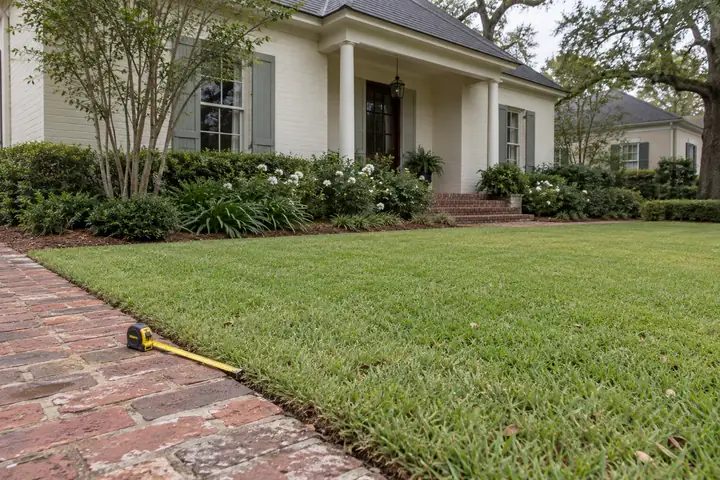
Decide which area the number is supposed to describe
The size of a parcel is not automatically the size of its lawn. A house, driveway, planted beds, patio and other surfaces occupy space inside the property boundary. Begin by naming the purpose of the measurement: the grass footprint, a particular irrigation zone or a defined project area. Those can be different shapes. Sketch the selected boundary before calculating anything. A number is easier to review when another person can see which ground it includes. Do not assume a real-estate listing's lot size answers a lawn-maintenance question. It may describe the parcel correctly while including substantial ground that is never part of the agreed grass-cutting area.
Divide an irregular lawn into simple pieces
A complicated outline becomes easier to estimate when separated into rectangles, triangles and other manageable shapes. Mark each piece on a sketch and give it a name. Avoid overlapping the pieces, because overlap counts the same grass twice. Also check for small strips omitted between the main shapes. The goal is a transparent calculation that can be corrected, not a drawing that looks professional while hiding its assumptions. If a curve is approximated, identify the approximation. A rough but clearly explained estimate can be useful for an initial conversation. A precise-looking total with unexplained boundaries can be much harder to interpret or improve.
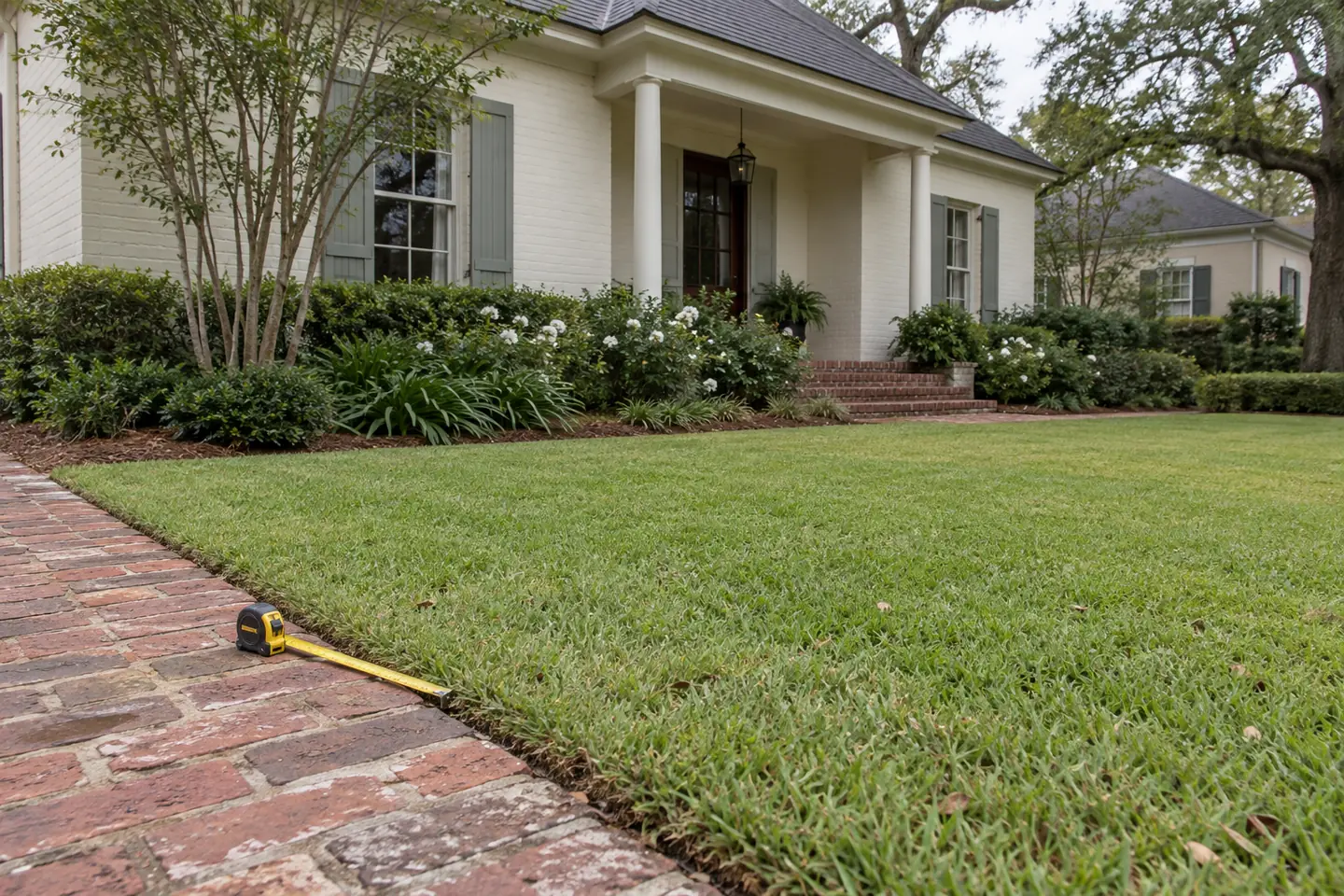
Use consistent units from the first measurement
Record lengths and widths in the same unit before multiplying them. Feet multiplied by feet give square feet; inches mixed into a feet calculation need conversion first. Write the unit beside each dimension so it survives when a sketch is photographed or shared. Do not assume another person knows that one small measurement was taken in inches because it concerned a narrow strip. Keep the raw dimensions as well as the calculated area. If the arithmetic is questioned later, the dimensions show whether the issue came from measurement, conversion or the shape formula. A total without its inputs can force the whole exercise to be repeated.
A rectangle example shows the calculation clearly
Suppose a rectangular grass section is measured as thirty feet long and twenty feet wide. Multiplying those dimensions gives six hundred square feet. This is an arithmetic example, not a measurement of your yard or a service price. If a rectangular bed within that section measures five feet by eight feet and is excluded from the lawn footprint, its forty square feet would be subtracted, leaving five hundred sixty square feet of grass in this simplified layout. The sketch should show that the bed lies inside the original rectangle. A bed outside the rectangle should not be subtracted from it. That small boundary check matters as much as performing the multiplication correctly.
Treat triangles and curves with the same honesty
For a right-triangle-shaped section, one-half of the base multiplied by the perpendicular height gives its area. The height must meet the base at a right angle; an angled edge is not automatically the height. A curved border may need a suitable approximation or a more capable measuring method. State which was used. Do not turn a rough pacing estimate around a curve into a highly specific final total. If a professional needs greater accuracy for an authorized project, they can choose the appropriate measurement method. The household sketch remains useful because it identifies the shape and the uncertainty rather than pretending that every decorative border was measured exactly.
Subtract an excluded surface only once
When several shapes surround the same bed or patio, keep track of whether the original pieces already exclude it. Subtracting the feature again can understate the lawn. One way to avoid confusion is to label each shape as gross area before exclusions or net grass area after exclusions. Use one approach consistently within the final calculation. Add the pieces and check that the resulting footprint matches the sketch visually. If the total seems too large or too small, revisit overlaps and omissions before assuming the measuring tool is wrong. Clear bookkeeping makes a practical estimate reviewable without requiring elaborate software.
Measure safely without turning it into a survey
Use an appropriate measuring method from safe accessible ground. Do not enter traffic, climb a retaining edge or walk into a wet unstable area to complete a dimension. An uncertain boundary can be marked as an estimate or left for professional measurement. Lawn-area calculations do not establish legal property lines, ownership of a roadside strip or permission to maintain shared ground. Resolve those questions separately with the appropriate records and people. A homeowner can estimate a known grass footprint without presenting the sketch as a boundary survey. Keeping that limit explicit helps avoid a small maintenance discussion becoming a claim about land rights the calculation was never intended to settle.
Understand what aerial tools can and cannot add
An aerial measuring tool may help outline a visible area, but image age, tree cover and recent landscape changes can limit what it shows. Compare its outline with the current property and identify sheltered strips that are hard to see. Do not assume a hidden backyard is empty because the image mostly shows a tree canopy. Keep the measurement source and date with the estimate when available. An aerial figure and a ground sketch can complement each other, but neither should be treated as infallible. If they disagree, compare the included boundaries and exclusions before choosing whichever number better fits an expected quote.
Keep area separate from perimeter and access
Square footage describes a surface. Edging involves linear boundaries, and access involves routes, gates, obstacles and other conditions. Two lawns with similar grass area can have very different lengths of sidewalk edge or very different entry constraints. Do not use an area estimate alone to decide what every part of a maintenance visit should cost or include. Save the relevant perimeter descriptions and access photographs separately. A narrow side strip can be a small area with a long border. A large open rectangle can have a simpler route than several smaller enclosed spaces. The estimate helps describe the yard while those other details explain work that square footage does not capture.
Check a whole layout with a second simple calculation
Consider a hypothetical front lawn divided into two non-overlapping rectangles, each with its own saved dimensions. Add their net grass areas, then compare the combined outline with the broad rectangular envelope around them. The difference should correspond to the excluded house approach, beds or other non-grass pieces visible on the sketch. This is a reasonableness check rather than a new measurement. If the total exceeds an envelope that visibly contains every selected grass section, revisit overlap and arithmetic. If a narrow strip disappears from both calculations, add it explicitly instead of hiding it in a rounded total. This check helps find mistakes while the layout is still fresh in your mind.
Match the precision of the total to the inputs
Measurements rounded to the nearest foot do not support a claim that the finished lawn area is accurate to a tiny fraction of a square foot. Keep an estimated total appropriately described as estimated, even when a calculator displays many decimal places. The raw dimensions and sketch allow a provider to judge whether the estimate is sufficient for the conversation or needs refinement. Useful accuracy comes from a suitable measuring method and clear boundaries, not from copying every digit on a screen.
Share a calculation that can be checked
Send the purpose, sketch, included sections, excluded surfaces, raw dimensions and any approximations. A short explanation can prevent a total from being mistaken for a professional site assessment or a guaranteed quote basis. If only the front lawn is included, say so before adding a backyard photograph. If one strip is shared or its scope is unresolved, leave that question visible rather than quietly including it. A homeowner in Marrero can give Happy a useful starting point with this information and current photographs. The final maintenance scope can then be discussed against the actual yard, rather than inferred from a single number detached from its boundaries.
- Name the footprint being measured and its purpose.
- Divide it into non-overlapping shapes with saved dimensions.
- Convert units before calculating and retain the arithmetic.
- Show excluded beds, paving and uncertain curved boundaries.
- Describe edging length, access and unresolved scope separately.
Let Happy review the whole yard request
Use your estimate to explain the grass area, then share the access and finishing work you want considered. Ask Happy Grass about available mowing, edging, trimming and blow-off work at 504-339-3571. A household area estimate is not a survey, a price promise or an agreement covering ground not yet discussed.