
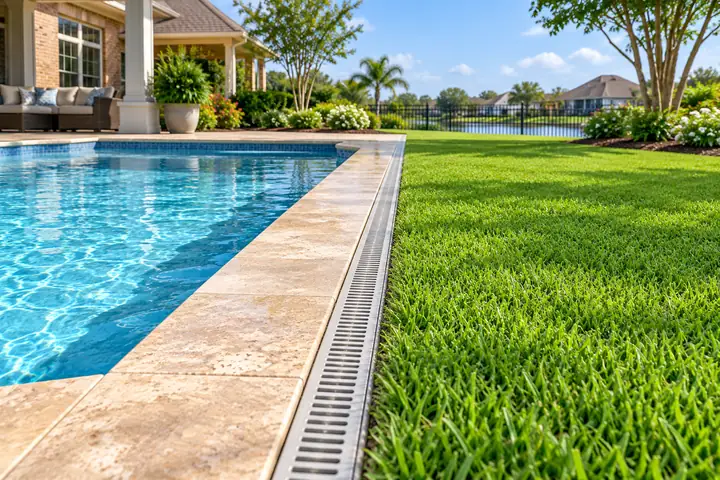
Trace the full channel before mowing
Linear drains can follow one deck side, wrap corners or end at an outlet hidden by landscaping. Walk the entire grate and note transitions, missing sections, cleanout points and nearby turf. Do not assume a decorative strip is a drain or pry up a section to confirm. The owner should provide the pool or drainage plan when function matters. Happy only needs the visible route and a safe boundary for mowing, edging and blowing.
Make sure every grate section is seated
A loose, cracked or lifted segment can catch a wheel, trimmer line or foot. Inspect from above without stepping on a questionable area. If one section rocks, separates or leaves an open gap, close that lane and notify the owner. Happy does not reset, replace or load-test pool-deck grates. The appropriate pool, deck or drainage provider should restore the assembly before lawn equipment works beside it.
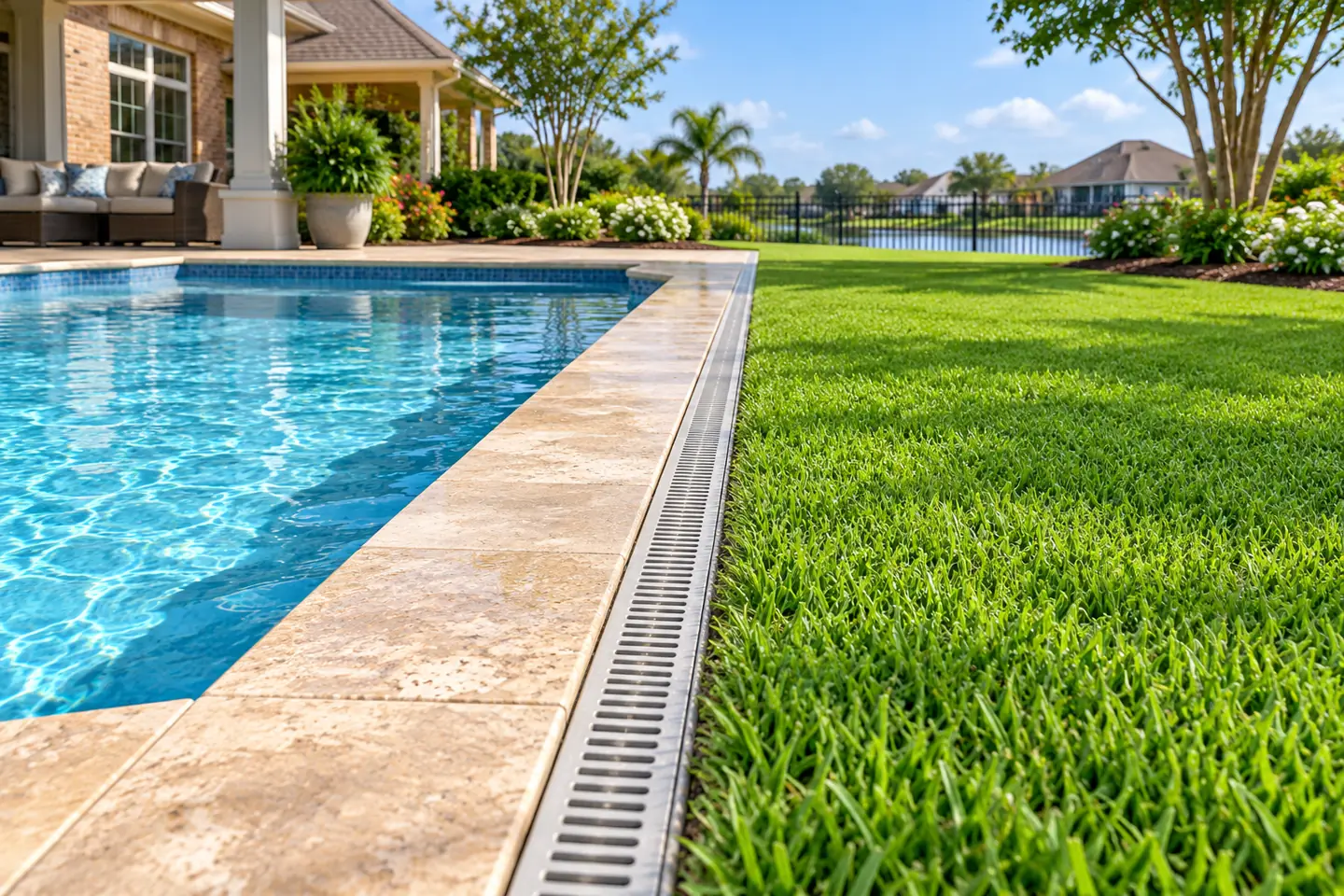
Keep a deliberate turf margin
Grass can creep across narrow slots and hide the deck-to-drain seam. Maintain an even boundary that reveals the grate without cutting a bald trench. Approach from turf with controlled finishing methods and keep hard vertical blades away from plastic or metal edges. If the deck has settled lower or higher than the lawn, mark the abrupt change and adjust the wheel path. The goal is a readable edge, not contact with every grate segment.
Keep clippings out of the water route
EPA stormwater information explains that runoff can carry yard waste and pollutants from hard surfaces. At a pool deck, concentrated clippings can clog slots, stain wet paving or travel toward an outlet. Direct mower discharge into open lawn, then blow the deck away from the channel where practical. Do not force debris through the grate with high-pressure air or water. If the drain already contains packed material, the owner should arrange appropriate cleaning.
Separate pool safety from lawn access
Gates, barriers and supervision rules remain in effect during a lawn visit. Never prop a pool gate open for convenience or leave children near equipment and water. The owner should secure the pool area and provide an access method that preserves the barrier. Happy does not move safety equipment, test alarms or supervise swimmers. If the required route conflicts with the pool enclosure, reschedule or use an approved alternate that actually fits.
Wet deck and wet turf need different decisions
Splash can leave the deck slippery while irrigation or rain softens the adjacent grass. Check both surfaces. A dry lawn does not make a wet grate safe to step across, and a dry deck does not mean the turf can support a turn. Keep wheels off stone coping and drain covers unless the route was designed and approved for that load. Postpone the strip when traction or footing is uncertain.
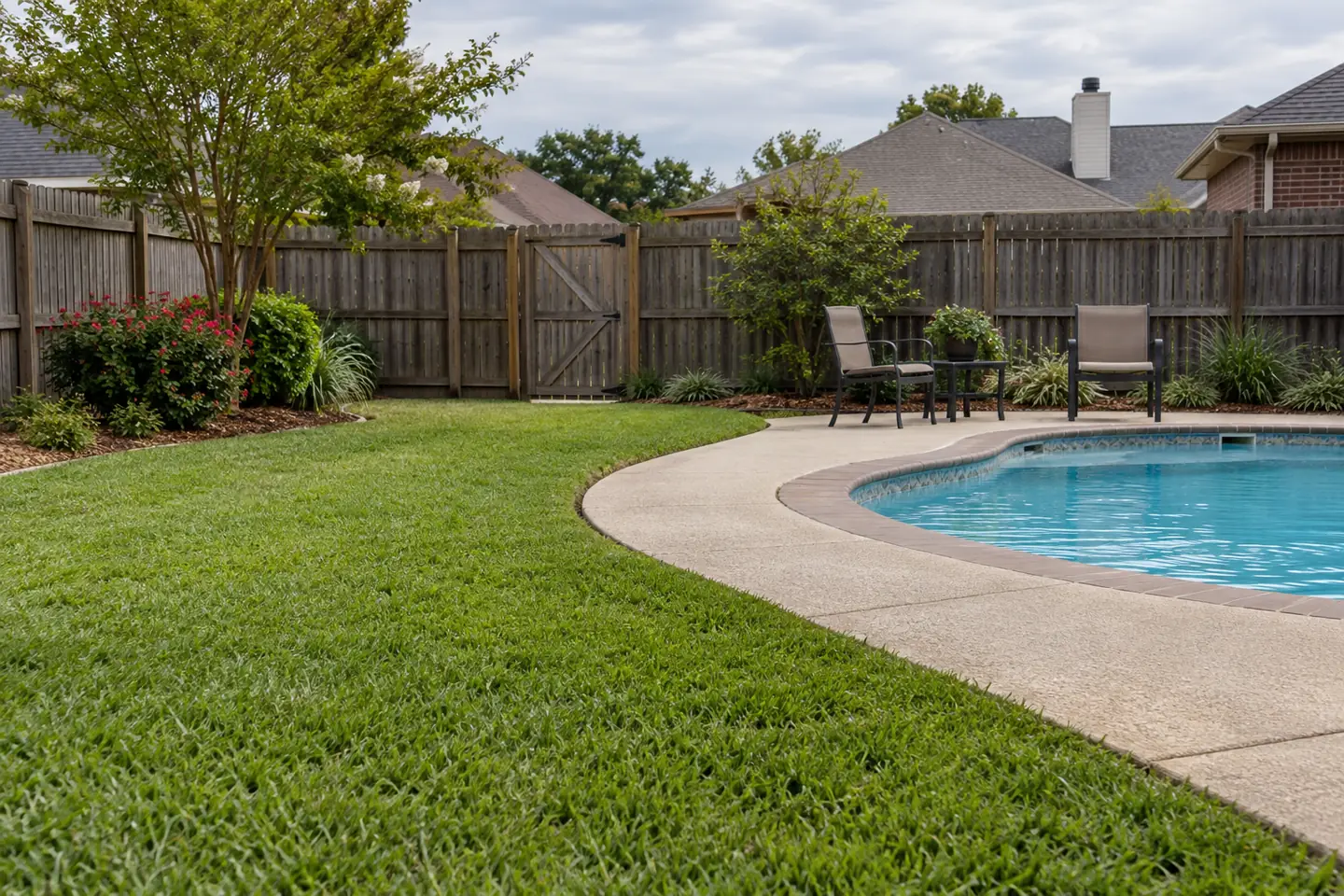
Watch for toys, covers and cleaning hoses
Pool noodles, vacuum hoses, robot cords, cover straps and small toys can cross the grass edge or lie over the drain. The owner should remove and store them before service. Do not coil a pool-cleaning cable beside the dock or disconnect equipment from the water. A hidden strap can wrap around a mower spindle, and a toy can become a projectile. The released lawn lane should contain only permanent, mapped features.
Use a pool-edge checklist
- Secure the pool area and keep children and pets away.
- Remove toys, hoses, cords, towels and loose deck items.
- Confirm grate sections are closed, seated and visibly intact.
- Check both deck traction and turf firmness after water use.
- Direct clippings away from slots, coping and pool water.
- Report damage or blockage without opening the drain.
Protect deck finishes from mower turns
Stone, pavers and coated concrete can scuff or stain under tires and wet clippings. Keep machine turns on grass where the soil supports them. Do not use the channel as a wheel guide. Where the lawn narrows between deck and fence, define whether smaller equipment or hand finishing is appropriate. A good route respects both surfaces and avoids a tight pivot that can tear turf at the exact point runoff reaches the grate.
Do not confuse channel cleaning with blowing
Removing a few loose clippings from the top is part of a clean finish. Pulling grate sections, flushing a buried line or treating algae is pool or drainage maintenance. Happy will not add chemicals, open components or claim that water flows correctly. If rain ponds on the deck, splash returns toward the pool or an outlet overflows, document the visible condition and contact the appropriate provider.
Consider where the channel discharges
Some channels connect to approved drainage, while others lead to a landscape area or system that is not visible. Do not guess, reroute water or publish precise infrastructure details. For lawn planning, note only the surface endpoint and any soft grass around it. If the outlet creates erosion or standing water, exclude that patch. The owner should obtain a site-specific evaluation rather than asking the mower pattern to compensate for drainage behavior.
Coordinate with nearby irrigation
Sprinkler heads along a pool edge may spray the deck, while overspray can keep the channel and grass wet. Map heads and valve work separately. Happy does not adjust irrigation hardware during ordinary mowing. If a head is broken or the drain remains wet before the visit, ask the owner to correct or pause the schedule. Keeping the grass at an appropriate height is better than cutting lower in an attempt to dry the edge.
Keep barefoot traffic away during service
Even a carefully maintained route can contain ordinary clippings, noise and moving equipment. Close the poolside lane to residents and guests until work and cleanup finish. Afterward, the owner can inspect the deck before reopening it. Happy should account for every tool and leave the grate surface visible, but this is not a certification that the pool area meets safety codes or is free of every small particle.
Review coping corners and drain transitions
Channel drains often stop where coping curves, a gate begins or another deck material takes over. Those transitions can contain short grate pieces, end caps and narrow turf wedges. Mark them in the route instead of assuming the straight section tells the whole story. Use a slow finish around each corner and keep mower turns farther into the lawn. If an end cap is missing or a gap exposes the channel, exclude the corner and ask the pool or drainage provider to restore it.
Keep pool chemicals outside lawn operations
Chlorine, acid and other pool products require their own storage and handling plan. Containers, tablets and measuring tools should never be placed in the grass for a lawn crew to move. If a spill, strong odor or open chemical container is present, leave the area and notify the owner. Happy does not neutralize pool chemicals or judge whether a surface is safe afterward. Resume lawn service only when the responsible pool professional has completed cleanup and the owner has released the route.
Coordinate cover anchors and winter equipment
Even in a mild climate, some pools use covers, reels or removable fencing whose anchors sit close to turf. A flush socket can resemble a drain fitting, while a loose strap can cross the mowing lane. The owner should identify each component, retract or store temporary pieces and cap openings according to the system instructions. Happy will not tension covers, pull anchors or move reels. Add any permanent low hardware to the property map so it remains visible when the pool is fully open.
A clean line connects two different spaces
The pool deck is hardscape and recreation space; the lawn is a living surface with changing moisture. The channel drain sits between them and deserves a mapped buffer. With seated grates, a secured pool, cleared accessories and discharge pointed away, Happy can give the grass a finished edge while the pool professional retains responsibility for drains, water and equipment.
Describe the lawn route without changing the pool arrangement
Identify which authorized entrance reaches the lawn beside the pool deck and which boundary the owner wants included in the mowing discussion. Keep pool access controls and equipment preparation under the responsible owner’s arrangement. A photograph of an open route for assessment should not become an instruction to leave that route unsecured during ordinary household use.
Give the channel and the grass-to-deck edge separate location labels when both appear in the request. If a concern is about the drain itself, name it as a separate question rather than implying that the lawn finish resolves it. After pool service or another project changes the setup, update the current photograph before carrying the old lawn note forward. This lets the maintenance request describe an actual prepared perimeter without blending pool-system work and ordinary grass finishing.