
A little foam can start a big lawn conversation
You bend down to pick up a twig and notice something that looks like bubbles tucked among the grass stems. A few steps away, the lawn has a yellow section. It is tempting to connect those two observations immediately. Keep them together in your notes, but give each its own description. The location of foam, the condition of nearby leaves and the condition of grass farther away are three separate pieces of evidence. A helpful lawn conversation starts with those details instead of a confident insect name.
A photograph of a foamy stem can help someone understand your question, but it does not measure the condition of the whole yard. Before sending it, add a view that shows whether this is one little corner or a repeated feature through the lawn. Happy Grass can use the wider context when discussing the next maintenance visit. An insect identification question may need a different person to answer it. Both conversations can move forward without pretending that a phone picture has settled everything.
What the Louisiana background actually tells us
LSU AgCenter describes two-lined spittlebugs as insects that feed on plant juices. The young insects occupy frothy masses near the grass surface; adults have dark bodies with two orange bands across the wings. Both stages can injure turf, and affected grass may weaken and yellow. These are useful background clues, not a checklist that turns every bubble or pale leaf into confirmed spittlebug injury. A recognizable insect and a stressed lawn still need to be evaluated in their actual setting.
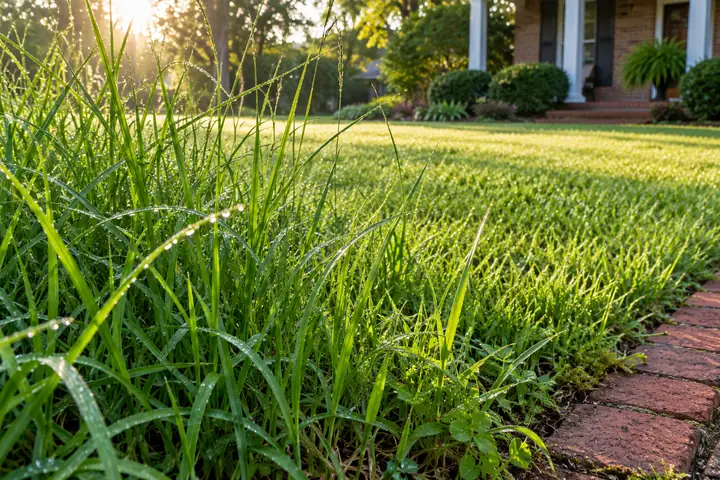
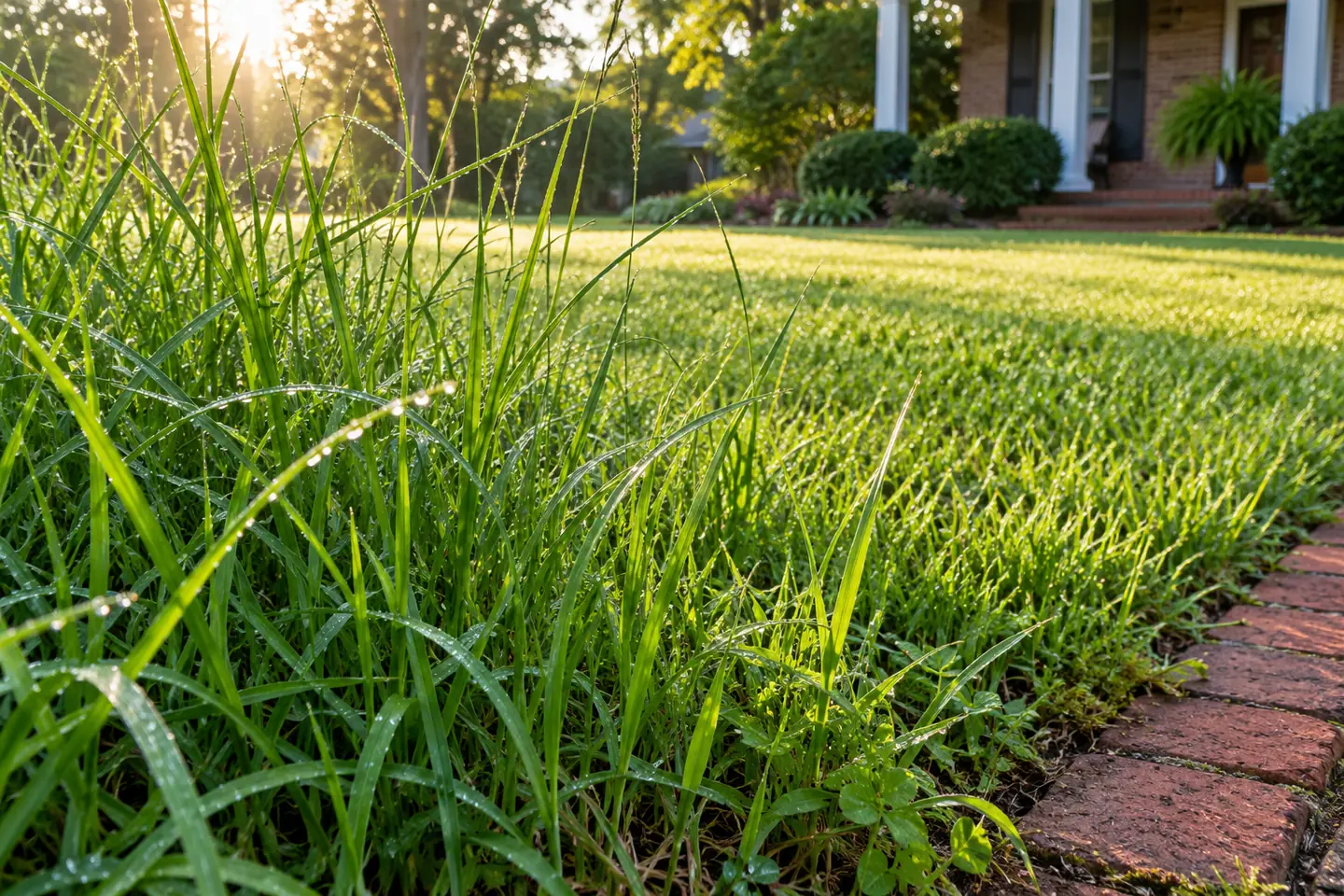
The practical question is therefore broader than whether foam exists. Ask whether an identifiable insect is present, whether the grass around that location has changed, and whether the same change occurs where you did not notice foam. Those questions help an Extension professional decide what additional evidence would be useful. They also stop a maintenance request from becoming a treatment order based on one striking detail. The illustration on this page shows a dewy lawn setting; it is not an image of identified spittlebugs or diagnosed damage.
Distinguish bubbles on stems from a generally wet morning
Begin with a plain description of what you can see without disturbing the grass. Is the froth a small cluster attached around a stem, or are individual droplets spread across many leaves? Is it close to the ground, higher in the foliage, or impossible to tell from your standing position? You do not need to pull apart every cluster to make a useful note. If the view is unclear, write that it is unclear. That is more informative than changing an uncertain observation into a firm label.
Record whether rain or irrigation occurred before the photograph, and include the time of day. These details explain the conditions in which you noticed the feature. They should not be used as a shortcut to announce why it formed. A damp lawn, a dripping hose and a small mass around a stem can all appear in the same picture. Identify which item you are asking about so the person reviewing it does not have to guess where to look.
Give the yellow grass its own description
A yellow section deserves a separate set of notes, even when it sits beside the foam. Describe its shape in ordinary terms: a broad pale band along the walk, several scattered patches, or a small area below a dense shrub. Note whether grass is still standing there and whether the leaves appear intact from the view you can safely obtain. Avoid using a color description as a declaration that the plant is dead. The difference matters when a maintenance plan is being discussed.
Compare the affected-looking area with another part of the same lawn. Choose a place you can find again, such as the opposite end of a brick border. A paired comparison is easier to interpret than unrelated close-ups taken in different light. Keep the photos separate and label their locations. If both areas look yellow but foam was only noticed in one, that difference belongs in the record. It gives the reviewer something concrete to investigate rather than a single explanation to accept.
Look for an insect without making identification a handling task
If an insect is visible from a comfortable distance, photograph it where it is. Try to keep the body and its markings in focus, then retain the original image rather than sending only a heavily enlarged screenshot. Note whether it was on grass, a shrub, a wall or a paved surface. The place where you saw an insect is part of the observation. Finding one on a nearby object does not prove that it explains every changed patch of grass.
There is no need to catch an unfamiliar insect with bare hands to make your maintenance request complete. Ask the identification service what it can use and whether it needs a specimen at all. If your only photograph is blurry, say so and provide the wider lawn views. A reviewer may request different evidence. That is a normal step in reaching a reliable answer, not a reason to improvise a collection method or apply something to make insects appear.
Keep the record small enough to be useful
A compact record might have four parts: a whole-area view, a close view of the foam, a separate insect photograph if available, and a short description of the grass change. Assign simple location names such as front-walk corner and back-fence midpoint. Keep the date with each set. This lets someone compare the same place over time without sorting through a long stream of nearly identical pictures. More files are not automatically better evidence when their locations are unknown.
Write down what you actually changed between photographs. If you moved a planter, redirected a hose or had work done near that section, include the date. These events do not establish a cause, but they keep the timeline honest. If nothing was changed, that is useful too. Do not recreate an earlier condition just to obtain a more dramatic comparison. The goal is to explain the lawn as it is, with enough history for the next person to ask a good follow-up question.
Decide what the next mowing conversation needs
For a scheduled lawn visit, separate the observation from the work request. You might say that foam was noticed near the back border and that you are seeking identification, while also asking whether the yellow area should be reviewed before cutting. If you want a particular section left alone while someone evaluates it, identify the boundary clearly and confirm that the instruction reached Happy. A vague note saying bugs everywhere leaves both the location and the requested action unresolved.
Also explain whether the rest of the property remains part of the usual request. A concern in one corner does not tell anyone what you intend for the front lawn, side passage or paved finish. Discuss the proposed scope in ordinary language and let the actual conditions inform the response. Do not assume that a shorter cut will answer an insect question. The appearance after mowing and the reason for a stressed patch are different matters, even when you want both addressed promptly.
Avoid turning every later change into proof
After the next visit or the next rain, compare the same locations again. Note what changed in the visible foam and what changed in the grass, using separate sentences. If bubbles are no longer visible, do not report that as proof that the lawn issue is solved. If yellow grass remains, do not report that as proof that the earlier identification was correct. A sequence of observations is useful precisely because it can preserve differences instead of forcing them into one story.
When you receive professional identification advice, save the wording and the date with the photographs. Ask which conclusions are confirmed and which remain possibilities. A homeowner note can then move from suspected spittlebugs to an identified insect without rewriting the original observations. That careful progression helps everyone understand what was known at each stage. It also makes a future maintenance discussion easier if a different-looking concern appears elsewhere in the yard.
Where Happy Grass fits
Happy Grass discusses mowing, edging, weed-eating and blowing for Westbank yards. Pest identification and pest-control treatment are outside that maintenance offer. Call 504-339-3571 and ask for Happy to explain the location you want reviewed and the lawn work you are requesting. A friendly conversation can keep the grass plan clear while an appropriate specialist handles the insect question.
A short record to bring to the conversation
- Record foam position independently of grass color.
- Pair a stem detail with a whole-area image.
- Retain the identification reply with its original evidence.