
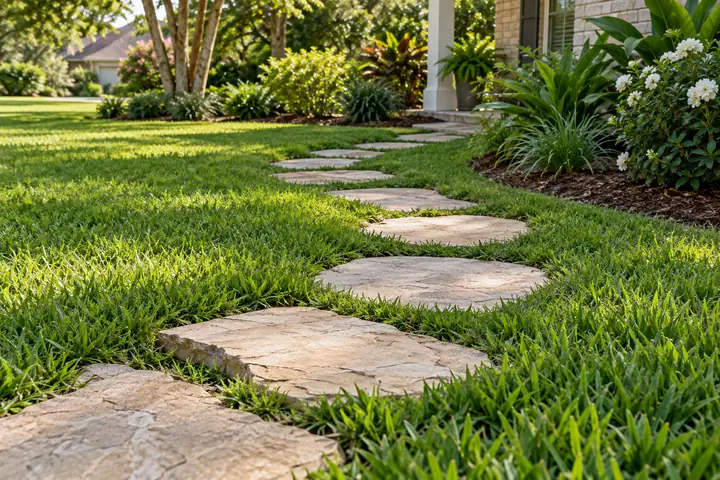
Identify the path beneath the grass
Stepping stones can be obvious from the back door and almost disappear when taller grass leans across their edges. Before arranging lawn care, show Happy where the path begins, where it ends and how the individual stones sit within the grass. A view along the route explains its shape; a lower view can reveal an edge that stands above the surrounding ground. Both are useful when the path is irregular rather than a continuous paved walk.
The question is how to maintain the existing grass around the stones. Lifting, leveling, replacing or adding stones is a separate project. A lawn visit should not depend on someone discovering the path by contact or shifting a loose piece to make equipment pass. You can want the stepping-stone route to remain informal while still describing its boundaries clearly. The arrangement does not need to look like a new sidewalk to deserve a practical maintenance plan.
Distinguish stones at different levels
Some path stones may sit close to the grass surface while another has a visibly raised corner. Mention the differences you already know about. A top-down photograph can make them all appear flush even when the ground-level view tells a different story. Do not assume a mower can travel across the whole route because one stone appears level in a picture. Equipment and the actual surface need their own review.
Toro's mowing guidance warns against striking solid objects and calls for checking the area before use. In your preparation, that translates to identifying the stones and their known irregularities. It does not provide a universal cutting height that makes crossing them suitable. Leave an unstable stone alone and report it rather than testing it with your foot for the sake of the lawn request. If the path needs separate repair, make clear which part remains unresolved and which grass sections can be discussed independently.
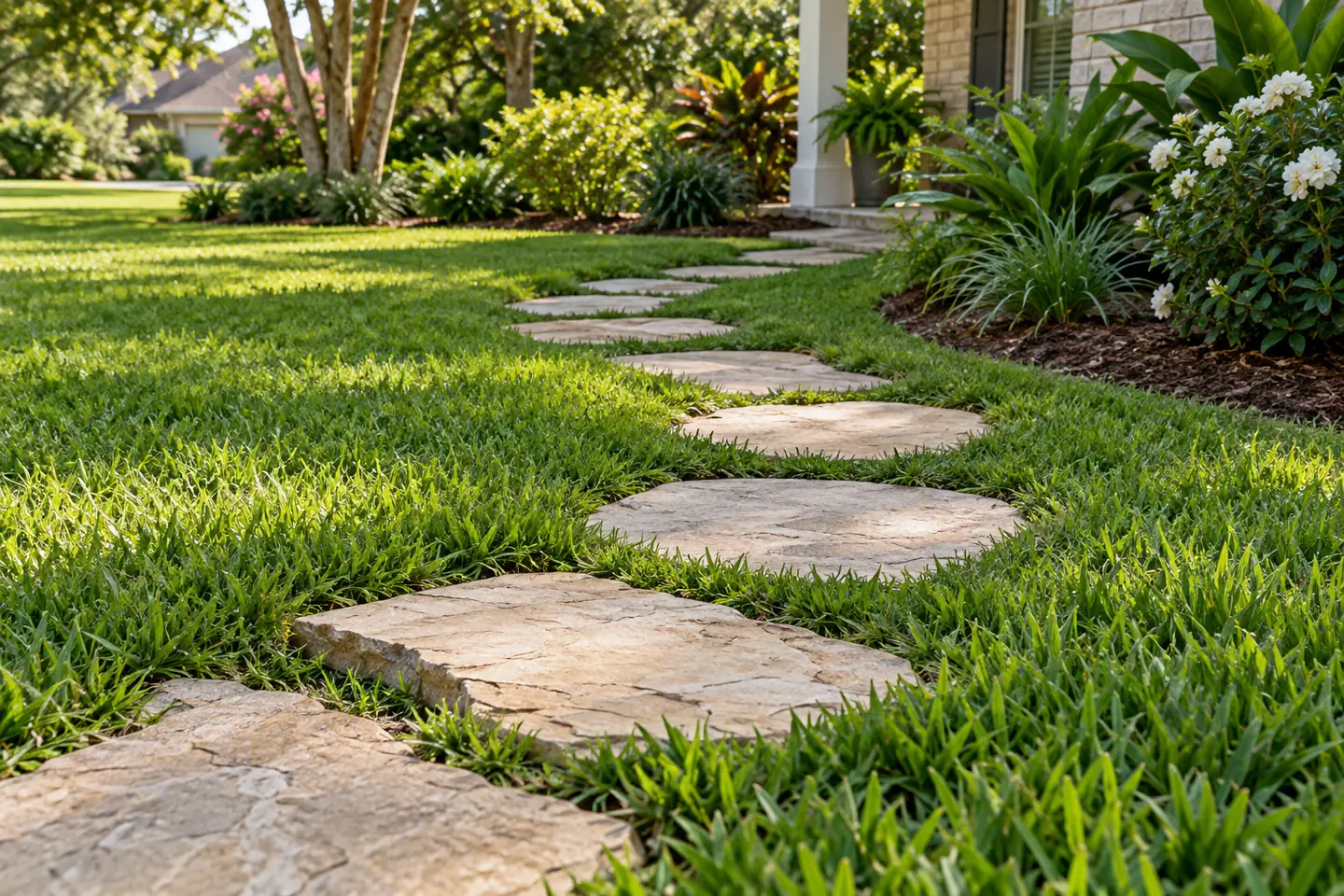
Describe the grass between individual stones
The strips between stepping stones may be wide enough to look like lawn or narrow enough to resemble joints. Tell Happy what you want maintained there and whether any intended groundcover is mixed with the grass. Avoid an instruction to remove everything green unless that is a separate project you have actually discussed. A grass path can retain vegetation between its stones while still looking intentionally cared for.
Explain whether the concern is tall growth between stones, grass overhanging their edges or the open lawn beside the path. Those are different views of the finish. A close corner between two irregular slabs may not have the same access as a broad grass strip along the outside. If a particularly narrow pocket needs an exception, name it using a visible landmark. A clear limit is more useful than expecting one machine pass to produce the same appearance across surfaces that have very different shapes and clearances.
Follow the route people actually use
A stepping-stone path often exists because people repeatedly cross the yard to a gate, shed or clothesline. Show that destination and explain whether the route also serves as the only access to another lawn section. The stones may be suitable for their intended walking use without establishing a passage for lawn equipment. Tell Happy if there is another way around the path, and show that route rather than assuming the open-looking space is available.
Include the everyday details that affect the approach:
- Point out a turn where the path narrows beside a bed or fence.
- Identify a stone hidden by grass or a plant near the route's end.
- Explain whether movable belongings usually sit on the adjacent lawn.
- Show any gate or threshold reached after the stepping stones.
This context keeps the quote conversation connected to the whole yard. A path is more than a row of isolated objects when it controls how the rear lawn can be reached.
Separate trimming from changing the path
You might prefer a crisp outline around every stone, or you might want only the taller grass reduced while the edges remain soft. Describe the look you mean before the work is arranged. A sharper outline can be a different request from a routine grass cut, and it should not imply widening the path or exposing soil around every piece. Use a current close photograph to show which overhang concerns you.
Do not ask for the grass to be shaved low just because a stone is difficult to see. The stone's level and the grass's suitable maintenance are separate considerations. If a path has gradually become obscured, discuss identifying its original footprint and any separate work that may be needed. Lawn maintenance should follow the understood layout, not invent a new shape by cutting into an area whose materials are hidden. Keeping that distinction clear protects the character of the path and makes the desired finish easier to evaluate.
Report changes in the surrounding ground
Rain, another yard project or repeated use may leave a new soft patch or depression alongside the route. Describe what has changed rather than diagnosing why it happened. Include the grass immediately beside the stone, because an apparently unchanged top surface does not tell the full story about the approach. A current view can show whether the route differs from the condition discussed at the last visit.
If someone has recently reset a stone, say which one and whether that work is finished. Temporary sand piles, tools or removed pieces should not be treated as ordinary lawn debris. Arrange their handling separately and tell Happy what remains. A newly completed path may also change which grass belongs in the mowing area, particularly if the route was widened or moved. The next lawn plan should use the actual finished footprint, without assuming that a scheduled paving task has already produced a clear, stable route.
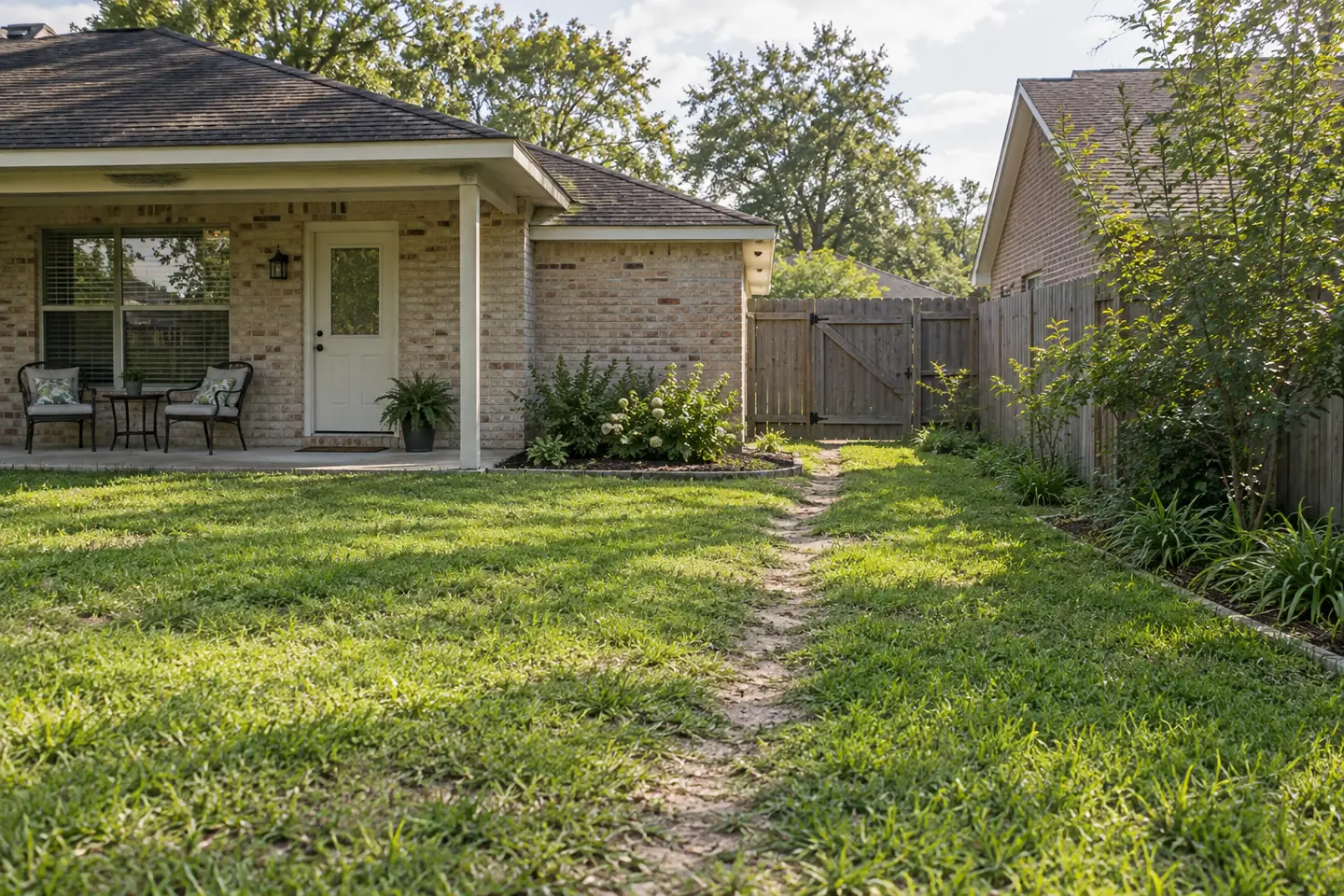
Review the finish from the doorway and up close
After the visit, look at the route from the place you normally see it and then inspect individual edges where practical. A distant view helps judge whether the path is visible within the lawn. A closer view helps explain whether a particular grass pocket differs from the agreed finish. Combining the views prevents a small detail from being lost in a wide photograph or exaggerated by a tight crop with no context.
Keep feedback tied to the vegetation and boundary. Say that grass still overhangs the stone near the shed, or that a planted joint was meant to remain. A stone that seems more prominent after surrounding grass is cut may have been raised already; a photograph alone does not prove a new cause. If a section was intentionally excluded because of an unresolved surface concern, keep that note with the property instructions. The finished appearance can then be compared with the work that was actually agreed and accessible.
Explain the path as part of your lawn request
For a Harvey yard or another Westbank property, a few clear views can tell the whole story: the path from the door, one representative edge and the entrance to the lawn beyond. Mention whether the stones are an everyday walking route, decorative crossing or the only way to reach the back section. Those differences help Happy ask the right questions without assuming every stone path should be handled alike.
Call 504-339-3571 and ask for Happy with a description of the grass between and beside the stones. Explain any known raised or unstable piece and any separate path work still pending. Agree what a tidy finish means for your particular layout. With the path identified and access understood, the lawn can frame it naturally while leaving stone repair, redesign and other unrelated work to their own appropriate arrangements. A little clarity at the start makes an informal garden feature much easier to include in a regular lawn routine.
Identify isolated stones outside the main route
A single decorative slab or old path remnant may sit elsewhere in the lawn without appearing connected to the stepping-stone trail. Include it in your property notes if grass can hide its edges. Explain whether it is intended to remain and show its location relative to a fixed landmark. Do not assume that a person who understands the main path will also know about one isolated piece near the fence. When a stone is removed during a separate project, update that location too, including any remaining depression or disturbed ground. The lawn map should follow the actual objects rather than just the most visible route.