
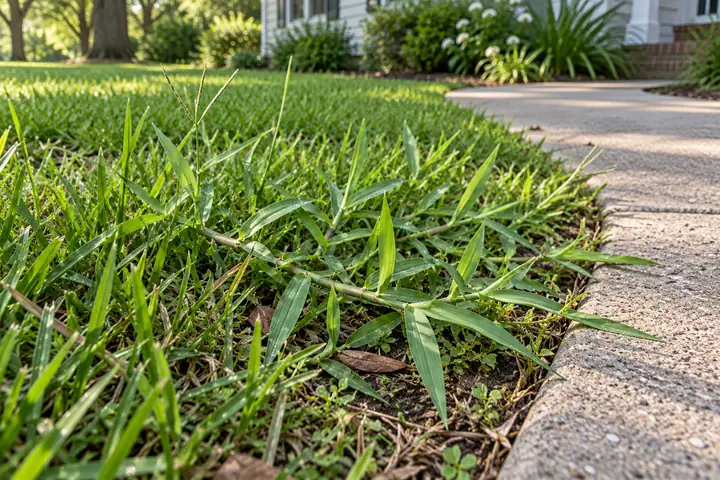
A patch can look like grass and still need identification
Crabgrass is confusing partly because it is a grass. A homeowner may see a coarse spreading patch and assume it only needs a closer cut. The useful question is whether it matches the turf intended for the lawn. Look at its leaf texture, stem arrangement and relationship to the surrounding grass. A patch that supplies plenty of green cover can still interrupt the lawn's intended plant mix and produce a different maintenance result.
LSU AgCenter identifies crabgrasses as warm-season annual grassy weeds. UC IPM distinguishes large or hairy crabgrass from smooth crabgrass and describes their spreading growth. The stems can lie along the ground, with lower joints sometimes rooting. These details explain why cutting the tallest leaves does not describe the entire plant. The horizontal structure and the grass remaining between its branches are just as important as the height seen before a visit.
Follow a jointed stem outward
Choose an edge where a stem is visible and follow it between leaves. Look for joints and the way branches extend across the surface. Compare that arrangement with the desired turf nearby. Do not identify a species from one detached blade: many grasses have pointed leaves, and a blade alone omits the stem features needed for a better comparison. Keep the plant's architecture in view instead of relying on its slightly different shade of green.
Where a stem disappears into dense turf, note the limit of the observation rather than pulling the whole patch apart. A visible edge may be enough to show a spreading habit. If the intended grass also spreads by runners, the comparison needs more detail, not a quick conclusion that all runners are weeds. Use an extension identification reference or qualified help when the distinction will determine a management method.
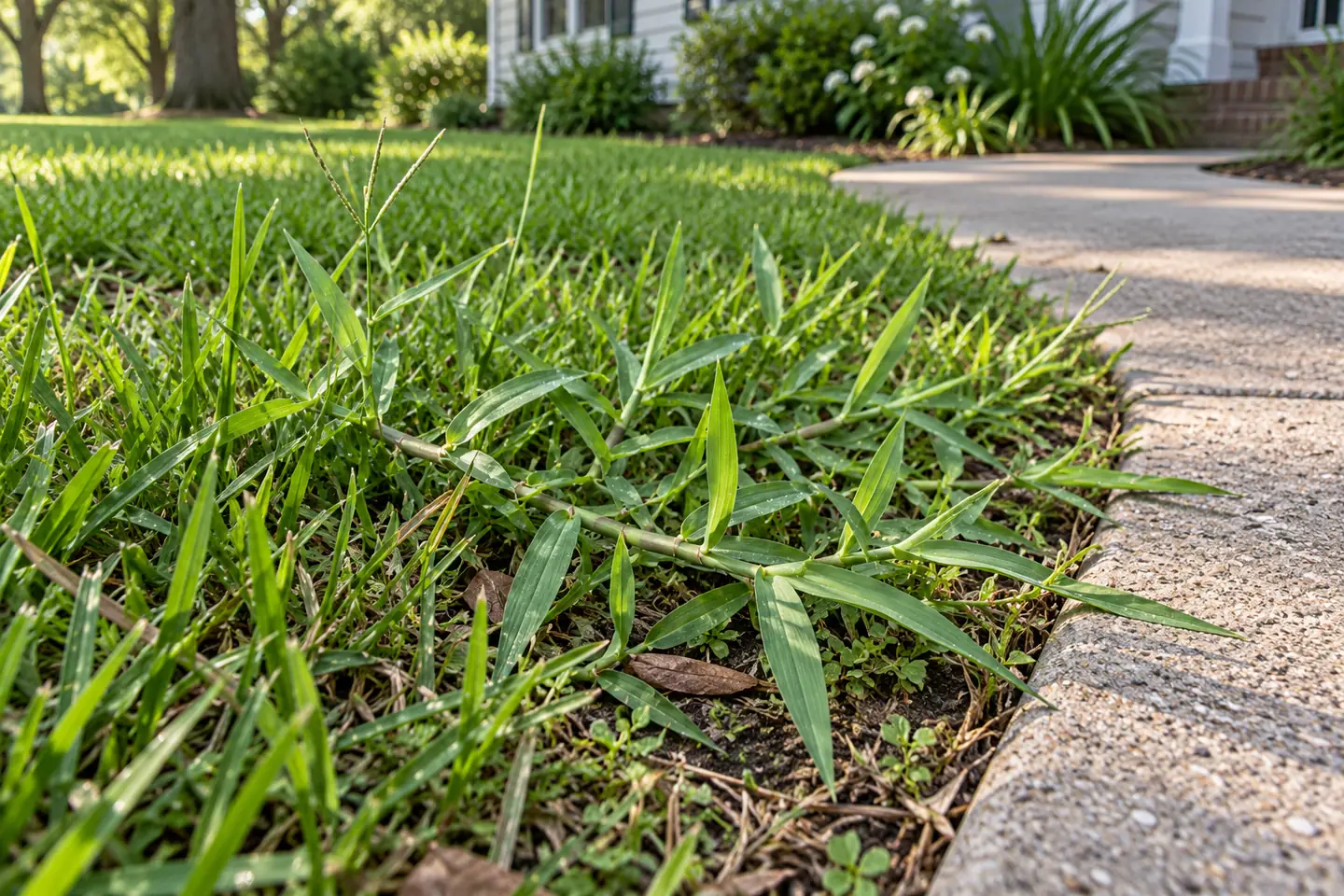
Hairiness can narrow a crabgrass comparison
Large crabgrass commonly shows conspicuous hairs on leaves and sheaths, while smooth crabgrass is less hairy. UC IPM's identification pages illustrate these differences. The sheath is the lower leaf portion wrapped around the stem; including it in a close view can be more useful than photographing only the leaf tip. Keep the image sharp enough to show actual hairs rather than a phone filter's artificial edge texture.
This comparison helps refine an identification, but it should not become a forced choice when the plant does not fit either reference. Other grassy weeds and the desired turf can occupy the same patch. If leaves vary greatly, check whether you are looking at more than one plant. A mixed handful can combine a hairy sheath from one grass with a seed head from another and produce an apparently convincing but inaccurate description.
Seed-head branches are clues, not a shortcut
Crabgrass seed heads have slender finger-like branches, but that general outline is shared by other grasses. Goosegrass can also produce finger-like branches, while its flattened pale-centered base offers a different clue. If seed heads are present, trace one back toward its own leaves and base. If they have been mowed off, do not infer that the plant has never produced seed or that the remaining stems are harmless turf.
A useful identification set combines the base, a leaf and sheath, a spreading stem and an attached seed head when available. These features should come from the same plant or clearly identified connected growth. The goal is not an impressive collection of grass pictures. It is a coherent view of one plant that someone can compare with a reliable reference. That is especially valuable before choosing a selective weed-control approach.
Annual does not mean the gap is permanently solved
Crabgrass is generally treated as a summer annual, but UC IPM notes that plants may persist where a killing frost is absent. Avoid promising that winter will reliably solve a particular West Bank patch. Even where existing plants die, seed and the condition of the underlying turf remain separate questions. A seasonal color change is not proof of permanent removal or a complete lawn beneath it.
Keep a record of where the patch occurs rather than relying on the memory that crabgrass was somewhere by the drive last year. If it recurs in an opening, inspect the desired turf in that opening as well as the new plants. A repeated location is useful evidence for a turf assessment. It does not by itself identify the cause of the opening, the age of the seed or a failure by the most recent person who mowed it.
Check what the sprawling cover is hiding
At the patch center, transition and nearby intended turf, look for continuity of the grass you want. A broad crabgrass plant can cover a gap with leaves while little desired turf remains beneath it. That distinction affects expectations for removal. Reducing the unwanted grass may expose sparse ground rather than reveal a ready-made smooth lawn. Discuss the condition before work if an immediate uniform appearance is especially important.
For example, a spreading plant over a narrow bare strip beside the driveway is different from scattered crabgrass among continuous turf. The first may supply most of the visible cover; the second may interrupt an otherwise established surface. A single whole-yard request to remove crabgrass hides that difference. Describe the location and density so the next decision concerns the actual patch rather than an imagined uniform infestation.
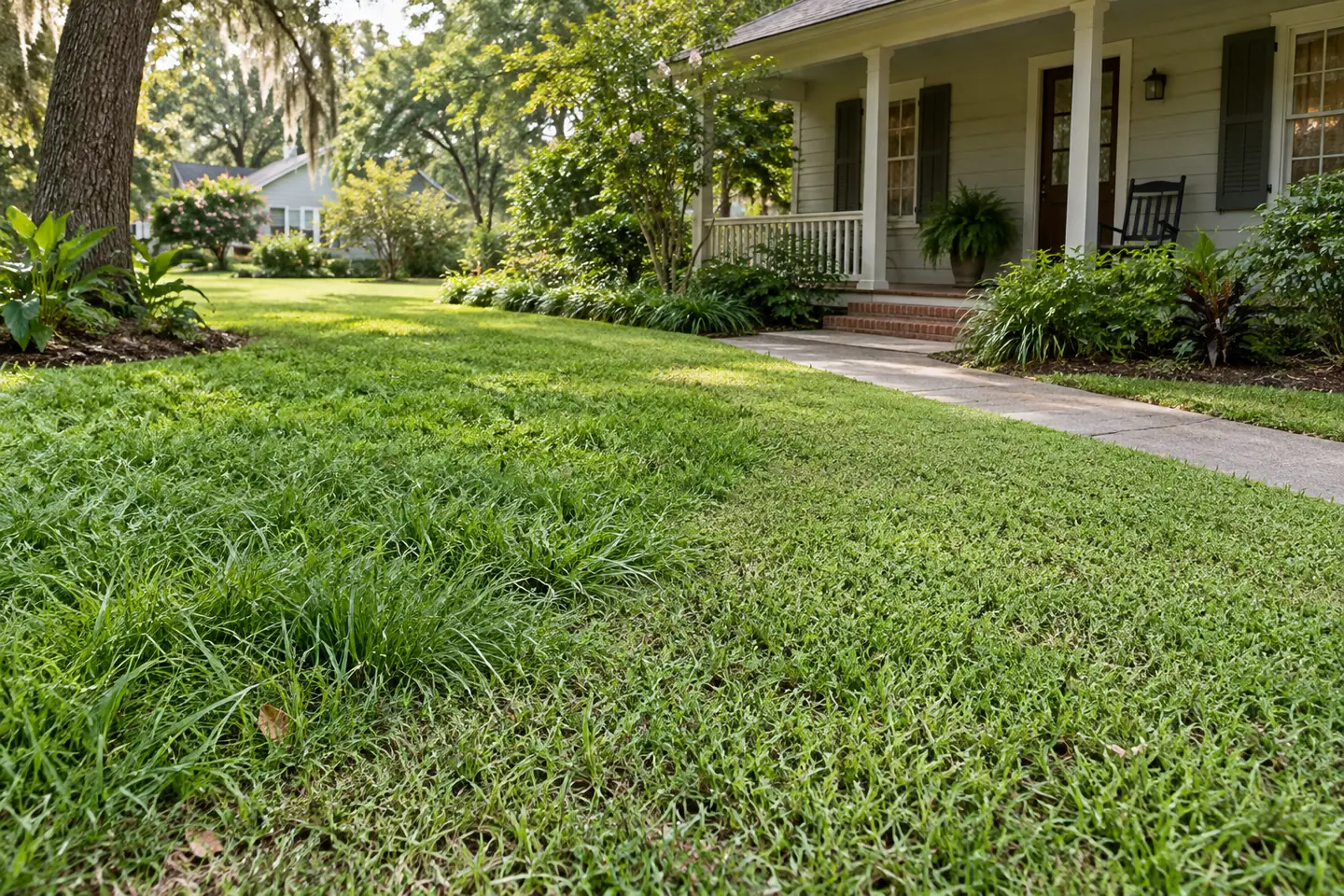
A cut changes the skyline more than the map
After mowing, tall leaves and seed heads may be reduced, making the patch look much less noticeable. Compare the horizontal stem footprint as well. If the same branches still occupy the same opening, the appearance improvement and the persistent plant can both be accurately reported. Do not use a freshly even silhouette as the only evidence of weed management, and do not dismiss a good turf cut simply because a separate weed remains.
The cutting height should still be appropriate for the intended grass. Asking for repeated lower passes to hide a coarse patch can change the surrounding lawn without resolving the spread or seed question. If the plant is uncertain, preserve useful identification views before the visit. A mower should not be treated as a diagnostic tool that reveals a species by how short it can be made.
Distinguish old branches from new small plants
During follow-up, look for the original spreading center and for separate seedlings around it. These observations have different meanings. A surviving branch attached to the old plant is not the same thing as a new small plant in a neighboring opening. You may not be able to determine the age of every stem, and that is fine. Record the distinction where it is visible and keep uncertainty explicit elsewhere.
This helps review a management discussion without exaggerating either success or failure. One remaining large plant should be described as such, while many small emerging plants should not be called the same old clump without checking. Ask how the agreed approach addresses established plants and what follow-up observations matter. Do not assume that a reference to prevention also promises removal of every plant already present on the day work begins.
Read a driveway-edge patch in three parts
At a spreading crabgrass-like patch beside the drive, separate the central plant, its outer jointed stems and the desired turf between them. The center can stay in the same place while branches cover a larger opening. The outside can look greener even as the desired turf remains sparse. These observations are more informative than calling the whole strip a taller lawn.
Now compare two possible next steps. A mowing request concerns the maintained grass height and visible finish. A separate management discussion concerns the identified unwanted grass and the surface that would remain if it were reduced. If the sprawling plant supplies most of the cover, those two conversations should happen before the owner expects a complete smooth lawn at the end of removal work.
- Central base: keep the identity linked to the actual plant.
- Outer joints: note visible branches crossing beyond the previous footprint.
- Desired turf: compare continuity inside and outside the patch.
- Attached head: preserve its relationship to the base instead of identifying from a loose branch alone.
If the patch later turns brown or becomes less noticeable, repeat the same three-part comparison. A seasonal appearance change should not erase the record of where the desired grass was sparse or become proof that no future crabgrass plants can appear.
Keep the desired grass at the center of the plan
Before considering any product, establish the target and the turf to preserve. A lawn containing mixed grasses requires more care than a label such as mostly grass suggests. Sites beside beds, paving or newly planted areas also need clear boundaries. This guide does not select a herbicide, rate or calendar. Current label directions and appropriate local guidance belong in any specific treatment decision.
For Happy Grass requests in Harvey, Marrero, Gretna, Algiers, Belle Chasse or Westwego, call 504-339-3571 and ask for Happy. Describe the spreading stems, any seed heads and the grass remaining within the patch. Confirm available weed-control scope separately from ordinary mowing. Fertilization, aeration, overseeding and pest control are not offered. A useful crabgrass plan starts with the actual plant footprint and a realistic view of the turf beneath it.