
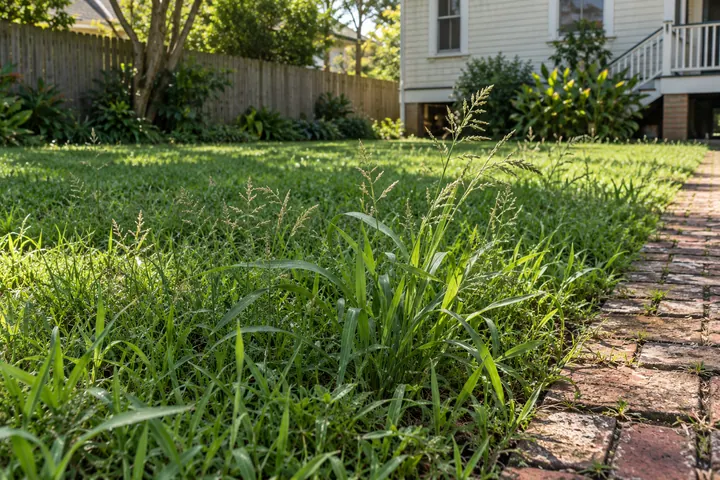
A big clump is a starting description
There is nothing wrong with telling Happy that a patch looks like coarse grass. That describes the visible lawn concern without pretending to settle the plant's identity. The next useful question is what makes that particular clump different from the surrounding turf. Its upright form, broad blades and branching head may help organize an inquiry, but they do not make the name barnyardgrass certain. A useful record gives the smaller features somewhere to fit.
LSU AgCenter describes barnyardgrass as a warm-season annual with coarse leaves, a pale midvein and terminal branching heads that may be green or purple. Its identification account emphasizes the absence of a ligule, a structure at the junction of leaf blade and sheath. Short hairs can occur near the leaf base. These are connected traits to examine, not instructions to label any large grassy plant beside a wet-looking path barnyardgrass.
What the leaf junction question means
In an ordinary lawn photograph, the blade often hides the place where it meets the stem. That is exactly the area the ligule question concerns. A viewer cannot establish that a structure is absent if the relevant surface is turned away, covered by another leaf or blurred. Keep the distinction between no feature visible in this photograph and a feature shown to be absent on the plant. They are not interchangeable conclusions.
Ask a qualified reviewer which view of the junction would be useful before trying to produce a diagnosis yourself. You may need an intact attached leaf shown from another angle, or the reviewer may request a specimen. Do not take the plant apart merely to satisfy a guessed internet checklist. The goal is to show the relevant relationship honestly, including any part the available image cannot resolve.
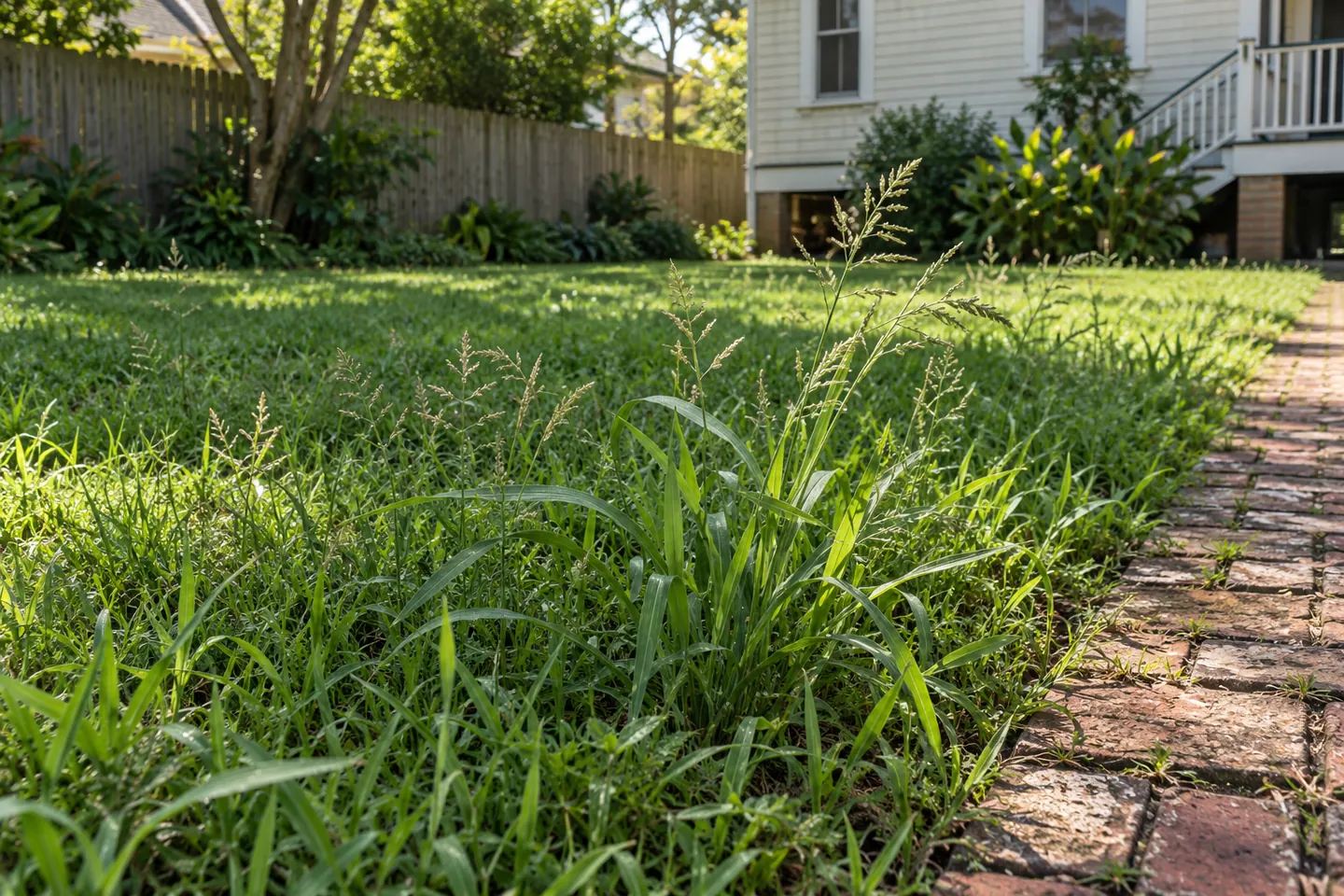
Keep a leaf and its head connected to one example
A mixed clump can contain intertwined grass from more than one plant. If the broad blade is in front and the branching head is behind it, their apparent connection may be an accident of the camera angle. Follow the supporting stem where it can actually be seen. Include an overall view that lets another person understand which example supplied the leaf-junction photograph and which supplied the head.
Use a simple location label such as brick-path clump. That label can stay with the photographs even if the candidate name changes later. It is much more reliable than a collection called barnyardgrass in which several unrelated plants have been grouped together. A clear sample identity is useful before a scientific identity is established, and it prevents later photographs from silently replacing the original evidence.
Do not let purple become the whole identification
The reference allows green or purple coloration in the head. A color impression by itself is therefore not a complete comparison, and it should not be used to exclude every greener example. Photograph the head's arrangement as well as its color. Make sure the image shows the actual plant under ordinary lighting rather than a heavily edited phone filter that changes the tones.
If two examples are being compared, keep them under similar light and label them separately. A sunlit head and a shaded head can look dramatically different on a screen. Describe a difference you can observe without claiming that the difference proves two species. Color can be part of the evidence while the leaf, stem and overall structure still need review.
Separate the pale midvein from reflected light
A pale line down a blade can be useful to photograph, but a highlight running along a folded leaf is not automatically the same feature. Try a second viewing angle of the same attached leaf. If the bright stripe changes with the angle, note that the photograph may be showing glare. Keep the blade's outline and the point of attachment visible so the detail does not become detached from its context.
You do not need an elaborate camera setup. A readable image with a short caption can explain more than an extreme enlargement of an out-of-focus blade. State what the picture resolves and what it does not. A message saying the center line is visible but the leaf junction is obscured gives the reviewer a focused next step instead of an apparently complete description copied from a source.
A damp location does not diagnose the whole site
LSU's background mentions moist soils, but a possible plant identity cannot establish the drainage condition of a particular yard. Describe current observations separately: a damp-looking strip, standing water at a known time or a dry surface today. Keep any known watering or rainfall history factual. Do not turn a species possibility into proof that an irrigation setting, soil type or previous lawn visit caused the patch.
The location can still matter to the maintenance discussion. A soft or inaccessible path-side section may need to be reviewed before work is arranged, regardless of the grass name. Explain that practical condition directly. A lawn provider should not have to infer a drainage-repair request from a photograph of a coarse plant, and an ordinary cut should not be presented as a correction for an unassessed water problem.
Decide whether the head, the clump or access is the concern
Three homeowners can show the same kind of grass and want different help. One dislikes the raised heads in the front view. Another is concerned about the broad clump's texture. A third wants to know whether a route beside it is practical for the next visit. State the result you want discussed rather than expecting the plant name to communicate the entire task.
If the request concerns the visible lawn finish, identify the fixed boundary and viewing position. If identification is the unresolved issue, say that first. Mowing, edging, weed-eating and blowing should be discussed as the specific routine operations proposed. A species article does not turn a maintenance inquiry into a separate treatment or removal agreement, even when the plant has been correctly identified.
Keep cutting history useful rather than accusatory
When a head becomes noticeable again, record the observation date and the last known maintenance date separately. Do not describe the growth as overnight unless the same marked example was actually checked on consecutive days. A new-looking structure may have been hidden in the earlier view. The record should preserve what was observed without inventing an exact growth rate or assigning a cause nobody saw.
For a follow-up, describe the marked clump and the particular appearance that remains. A branching head is visible again beside the second brick-path corner is easier to review than the weed is everywhere. Compare the result with the agreed task. A tidier surface and a resolved plant-identification question are separate outcomes, and either can remain useful even when the other still needs work.
Send a small evidence set with clear roles
If the leaf junction is the missing evidence, make that the subject of the next message rather than sending another distant photograph of the whole patch. A useful caption can say that the attached blade belongs to the marked clump, the upper surface is shown and the junction remains covered. That tells the reviewer exactly why the available record cannot answer the ligule question. It also keeps a request for better evidence from sounding like a rejection of everything already supplied.
Keep the original file alongside any cropped detail. Cropping can help someone find a small feature, but the wider image may be the only record linking that feature to a particular stem. Give the two versions matching labels and explain that one is a crop of the other. If the close view came from a different example, label that difference openly. A comparison remains useful when its limits are explicit; it becomes misleading when separate examples are presented as a single continuous plant.
Choose a few photographs that answer different questions. The overview locates the clump. A connected-plant view links the parts. A close leaf-junction view addresses the missing-feature question. A head view records its structure. Label anything detached or taken from a different plant. A large unlabeled album can make the inquiry less clear by adding examples whose relationships nobody can follow.
- Give the sample a location label that survives a revised name.
- Distinguish an obscured junction from a demonstrated absence.
- Record color under ordinary, comparable lighting.
- Keep the identification question separate from the routine finish request.
For a Harvey or Gretna yard, this approach makes the first conversation useful without requiring you to become a grass specialist. You can explain what stands out, show the part that needs review and ask about a practical lawn visit. A careful question is a stronger starting point than a confident label that the photographs cannot support.
Talk through the coarse clump with Happy
Call 504-339-3571 and ask for Happy. Describe the marked clump, any current access condition and the mowing, edging, weed-eating or blowing you want discussed. Confirm the actual work and availability before arranging a visit.