
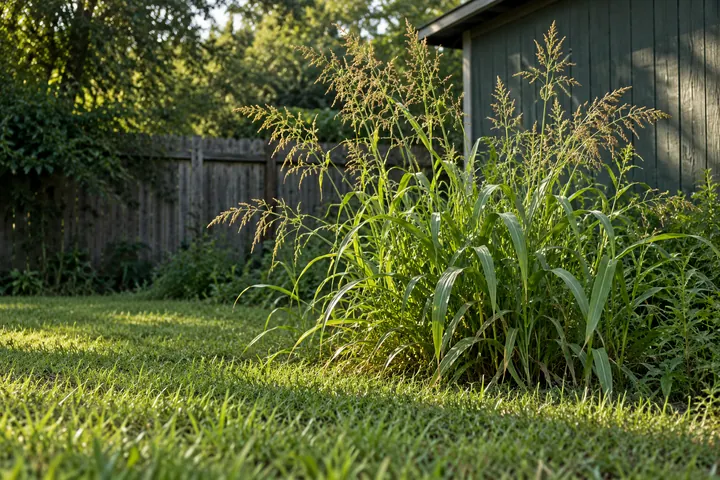
Describe the stand before choosing a service
If a tall grassy patch occupies the back corner, begin by showing how it relates to the maintained lawn. Is it one distinct stand behind a shed, a few shoots at a fence or growth interwoven through the usable yard? Those descriptions can imply different work. Calling everything johnsongrass does not explain the size, access or visible condition, and calling it grass does not automatically make it part of a routine lawn visit.
UC IPM describes johnsongrass as a perennial grass with coarse leafy tufts, a prominent pale midvein, an open branching head and thick segmented underground stems. Those underground structures can produce new shoots. The reference helps explain why the visible top and the plant's continuing presence are different questions. It does not identify your stand from height alone or establish that the proposed lawn work includes brush clearing, digging or a species-control program.
A white midrib is a clue with limits
A broad leaf with a pale center line is worth documenting, but it should not end the identification inquiry. Keep the whole blade, the supporting stem and an attached head in the evidence where available. A reviewer needs the plant's relationships as well as a striking stripe. Do not label an entire fence row from one detached blade found near its edge.
If the source of a loose leaf is unknown, preserve that uncertainty. A photograph of the item can still be useful when paired with an honest caption about where it was found. It becomes misleading when the caption implies the leaf was seen attached to the nearest tall plant. Keep the original finding and any later connected example separate until the evidence supports joining them.
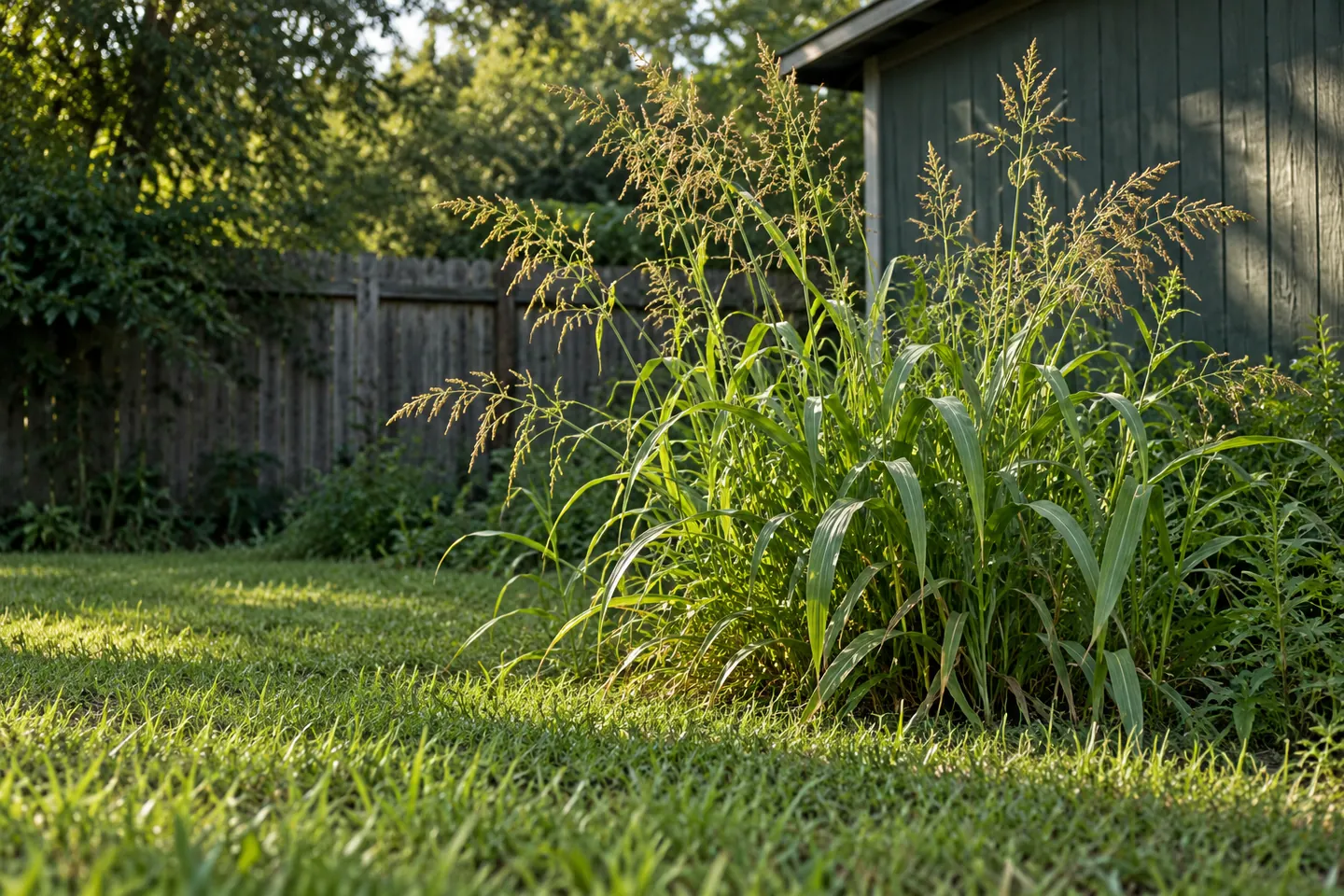
Show where the maintained lawn stops
The most useful overview often crosses the transition from ordinary lawn to the taller stand. Include a fixed reference such as the shed corner or fence opening. That shows whether the tall growth interrupts the routine route or sits beyond it. Avoid cropping away the surrounding area to make the plant more prominent if the real service question concerns how the stand affects access.
Mark the physical work boundary independently of the plant's outermost leaf. An arching blade can extend beyond the base, and the visible outline may shift with the viewing angle. A fixed boundary gives the discussion something stable to refer to. If the desired stop line has not been decided, say that it needs review before work is arranged rather than asking a provider to infer it on arrival.
Height should be reported as an observation
Give a reasonable description of the stand's present scale using a visible fixed feature or a clearly labeled measurement where practical. State whether you mean the top of the leaves or the highest flowering structure. Those are different endpoints. A head above a fence panel can make the growth look taller than the main leafy stand; keep that distinction in the description instead of reducing both to one uncertain number.
Do not treat a general mature-height range in a reference as a measurement of your property. The actual stand may be cut, bent or at another stage. Likewise, a shorter example should not be rejected simply because it does not resemble the tallest reference photograph. The point is to communicate the condition being reviewed, not to make your yard fit an illustration's proportions.
Keep the route separate from the removal question
Explain how the lawn is normally reached and whether the tall stand occupies part of that route. A clear approach to the front lawn does not establish access to a patch behind a shed. Show the gate, the available opening and any fixed equipment or retained planting nearby. Do not promise access from a photograph if the route has not actually been checked for the proposed visit.
The provider needs a truthful account of the area, not a path staged to look more open than it is. If part of the boundary cannot be seen from the maintained side, describe that limitation. Do not enter an uncertain overgrown space merely to produce a more convincing image. The next step can be a discussion about an appropriate site review rather than an automatic instruction to cut through unseen ground.
Do not assume a routine cut includes every tall stem
Ask which part of the property the proposed mowing, edging, weed-eating or blowing covers. A separate tall stand may need a different assessment from the existing lawn surface. Happy Grass should be given the actual condition before you rely on an ordinary booking. A plant name mentioned during a quote conversation is not itself an agreement to clear every area where that plant might occur.
If the goal is a longer-term change in the stand, state that as a separate question. This guide does not offer a chemical treatment, excavation or grass-replacement plan. A source may explain a perennial plant's structures without making those services part of the business's offering. Keep the operation being proposed and the outcome being expected in the same plain-language agreement.
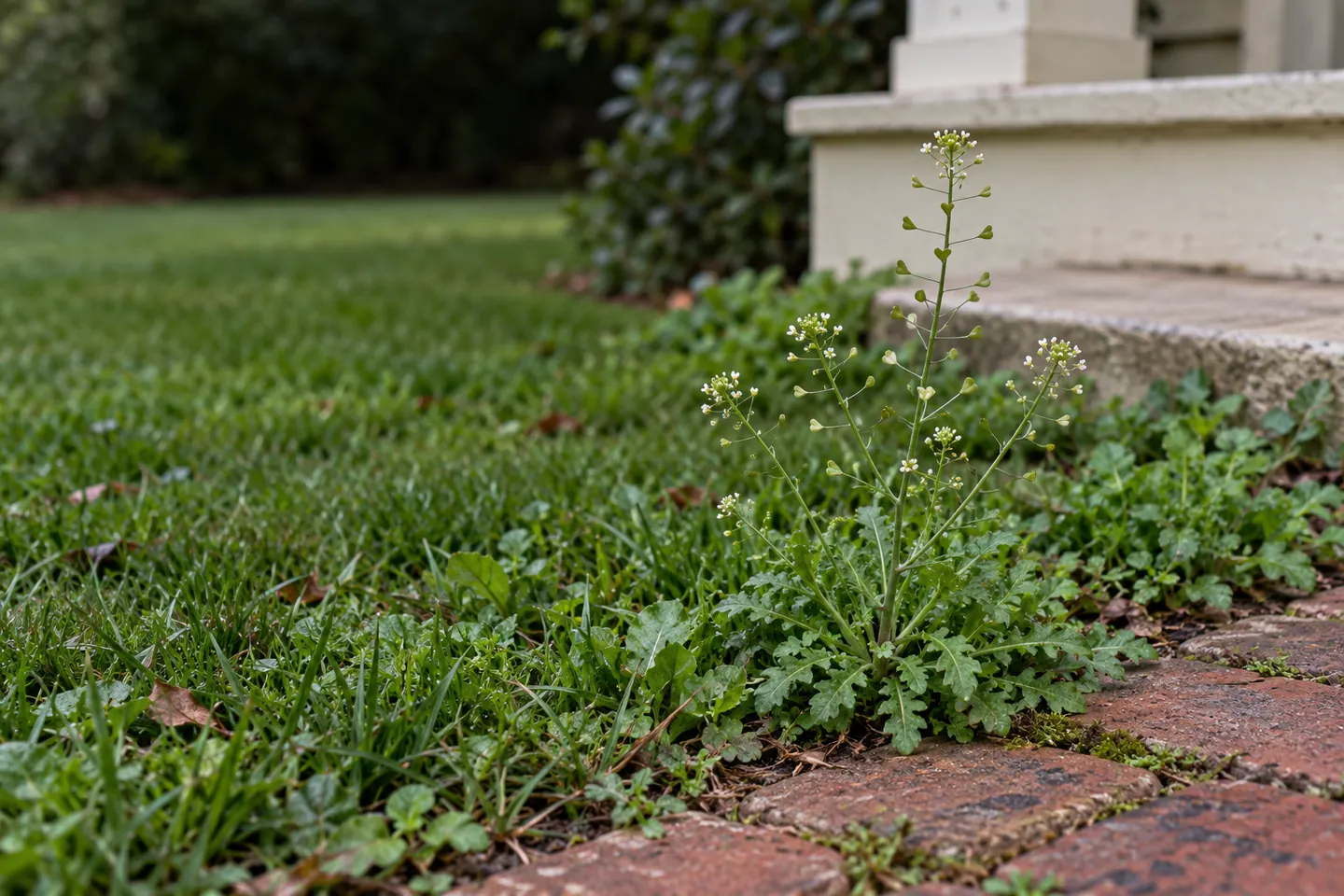
A shorter stand and an absent plant are different results
After any agreed surface work, describe the visible result at the marked boundary. The tall stems may be less conspicuous while other parts of the plant remain. Do not call the plant eliminated simply because the view is tidier. The reference's underground-stem description is a reminder to keep the claim modest, not an instruction for you to investigate below ground or diagnose the whole property yourself.
The same distinction helps with follow-up. If shoots become noticeable later, identify the location and date. Do not assume the new observation proves a previously promised eradication failed when eradication was never the agreement. A clear surface-maintenance result can coexist with an unresolved long-term plant question. Both should be recorded in the terms actually used to arrange the work.
Keep neighboring land out of an assumed task
A stand beside a rear fence may visually merge with similar growth outside the property. That does not establish shared ownership, a shared source or permission to work beyond the boundary. Describe which area you can authorize and what is merely visible in the background. Do not ask Happy Grass to settle a property-line or neighboring-vegetation dispute through an ordinary maintenance visit.
If the boundary itself is uncertain, keep the request within an agreed area until the owner resolves it appropriately. A plant's apparent continuity across a fence is not a substitute for a known work limit. This is especially important when the desired result sounds broad, such as clearing everything behind the yard. Translate that phrase into a definite authorized location before treating it as a task.
Build a useful record of the stand's history
Record the last time the area was known to be maintained, if that information is reliable. Distinguish a dated photograph from a recollection that the corner used to be shorter. Neither should be converted into a precise growth rate without supporting observations. A straightforward history can help explain the present request while leaving the origin of the stand unresolved.
If the stand has already been cut before identification, tell the reviewer. The remaining shape may not display the same features as an intact mature plant. Keep any earlier photographs with their dates and avoid combining their visible heads with a later base as though the two were documented together. A sequence can be useful when its gaps remain clear.
Arrange a review that matches the question
A good first inquiry identifies the stand, the accessible side, the authorized boundary and the result you want discussed. It can also acknowledge that the name is provisional. Ask whether the condition fits the routine work being considered and what information is needed before any visit is confirmed. That is more useful than requesting an ordinary cut while privately expecting complete removal of a perennial stand.
- Show the transition from maintained lawn to taller growth.
- Distinguish leaf height from the highest head.
- Keep access, ownership and plant identity as separate questions.
- Define the visible finish without implying permanent plant elimination.
For a Belle Chasse or Westwego property, this keeps the conversation practical. You can want a neater usable yard and still recognize that a separate tall stand may need its own review. Clear evidence and scope help everyone understand what the proposed visit is intended to accomplish, and what decision remains afterward.
Review the tall-growth boundary with Happy
Call 504-339-3571 and ask for Happy. Describe the actual stand and route before discussing mowing, edging, weed-eating or blowing. Confirm whether the proposed routine work fits the site condition, the authorized boundary and availability.