
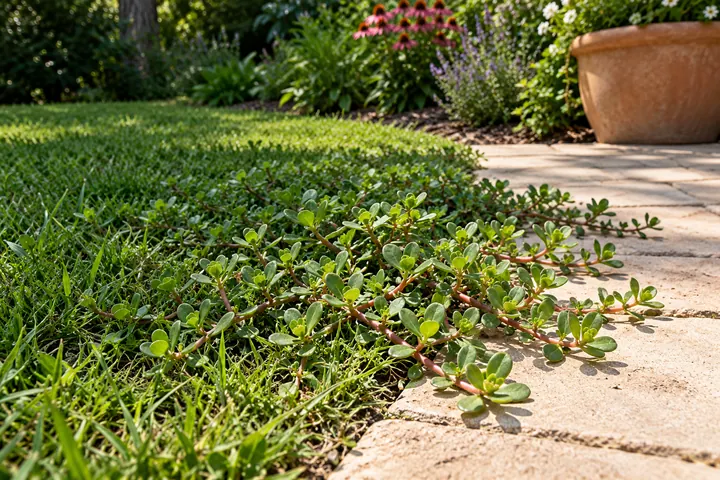
Start with the low plant's structure
The University of California gallery describes common purslane as a summer annual with a prostrate, spreading habit. Its leaves and stems are succulent, the leaves are oval to spatula-shaped, and the stems may be reddish. Small yellow flowers and round capsules with a lid are additional features in the account. Reproduction is mainly by seed, with some capacity for establishment from stem pieces.
Those details help organize an inquiry, but they do not make every red-stemmed mat beside paving purslane. Begin with an attached leaf and stem, plus an overview of the marked example. Keep the identity provisional when flower or capsule details are unavailable. A useful message can explain the visible surface concern without pretending that a phone photograph has already settled every botanical question.
Fleshy is a description, not an invitation to squeeze
An image may show a thick-looking leaf, but the camera angle can exaggerate its depth. Include the outline and a side view where practical. Describe the part as apparently fleshy if the thickness is not clear. There is no need to crush an unidentified plant or stage a handling test to make a routine lawn inquiry more convincing.
Avoid using an identification page as permission to taste, consume or apply a plant. This guide is about describing a lawn example and defining a practical work request. Common names and broad visual resemblance do not provide that kind of assurance. If the identification matters beyond routine yard appearance, ask a qualified reviewer to assess the actual plant and the evidence required for that particular question.
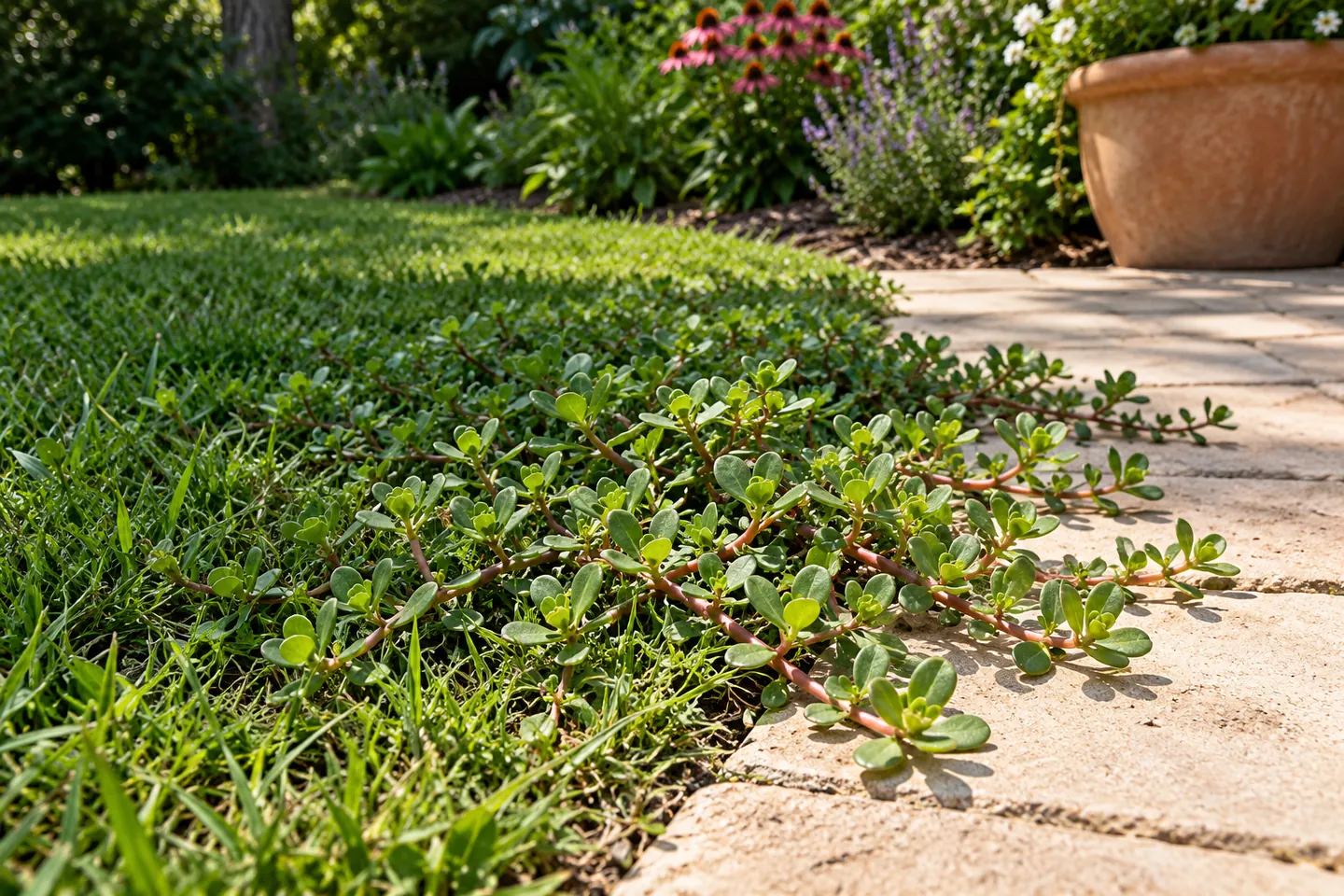
Red stems are useful context but weak shorthand
Stem color can help describe the example, yet a red or pink cast alone is not a complete comparison. Keep the color observation with the branching form and attached leaves. Ordinary lighting is useful; a heavily altered photograph can make it difficult to know whether the image or the plant supplied the color. Preserve the original file beside any adjusted crop.
When two examples are compared, photograph them under reasonably similar light and label them separately. A shaded stem and a sunlit stem can look different on a screen. Do not turn that difference into a species conclusion by itself. A reviewer can consider color among the other features while the location record remains useful regardless of whether the first candidate name is retained.
Trace the mat before deciding its footprint
A low branching plant can pass beneath turf or another plant and reappear on the far side. An overview helps show the visible footprint, but it does not prove every hidden connection. Describe the area where attached stems can actually be followed. If two patches have no visible connection, record them as separate observations rather than one measured individual.
This distinction matters beside pavers because the visible plant may cross several kinds of surface. Label the turf, joint and bed margin separately. A larger green outline in a photograph does not tell Happy which of those areas you want included in a routine visit. Show the fixed boundary and state the requested area, even while the plant's full connected footprint remains uncertain.
A small flower can be hidden by the leaves
The gallery's yellow-flower description can guide a close observation when an open flower is present. It cannot be confirmed from a yellowish blur under overlapping leaves. Include the attachment and position if the detail is readable. When no open flower was seen, write not observed rather than no flowers exist. A single visit does not necessarily reveal every structure the plant can produce.
The same care applies to the round, lidded capsule. A dark speck or an ordinary cut stem is not automatically that structure. Ask a reviewer which view would be useful instead of prying apart an unidentified object to find the expected lid. A photograph can remain valuable as a stem-and-leaf record even when the flower and fruit questions still need additional evidence.
Stem fragments need an honest history
The UC account's note about stem pieces supports care in describing detached material. It does not prove that a particular clipping in your yard has established a new plant, nor that routine equipment moved it there. If loose pieces are part of the concern, photograph their location and record what is actually known about when they appeared. Leave their origin unknown when it was not observed.
A detached piece lying on a paver is different evidence from a stem visibly attached to a rooted plant. Keep those records separate. Do not convert a possible biological pathway into a claim about the cause of a customer's patch. A maintenance follow-up should compare the observed condition with the agreed work while preserving uncertainty about events nobody actually saw.
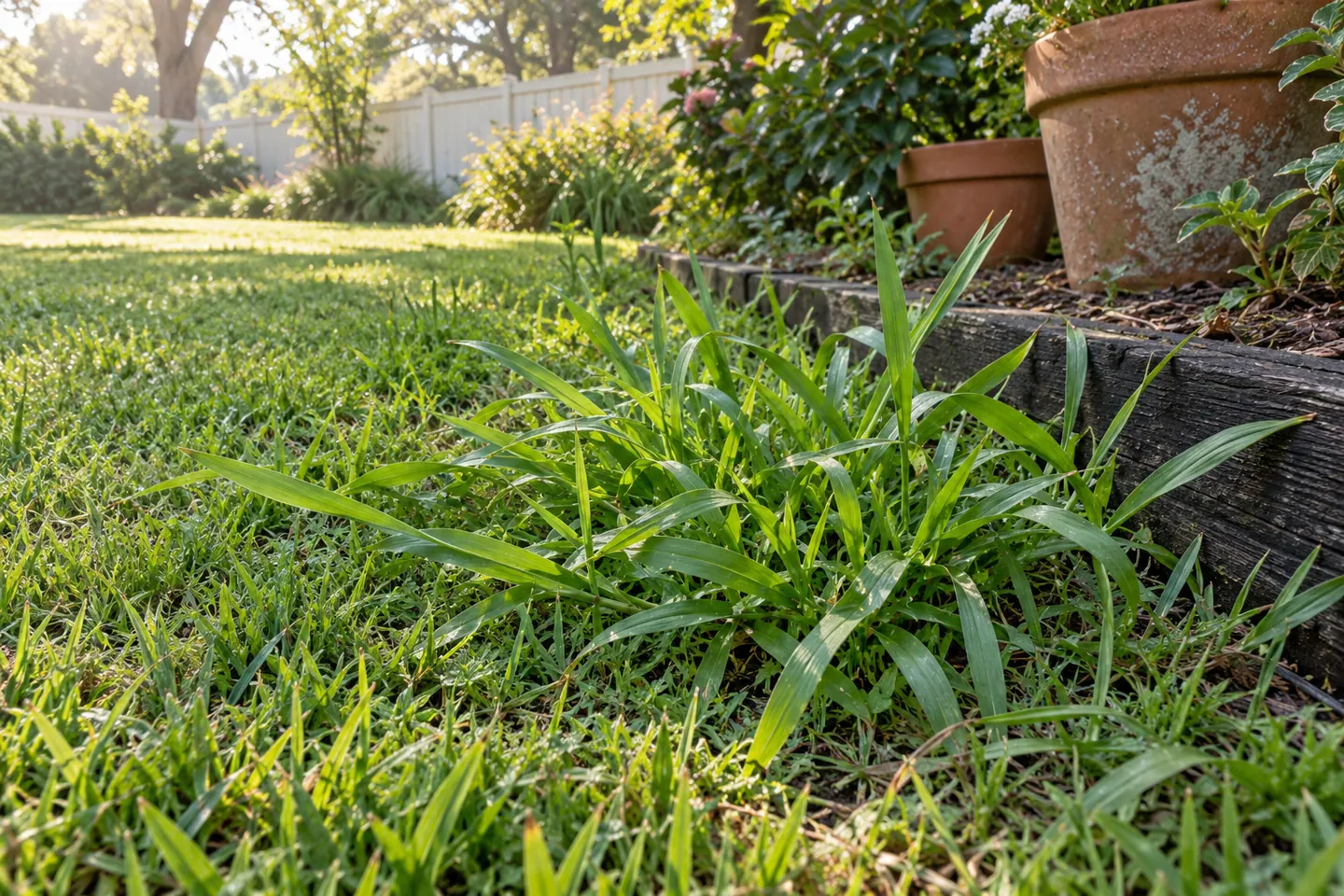
Ground contact is not proof of rooting
A stem resting against soil may be attached elsewhere, detached or partly hidden. A top-down photograph often cannot distinguish those situations. Describe contact as contact unless the actual attachment or rooting relationship was observed. There is no benefit in drawing a root system under a photograph that only shows a surface stem. A reviewer may request a different view if that distinction matters.
For a Belle Chasse yard, a useful message can identify the pale-paver edge and show the low plant without claiming a complete belowground history. The immediate practical concern may be visual spread across the joint or a different texture beside the turf. Those are clear observations that can be discussed while a separate question about establishment remains unresolved.
A low mat is not an automatic height target
Routine mowing addresses an agreed lawn surface, but a low plant crossing a paving edge may require a different discussion about the precise location and finish. Explain whether the concern is the turf appearance, the joint, or loose material on the hard surface. A close-up of a fleshy leaf cannot define which operation is being requested.
Confirm the mowing, edging, weed-eating or blowing proposed for the marked area and the result included in that work. A tidier boundary should not be described as a guarantee that every seed or stem fragment is absent. Equally, a remaining low leaf should be evaluated in relation to the actual agreed task. Defining the result before the visit makes the follow-up conversation more useful and fair.
Measure the requested edge rather than guessing a hidden plant
If Happy needs a rough description of the affected boundary, describe the visible section between fixed points such as the first and fourth paver. That identifies a work location without pretending to measure one plant's unseen connections. If you provide a distance, explain how it was measured and which endpoints it covers. Do not infer an exact mat area from a close-up whose perspective and scale are unknown. A useful boundary measurement and a botanical footprint are different records.
Keep any scale object outside the plant where it can be placed without disturbing the example, and make clear that it measures the pictured surface rather than an underground system. You can instead use an overview with recognizable fixed features when a measurement is unnecessary. The practical goal is to prevent a request for one short joint from being interpreted as every seam across the patio. When several disconnected patches are involved, number their locations separately and state whether all are part of the proposed discussion. This gives Happy a usable description of the area while preserving uncertainty about how many individual plants are present. It also makes a later result easier to compare with the agreement: both people can return to the same endpoints instead of debating what the phrase all along the paving originally meant.
Preserve a clear before-and-later comparison
Choose one fixed viewpoint that shows the boundary and another that shows the marked plant detail. Keep observation dates separate from any known maintenance date. If the later photograph shows a different example, label it accordingly. A new-looking piece in the same joint is not automatically proof of what happened to the original plant.
Ask an identification reviewer whether the attached succulent-looking leaves, branching red-toned stems and any readable flower or capsule support common purslane. Explain the missing evidence rather than copying it from the reference. For the lawn discussion, give Happy the fixed area and desired visible finish in a separate sentence. That keeps the plant inquiry from becoming an unstated service promise.
- Separate the visible footprint from hidden connections.
- Label attached stems and loose pieces differently.
- Record flowers as unobserved when the view is insufficient.
- Define turf and paving work as specific locations.
Discuss the paver-edge concern with Happy
Call 504-339-3571 and ask for Happy. Describe the marked area, access and the mowing, edging, weed-eating or blowing you want considered. Confirm scope and availability before arranging a visit.