
One familiar name can cover more than one plant
When someone calls a plant cheeseweed, ask which example they mean before treating the word as a settled identification. UC's mallow account applies that common name to both common mallow, Malva neglecta, and little mallow, Malva parviflora. The two resemble each other closely. A homeowner can preserve a useful record without choosing between them immediately, especially when the only available photograph shows a round green leaf beside the lawn.
The UC comparison uses flower and fruit details. It describes common mallow with notched petals longer than the sepals and a smooth, flattened, segmented fruit. Little mallow has shorter petals and wrinkled fruit. Common mallow's leaves are rounded and lobed on stalks, with alternate mature attachments. Treat these as questions to document rather than a script to copy into a message as though every trait had already been observed.
Begin with the fruit still attached
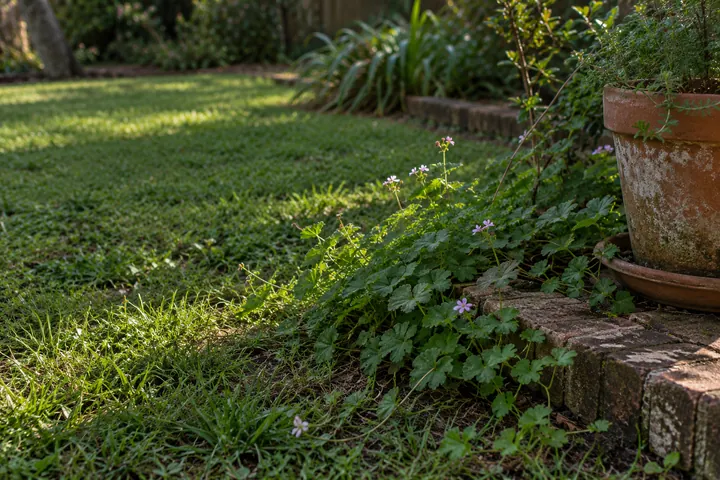
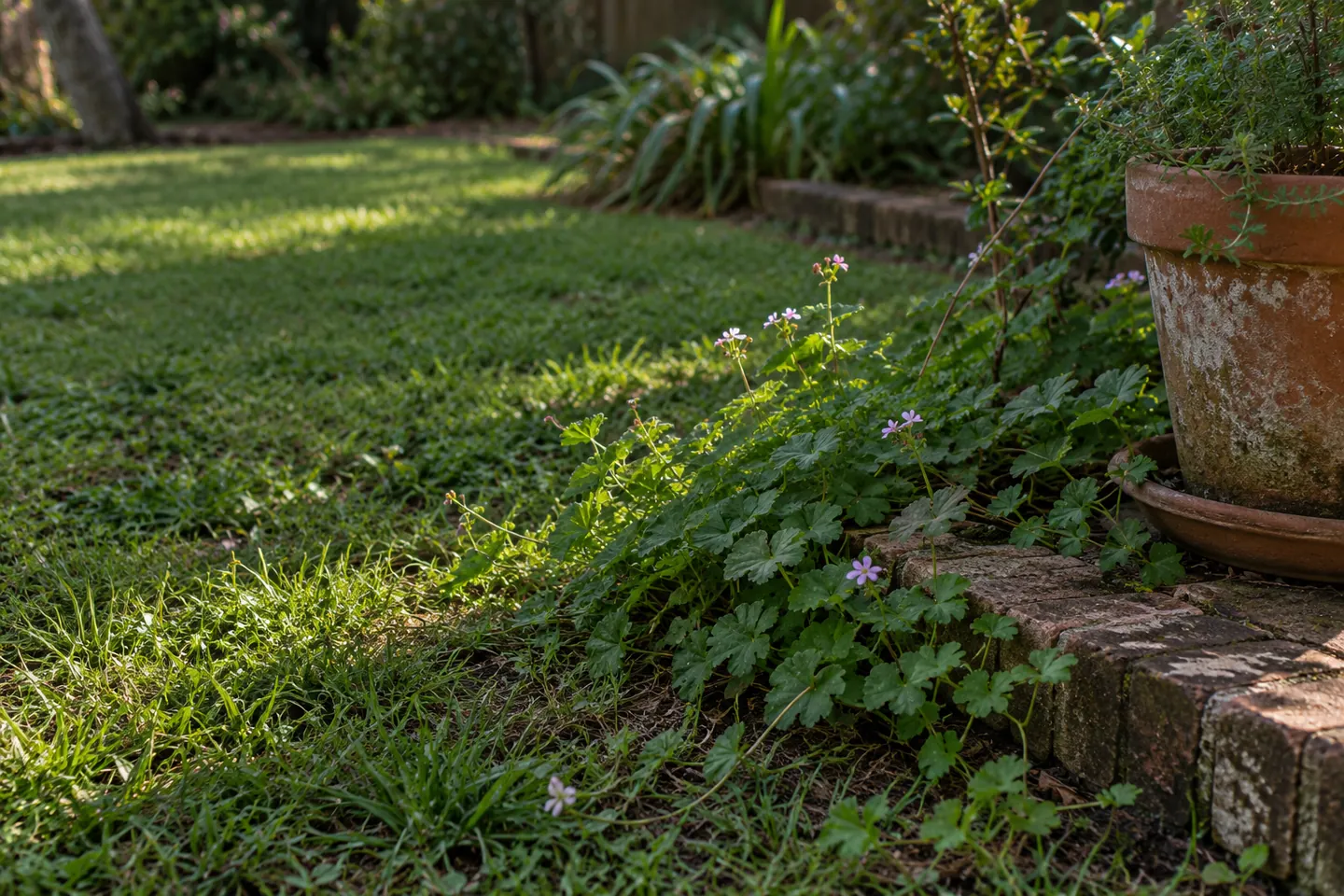
An attached fruit provides more context than a loose little disk on a path. Show its supporting stalk, the neighboring leaf and the part of the plant they join. Include an overview of the marked example beside the terracotta pot or other fixed feature. If the attachment is hidden, label that limitation instead of using a nearby object to complete the candidate's description.
A small fruit can look smooth in a blurred photograph even when its surface is not resolved. Write surface detail unclear when that is the actual situation. Do not interpret a lack of visible wrinkles at an inadequate scale as proof of a smooth surface. The distinction is especially useful here because the species comparison asks about a fine detail that an ordinary distant lawn photograph may not capture.
Preserve the face and the edge of the little disk
One angle may show the fruit's broad face while another reveals its thickness and attachment. Keep those views under the same example label. A simple pair can be more useful than an extreme enlargement of one ambiguous surface. If the object was detached before the second photograph, explain when that happened and how its origin was recorded. The reviewer should not have to guess whether two images show the same item.
Avoid drawing segment lines on an unclear photograph and then using the drawing as evidence. An annotated copy can point to the feature being discussed, but the original needs to show what was actually visible. Put labels in the background rather than across the fruit's outline. When the detail cannot be resolved, a qualified reviewer can advise which additional view or specimen information would help.
Compare petals with their own flower base
The petal-length question involves the same flower's sepals, the leaflike parts around its base. A large petal from one flower and a short sepal from another are not a reliable comparison. Show an intact flower with its base and keep a wider image linking it to the marked plant. The relative proportions matter more than the apparent size of the flower on the screen.
Do not assign a ratio from a tilted image whose parts lie at different angles to the camera. A side view may make one part appear shorter simply because it points away. Describe which parts are readable and ask whether the view supports the comparison. A precise-looking number is less useful than a clear statement that the petal tips are visible but the base remains hidden behind another structure.
Notched petals can complicate a quick count
The UC account explains that notches in common mallow's five petals can make the flower look as though it has ten. Keep the petal bases in view if counting is part of the inquiry. A count made only from the outer tips may be answering a different question. There is no need to pull a flower apart to make a more impressive identification packet for routine lawn help.
If a flower is damaged or partly closed, say so and keep it separate from a clearer example. Do not combine the readable half of one flower with the readable half of another and describe the result as a complete observation. Separate records remain useful. The reviewer can explain which example is stronger and which detail still needs confirmation without losing the location of the actual lawn concern.
A round leaf needs its stalk and margin
A nearly circular outline may be the feature that first catches your eye. Show the whole blade, its lobes and the place where the stalk joins it. Keep a view of the mature stem attachment as well. A round detached leaf alone can resemble many things, and a close crop may conceal the very notch or connection that another person needs to understand the shape.
When several leaves overlap, select an example whose boundary is readable. Label a second plant separately even if it has similar foliage. A mallow inquiry becomes less clear when a picture set silently borrows the largest leaf in the area and pairs it with the most attractive nearby flower. Your record can be modest and incomplete while still preserving the relationships that were actually seen.
The cheese nickname does not answer a use question
Keep the common-name discussion within the identification inquiry. A familiar food word does not establish that an unknown lawn plant is suitable for consumption or another use. This page does not provide that assurance. The useful next step is a qualified review of the actual example when its identity matters beyond the visible lawn appearance, with the intended question explained clearly to the reviewer.
For routine maintenance, describe what is present and where it lies. A homeowner may want a pot-side patch reviewed without needing to resolve every possible use of the plant. Those conversations can stay separate. Happy should receive a clear description of the lawn area and desired finish, while an identification specialist receives the attached flower and fruit evidence needed for a narrower botanical comparison.
The surface finish and the crown are different outcomes
A shorter visible plant is not proof that a whole crown or root has been removed. UC's account explains why ordinary mowing is not the same as complete mallow control. Use that background to set a clear scope, not to diagnose the hidden condition of an individual root. A surface photograph cannot establish whether every belowground part remains, was removed or was ever connected to the marked leaf.
State whether the concern is the raised foliage, the low spreading texture or an edge where the plant crosses from turf toward the pot. Confirm which mowing, edging, weed-eating or blowing is proposed for the included area. A routine visit should be assessed against the agreed visible work. It should not inherit an unstated promise about permanent absence, future seed or a separate removal task merely because the candidate name was discussed.
Track the example rather than rewriting its history
Save the observation date with each image. If a later fruit view came from another plant, call it a comparison rather than the next stage of the first example. A convenient collection of flower, leaf and fruit pictures can look like a complete life history even when the photographs were made at different locations. Honest labels prevent that accidental story from becoming part of the identification record.
When a reviewer revises the name, preserve the earlier candidate and the reason for the correction in a short note. Keep the location label unchanged. That makes a follow-up understandable to another person and lets you find the same area again. The practical lawn map can remain accurate even while the botanical conclusion improves, which is much more useful than starting over with a new unlabeled album.
Send a comparison that leaves room for an answer
A useful first question asks whether the attached fruit surface and the flower-to-sepal proportions support common mallow or whether the evidence is insufficient to distinguish it from another mallow. Include the leaf and overall plant, but make the unresolved fine detail explicit. You do not need to present a final name in order to have a focused conversation about the visible patch beside the lawn.
- Keep common mallow and little mallow as separate candidates.
- Show an attached fruit before interpreting its surface.
- Compare petals with the base of that same flower.
- Count petal bases rather than only notched outer tips.
- Define the pot-side work boundary independently of the name.
Bring the pot-side patch to Happy
Call 504-339-3571 and ask for Happy. Describe the marked lawn area, current access and the mowing, edging, weed-eating or blowing you want considered. Confirm the actual work and availability before arranging a visit.