
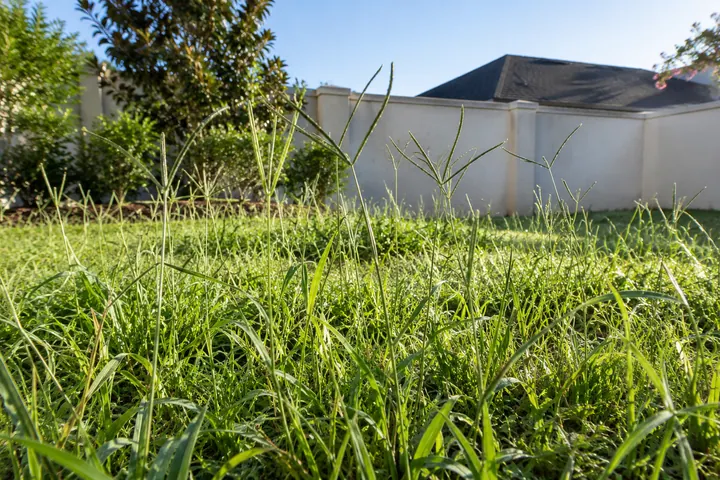
A recurring outline deserves a specific question
You look across the lawn and notice a few forked heads standing above the surface. The last cut may still look tidy around them. It is tempting to reduce the issue to a single question about mowing more often, but that may skip the part that matters most: are you concerned about the raised heads, the coarse clump beneath them, or a mismatch with the surrounding grass? Start by naming the visible difference rather than assuming one extra pass answers every concern.
LSU AgCenter describes bahiagrass as a warm-season perennial that may occur as an unwanted grass in a lawn. Its profile notes coarse, light-green, pointed leaves and a head commonly made of two spikes forming a V, with dark flowers along them. It also describes underground spreading stems. These features help frame an identification review. A V-shaped silhouette alone does not prove a particular lawn plant is bahiagrass, establish its origin or determine the appropriate maintenance request.
Separate the forked head from the coarse patch
Photograph the whole clump and the raised structure as related but distinct parts. A close-up of the fork may be useful for naming the grass, while a lower view may better explain why the patch looks uneven after mowing. Keep both questions available. If the heads are the only feature you dislike, say that. If the lawn would still look patchy without them, a request limited to the heads may not address your concern.
Use a familiar viewing position when describing the patch: the driveway entrance, the front step or the path beside the house. A textured area can look different from opposite directions, especially when the light changes. The service discussion should refer to the view you actually care about rather than a single dramatic photograph taken from ground level. Include that wider view before focusing on small plant features.
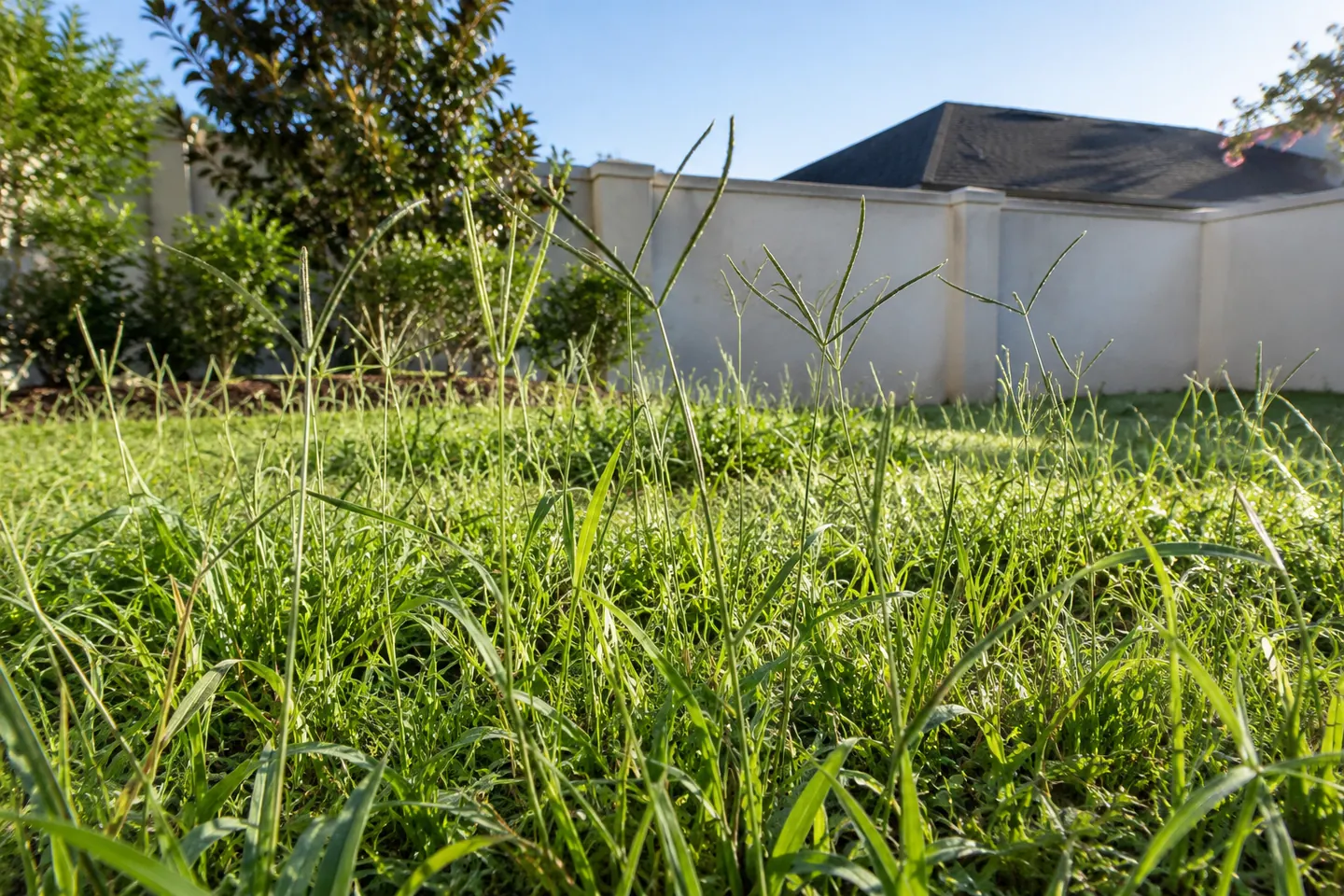
Do not turn one fork into an automatic name
Several grasses can produce branching structures that look similar in a quick phone picture. Keep the number and arrangement of visible branches clear, but avoid treating an incomplete outline as conclusive. A head may be broken, partly hidden or seen at an angle. Explain whether the whole structure is visible and connected to the pictured clump. If it was found loose after cutting, identify it as a separate item.
For a clearer comparison, photograph the same attached head from two angles without changing its shape. Include the leaves and base in another frame. An extension identification review may require more than the outline, and that is normal. You can still request help with a routine lawn finish while acknowledging that the plant name remains tentative. Uncertainty about the name does not require uncertainty about the task boundary.
Write down what makes the recurrence noticeable
When the heads catch your attention again, note the observation date and the last known maintenance date separately. Avoid using the phrase overnight growth unless you actually compared the same location on consecutive days. A long stalk noticed today may simply have escaped yesterday's photograph. The record should explain what you know, not convert an impression of speed into an exact growth claim.
Describe the number of conspicuous areas at a useful level. Three marked clumps beside the driveway is more informative than thousands of weeds everywhere if no count or boundary supports that statement. You do not need to count every head. Identify the places that repeatedly interrupt the appearance you want and distinguish them from the rest of the lawn. A focused follow-up gives Happy a concrete result to review.
Set the service boundary around the actual concern
A roadside-looking strip and the home's front lawn may not share the same ownership, access or maintenance agreement. Do not assume a coarse grass connects them into one authorized task. Explain which portion is yours to request work on and where the proposed visit should stop. A photograph can include adjacent land for orientation without asking Happy Grass to alter it.
Use a fixed boundary that remains understandable after the grass is cut. The inside driveway edge to the front walk corner is better than the area behind those three tall stalks, because the stalks may be gone by the time someone arrives. Stable landmarks make the instruction reviewable. They also help keep a follow-up from shifting to a larger area than the one originally discussed.
Define appearance without promising removal
Mowing can be discussed as a surface-maintenance task. It should not be described as proof that a perennial grass has been eliminated. The LSU background about underground stems is one reason to keep those claims separate, but you do not need to investigate below ground to make a sensible request. State the visible result you want and ask what the proposed routine work can reasonably include.
If you want a longer-term change in the lawn's grass composition, say that this is a separate question needing appropriate review. Do not use an ordinary maintenance booking as an implied treatment agreement. Happy Grass's discussion here concerns mowing, edging, weed-eating and blowing. A technical reference may describe additional practices, but those practices do not become offered services simply because the article is linked from a guide.
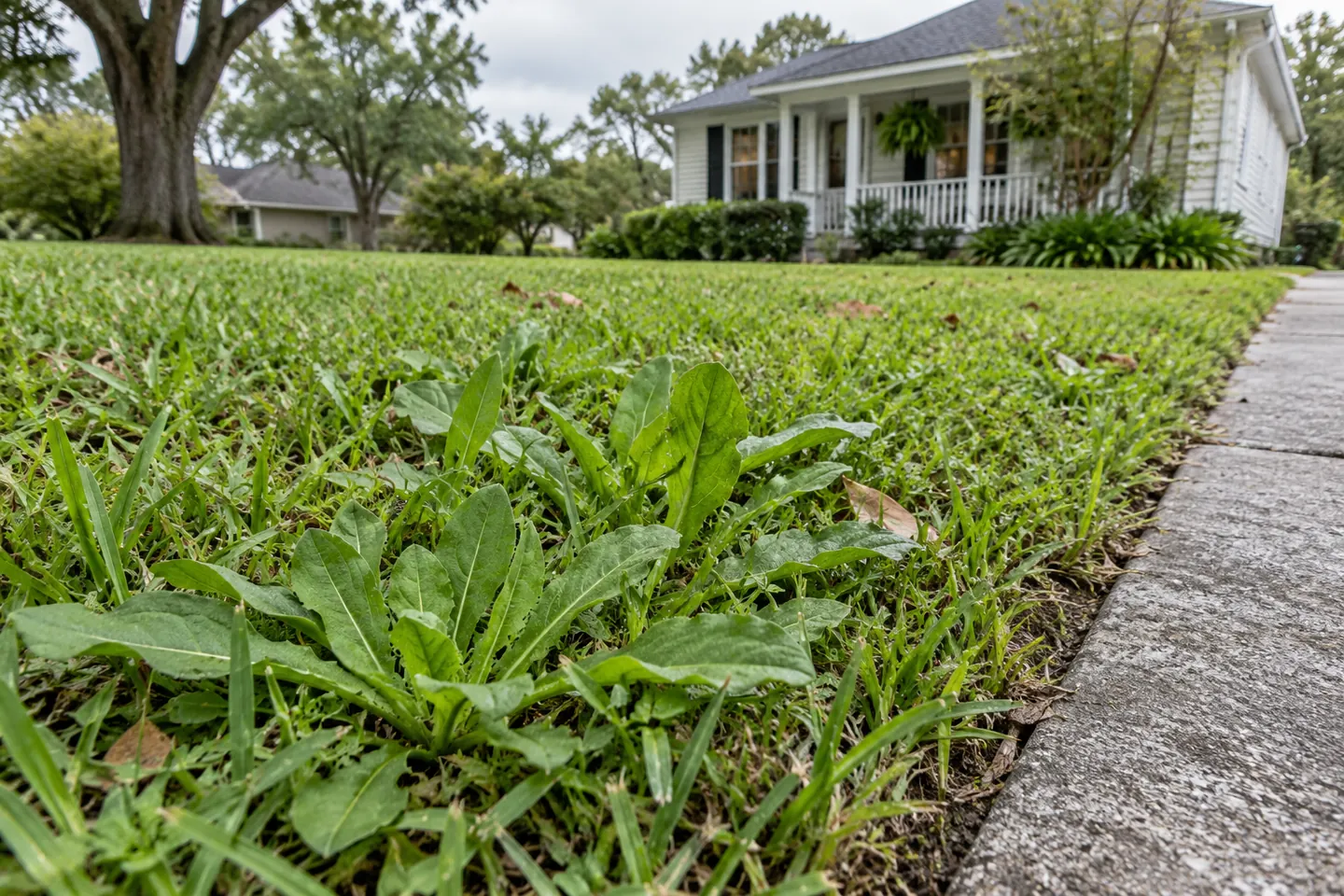
Avoid making the surrounding turf pay for one contrast
A coarse patch can invite a request to lower the entire yard until everything looks alike. That request needs reconsideration in light of the lawn grass actually present. The appearance of one clump is not enough information to specify an overall mowing height. Ask how the proposed finish accounts for the surrounding turf rather than treating the tallest visible structure as the sole target.
Bring the whole-lawn view to this conversation. A provider needs to understand whether the contrasting plants occur in an otherwise consistent lawn or among several textures. A short message can capture the distinction: the heads beside the drive stand out, but the rest of the lawn's current height is the part we want to preserve appropriately. The exact arrangement of work should then be confirmed for the actual site.
Compare follow-up views fairly
Use the same driveway or walk reference for a later photograph. Keep the viewpoint reasonably consistent and identify any change in lighting or maintenance history. If a fresh photograph shows heads again, say that. Do not claim that the clump doubled in size unless the image and the boundary genuinely support a size comparison. A repeated visual interruption and a measured expansion are different findings.
- Record the marked clump or strip being compared.
- Distinguish leaf texture from stalk visibility.
- Note when maintenance is known to have occurred.
- Describe the appearance before offering an explanation for it.
These notes do not need a spreadsheet. A few dated sentences can be enough to distinguish a new concern from a repeated one. Keep the record useful for the next conversation instead of turning it into an unsupported argument about how the grass arrived.
A useful request can remain modest
You may decide that the first goal is simply a clearer driveway-side finish and a fair review of recurring heads. That is a legitimate maintenance question. You may instead discover that the coarse base is the real issue and want identification advice before deciding what to do. Either outcome is more useful than repeatedly requesting the same cut while expecting an unspecified change in the lawn's composition.
For a Belle Chasse or Harvey property, provide the marked boundary, the relevant photographs and the outcome you want discussed. Let the name remain provisional if necessary. Clear scope and honest evidence make it easier to assess what a visit accomplished and what question remains afterward. A tidy lawn conversation starts with a task someone can understand and a result someone can actually review.
Compare a clump outline with its own earlier view
When the coarse base is the concern, use a fixed nearby paving joint to describe its visible footprint rather than the span of the tallest heads. A stalk leaning outward can make a patch look wider without showing that its base changed. Keep those dimensions separate in the caption. If the base is hidden by the surrounding lawn, leave the extent unresolved instead of outlining a precise patch from the flowering structures alone. This gives a later site discussion a more honest starting point.
Review the coarse-grass area with Happy
Call 504-339-3571 and ask for Happy. Explain whether your concern is forked heads, coarse texture or both, and identify the authorized area. Confirm availability and the specific mowing, edging, weed-eating or blowing proposed for the visit.