
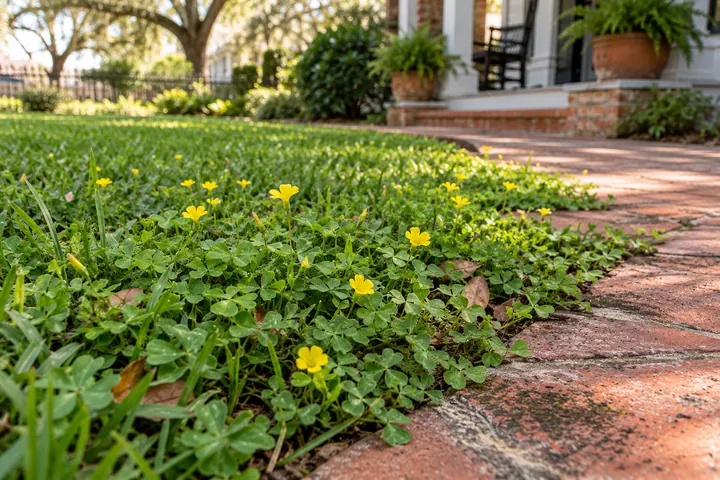
A yellow dot is a starting point
You may notice the flowers before the plant: little yellow dots beside a patio, scattered through short grass or gathered near a bed border. From standing height, several unrelated low plants can blend together. Start by asking whether the flowers and leaves you are looking at actually belong to the same stem. That connection is more useful than a quick label based on color. If the view is unclear, record the uncertainty and keep the wider scene in the photograph.
Black medic is one possible identification for a low plant with small yellow flowers and three-part leaves. It is not the only reason a maintained lawn might contain yellow blooms. The practical first task is to document a connected plant, rather than assemble a description from whichever nearby features resemble an online picture. This guide helps you prepare that record and discuss the finish you want from lawn maintenance. It does not diagnose your soil or select a treatment from a flower photograph.
The features worth asking an adviser to check
LSU AgCenter describes black medic as a spreading, low-growing legume. Its leaves have three oval leaflets, with the middle leaflet carried on a longer stalk. Small yellow flower clusters later develop dark seed pods. LSU notes that the plant often behaves as a winter annual in Louisiana, growing from a central taproot. These connected features are more informative than the phrase yellow clover, but an identification still needs an adequate view of the actual plant.
Use the botanical name Medicago lupulina only as a proposed identification until the evidence supports it. If a professional identifies another species, retain that answer with the same photographs rather than altering the original record to make your first guess look correct. The illustration here shows low foliage and small yellow flowers in a general yard setting. It does not confirm black medic, distinguish it scientifically from other plants or document work at a customer property.
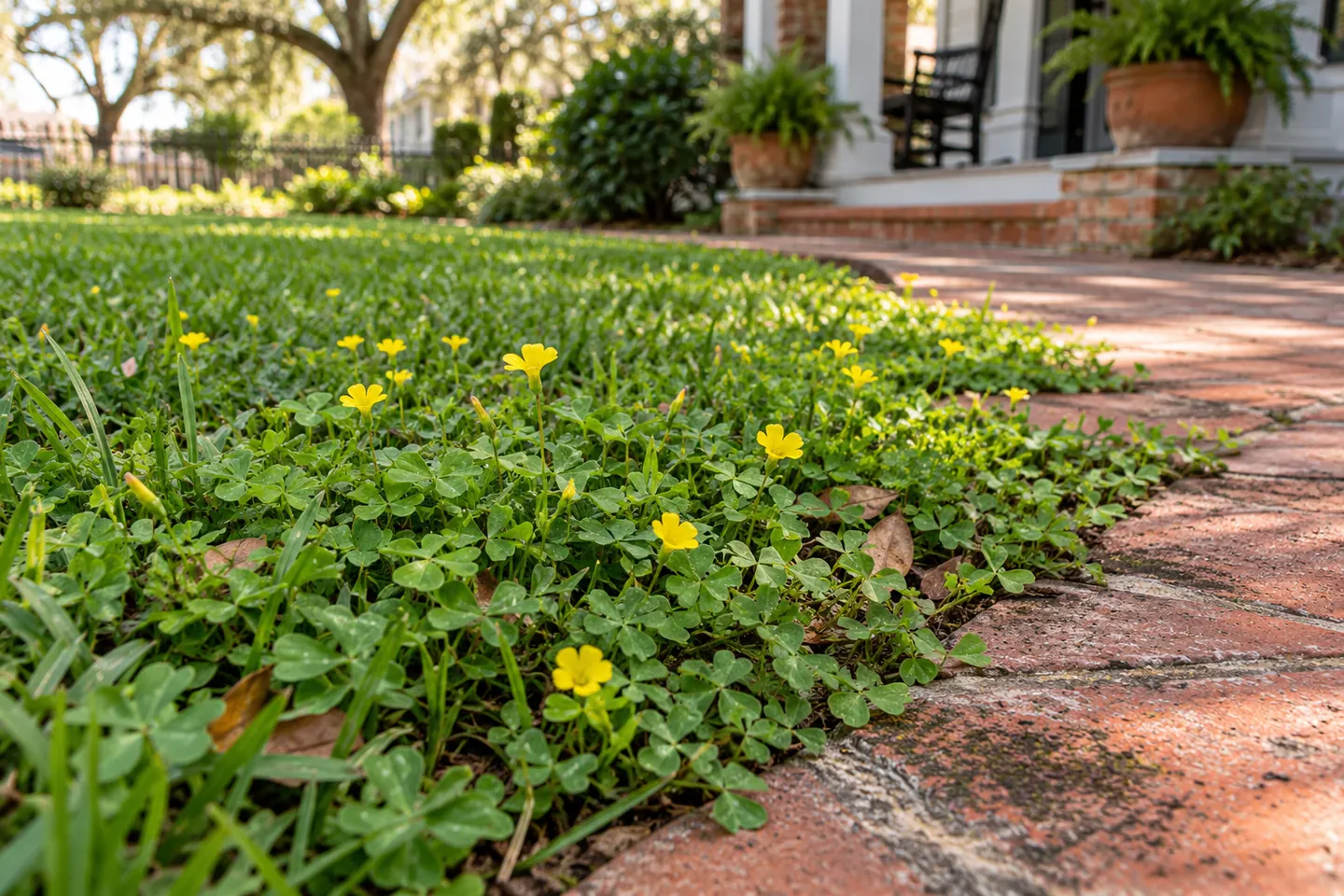
Photograph the leaflet attachment, not just three green shapes
For an identification photograph, try to show the small connection between the leaflets and their stalk. A close crop of three overlapping leaves can hide the very feature that prompted the question. Photograph the leaf group in place if you can obtain a clear view without pulling the plant apart. Include the adjacent stem so the reviewer can understand what is connected. If the camera focuses on the paving behind it, retain the attempt but do not describe an invisible feature as confirmed.
Keep a second image showing the whole low plant in relation to the grass. That view helps explain whether you are asking about an isolated plant or a broad patch. A detached leaf can be useful if an adviser requests it, but label it as detached and say where it came from. Do not silently combine a leaf from one location with flowers found elsewhere. The usefulness of the record depends on preserving the connections that were actually observed.
Distinguish this question from yellow woodsorrel
A lawn may contain more than one kind of three-part leaf. If you have previously discussed yellow woodsorrel, do not automatically apply that identification to every new yellow-flowered plant. Make a separate record for the new observation and compare the attached leaf groups and flowers that you can actually photograph. An adviser can tell you which differences matter. Your job is to preserve them rather than choose a name because it is already familiar from another part of the yard.
For a maintenance discussion, the distinction can be practical even before identification is finished. One patch might sit within the grass area you want reviewed, while another grows over a border you intend to keep separate. Explain those locations independently. A generic instruction to remove the clover can hide both an uncertain identity and an uncertain work boundary. Clear descriptions let Happy discuss the actual request without having to accept a guessed plant name as the entire scope.
Record flowers and pods as different observations
If flowers are present, photograph a cluster on the plant and retain the date. If dark seed-like structures are visible later, give them their own dated image. Do not assume that a dark speck on the soil is an attached pod simply because a reference describes dark pods. Trace the visible connection when possible, or explain that it could not be seen. A small detail becomes useful evidence when its location and attachment remain clear.
There is no need to wait for every life stage to appear before asking a question. Send the evidence available and let the receiving professional explain whether more is required. Likewise, do not strip the plants to assemble a complete display before a maintenance visit. That changes the scene and may remove material a reviewer would have preferred to examine in place. Ask about any requested collection method before turning a simple observation into a sampling project.
Read the patch in relation to the lawn footprint
Walk the accessible edge of the area and describe where the low foliage is noticeable. It may follow a paver seam, occupy a thin strip beside the patio or appear as separate islands farther into the grass. Mark those places on a simple private sketch using fixed landmarks. This can explain the scale of the concern without an unsupported estimate of how much of the whole property is affected. A patch photograph alone often leaves that scale unclear.
Keep the grass footprint separate from a bed or paved joint when discussing work. If foliage crosses the boundary, state which side is included in the request. Trimming a visible edge, mowing surrounding grass and addressing an established plant population are different outcomes. Ask which work is actually available and agreed. A provider should not have to infer that a broad weed-control objective was included because a few flowers appeared in the same photograph as the mowing area.
Avoid turning a plant association into a fertilizer instruction
Reference material can describe conditions where a plant is often found. That is not a measured nutrient report for your yard. If someone suggests a fertility explanation, ask what evidence would establish it and which service can advise on the soil question. Do not report an exact deficiency or choose an amendment solely because a suspected black medic plant is present. A plant identification and a laboratory analysis answer different questions, even when both may be relevant to a thin lawn.
You can provide useful context without making that leap. Describe whether the grass looks sparse beside the foliage, whether a large object recently covered the area and what changes are documented in your own records. Label uncertain history as uncertain. These details help a professional understand the setting without pretending they establish cause. Happy Grass does not offer fertilization, so a maintenance request should not be framed as an unspoken instruction to supply a nutrient treatment.
Agree on what the next cut is expected to achieve
Tell Happy whether your immediate concern is the visible stalks, the uneven appearance of mixed foliage or the boundary beside the patio. Discuss the actual grass condition and the proposed maintenance before selecting an expectation. A cut that changes the height does not establish that the plant has been eliminated. Conversely, low foliage remaining visible does not automatically prove that an agreed mowing task was omitted. Compare the result with the scope that was actually confirmed.
Avoid requesting an unusually low cut as an improvised plant-control method. The surrounding grass still needs an appropriate maintenance discussion. This guide gives no herbicide choice, rate or calendar and does not promise that repeated mowing will resolve a weed population. If a separate assessment or different service is needed, identify who is responsible for it. Keep the plant question specific enough that a useful answer can be obtained without assigning unsupported duties to a routine lawn visit.
Keep a comparison that preserves the details
After the agreed visit, return to the same wider photograph and note which visible features changed. Record the condition of the grass, flowers and low foliage separately. If identification is still pending, keep using a neutral label such as yellow-flowered patch beside patio. There is no advantage in making the name sound more certain while the evidence remains the same. A clear, dated comparison helps the next conversation focus on an actual remaining question.
Save the original image files alongside any identification reply and the maintenance agreement. If you later notice a different three-leaf plant near the fence, start a new entry instead of overwriting this one. That small organizational step prevents unrelated observations from becoming an apparent history of one spreading plant. The resulting record can stay short: a few labeled images, a confirmed finding if available and the work that was actually requested.
A useful first message
- Identify the patio or lawn section where the yellow flowers were observed.
- Keep the leaflets, stem connection and flower photograph associated with the same plant.
- State whether you want identification advice, a maintenance review or both through their appropriate providers.
You do not need to solve every plant question before starting the conversation. You do need to avoid turning an uncertain name into a guaranteed outcome. A careful first message gives the reviewer enough context to ask for the next useful detail, while leaving Happy a clear lawn task to discuss.
Talk to Happy about the maintenance scope
Call 504-339-3571 and ask for Happy about mowing, edging, weed-eating and blowing. Explain the grass and patio boundary rather than assuming treatment is part of a cut. Happy Grass does not offer fertilization, aeration, overseeding or pest-control services. Confirm any additional weed-control question against the actual available scope before arranging work.