
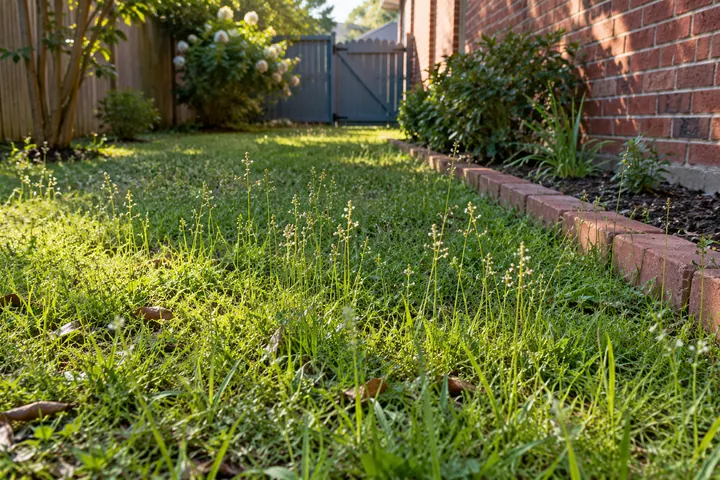
Start where the narrow leaves meet
The useful question is not simply whether something long and green is growing in the grass. It is whether several particular leaves belong to the same low plant. Buckhorn plantain can be difficult to discuss when the only picture shows a clipped stalk rising above a busy lawn. Start the conversation at the base, where the individual parts can be related to one another. A photograph that explains the connection is often more useful than a much larger collection of disconnected close-ups.
UC IPM describes buckhorn plantain with narrow, prominently veined leaves clustered around the plant base and upright, leafless flower stalks. The flowering head is a compact structure at the stalk's end; white projecting flower parts can be visible when flowers are open. These are features to examine together, not a diagnosis from a single green line. The reference includes California observations, so its flowering calendar should not be presented as a guaranteed local timetable for a West Bank yard.
The missing connection in a common photograph
Imagine a picture taken beside a driveway after the grass has been cut. It contains several narrow leaves and a dark oval at the end of a stalk. The camera has cropped out the ground. A viewer may recognize possibilities, but cannot confidently connect the oval to the leaves in that frame. Moving the phone closer to the oval does not restore the missing relationship. A second view needs to include the route from the stalk down to the plant base.
Give that second view a clear purpose. Keep a recognizable driveway joint or another fixed feature visible so the two pictures can be paired. Avoid rearranging loose cuttings to make the scene resemble a reference illustration. If a stalk was already detached, say so. An honest gap in the evidence is easy to work around; an apparently complete connection that was assembled after the fact can lead the discussion in the wrong direction.
Long leaves are not automatically lawn grass
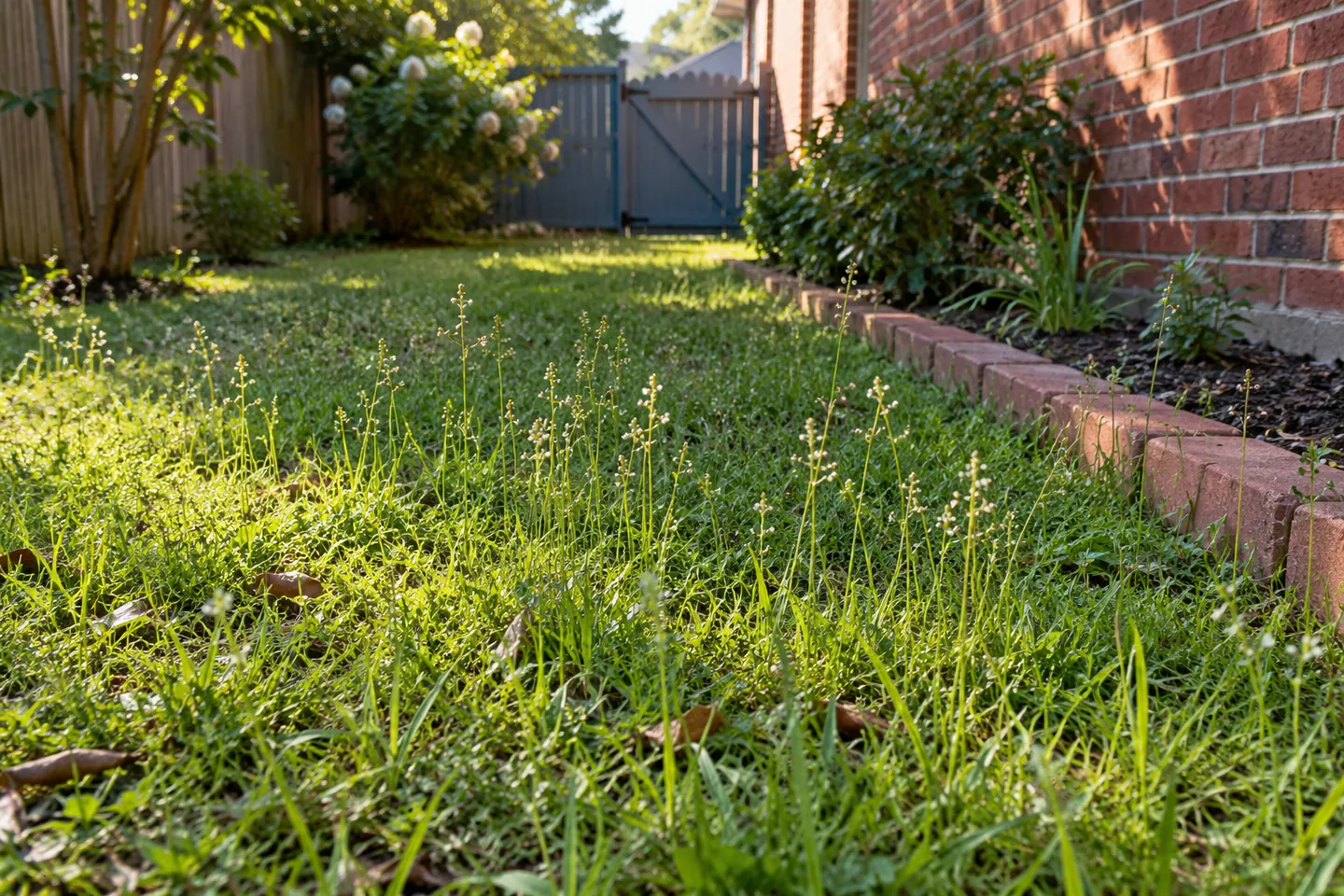
People often use the word grass for every narrow green leaf in a yard. That is understandable in ordinary conversation, but it can hide the very feature under review. Describe a small cluster of narrow ribbed leaves if that is what you can see. You do not need to supply a botanical label before contacting Happy Grass. A plain description lets someone ask the next useful question without treating your first guess as an established identification.
Try comparing the leaf cluster with the grass immediately beside it in the same frame. Is your concern the leaf's outline, its visible ribbing, the way several leaves meet, or the tall stalk? State which difference caught your attention. A photograph of the whole lawn may explain where the problem is, while a closer view explains why it looks different. Neither needs to carry all the information by itself.
Preserve the outline instead of sharpening a blur
An enlarged image cannot reveal a leaf margin that was out of focus in the original. Choose a clear view where the leaf separates from the background. If the camera keeps focusing on the ground behind the plant, change the angle and inspect the result before taking twenty more copies. The goal is a readable outline and the relationship between parts, not an impressive level of digital magnification.
- Include one intact leaf from its visible base toward its tip.
- Show the ribbing under lighting that does not wash the surface out.
- Keep the stalk and flowering head together in another view.
- Mark whether the photographed pieces were attached when observed.
This small set gives each image a job. It also makes it easier to explain uncertainty if some parts have already been cut or cannot be seen without disturbing the plant. Do not turn a missing feature into a confident written claim just because a picture on another website contains it.
Read the flower head as its own structure
The compact head and the long supporting stalk should be described separately. In a distant photograph, the head may look like a tiny dot and the stalk like a blade of grass. Say which part appears dark, pale or bent. If small pale projections are visible around the head, photograph that feature clearly and let a qualified identification review place it in context. Color descriptions without a named plant part are much harder to compare.
Do not expect a recently trimmed plant to display every reference feature at once. Record what was present before the work if you have a reliable dated view. If the head is absent, the review may remain provisional. Waiting for better evidence or asking the local extension office about identification is more useful than filling the empty space with a confident species name.
Give the stalk concern a location
A few upright stalks beside the front walk can be visually distracting even when they occupy very little ground. Explain the viewing position that makes them noticeable. For example, the concern might be the line seen from the front door rather than every plant of similar shape behind the house. That distinction helps define the finish being requested without implying that an entire property needs the same work.
Describe the actual boundary in words a person can follow: between the walkway corner and the first driveway panel, or along the inside edge of the fence opening. Use references you can identify from the property, not exact coordinates or a public landmark assigned to a photograph. A precise task boundary can remain useful even while the plant identification is still being checked.
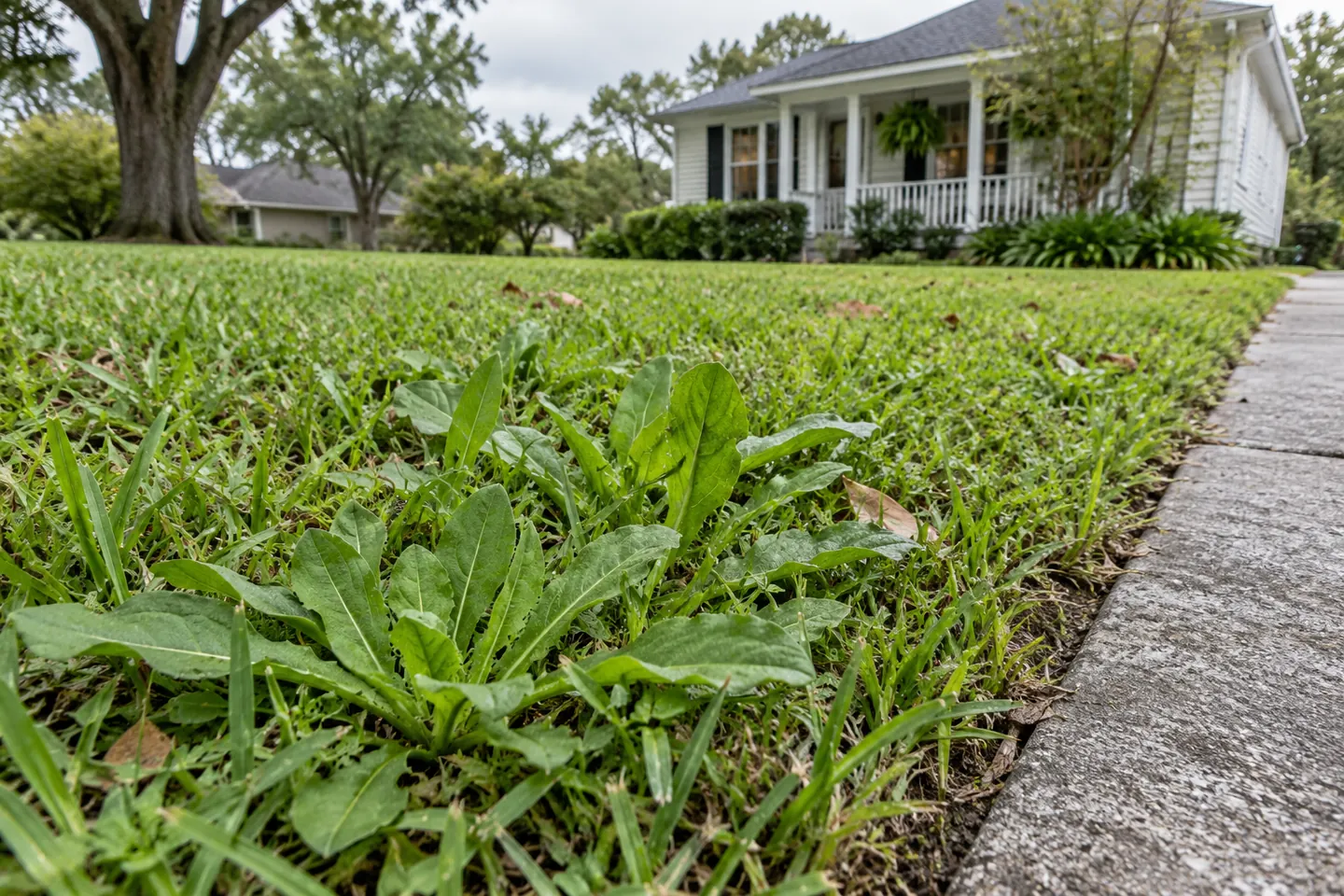
A cut surface and a plant's presence are separate observations
After routine lawn work, you may notice that the upright structures are less visible while the low leaf clusters remain. Record those as two observations. A neater view is a meaningful maintenance result, but it does not prove the plant has been removed from the site. Conversely, a remaining low cluster does not by itself mean an agreed surface-finishing task was missed. The agreed scope determines how to assess the work.
Before the visit, clarify whether the request is about an even-looking lawn surface, finishing around a hard edge, or obtaining help understanding an unfamiliar plant. Avoid asking for the lawn to be cut progressively lower simply to chase a particular stalk. The grass species and the overall lawn need appropriate consideration; a weed photograph alone is not a mowing-height specification.
Keep a simple record when stalks appear again
If similar stalks become noticeable later, compare the same boundary and viewing direction. Note the date, the last known cut and whether you are seeing the same marked plant base or only the same general area. That last distinction matters. New photographs can show a recurring appearance without proving that every stalk belongs to one surviving individual. Use wording that stays within what the record actually establishes.
An especially useful follow-up might say that three upright structures are visible again inside the previously described walk-side strip, while the rest of the surface still looks even from the doorway. That gives Happy a practical question to review. A message saying the entire job failed because the weed returned mixes several possible issues together and makes the next step harder to identify.
Build a request that can receive a useful answer
Bring the base-and-stalk photographs, the boundary description and one sentence about the finish you want. Ask what routine lawn work can address that appearance and what remains outside the proposed visit. If identification is the unanswered question, say that first. Do not treat a plant name mentioned in a conversation as an agreement to perform a separate removal or treatment service.
You can be specific without being certain about everything. The name may stay tentative while the task becomes clear: review the stalks beside this walk, confirm the suitable lawn finish and explain what the visit includes. That is a useful outcome for a Harvey or Marrero homeowner who wants a tidy yard and a straightforward conversation. The paperwork does not need to become a plant-science project to serve that purpose.
Talk through the walk-side finish with Happy
Call 504-339-3571 and ask for Happy about mowing, edging, weed-eating and blowing. Explain the narrow-leaf cluster and the precise walk-side strip. Confirm availability and the agreed maintenance result before scheduling; identification guidance does not create an additional service commitment.