
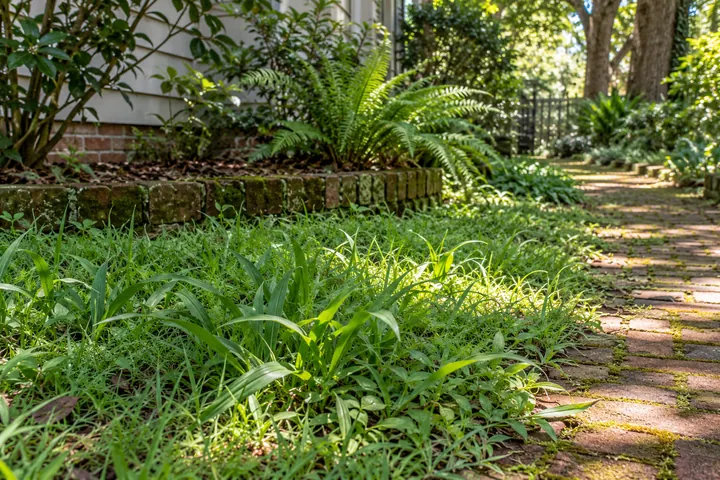
The same grass can have two different roles
The first question is often phrased as how to get rid of carpetgrass. Before accepting that goal, ask what the homeowner intends the lawn to be. A grass can be part of an accepted existing surface in one yard and an unwanted contrast in another. The name does not make that decision. A maintenance request should explain what is supposed to stay and what appearance is causing concern, especially when several people share responsibility for the property.
LSU AgCenter describes carpetgrass as a perennial warm-season turfgrass with light-to-medium green, coarse leaves and rounded tips. Its profile describes aboveground spreading stems and a head with multiple slender spikes, often a pair forming a V with another spike lower on the stalk; that third spike is not always present. LSU also notes similarity to centipedegrass and St. Augustinegrass. These are identification considerations, not permission to label every broad-bladed area carpetgrass from a distant photograph.
Establish the intended surface before selecting an outcome
Ask whether the current lawn has a known grass identity or simply a long-standing appearance the household accepts. A lawn can have been maintained for years without anyone recording its species. That is an information gap to acknowledge, not a reason to choose whichever name sounds familiar. If an old planting record exists, keep it separate from current plant observations and identify which portion of the yard it describes.
Write a sentence about the desired outcome that does not rely on a disputed name. The owner may want the existing broad-bladed surface maintained neatly, or may want a contrasting strip assessed before deciding on a longer-term change. Those statements remain understandable even if a later review changes the identification. A request built only around the word carpetgrass can become confusing when different people use that word for different plants.
The rounded tip needs an actual readable view
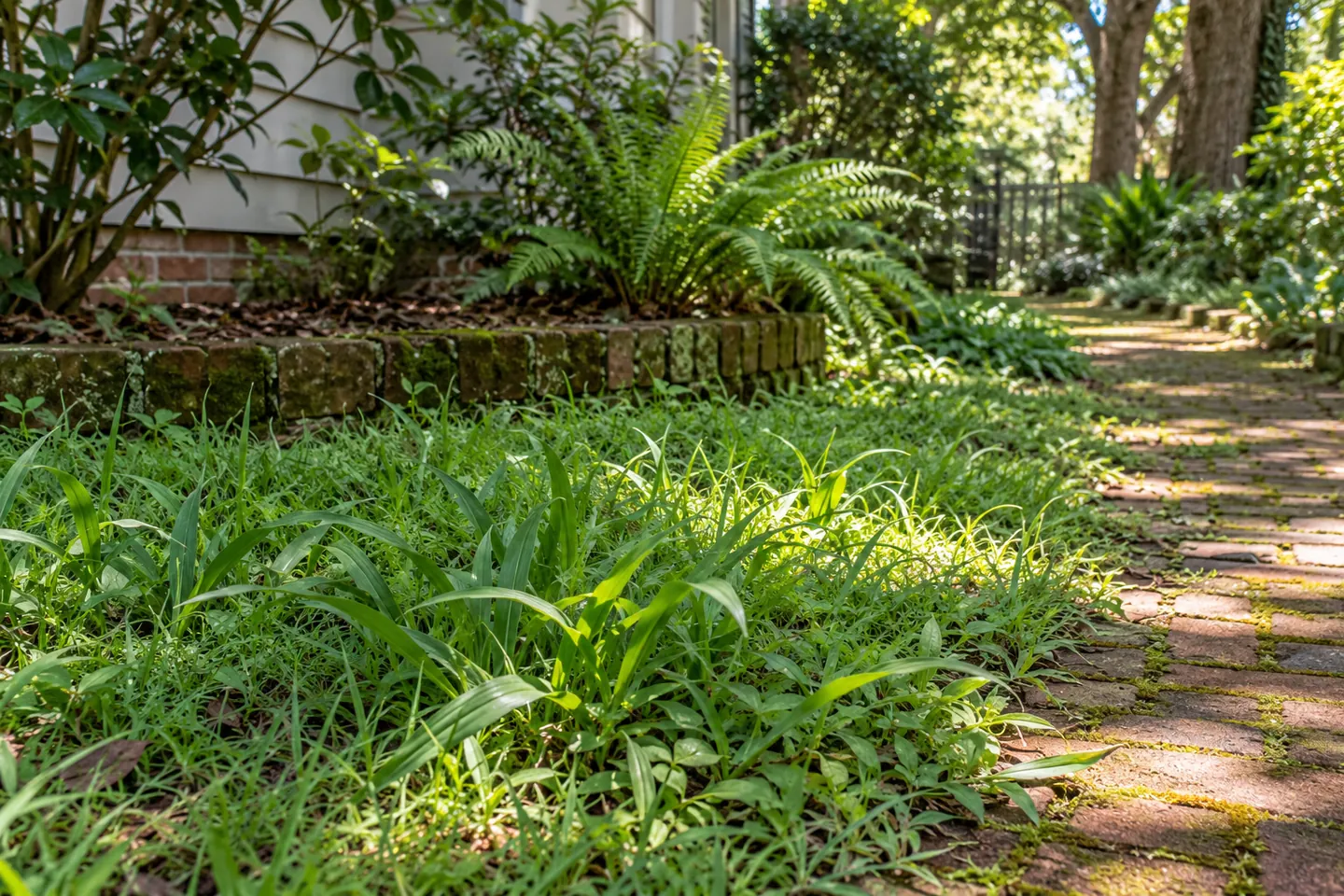
If leaf-tip shape is part of the comparison, show an intact attached leaf in focus. A freshly cut tip does not reveal the original outline, and a torn edge may be a poor example. Label the condition of the photographed leaf. Do not reconstruct the missing end mentally and present that reconstruction as something the photograph proves. The most useful leaf may be a different intact example from the same marked patch.
Keep a wider frame that connects the example to the surrounding surface. A close-up without location can be mistakenly reused for another section of the lawn. If several patches are under review, name each one and avoid mixing their photographs. A reviewer should be able to understand which leaf, head and overall lawn view belong together without guessing from the order in which files were sent.
Do not require every head to show the same branch count
The LSU profile explicitly allows variation in the head's visible spikes. That means a missing third spike should not be filled in by assumption, nor should a two-spike picture automatically settle the name. Record the complete head you can actually see. If a branch seems broken, hidden behind another structure or outside the focus plane, explain the limitation. Good identification work can include uncertainty rather than forcing a tidy match.
Use more than one view of the same attached example when possible. The second angle may clarify whether a lower branch is present. Avoid collecting unrelated heads just to assemble the reference pattern. A plant's actual structure matters more than producing a photograph that seems to agree with the expected answer. If a qualified review needs a better specimen, ask what specific additional feature would help.
Keep wet-looking ground separate from a soil diagnosis
Carpetgrass references discuss growing conditions, but a grass identification or a wet-looking photograph does not substitute for a soil test or a site assessment. State what you observed: standing water at a particular time, damp ground near the path or an area that looked different from the rest of the yard. Do not turn a species possibility into a confirmed claim about soil acidity, drainage performance or the cause of the lawn's appearance.
This distinction is useful when arranging routine work. A damp or inaccessible section may affect whether a proposed visit can proceed as planned, regardless of the plant name. Give current conditions and ask about access. Do not expect Happy Grass to infer a drainage repair request from a lawn photograph. The routine services discussed here should be confirmed explicitly instead of expanded by implication.
Decide whether the heads or the ground cover are the concern
A homeowner may be happy with the low surface but dislike the visible heads. Another may dislike the leaf texture even when the heads are absent. Describe which applies. A photograph taken only after mowing can hide the feature that originally prompted the request, while a photograph taken before mowing may exaggerate the role of the heads in the overall appearance. A paired record makes the distinction much clearer.
State the maintenance result in terms that can be reviewed after the visit. For example, identify the front lawn view and the transition beside the walkway. Do not ask a routine cut to change the species composition of the lawn without a separate, appropriate discussion. A neater surface and a different ground cover are not interchangeable outcomes, even when the same plant name appears in both conversations.
Resolve mixed instructions before the work begins
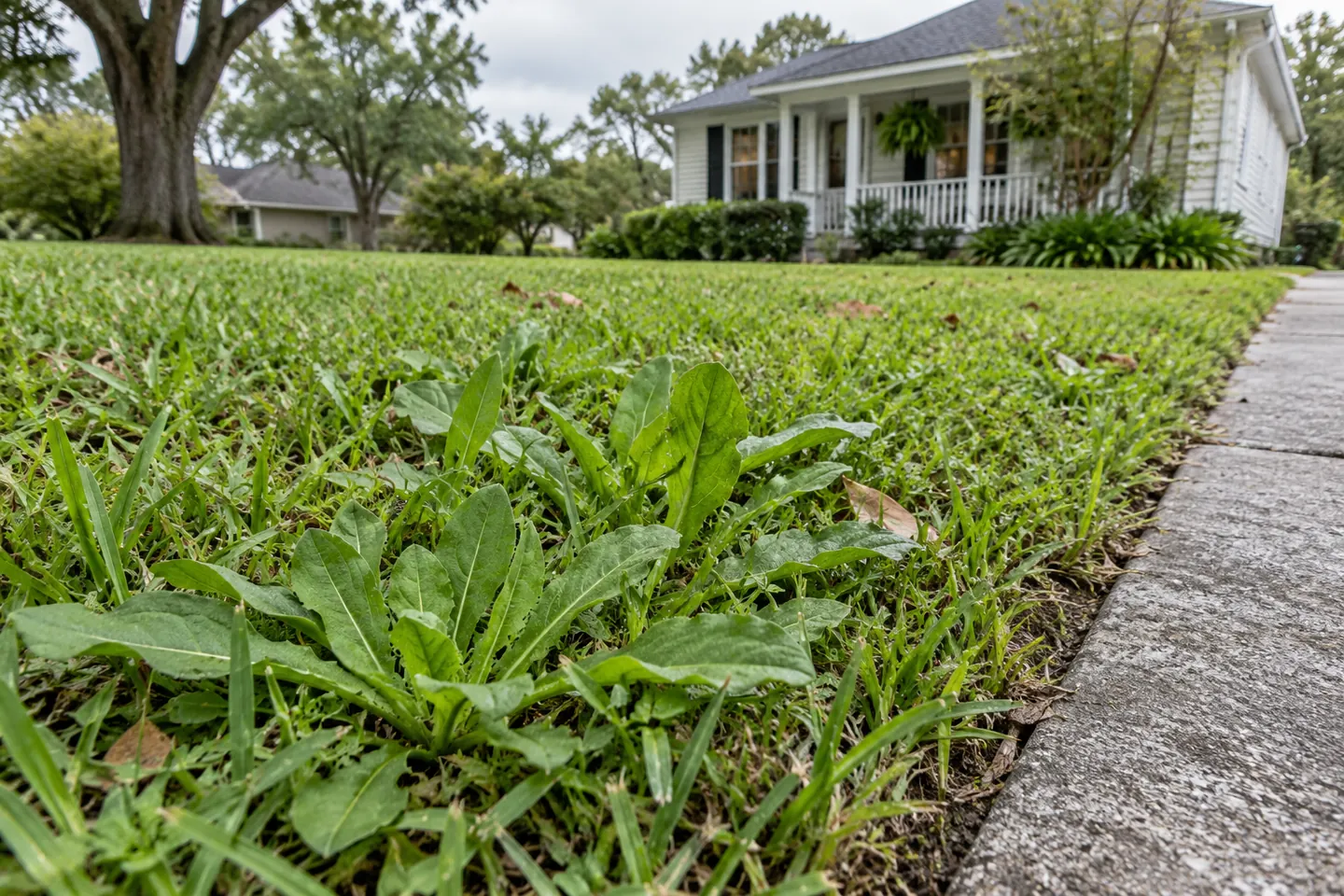
One family member may call the broad-bladed area the lawn, while another calls it the weed patch. If both issue instructions, a provider can be left with no clear approved outcome. Choose the authorized decision-maker and settle whether the area is to be maintained as part of the current lawn or only reviewed. Avoid relying on a photograph caption to resolve a disagreement that is really about ownership and preferences.
For a rental or shared property, record the permission boundary as well as the physical boundary. A person authorized to arrange mowing may not have authority to approve a change in landscape composition. Clear that up before asking for an irreversible result. You can still request ordinary surface care within existing permission while other decisions remain pending. The key is to make the present authorization understandable.
Make the transition itself visible
Where one texture meets another, include a frame crossing the transition under the same light. Do not compare two separate close-ups taken at different times and assume their color difference is entirely botanical. The transition view can show the extent of the contrast, the relation to the path and the appearance the homeowner wants reviewed. It does not need to serve as a complete species key.
- Identify both sides of the transition in the caption.
- Keep the desired lawn area distinguishable from adjacent beds or other ground cover.
- State whether the head and leaf photographs came from the same side.
- Explain which side, if either, has a confirmed planting history.
These details are especially helpful when the task involves only a narrow strip. They prevent an inquiry about one edge from becoming an assumption about every similar-looking area across a West Bank property. A modest map and a clear viewing direction can save a great deal of back-and-forth.
Review appearance and identity on separate tracks
After the visit, assess the agreed surface finish using the same transition and viewing position. If the identification question remains open, keep it open. A tidy result does not prove the plant name, and a revised name does not automatically change whether the agreed task was completed. These two tracks can inform one another while still being documented honestly.
For a Gretna or Marrero homeowner, the practical aim is a yard-care conversation that reflects the lawn you have and the outcome you actually want. Establish the accepted surface, supply connected evidence and confirm the work boundary. You do not need to force every plant into a label before asking for a neat lawn, but you do need a clear plan for what is supposed to remain.
Keep older lawn labels in their original context
An old note may call the whole property carpetgrass even when it was written for only one section. Preserve the date and location attached to that note. Do not remove its qualifications when forwarding it to a caretaker. If the record lacks a boundary, state that limitation and compare it with current evidence. A historical label can guide a question without overriding the visible differences between areas or the present owner’s instructions about what should remain.
Clarify the existing-lawn request with Happy
Call 504-339-3571 and ask for Happy about mowing, edging, weed-eating and blowing. Explain the accepted lawn area and any uncertain contrasting strip. Confirm the actual work, permission boundary and availability before scheduling.