
Fine texture can hide a different kind of plant
A patch may look pleasantly green from the driveway and quite unlike grass when you kneel beside the path. Small leaf groups and slender stems can weave through the lawn so closely that the whole area seems to be one surface. Start by distinguishing the low layer from the grass growing through it. Which part is taller? Where can individual stems be followed? Those observations help explain why the patch catches your attention even when the yard was cut recently.
Common lespedeza is a possible subject for identification when a low, fine-textured mat raises that question. It should not become a convenient label for every flat plant in the yard. A maintenance discussion benefits from a plain description of the structure whether the name is known or not. Happy Grass can review the proposed lawn work, while an appropriate plant adviser can assess the identification evidence. Neither conversation requires pretending that a distant green patch has already been fully explained.
What the Louisiana description helps you notice
LSU AgCenter describes common lespedeza as a warm-season annual that grows in low mats. Its small oval leaflets occur in threes, with visible veins and smooth edges; stems become harder and woody with maturity. Small pinkish to purple flowers can occur at leaf junctions. LSU also notes that the low habit makes the plant difficult to cut during mowing. These features explain why the mat and its taller surroundings need separate descriptions. They do not identify an entire lawn from one tiny leaf group.
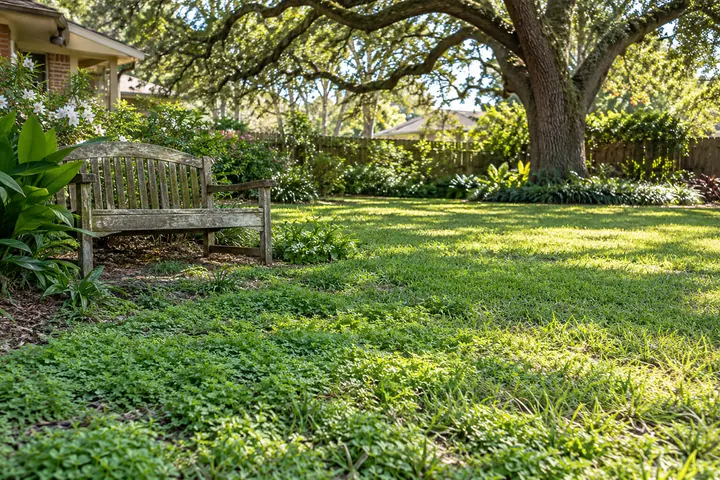
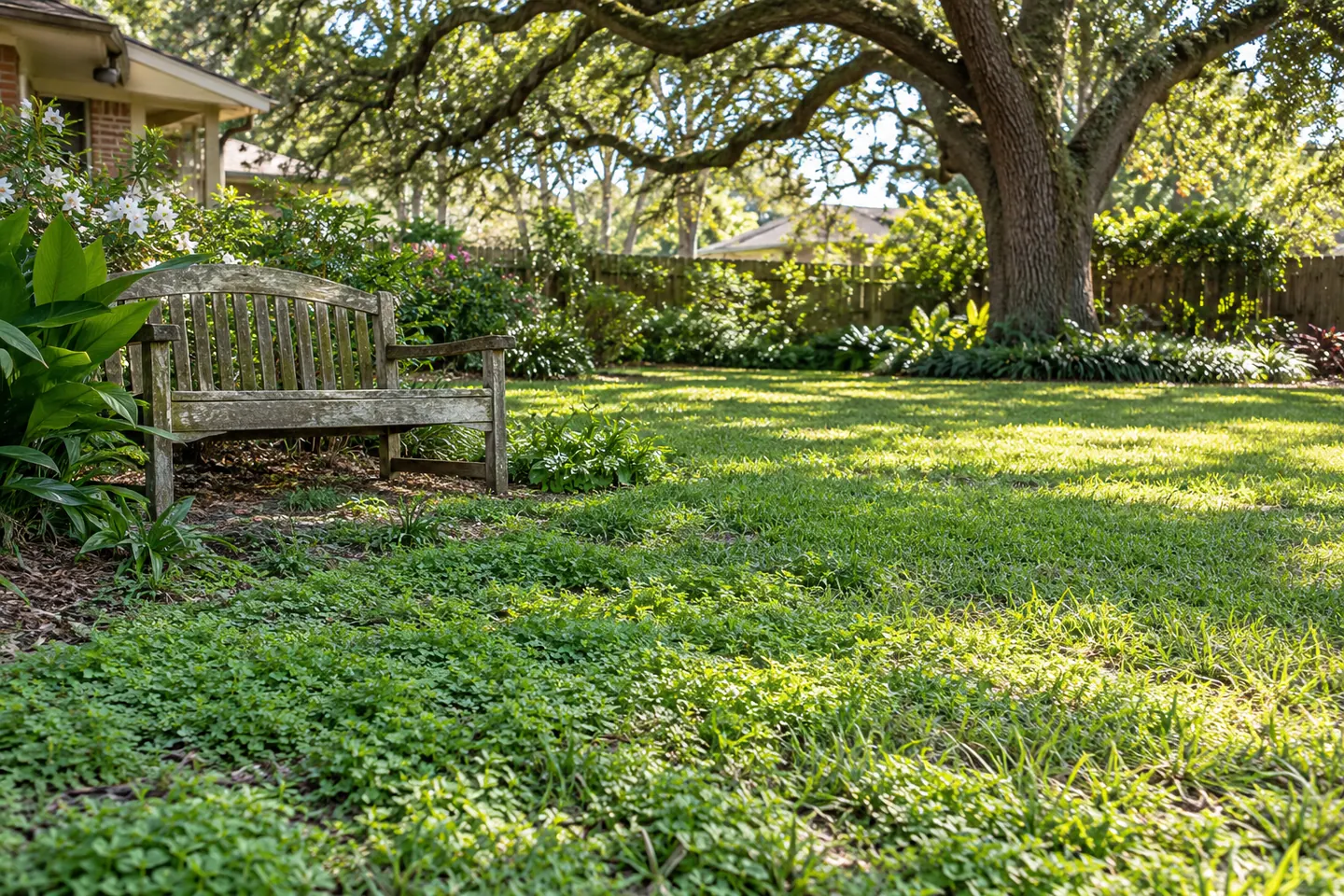
Look for connected features that an adviser can actually evaluate. If stem texture or a flower junction is not visible, say so instead of completing the description from a reference. Keep the plant name tentative until supported. The garden-bench illustration on this page provides general context for a low green layer within grass. It is not a botanical key, a verified lespedeza specimen or a record of maintenance performed at a customer's property.
Follow a stem before calling the patch a mat
Where the surface is visible without unnecessary disturbance, photograph a section that shows how leaves attach along the stems. A dense green view can hide whether the apparent layer is one branching plant, several plants or unrelated foliage mixed with grass. Do not pull apart the whole patch to create a cleaner picture. Begin with an intact view and ask an identification professional what additional detail would be useful. The original arrangement may be more informative than a pile of detached pieces.
Use a second photograph to show the edge of the low layer against recognizable grass. This helps establish what you mean by mat without requiring a technical growth-habit term. If you cannot follow the stems through the foliage, describe that limitation. A clear boundary image and an honest account of what is obscured give the adviser a better starting point than a confident statement that all the green leaves belong to one species.
Give stem maturity a separate record
If the stems feel or look noticeably different from those seen earlier, record the date and the visible change rather than assigning an exact plant age. Do not bend or snap unfamiliar material just to demonstrate toughness for a photograph. Describe what is already exposed and what the view supports. A note that brownish stems are visible beneath the leaves is useful even when their identity and maturity remain unresolved. An ordinary observation should not be converted into a destructive test without a reason.
For a maintenance request, explain whether the concern is the feel of the low layer, its appearance after a cut or a visible accumulation beside a boundary. Those are different questions. A mature-looking stem in the grass does not by itself define a removal service, a repair need or a treatment plan. Ask what work is actually proposed and who can answer the biological question. This keeps an interesting plant feature from becoming an ambiguous instruction to remove everything in a broad area.
Use the tiny flowers as location-specific evidence
A small flower can be difficult to photograph against a busy lawn background. Try to show the flower's attachment to the same stem and leaf group you are asking about. Keep the wider location view so the close image does not become anonymous. If the camera cannot resolve the flower, state its observed color as an impression rather than claiming a detailed structure the image cannot show. The receiving adviser can request another approach if the feature is necessary.
Do not combine a flower from a garden bed with a leafy stem from the lawn simply because both resemble the reference description. Mark them as separate observations. A useful identification record makes the connections explicit and preserves the gaps. This is particularly helpful in a mixed edge where ornamental plants, volunteers and lawn foliage overlap. An accurate small set can be more informative than a large collection of attractive but unrelated plant photographs.
Describe what the mower can and cannot visibly change
A low layer may remain apparent when taller grass is shortened. Before deciding that the next visit should cut lower, identify which layer you want Happy to review and what result you expect. An even grass height and removal of an established mat are not the same task. Ask for an explanation of the proposed maintenance scope in terms of the actual site. The plant's presence should not create an unspoken guarantee that every trace will disappear after an ordinary cut.
If the mat extends across a bed edge or into a paved seam, include that crossing in the request. Do not assume the lawn footprint includes all adjacent surfaces or that a trimming discussion includes excavation of the plant's base. A marked-up copy of a wider photograph can help show the intended boundary while you retain the original. Confirm the agreed work before comparing the result with an objective that may never have been included.
Do not turn an indicator description into a soil finding
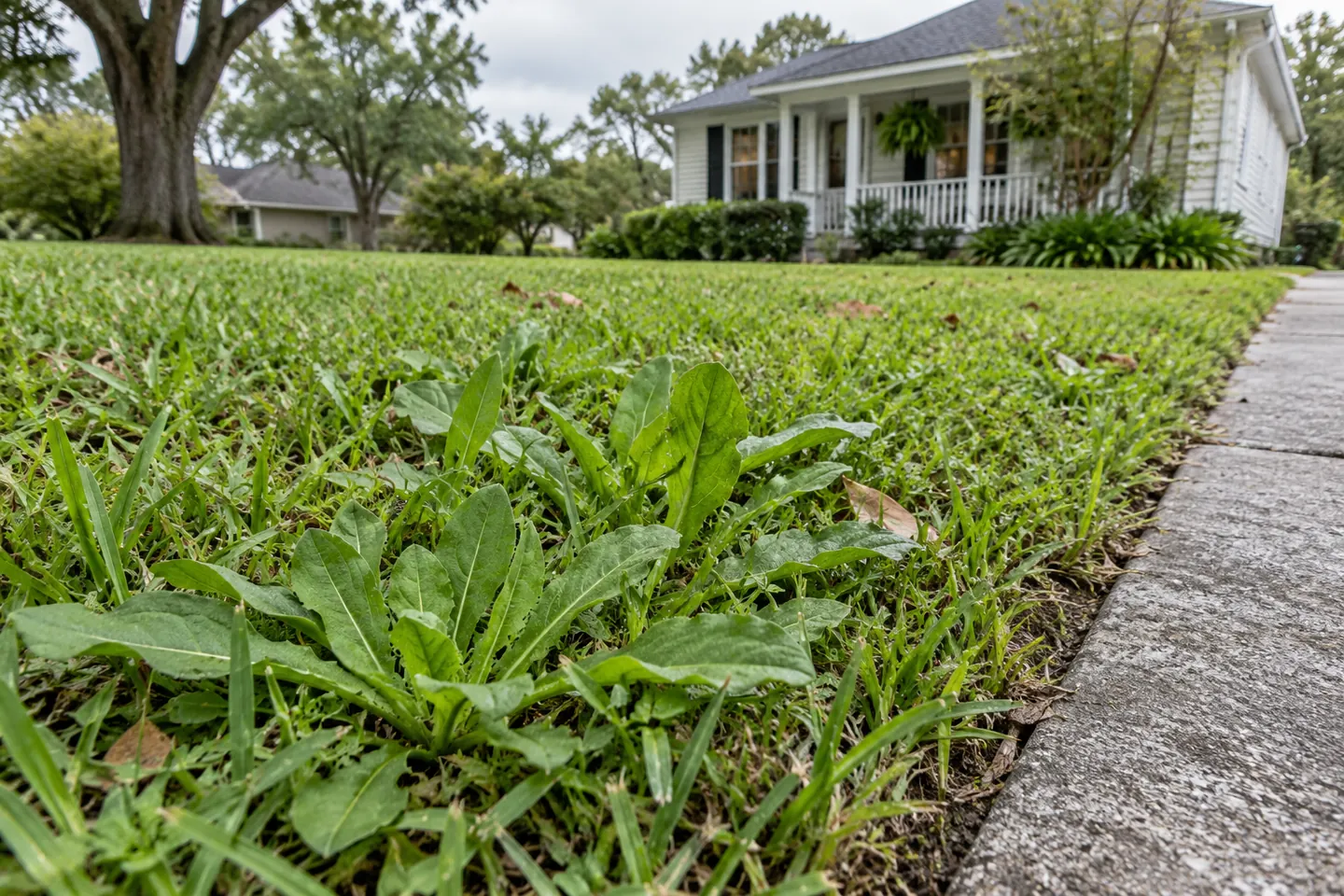
You may read that common lespedeza is associated with particular lawn conditions. That background can prompt a question, but it does not provide a laboratory result or establish the history of your property. Describe observable context such as thin grass or a frequently used route without announcing a nutrient deficiency or a measured level of soil compaction. If those concerns matter, ask the appropriate service what evaluation would address them. A plant record and a soil test serve different purposes.
Avoid changing several unrelated routines merely to act on an uncertain name. If a qualified adviser recommends further evaluation, retain the actual recommendation and its scope. Happy Grass does not provide fertilization or aeration, and this guide does not prescribe either. A clear maintenance agreement should continue to describe the services actually available. Keeping those responsibilities separate lets the lawn discussion progress while the underlying growing-condition question receives suitable attention.
Compare the patch without confusing camera angle and spread
Choose a reference view that includes a permanent feature, such as the bench leg, path corner or end of a border. Return to that position when you take a later photograph. A lower camera angle can make a mat look broader because the leaf layer fills the foreground. A standing view may make the same area almost disappear among the grass. Explain the viewpoint before presenting the two pictures as evidence that the plant spread or receded by a precise amount.
If the visible boundary truly changes, describe which landmark it approaches and keep the date. Record relevant work that actually happened between photographs. Do not automatically attribute a new appearance to the most recent cut or to an unconfirmed treatment theory. The comparison is valuable when it preserves a sequence that someone else can interpret. It becomes less useful when the original observations are rewritten to fit the explanation you now prefer.
Decide what a useful answer would resolve
An identification reply can settle the name without defining the next maintenance task. A maintenance review can clarify what a cut is expected to change without establishing the plant's identity. Write those questions separately so you can tell which one has been answered. If you want to discuss a different kind of weed-control work, confirm its actual availability and scope rather than treating a general lawn-service conversation as an order for a specific product or procedure.
For a shared or rented yard, make sure the person arranging the visit knows which area the plant record describes. A homeowner's photograph and a property manager's instruction can lose their connection when forwarded without a location label. Use the same simple name in both messages. That helps avoid work being expected in a different section merely because the entire backyard was described as having the same low green layer.
A short mat record
- Show an intact leafy stem and its relationship to the grass.
- Keep any flower image tied to the same observed plant.
- Photograph the mat edge from a repeatable position.
- State whether your concern is identification, visible finish or a separately confirmed service.
These details are enough to begin an informed conversation without turning the yard into an inspection experiment. Ask for the next useful piece of evidence when the record is incomplete. A careful description can move the request forward even while the name remains uncertain.
Discuss the lawn finish with Happy
Call 504-339-3571 and ask for Happy about mowing, edging, weed-eating and blowing. Identify the low layer and the boundary of the lawn work you want reviewed. Happy Grass does not offer fertilization, aeration, overseeding or pest-control services. Confirm any additional weed-control scope explicitly; do not assume that an ordinary cut includes plant eradication.