
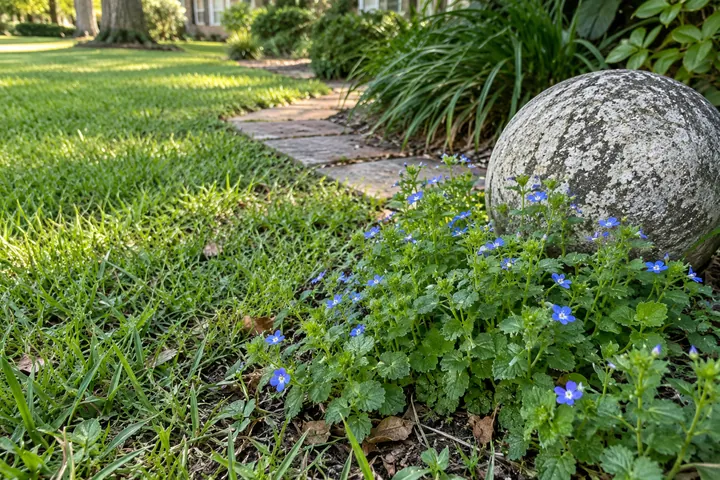
Give the small blue plant a readable stem record
A low blue-flowered patch can look like a single kind of plant even when several examples overlap. Choose one readable stem and label its location, such as stone-sphere example one. Include an overall view of the patch before making close crops. The fixed label gives a reviewer a way to discuss the evidence and gives Happy a practical lawn area to review even if the first candidate name changes.
NC State describes corn speedwell, Veronica arvensis, with rounded toothed lower leaves and smaller, more pointed upper leaves. Lower attachments are opposite and upper ones alternate. Its tiny blue flowers have pale throats and are nearly stalkless; related speedwells can differ in flower-stalk length. Heart-shaped pods are shared among several candidates. This makes a connected comparison more useful than choosing a name from the blue flower or pod outline alone.
Preserve position when photographing different leaf shapes
The contrast between lower and upper leaves matters only when their positions are known. Keep a whole-stem view and label the details it supports. A detached rounded leaf and a detached narrow leaf do not establish a change along one individual. If the connection disappears beneath turf, mark that gap rather than supplying it from the candidate description.
Use another readable example separately if the first is too crowded. A reviewer may find that second record more informative, but the file labels should preserve the change. Quietly combining the clearest lower leaf from one plant and the sharpest flowering tip from another can create a false impression that the entire stem was documented together. Separate comparisons remain useful without becoming an invented complete specimen.
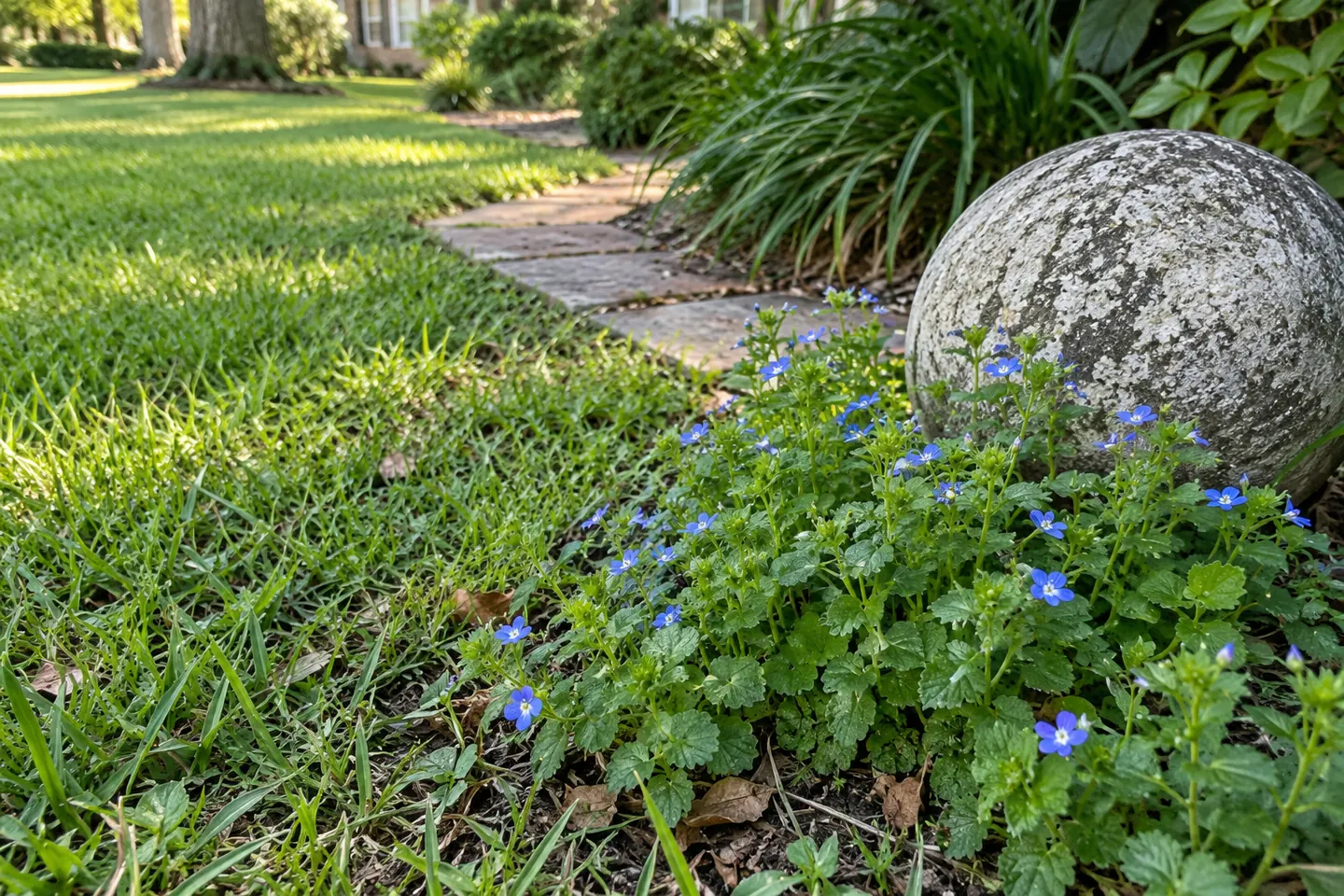
Leaf arrangement needs visible attachments
Two leaves at the base can appear opposite in a flat view while their points of attachment remain unclear. Show the node and a short stretch of supporting stem. For the upper portion, include successive attachments rather than a silhouette of small green marks. State which joins are readable and which are concealed by a neighboring leaf or grass blade.
A close crop should retain enough orientation for another person to know whether it shows the lower plant or the tip. Keep the wider original beside it. If a crop no longer shows its position, the label needs to explain that relationship accurately. Technical terminology is less important than a record that another person can follow without guessing which end of the plant is being discussed.
Nearly stalkless is a close observation, not a distant impression
The reference's flower-stalk comparison concerns a very small structure. A blue dot close to a stem in a wide photograph may simply have its stalk hidden by the viewing angle. Show the intact attachment when possible and state whether the supporting part can be resolved. Do not convert a missing visible line into proof that a stalk is absent or has a particular measured length.
If a reviewer asks for a scale reference, explain how it was positioned and keep it outside the structure being compared. A tilted photograph may not support an exact tiny measurement even when a ruler appears somewhere in the frame. A plain statement that the flower base is obscured is more useful than a precise-looking number derived from an unsuitable image. Let the reviewer decide which additional evidence would help.
Keep flower color separate from attachment evidence
The bright blue and pale throat can be useful features to record when the flower is actually readable. Preserve ordinary camera color and identify any edit made to a shared image. A white highlight caused by glare should not automatically be described as a confirmed throat pattern. Show the attached flower and its supporting context rather than relying on an isolated saturated crop.
When several blue-flowered examples are compared, give each its own label and keep the lighting reasonably similar. A darker shaded image and a brighter sunlit one may look more different on the screen than the plants did in the yard. Describe the observed difference without deciding that color alone proves separate species. The arrangement and readable flower-base evidence still need their own review.
A heart-shaped pod does not settle the speedwell name
The NC State account notes that related speedwells share a heart-shaped pod outline. That makes the structure worth photographing while limiting what it can establish by itself. Keep it attached to the marked stem where possible. A loose heartlike object found near a blue flower should remain a separate collected item unless its origin was observed.
Do not trace a heart around a blurred structure and use the annotated copy as proof of its outline. Keep the original image and place any label outside the edge being discussed. If only one side is visible, state that limitation. A reviewer can explain whether the pod, leaf positions and flower attachment together support the candidate or leave the comparison unresolved.
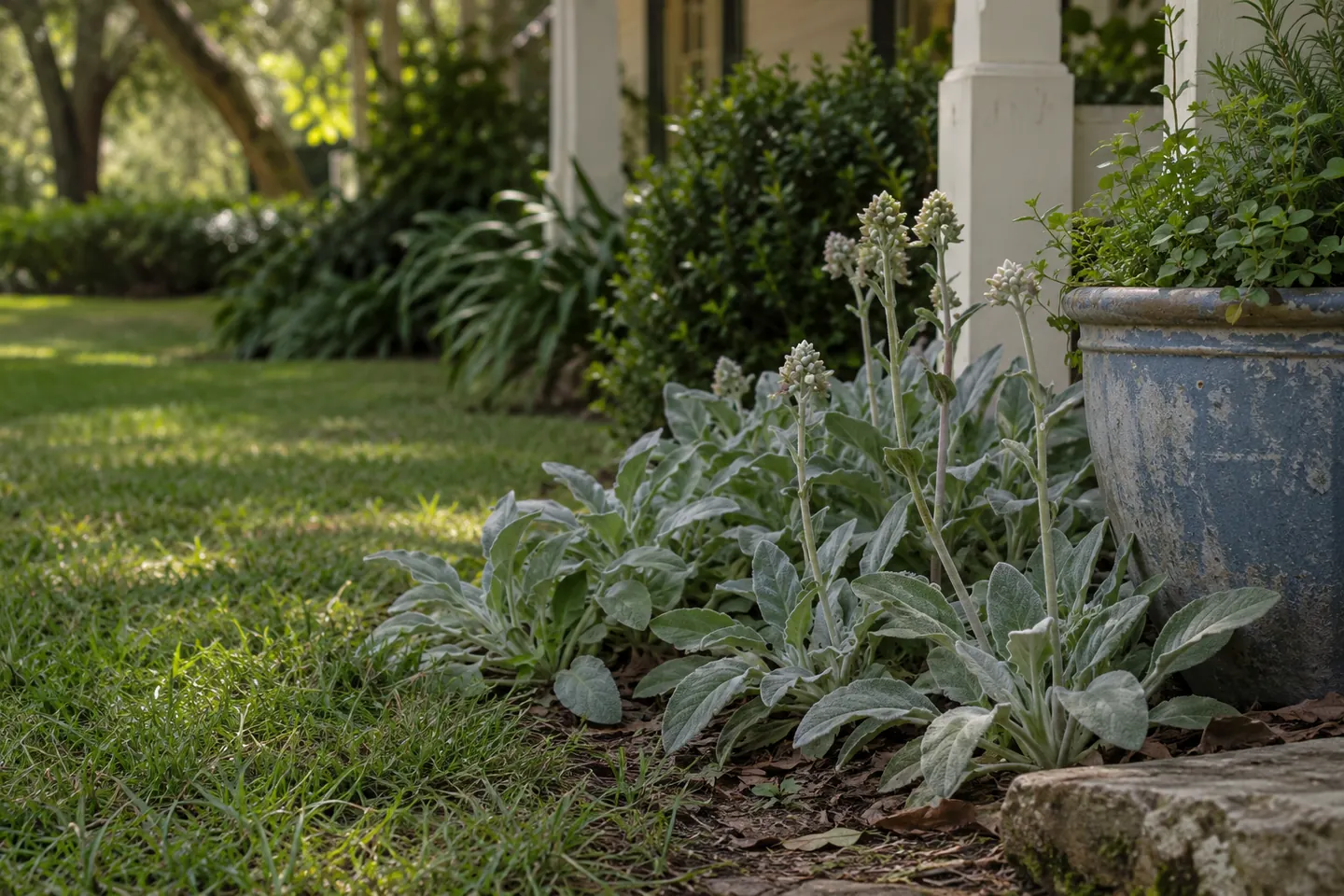
Fine surface detail should name the actual part shown
If hairs are part of the identification question, specify whether the image shows a leaf surface, its margin or the stem. A general fuzzy impression is less useful than a close view with an orientation label. There is no need to rub an unidentified plant or stage a tactile test to make a routine lawn inquiry more convincing.
Preserve any handling history when a detail was moved or detached. A reviewer should know whether the photograph shows the plant in its original position or a separate comparison piece. That distinction can affect how confidently the parts can be connected. A modest record of a single intact section is often easier to interpret than many enlarged details whose origins and relationships have not been preserved.
Separate the low patch from the turf around it
Take an ordinary viewing-distance photograph that shows why the area matters to the homeowner. The concern may be scattered blue flowers, a continuous low texture or an open-looking gap in the grass. These are different observations. A tiny flower close-up cannot tell Happy whether the included work concerns the whole front lawn or a short strip beside the path.
Mark the turf, paving and any bed boundary separately. A plant spreading across more than one surface does not define the work area automatically. Use recognizable fixed endpoints and confirm which area is included. This practical map stays useful if a reviewer later identifies more than one plant within the apparent patch, because the location and homeowner's intended result do not depend entirely on the first species guess.
Keep regional season descriptions out of an invented timeline
NC State discusses a winter annual in its own regional context. For a West Bank yard, record the date of first notice and which structures were actually seen. If earlier checks were not made, the emergence date is unknown. A blue flower becoming noticeable from the walkway does not prove that the entire low plant appeared only after the last routine cut.
Keep maintenance dates separate from observation dates. If work later changes the flowering tips, retain the earlier labeled images that contain useful identification detail. A new photograph of another blue-flowered stem can be a comparison, but it should not silently replace the first plant's history. The useful timeline is one that preserves actual observations and the gaps between them.
Agree on a finish without promising a complete plant outcome
Describe the visible result you want reviewed and discuss the mowing, edging, weed-eating or blowing proposed for the marked location. A shorter raised tip and a lower leafy patch are not the same concern. Confirm the included area and result rather than expecting the word speedwell to communicate the whole task or select a particular operation.
A tidy routine finish should not be represented as proof that every seed, root or future plant is absent. A later remaining leaf should likewise be evaluated against the actual work agreed. Keeping that boundary clear allows a useful identification conversation without turning it into a separate treatment or removal promise. Happy can then understand what remains to be discussed in practical terms.
- Keep lower and upper leaf views tied to one marked stem.
- Show successive attachments instead of a crowded silhouette.
- Leave an obscured flower stalk unresolved.
- Use the pod alongside other features rather than as a complete answer.
- Preserve actual dates and the specific routine finish request.
Ask Happy about the blue-flowered lawn strip
Call 504-339-3571 and ask for Happy. Describe the marked area, access and the mowing, edging, weed-eating or blowing you want discussed. Confirm the actual work and availability before arranging a visit.