
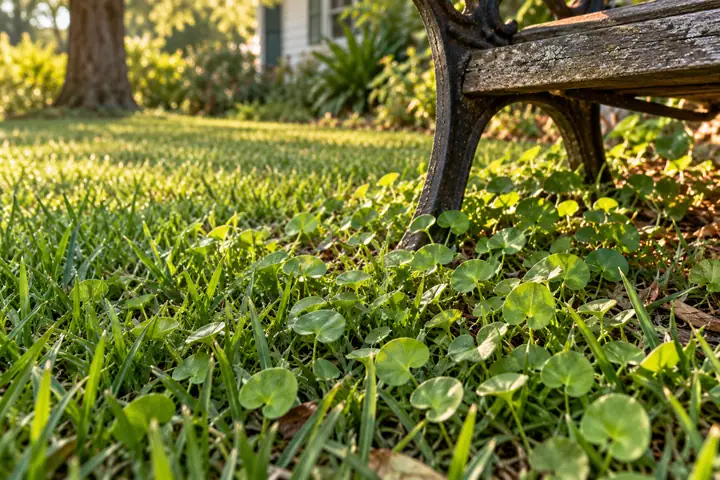
Look below the grass tips
Dichondra can be easy to overlook because the interesting part sits low in the lawn. A patch may look like ordinary green cover from the kitchen window, then reveal small rounded leaves between the grass blades when you walk closer. The first useful distinction is whether the green surface is mostly grass, mostly broad leaves or an interwoven mixture. That matters when judging whether the lawn is actually filling in with the grass you want.
LSU AgCenter describes dichondra as a warm-season perennial broadleaf that spreads by seed and aboveground creeping stems called stolons. Its leaves are kidney-shaped to nearly circular, and the plant can form a low mat. Those traits explain why a regularly cut lawn can still contain a substantial dichondra layer. An even surface is a description of height, not proof that everything making the surface belongs to the same turf species.
Read the notch and stalk together
The kidney-like outline is easier to understand when you follow one leaf stalk to the blade. Look for a rounded indentation at the base rather than a complete umbrella disk. Then compare another leaf attached to the same trailing stem. If the leaves are crowded, their overlap may hide the indentation. A single crushed or chewed leaf is a poor model for the entire patch, so base the comparison on several undamaged examples.
Dollarweed is the familiar look-alike. Its stalk joins beneath a more complete circular leaf near the center. Dichondra's stalk joins at the indented edge. Mississippi State's dollarweed publication illustrates this difference, while UC IPM describes dichondra's alternate leaves along trailing stems. Together these clues are more useful than size or brightness alone. A small dollarweed leaf is not automatically dichondra, and a large dichondra leaf is not automatically dollarweed.
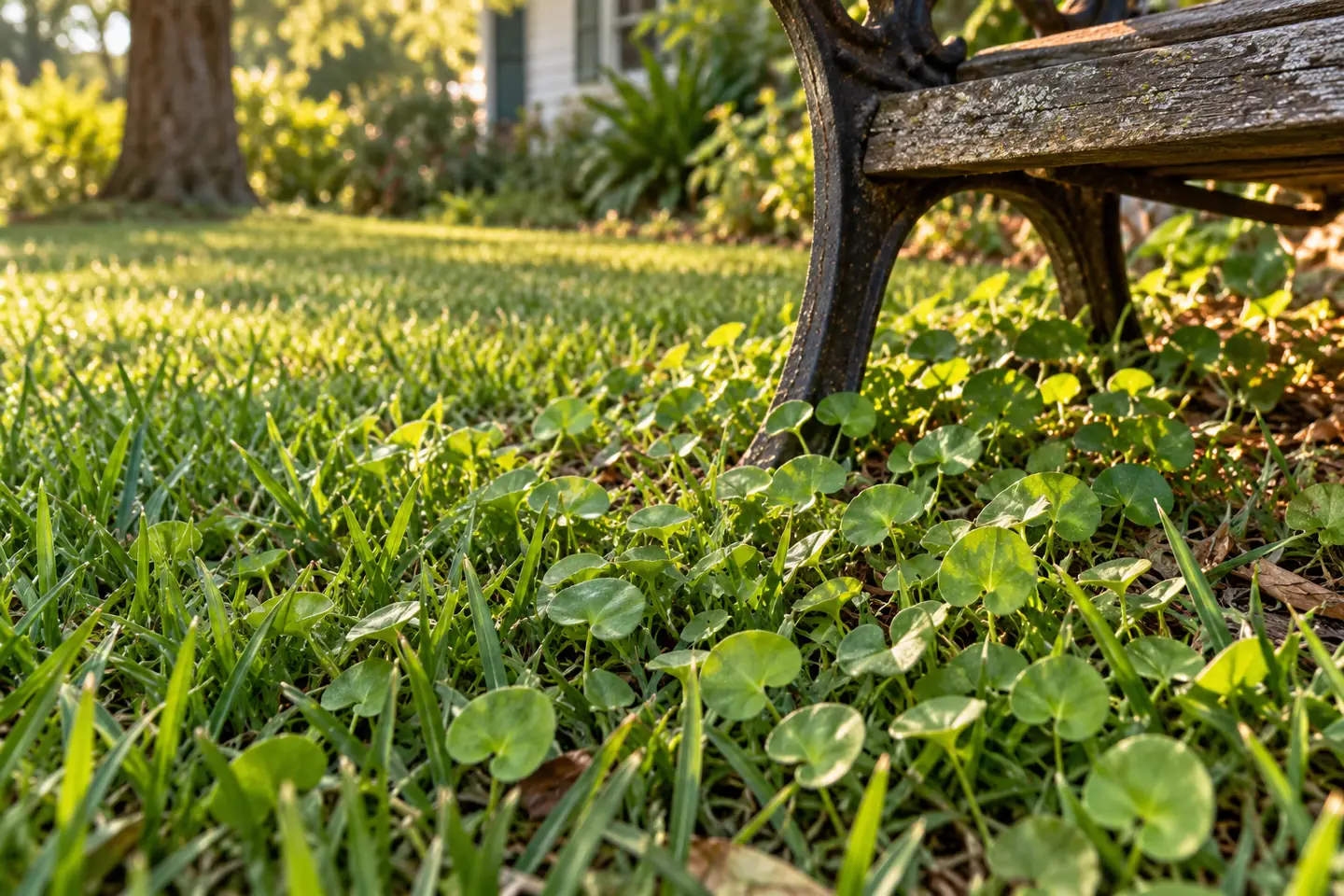
Trace a stem without turning it into a pulling contest
A creeping stem helps distinguish a mat from a collection of unrelated seedlings. Where the surface is visible, follow one stem across the ground and note where leaves arise. You are looking at the plant's arrangement, not trying to prove how much can be removed in one tug. Grass roots and other plants may be tangled through the patch. Aggressive pulling before identification can leave a disturbed spot without giving you a clearer answer.
If you cannot see a stem because the turf is dense, describe that limitation. A clear close view at the edge of the mat may show more than digging through its center. UC IPM notes that dichondra can be used deliberately as ground cover, which also means a plant photograph should be read in context. Confirm whether an earlier owner intended a ground-cover area before treating every low rounded leaf near a bed as an accidental invasion.
Decide what belongs in this particular area
The same plant can be acceptable beneath an ornamental display and unwanted in the main grass panel. That is a preference and landscape-use question. Draw the intended grass boundary first: perhaps the open play area should remain turf while a small ground-cover strip beside the porch is retained. A whole-yard instruction to remove dichondra would conflict with that choice. Clear boundaries prevent a tidy lawn request from quietly becoming a ground-cover removal request.
For a mixed lawn that you are happy to keep, the relevant question may be whether the surface and edges meet your needs. For a turf-focused lawn, the question is how much desired grass remains through the patch and why it is sparse there. Neither choice requires pretending that dichondra is a grass. Naming the plants and naming the preferred outcome allows an honest conversation about what routine maintenance can achieve.
Measure grass continuity rather than green coverage
Look at several small openings through the patch. Are grass blades scattered evenly, concentrated only at the edges or absent from its center? Record that pattern instead of simply calling the area full. A green broadleaf mat can conceal a thin turf stand. Conversely, a few kidney-shaped leaves among continuous grass do not describe the same situation as a nearly solid mat. The density of the desired plant is the more useful starting distinction.
An easy comparison uses three views at the same scale: the mat center, the transition and an adjacent section of intended turf. Keep the camera distance consistent so differences in leaf cover are not just differences in magnification. These views can show where a later assessment should concentrate. They cannot establish soil fertility, disease or the exact cause of thin grass. Those questions need appropriate evidence beyond the shape of the leaves.
Separate shade history from a plant diagnosis
A patch under a widening shrub canopy invites a sensible question about changing light. Note whether branches now shade ground that used to receive sun, whether furniture remains in one place or whether leaves accumulate there. These are landscape changes that may matter to the intended turf. Dichondra's presence does not prove that any single one caused the mat. Treat the history as context for assessment rather than announcing a diagnosis from one weed.
This distinction becomes useful when considering a permanent lawn expectation. If the physical setting has changed, repeating the old maintenance request may not answer why the desired grass remains sparse. An appropriate assessment can consider the turf species and setting together. Happy Grass's mowing, edging and cleanup scope should be discussed on its own terms; it does not automatically include tree pruning, soil correction or lawn renovation merely because those topics arise during research.
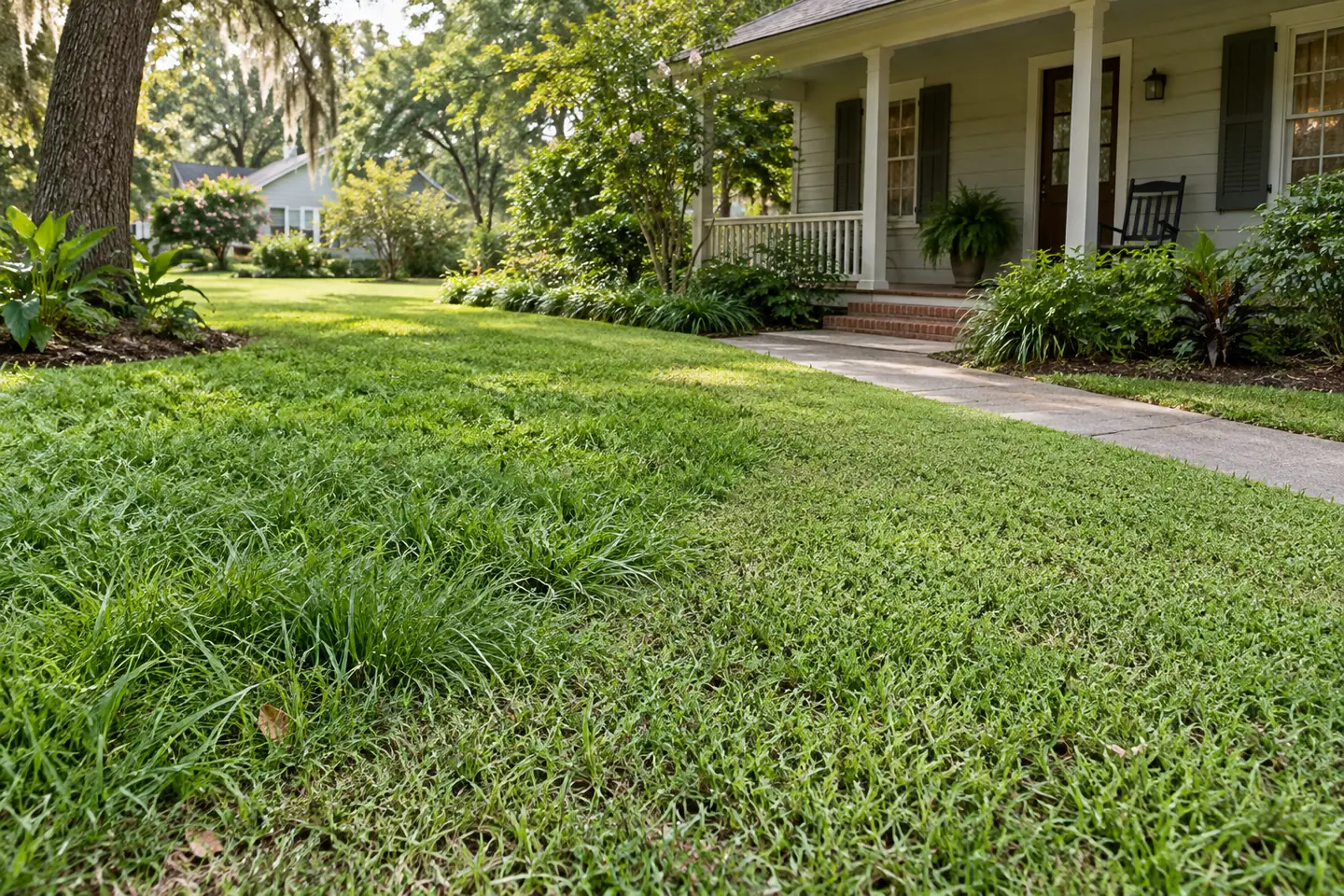
Why mowing can make the mat seem to disappear
Before a cut, taller grass may frame the rounded leaves. Afterward, the whole area may look more uniform and the dichondra less noticeable. The plant has not necessarily vanished; the visual contrast has changed. Review the low layer directly instead of using the freshly cut silhouette as the only measure. A second look close to the ground answers a different question from the view down the freshly edged sidewalk.
Lowering the entire lawn to chase a mat is also unlikely to resolve a choice about which ground cover you want. The intended turf still needs an appropriate maintenance approach. If a separate management plan is considered, distinguish its goals from ordinary height control. Ask whether the plan concerns the existing dichondra, the condition of the grass through it, or both. A promise of uniform height is not a promise of a uniform plant population.
Compare a transition over time
Pick one edge where the mat meets recognizable grass and compare it after similar intervals. Look for new kidney-shaped leaves beyond the old boundary and for grass continuity within it. A patch can become denser without moving far outward, or spread outward while retaining scattered turf. Recording both changes is more useful than one broad statement that it is taking over. A surface map should show visible leaves rather than a guessed underground border.
For a retained ground-cover strip, reverse the question: is it staying within the chosen area, and is the adjoining grass edge still readable? The desired outcome can be an orderly meeting of two covers rather than elimination of one. Describe any overlap into paving, planting pockets or the main lawn separately. Those surfaces may require different work, and a maintenance quote should identify which boundary or area is actually included.
Read three different kinds of mixed cover
A scattered kidney-shaped leaf among continuous grass is not the same condition as a nearly solid dichondra mat. For the scattered case, note the individual leaves and whether their connected stems can be seen. For an interwoven case, note where the two covers occur together. For a nearly solid mat, identify the few places where desired grass remains visible. These descriptions give a much clearer starting point than assigning the same severity label to every green patch.
The intended landscape result also changes the interpretation. A solid low cover may be acceptable in a deliberately retained strip, while a few creeping stems beyond that strip may be the part the owner wants reviewed. In a turf-focused panel, the amount of grass through the mat becomes more relevant. The plant has not changed its identity; the use and boundary have changed the maintenance question.
- Scattered leaves: preserve a connected stem view so the plant can be compared accurately.
- Interwoven cover: show both leaf forms at the same scale rather than photographing only the broadleaf.
- Mostly broadleaf cover: discuss the likely appearance of the surface if that cover is reduced.
- Intentional strip: define the transition into the grass before judging growth outside it.
This simple vocabulary keeps a mixed-cover assessment useful without pretending that green coverage measures grass density.
Choose the next question before the next task
If identification is uncertain, ask for identification help. If identity is clear but the landscape preference is unsettled, decide what you want to retain. If the goal is more continuous turf, seek an assessment of that turf and its setting before selecting a weed-control approach. This sequence avoids paying attention to the easiest visible feature while leaving the important decision untouched. It also keeps a small patch from turning into an unnecessary whole-yard project.
Happy Grass can discuss the lawn-maintenance request for Harvey, Marrero, Gretna, Algiers, Belle Chasse or Westwego. Call 504-339-3571 and ask for Happy, explaining which low-growing area you want retained or reviewed. Fertilization, aeration, overseeding and pest-control services are not offered. For any separate weed-control discussion, confirm the available scope, the intended grass and the actual target. Let the little kidney-shaped leaves start a useful conversation instead of an automatic treatment assumption.