
Start with the little umbrella
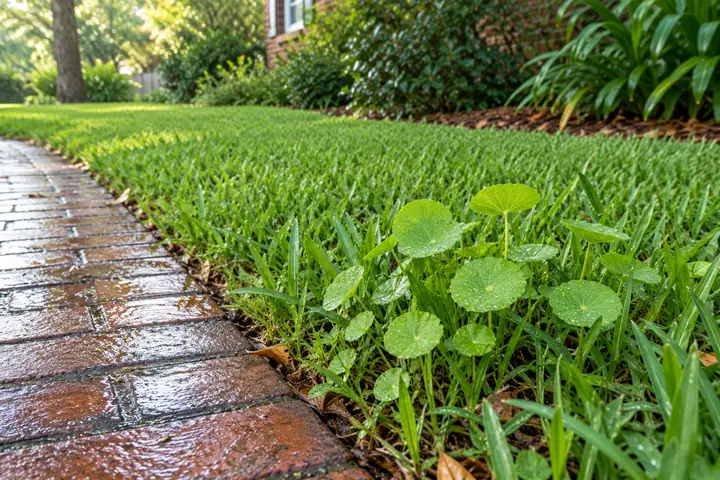
A shiny round leaf beside the back step can look cheerful until a whole patch interrupts the grass. The useful question is how that leaf is built. Dollarweed has a stalk that joins beneath the leaf near its center, rather like an umbrella handle. Follow the stalk with your eyes instead of judging from a circle of green seen from the porch. A leaf folded against another plant can hide this feature, so compare several intact leaves before settling on a name.
LSU AgCenter describes dollarweed as a perennial broadleaf associated with moist sites. Mississippi State Extension explains the scalloped, umbrella-like leaves and underground rhizomes. These features connect two otherwise puzzling observations: the round leaves look different from grass, and shortening them does not necessarily remove the plant. The visible disks are only part of the picture. A mowing visit can change their height without settling what remains beneath the surface.
Dollarweed and dichondra need different descriptions
The most helpful comparison is dichondra, another low plant with rounded leaves. Dichondra usually has a kidney-shaped indentation where the stalk joins the leaf edge. Dollarweed's stalk joins farther inward beneath a more complete circle. Think attachment point first, outline second. A damaged leaf can look notched, and overlapping leaves can look perfectly round. Checking the underside of an undamaged leaf in place gives more useful evidence than guessing from a distant photograph.
If the patch contains both shapes, do not force it into one category. Describe the two leaf types separately. A lawn can contain more than one broadleaf plant within the same green area. The label pennywort is also less precise than many homeowners expect: Mississippi State lists several Hydrocotyle species. For a management decision, a reliable identification matters more than agreeing on the nickname everyone on the block uses. An extension office can help resolve features that do not fit.
Make a water-timing record instead of a drainage verdict
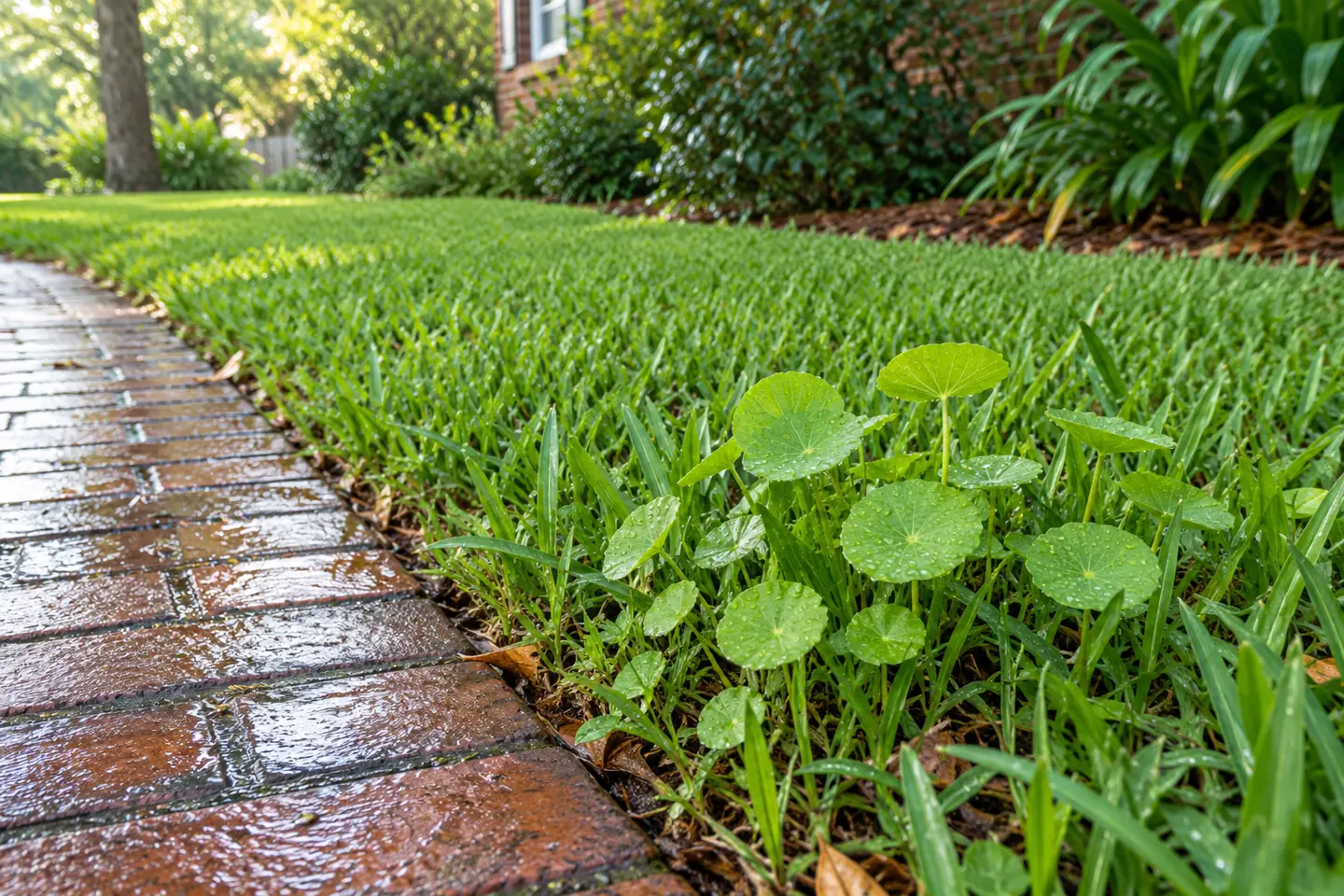
Dollarweed's association with moisture makes water worth investigating, but it does not identify a leaking pipe. Divide the observation into rainfall, deliberate watering and what happens afterward. Record whether the patch stays visibly wet after adjacent grass dries, whether water arrives during an irrigation cycle, and whether the same place receives runoff from a roof. These are different observations. Combining them into one statement that the lawn has bad drainage throws away the details needed to investigate it.
For example, imagine round leaves beside a downspout and another patch near a sprinkler. The first may become wet only after rain while the second gets wet whenever that zone runs. Keep two entries rather than treating both as one problem. A dry afternoon, the next morning and the next rain can reveal a useful sequence. Do not deliberately flood the yard to test a theory. The ordinary water events already occurring provide a safer starting record.
Compare four places, including a place without dollarweed
Choose the patch center, its outside edge, nearby intended turf and a comparable spot without round leaves. Comparing only the center can make every condition seem important. If the unaffected spot also receives shade and stays damp, those facts alone do not explain the difference. If the edge follows a hardscape joint or a concentrated flow route, that is worth noting. A comparison point helps turn a vague impression into a question someone can actually answer.
Keep this exercise simple. You are not conducting a soil test or measuring underground water movement. Note what is visible from normal safe access: standing water, worn turf, leaf cover, a low edge or a sprinkler spraying pavement. Avoid pushing probes near utilities or dismantling drainage components. The purpose is to separate observable conditions from possible causes, not to perform a repair before the cause has been checked. Bring uncertain conditions to the person qualified to assess them.
Read the edge of the colony
A broad green patch can hide two changes: dollarweed may be expanding, or grass within an old boundary may be thinning. Mark the boundary on a printed photograph using the sidewalk corner, fence post or patio edge as references. On the next comparison, look for round leaves beyond that outline and for grass still visible inside it. Those are more informative observations than judging whether the whole area looks greener in different afternoon light.
Pay particular attention to separated satellite patches. A small group of leaves beyond the main area is worth recording separately rather than drawing one large outline around everything. You do not need to excavate the ground to prove that the groups connect underground. A map of visible growth is enough to describe the maintenance concern. It also prevents a later photograph of one surviving group from being mistaken for a completely new problem somewhere else.
A shorter lawn is a poor identification tool
Once leaves have been cut, their appearance may become less distinctive. If identification is pending, retain a clear view of a few intact leaves before the visit. That does not require letting the whole yard become overgrown. The practical aim is to preserve the attachment point, leaf edge and relationship to surrounding turf. The height of an unwanted leaf should not decide the cutting height for every grass plant around it.
Ask what grass is being maintained and how the dollarweed area fits into the route. If the patch occupies soft ground, the ground condition deserves its own decision. A round leaf does not tell anyone whether equipment can travel there. Existing footprints, wheel depressions or water at the surface are more useful route information. Keep a soft-ground note separate from the plant identification so neither issue disappears inside the general instruction to tidy the corner.
Appearance, persistence and moisture are three outcomes
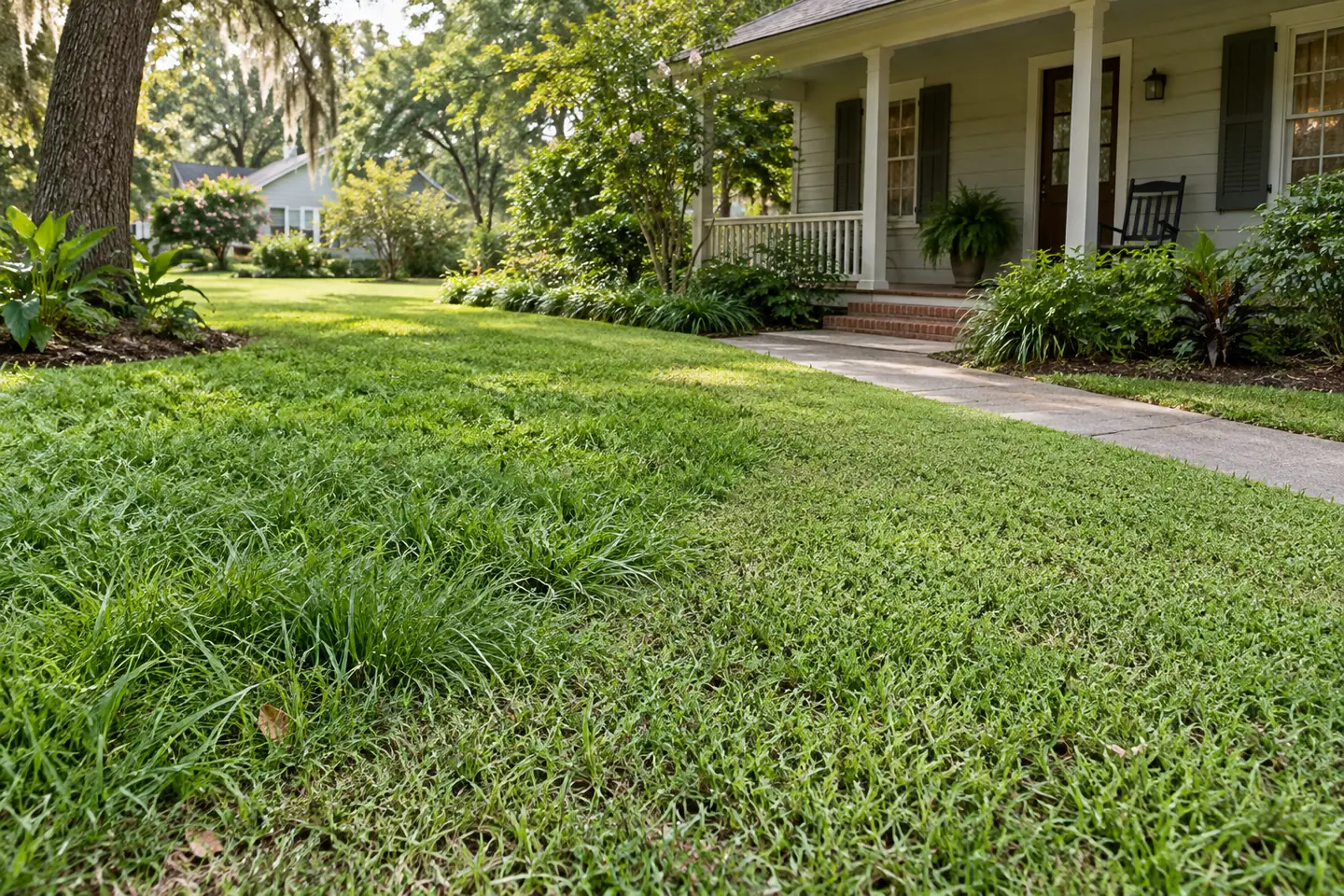
A good review separates these outcomes instead of expecting one photograph to prove all three. Appearance concerns the maintained grass and visible leaf height. Persistence concerns whether round leaves remain or return within the mapped area. Moisture concerns when and where the surface stays wet. A lawn can look tidier while the other two questions remain unresolved. Conversely, a drier week can make the site easier to access without demonstrating that the plant has been eliminated.
If watering is being reviewed, keep the actual changes in the record. Write down which zone or setting changed and when, rather than saying that irrigation was fixed. Appropriate watering depends on the turf and conditions; do not deprive desired grass of needed water solely to chase a weed. Clemson's dollarweed guidance discusses water management as part of a broader approach, not a guarantee that one adjustment will erase every established patch.
Keep the lawn and landscape-bed questions separate
Dollarweed near a shrub bed may cross several working surfaces: grass, mulch, paving and a water outlet. A lawn request should identify which surfaces are included. Edging the grass line, clearing leaves from paving and managing a broadleaf plant are separate tasks even when the patch touches all three. A neat edge can make the boundary readable; it cannot certify that underground growth stops at that line.
Before considering any weed-control product, confirm the plant, the desired turf and the exact site. A treatment suitable for one setting is not automatically suitable beside ornamental roots or on another grass species. This guide does not choose a product or application rate. Use current label directions and qualified local guidance for those decisions. General extension recommendations also do not expand Happy Grass's services to fertilization, aeration, overseeding or pest control.
Three dollarweed observations that lead to different questions
Consider three possible records from the same lawn. In the first, the round-leaf boundary stays in place but the ground is noticeably firmer after an irrigation adjustment. That supports a question about improved working conditions; it does not establish plant removal. In the second, the surface dries normally but new umbrella leaves appear beyond the old boundary. That supports a question about the visible plant distribution without proving that excess water is still present.
In the third, the outside boundary stays similar while fewer grass blades show between the round leaves. That is a turf-continuity concern even if the patch has not grown wider. Each record can be useful, but calling all three more dollarweed throws away the distinction. Keep the observations separate so a later assessment can address the part that actually changed.
- Firmer ground describes access conditions, not an inventory of underground stems.
- New disks beyond the mapped edge describe visible expansion, not the source of every new plant.
- Fewer grass blades within an unchanged outline describe a change in the desired turf component.
- A freshly shortened patch describes height; check leaf attachment again if its identity remains uncertain.
These comparisons also prevent a watering change from becoming an accidental eradication claim. The most useful review combines the leaf map with the actual water record, while allowing the two to tell different stories.
A useful dollarweed request is specific
For Happy Grass, a useful request might explain that round, center-stalked leaves occupy the strip between the patio and downspout, that the strip remains soft after rain, and that you want the surrounding turf maintained while discussing the patch separately. That gives the visit a location, a working condition and an outcome. It is much clearer than asking for all the wet weeds to disappear during ordinary mowing.
Happy Grass serves requests in Harvey, Marrero, Gretna, Algiers, Belle Chasse and Westwego. Call 504-339-3571 and ask for Happy, or share the patch details through the quote form. Bring the water-timing notes if you have them. The friendly goal is a lawn plan based on what is actually happening beside your home, with a tidy maintenance finish and realistic next steps for that persistent little umbrella patch.