
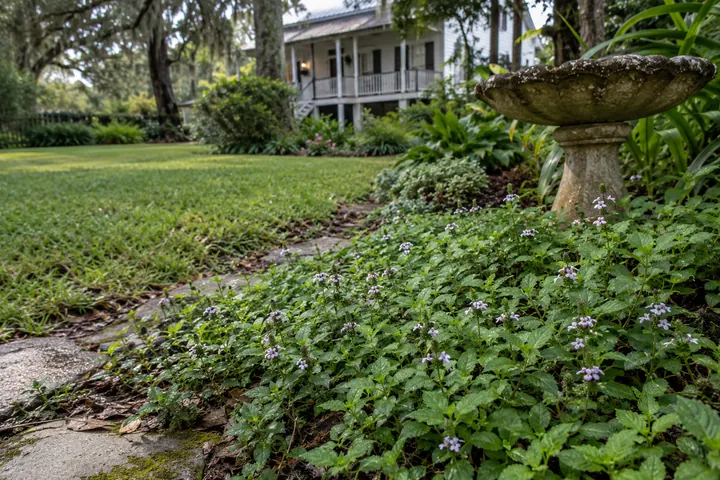
Start by asking whether this patch is meant to stay
Before describing a low flowering area as a weed problem, ask what the homeowner intends for that particular space. The same visible patch can be welcomed beside a birdbath and unwanted across an adjoining grass strip. A useful request identifies those two areas separately. Happy should not have to infer the keep boundary from a plant name or from a close photograph with no surrounding lawn.
NC State's plant account describes Phyla nodiflora, frogfruit, as a perennial groundcover with creeping stems, small opposite thick oval leaves and tiny purple-to-white flowers around cylindrical spikes. The stems can root at nodes. That background supports a comparison and helps explain why someone might discuss it as a chosen groundcover. It does not prove the identity of a particular low mat or determine the homeowner's desired boundary.
A flower cluster is not a single large flower
At ordinary viewing distance, a small head can look like one pale flower with a dark middle. The reference describes many tiny flowers grouped around a spike. Show a readable side view and an attached overview if a reviewer asks about that structure. Do not count every bright outer point as a separate petal of one oversized flower when the photograph cannot resolve the individual parts.
A close crop is useful only when its origin remains clear. Keep the original image linking that head to the marked stem, and label a second head separately if it comes from another example. The reviewer may need to compare the arrangement rather than the color alone. An attractive top-down picture can show the lawn's appearance while still leaving the cluster structure unresolved.
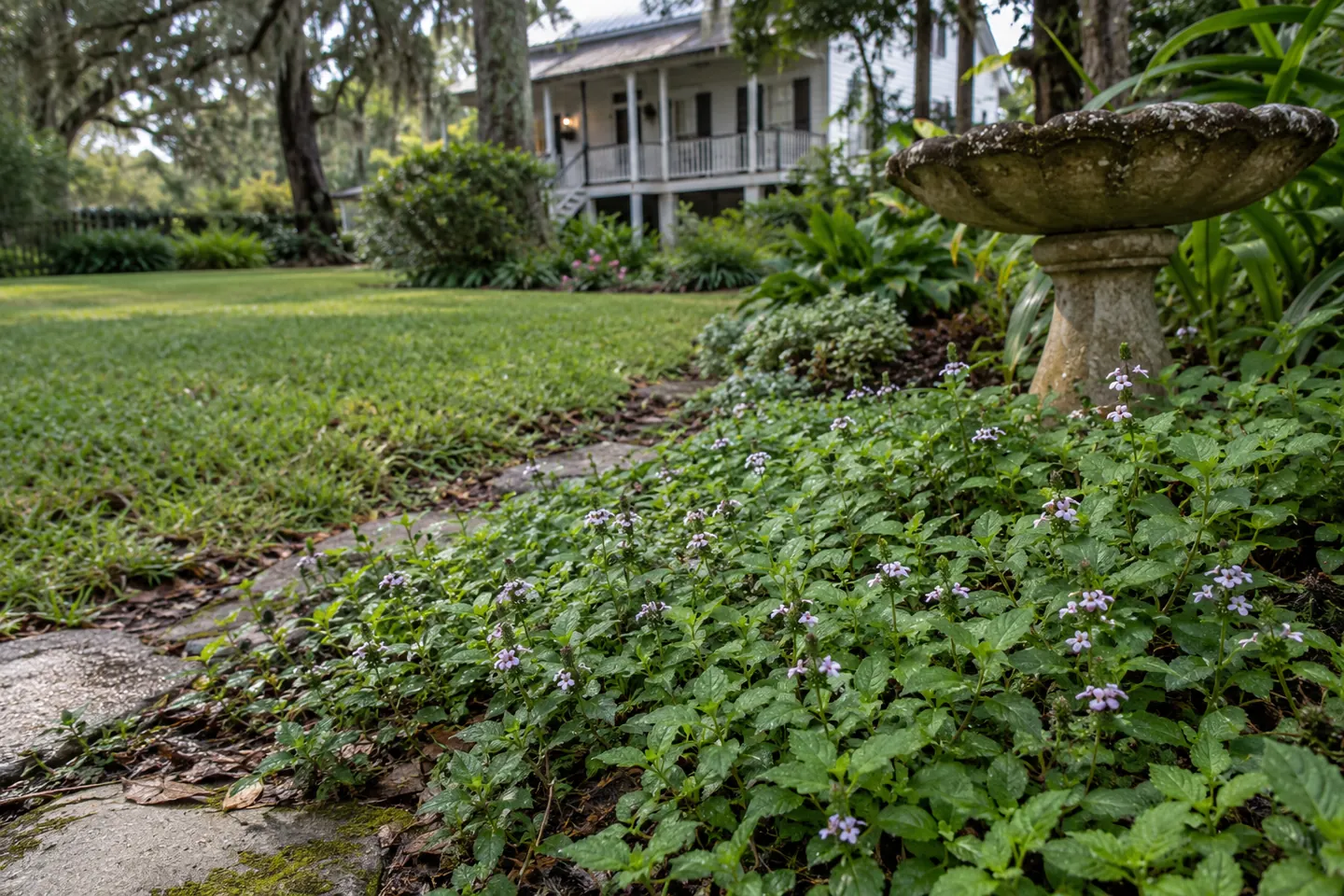
Connect the paired leaves to the flowering stem
Two small oval leaves in a flat image may look paired even when one belongs to a crossing stem. Include the node where their attachments can be followed. Show the blade margins and the short stretch of supporting stem where practical. If the far-side connection is hidden, say that one attachment remains obscured rather than claiming that the complete pair has been demonstrated.
Keep the leaf detail with its flower-head record. A low mixed border can contain several plants, and the clearest leaf may not belong to the nearest pale head. You do not need to supply every botanical term to make a useful inquiry. A plain description of which parts are actually connected gives a qualified reviewer more to work with than a complete reference description pasted beside unrelated photographs.
A creeping route is different from an assumed root map
Follow one visible stem where it crosses the surface and mark the points where it disappears beneath leaves or turf. The account's node-rooting description does not establish that every ground-contact point in your yard has rooted. Describe contact as contact unless the actual relationship was observed. A surface photograph should not be used to invent a detailed underground map.
The visible route can still be useful when discussing the edge of the maintained grass. It may show where the low plant crosses a chosen line or where several examples are present. Record those locations without assuming that all are one connected individual. A practical work map can stay accurate even when the full plant footprint and belowground relationships remain unknown.
Use two boundaries when the homeowner wants two outcomes
One line can identify the groundcover area intended to remain. Another can identify the routine lawn area to be reviewed. Use fixed features that another person can recognize, such as a paving edge or a birdbath-side bed corner. If there is no clear physical edge, discuss how the proposed boundary will be recognized before work begins rather than relying on a vague instruction to stop near the flowers.
Keep the boundary description in ordinary terms and show it in a wide photograph. A small close-up of leaves is not a substitute for that agreement. If someone changes the keep area later, record the revised line and date. This avoids a follow-up in which one person judges the result against the original boundary while another assumes that the entire low mat had become part of the lawn request.
A reference's landscape use is not a promise for every yard
The plant account discusses frogfruit as a groundcover. That does not establish how a particular patch will behave under the exact conditions of a Harvey or Westwego home, and it does not create an installation recommendation or service. Keep any planting or broader landscape decision separate from the routine lawn conversation. The actual identity, location and homeowner's intent still need to be clear.
If you are considering keeping an existing patch, ask the relevant qualified adviser about the questions that matter for that decision. Do not substitute a general plant profile for an assessment of access, use of the space or the boundary you want maintained. Happy can discuss the adjacent routine lawn work without promising a new groundcover installation or certifying every aspect of its performance at the property.
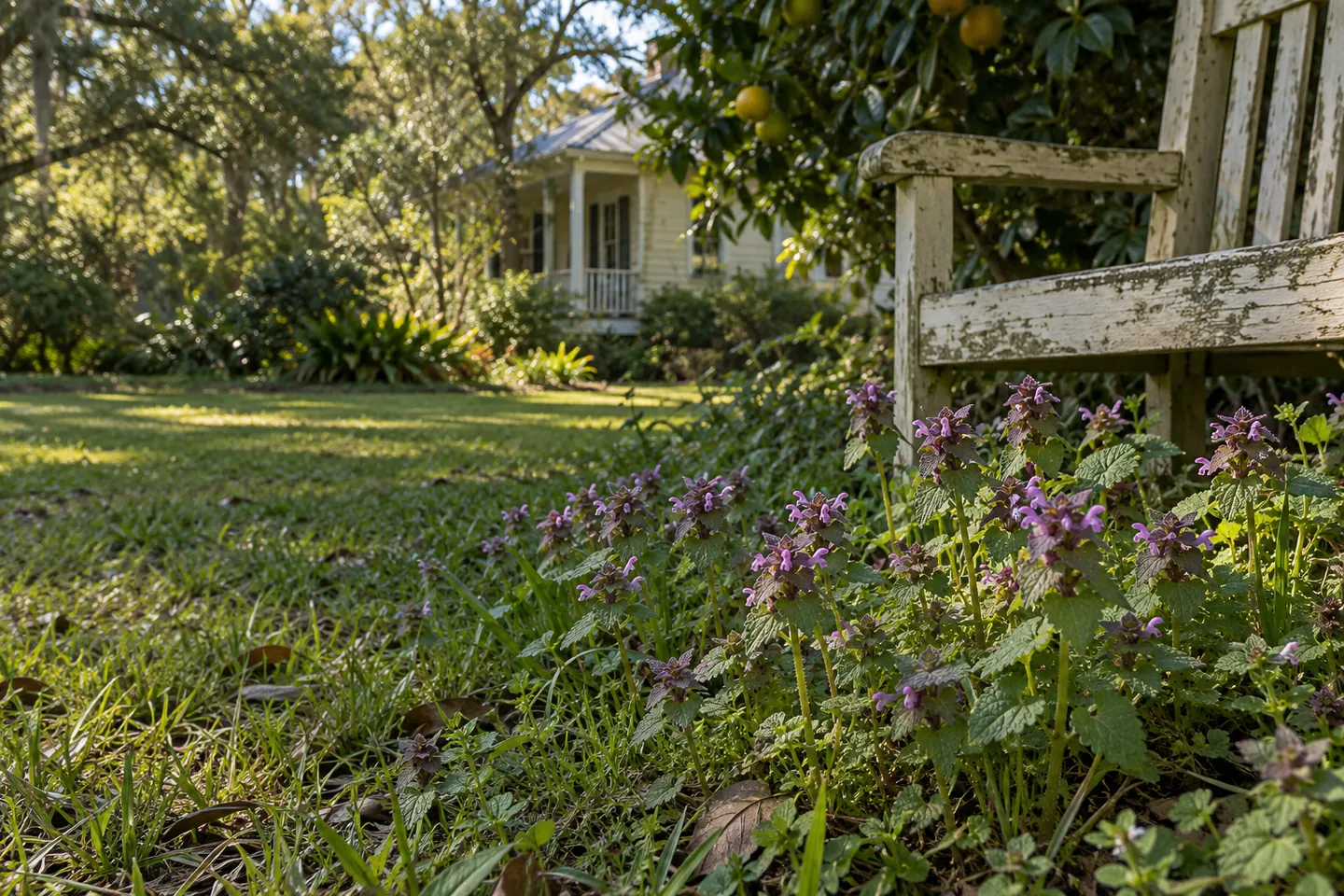
Describe flowers where they matter to the ordinary view
A close flower photograph may be beautiful while giving no sense of how the border appears from the porch. Include one ordinary viewing-distance image. Explain whether the concern is a flowering edge being retained, growth crossing onto the grass or an uneven low texture in the maintained area. These are different requests even when the same candidate plant appears in all of them.
Do not assume that the presence of flowers automatically defines a keep area. The homeowner's stated intent and the agreed boundary do that work. Equally, do not assume that a routine grass-cutting request authorizes work through every low flowering patch nearby. A clear conversation can preserve what is wanted while making the included lawn area straightforward to identify and evaluate.
Keep living visitors out of an identification demonstration
You do not need to arrange insects, move a birdbath or stage activity around the patch to make an identification inquiry more convincing. Record the plant structures that are actually visible from an accessible position. If current activity or use of the space affects the proposed visit, describe that condition directly rather than adding an unsupported claim about the plant's role at the property.
Agree on the lawn operation along the chosen line
Discuss whether mowing, edging, weed-eating or blowing is proposed for the included grass area and what finish is expected at the boundary. A clean visible line is different from a biological barrier that guarantees no plant will ever cross again. The agreement should name the current area and routine result rather than implying permanent control of every stem, root or future growth beyond the line.
If a later image shows growth crossing the boundary, describe the location and observation date. Compare the view with the agreed line and the known maintenance date, if one is available. Do not claim an exact spread rate from pictures taken at different angles. A measured repeat view or clear fixed reference can make the conversation useful without assigning an unsupported cause or timeline.
Pass the keep decision to the person arranging the visit
When one household member likes the low flowering patch and another arranges lawn work, put the agreed keep boundary in a message both can review. Identify who can clarify it if the visit description is still ambiguous. A photograph labeled leave these flowers is less useful when it shows only a close head and no fixed reference to the surrounding grass. The instruction needs a recognizable place as well as a preference.
If the decision changes, update the boundary record before treating the new preference as the standard for judging completed work. Keep the earlier agreement and date so the change is understandable. This is a practical communication step, not a claim about which plant identity is correct. A household can agree to retain a marked area provisionally while an identification question is still open, provided that provisional intent and the included lawn area are communicated clearly to the person arranging the routine visit.
Keep the identification answer with the boundary record
A reviewer may confirm a candidate, offer another name or explain that the evidence is insufficient. Save that answer with its limits and retain the original location label. If the species name changes, the keep boundary should not silently change with it. The homeowner's chosen area and the botanical conclusion are related records that can be updated independently.
For a focused first message, include the ordinary border view, one connected stem-and-leaf detail and an attached head view. State which area is meant to stay and which area is part of the lawn discussion. That packet gives both the identification reviewer and Happy a usable starting point without requiring the plant name to communicate every practical decision about the yard.
- Mark the intended groundcover area before discussing routine work.
- Show the flower cluster from a readable angle.
- Keep paired leaves attached to the example being reviewed.
- Distinguish a clean finish from a permanent plant barrier.
- Preserve a revised identification without silently moving the boundary.
Talk about the flowering edge with Happy
Call 504-339-3571 and ask for Happy. Explain the area being kept, the lawn area to review and the mowing, edging, weed-eating or blowing you want discussed. Confirm scope and availability before arranging a visit.