
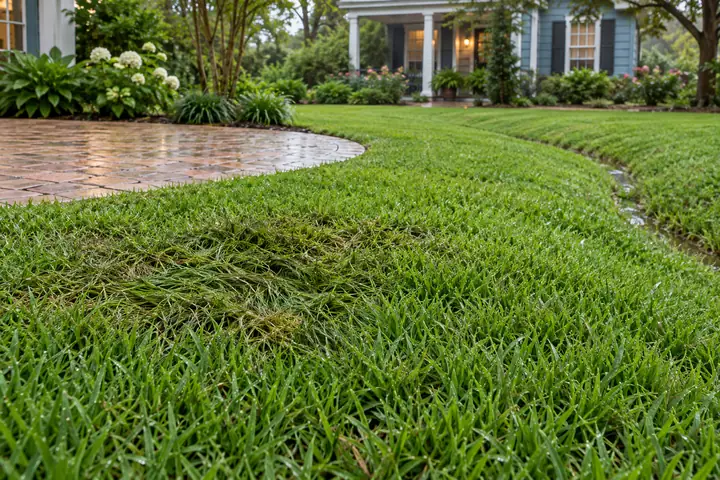
The speed of change is part of the report
A patch that changes markedly between observations deserves a different conversation from old brown foliage that has looked much the same for weeks. Pythium blight is one condition Extension references describe as potentially fast-moving under favorable circumstances. That does not make every sudden lawn change Pythium. It does make the actual sequence worth preserving and sharing promptly with an appropriate plant-health resource, rather than waiting through several ordinary mowing visits for a guess to become clearer.
Record when you saw the area and what was different at the next observation. If the first view was a photograph from someone else, keep that distinction. Do not invent an hourly expansion rate from two images taken at different angles. A useful report can simply say that the affected foliage occupied more of the same identifiable area by the following morning. The purpose is to communicate a changing condition accurately enough for the assessor to decide what needs attention next.
Matting and a greasy appearance are clues, not a chemical test
NC State describes affected leaves that become matted and dark or orange-gray, sometimes with a greasy appearance. UGA's tall-fescue guidance also discusses initially water-soaked foliage that collapses and turns brown. The word greasy describes how the tissue looks in these references. It does not establish that oil or another chemical has been spilled onto the lawn. An actual known spill remains a separate exposure history to report.
Describe whether leaves are lying flat together, individually upright or covered by loose material. Include their condition before mowing or cleanup changes it. A photograph of a shiny wet surface may not show which of those situations exists. Keep a close view connected to the whole affected area so the reviewer can see the relationship. Do not rub, wash or repeatedly rake the foliage merely to make the appearance easier to name.

Identify the grass and the management setting
Many Pythium blight references concern cool-season turf, while some discuss closely maintained warm-season grass. NC State explicitly distinguishes symptoms in cool-season lawns from those in bermudagrass putting greens. A home lawn on the West Bank should not be treated as a golf surface simply because the disease name is the same. The turf species, mowing setting and actual symptoms all belong in the assessment.
If the lawn is a mixture, identify which plants are collapsing and which remain normal. A symptom affecting one grass within the stand can create a misleading pattern when viewed as one uniform lawn. If the species is unknown, say so and ask what identification material is needed. The goal is not to select the reference photograph that looks most alarming. It is to choose the right comparison for the living plants that are actually being maintained.
White growth with dew does not settle the identity
Cottony growth may be visible on affected foliage during high humidity or wet early-morning conditions. UC IPM and UGA describe this sign, but similar-looking growth is discussed for other turf diseases too. Its presence is useful to show; its absence later is not a reliable exclusion test. Keep the observation in context rather than treating a white patch as the whole diagnosis.
For a useful comparison, record: – Whether the material is attached across affected leaves or spans a separate gap. – Whether the leaves themselves are collapsing or otherwise changing. – The location of the feature within the wider affected area. – The time and natural moisture conditions when it was visible. – What the same location looked like after the foliage dried.
These details help the assessor distinguish possibilities. They do not require you to create humidity, add water or preserve a morning appearance by keeping the lawn wet. Use what occurred naturally and retain the original unfiltered images.
Follow drainage patterns without assuming they prove a cause
Extension descriptions note that Pythium blight can spread along water movement and be tracked by equipment. A streak following a drainage route is therefore relevant history. It is not proof that the drainage system is defective or that a particular mower introduced the problem. Keep the observed pattern separate from conclusions about how it began. Other causes can also follow routes through a yard.
Show where the affected area lies in relation to a low section, path or normal equipment route. If water movement was actually observed, describe its direction. If the idea comes only from the shape of the injury, label it as a possibility. A map of the visible boundary and known water routes is more informative than a confident story about an unseen source. It also helps the next visitor locate the area if rapid changes have made an earlier photograph harder to match.
Separate prolonged leaf wetness from a single rain total
Pythium blight guidance emphasizes conditions on the foliage as well as temperature and moisture. A rainfall total by itself does not describe how long the leaves stayed wet. A shaded area, evening irrigation and a humid night can create different drying patterns from an open lawn after a brief shower. Report actual conditions without trying to calculate an infection threshold from a casual home record.
Also keep the soil and leaf observations distinct. Saturated ground, damp leaves and a wet-looking mat of declining tissue are related questions but not identical findings. Before making a broad irrigation change, ask what the assessment supports for the actual grass and area. Repeatedly adding water because the patch looks brown can miss the significance of the wet-condition history. A useful response should follow the identified problem rather than the color alone.
Pythium blight is not every problem carrying the Pythium name
UC IPM distinguishes the foliar blight described here from other Pythium-related problems such as root rots or seedling decline. A general label does not make those conditions interchangeable. UGA emphasizes accurate diagnosis because the organisms involved require a specific management approach. This is a reason to obtain the right assessment, not a reason to select a treatment from a broad fungus label or another lawn's experience.
Ask which plant parts are affected and what evidence supports the finding. Keep the assessment wording intact, including whether it is preliminary or confirmed. If the sample is inconclusive, record the next question instead of promoting the suspicion to certainty. A disease name can be a useful shorthand after the evidence is established. Before that, a precise description of collapsing foliage may be the more honest and helpful way to communicate the concern.
Preserve useful material and ask about timing
When rapid decline is suspected, contact an appropriate diagnostic or Extension resource and ask what it needs to review the condition. Current sampling and delivery instructions matter, particularly for a changing plant problem. Do not assume a bag of dry clippings from an earlier cut will show the same evidence as connected turf collected from the requested location. Ask before removing the material rather than trying to reconstruct it afterward.
Include the grass identity if known, the sequence of observations and recent mowing, water or product history. Identify the actual sample location in an overall view. If an adviser needs to see the area before cutting, arrange that explicitly. The maintenance crew cannot preserve evidence it does not know is under review. A prompt, focused handoff is more useful than waiting for the routine visit and hoping that a fresh cut will explain why the foliage collapsed.
Make the next visit a deliberate decision
Extension guidance cautions about mowing wet grass where this disease is a concern. Discuss the current condition and any supplied instructions before ordinary maintenance proceeds. The question is whether and how the agreed work fits the assessment, including route, sequence and cleanup. Do not assume that clipping collection, affected-material removal or treatment is included simply because an educational article mentions it.
If separate plant-health work is recommended, confirm its provider and how later mowing should fit around it. A tidy surface and disease suppression are different outcomes, and lost turf coverage raises a further recovery question. Ask which result will be reviewed next. The decision can then remain grounded in the living grass rather than being reduced to whether the yard looked neater after the mower passed.
Keep the record useful as the lawn changes
For a West Bank property, the practical value of this guide is recognizing when the pace and kind of change deserve a focused assessment. Preserve the location, affected grass, leaf condition and actual sequence. Do not assume that a familiar small patch will remain small, and do not assign a diagnosis simply because an internet photograph looks similar. The right next step follows the evidence available now.
In Harvey, Marrero, Gretna, Algiers, Belle Chasse and Westwego, a clear handoff can connect an urgent plant-health question with sensible routine maintenance. Keep the two roles coordinated and confirm what has actually been established before describing the lawn as treated or recovered. The grass may need more than a cut, and a useful maintenance conversation should leave that question visible rather than mowing it out of the story.
Discuss the agreed maintenance scope
Call 504-339-3571 and ask for Happy. Share relevant assessment instructions before arranging lawn maintenance. This guide does not add Pythium diagnosis, fungicide application, fertilization, aeration, overseeding or pest control to the service agreement. Separate specialist work requires an appropriate provider and scope.