
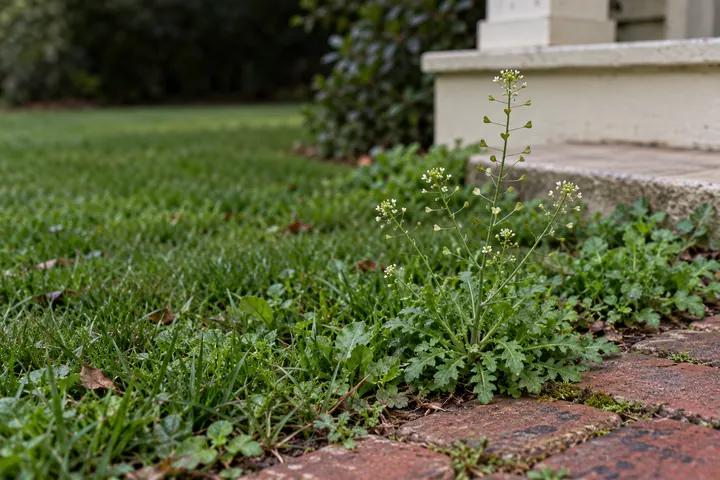
Look below the newest flowers
A tiny white flower at the top of a thin stem is an interesting detail, but it may not be the most useful part of the plant to show. Missouri Department of Conservation describes shepherd's purse with a basal rosette, small stem leaves, four white petals and flattened, two-lobed pods with a triangular or heartlike outline. Older pods occur below the newer flowers. That arrangement gives a reviewer more information than a white dot against a green lawn.
Start with an attached stem where several stages can be seen at once. The photograph should help another person distinguish an open flower from a developing pod. A familiar common name is easier to discuss when it is tied to a visible sequence on one plant. Do not label an unfamiliar structure a seed merely because it sits below a flower. Describe its outline and position while leaving the identification open.
A heart shape needs a readable outline
Small pale objects can look heart-shaped when their edges overlap. Move the camera's viewpoint enough to separate the candidate pod from the stem behind it, while keeping a wider view available for context. An outline that is completely lost in glare does not become more certain when the image is enlarged. Choose the frame that shows the boundary clearly, even if it is less dramatic than a close-up filled with green.
Record whether the apparent notch and two lobes are actually visible. If one side is hidden, say so. A caption such as flattened pod, one upper lobe obscured is more useful than an enthusiastic guess about a perfect little heart. This is a description of evidence, not an art contest. The reviewer needs to know which parts were observed and which were supplied by expectation after you read the candidate name.
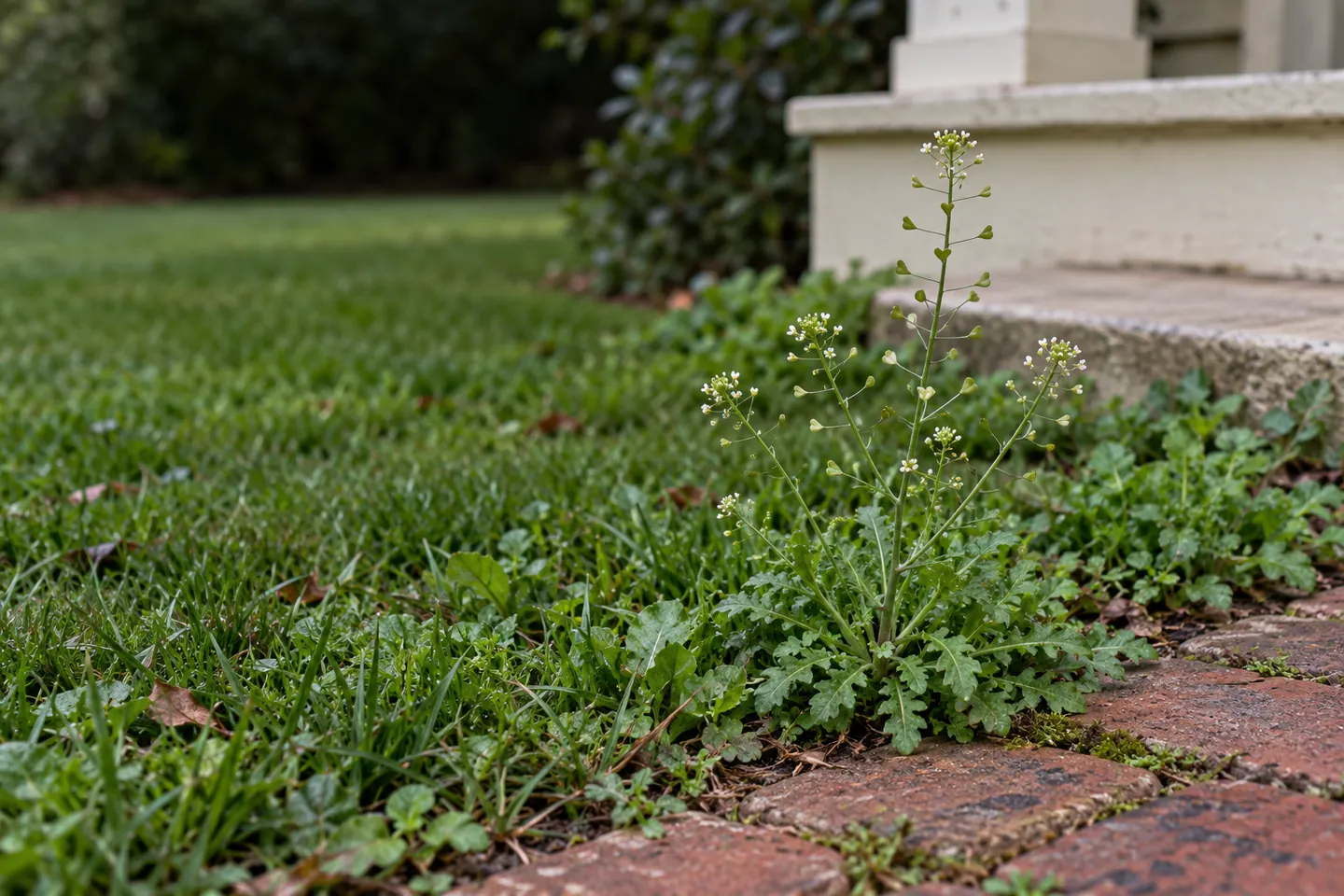
Keep the rosette in the same record
The plant's lower leaves and its flowering stem may look like separate lawn problems when photographed on different days. Give the example a fixed label such as porch-paver rosette. Show where the stem emerges from the lower plant if that relationship is visible. Do not pair a nearby rosette with an attractive flowering stem simply because both are in the same strip of lawn.
A low-angle photograph can be helpful when it is taken from an accessible position without disturbing the plant. Include enough surrounding detail to locate the example again. If grass hides the connection, document that limitation. A qualified reviewer may request a different view or a specimen, but there is no benefit in presenting a guessed connection as something already demonstrated. Keeping the parts together makes later corrections much easier to understand.
Four petals is a question about a flower, not a blur
The reference's four-petal description can guide a close look at an open flower. It cannot be applied to a bright spot whose petals merge in the photograph. Count only when the individual parts are resolved, and distinguish a fresh open flower from a damaged or partly closed example. Several neighboring white flowers in one photograph may belong to different stems, especially in an untidy border.
You can still send an imperfect image if its purpose is clear. Tell the reviewer that the flowering tip is shown for its position and that the petal count remains unresolved. Then include the sharper pod view rather than pretending the flower image answers every question. Different photographs can have different jobs. A small set with honest captions is more useful than an album in which every detail appears to be equally certain.
Separate a pod record from a spread claim
A row of visible pods says something about the photographed plant. It does not establish how far seeds have traveled, where every new rosette originated or when a particular patch began. Avoid drawing arrows across a yard photograph to invent a route of spread. You can map where similar-looking examples are visible without claiming a causal connection among them.
For a Marrero lawn, a practical record might identify a porch strip, a gate corner and a bed edge as three separate observations. Give each its own label and date. If a reviewer later finds that one example is a different plant, the location record remains intact. That approach supports a useful maintenance conversation while preserving the difference between seeing multiple examples and proving that one plant produced all the others.
Small plants can matter without being tall
The immediate concern may be a low rosette interrupting the lawn's texture rather than the thin stems above it. State which layer bothers you. A cut can change the appearance of taller growth while a lower plant remains visible. Comparing those two layers prevents a follow-up photograph from being judged against an outcome that nobody actually agreed to deliver.
Choose an ordinary viewing position, such as the porch step or the sidewalk corner. Explain whether the concern is the overall front view, a narrow paver seam or several individual rosettes. Those are different requests even if the same candidate species appears in each. A plant name does not tell Happy whether you want an identification discussion, a routine lawn visit or a review of an area that may fall outside the proposed work.
Paver seams are boundaries, not lawn measurements
A plant emerging between two pavers can look larger than it is when the image contains no context. Include the full seam and the adjoining lawn boundary in an overview. Note whether the example is actually in the turf, in a crack or inside a bed. That location matters to defining the requested work, even while the species question remains unresolved.
Do not assume that a general mowing request includes detailed work within every hardscape joint. Describe the particular location and ask what routine operations are proposed there. The useful agreement names the area, the intended visible result and any access limitation. It should not rely on a photograph of a pod to communicate an unstated paving repair, plant treatment or complete removal request.
Use repeat observations to preserve stages
An earlier photograph may show flowers while a later one shows mostly pods. Keep the dates on both records rather than overwriting the first image with the second. Compare the marked stem where possible. If the later photograph shows a different example, label it as another plant. Similar appearance does not prove that the two images document the same individual changing over time.
A short observation table can be enough: location label, date, open flowers visible, pod outlines readable, lower leaves shown. Leave an entry unknown when you did not check it. You do not need to calculate a growth rate or predict the next stage. The purpose is to preserve the evidence that was actually available at each visit, including the useful details that may disappear after routine maintenance.
Annotate stages without hiding the evidence
When several pods overlap on a stem, a small numbered copy of the photograph can help organize the question. Keep the unmarked original beside it, and place numbers in the empty background rather than over the pod edges. In a separate caption, explain that one number identifies an open flower, another identifies the clearest flattened outline and a third marks a structure whose stage you cannot resolve. This gives the reviewer a way to discuss specific details without making the annotation itself look like evidence.
Do not trace a heart shape around an unclear pod and then use the traced copy as proof of its outline. The drawing reflects your interpretation. The underlying photograph must still show the feature independently. If a reviewer corrects the stage labels, preserve that correction with the numbered example. This is particularly useful when a homeowner returns to the plant later and finds that the original structures have changed or disappeared. The record can explain exactly which pod was discussed and which conclusion was provisional, instead of turning a general conversation about little hearts into a claim that every structure on the stem was confirmed. A simple, reversible annotation can improve a question when its role is kept separate from the observation.
Give an identification reviewer a focused question
Ask whether the visible pod outline and its arrangement on the attached stem support a shepherd's purse comparison. Include the lower plant and flower detail with that question. A focused inquiry makes it easier to explain what is already readable and what remains missing. It also avoids treating a quick phone image search as a final botanical determination.
- Keep an original overview with each close crop.
- Label flowers and pods separately when their stages are clear.
- Keep unconfirmed stem-to-rosette connections marked as uncertain.
- Describe the lawn finish you want independently of the candidate name.
Bring the porch-strip question to Happy
Call 504-339-3571 and ask for Happy. Explain the marked area and the mowing, edging, weed-eating or blowing you want discussed. Confirm the scope and availability for your yard before arranging a visit.