
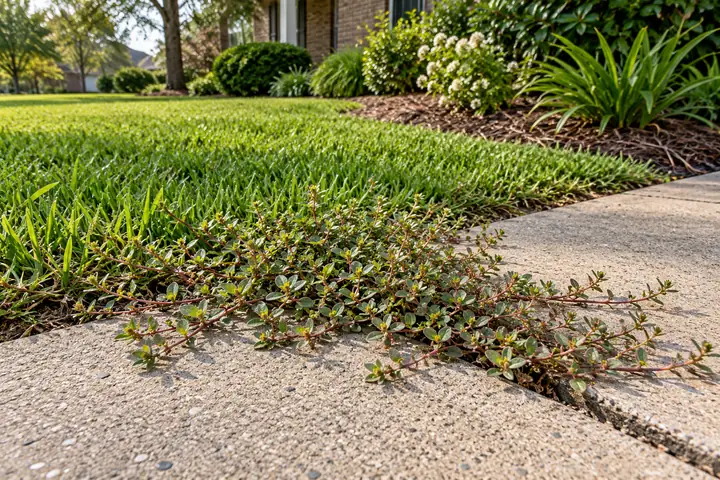
A weed can hide below an otherwise neat edge
The sidewalk line looks straight, yet a flat reddish mat still spreads beside it. That is a different problem from long grass leaning over the concrete. Spotted spurge grows close to the ground, so the important view is down at the branching stems rather than across the cut lawn. Before asking for a sharper edge, establish whether the unwanted growth belongs to the turf edge or is a separate plant occupying the open surface next to it.
LSU AgCenter describes spotted spurge as a warm-season annual found in lawns, landscape openings and sidewalk cracks. Its low stems radiate outward, small oval leaves occur in opposite pairs and many leaves carry a reddish central spot. Seeds are its principal means of spread. These clues explain why a little plant in a joint can become a conspicuous mat without ever looking like tall grass that a mower should easily remove.
Trace the branches back toward their origin
Start at the outer edge of one mat and follow a visible reddish stem inward. Look for a common center rather than assuming every small leaf belongs to an independent plant. A mat's width can exaggerate how many plants are present. On the other hand, overlapping mats can conceal several centers. That distinction matters when describing the area: one broad mat in a crack and numerous separate seedlings across a thin lawn are different patterns.
Do not tear through unknown plants to count roots. The point is to understand the visible architecture. Where stems disappear beneath grass or mulch, record that the connection is unclear. This keeps a removal conversation honest. A flat patch may look easy to brush away, but the visible tips do not show what remains attached at the center. Describe the branching pattern before choosing an approach based solely on the mat's shallow appearance.
The leaf spot helps, but it is not the whole identification
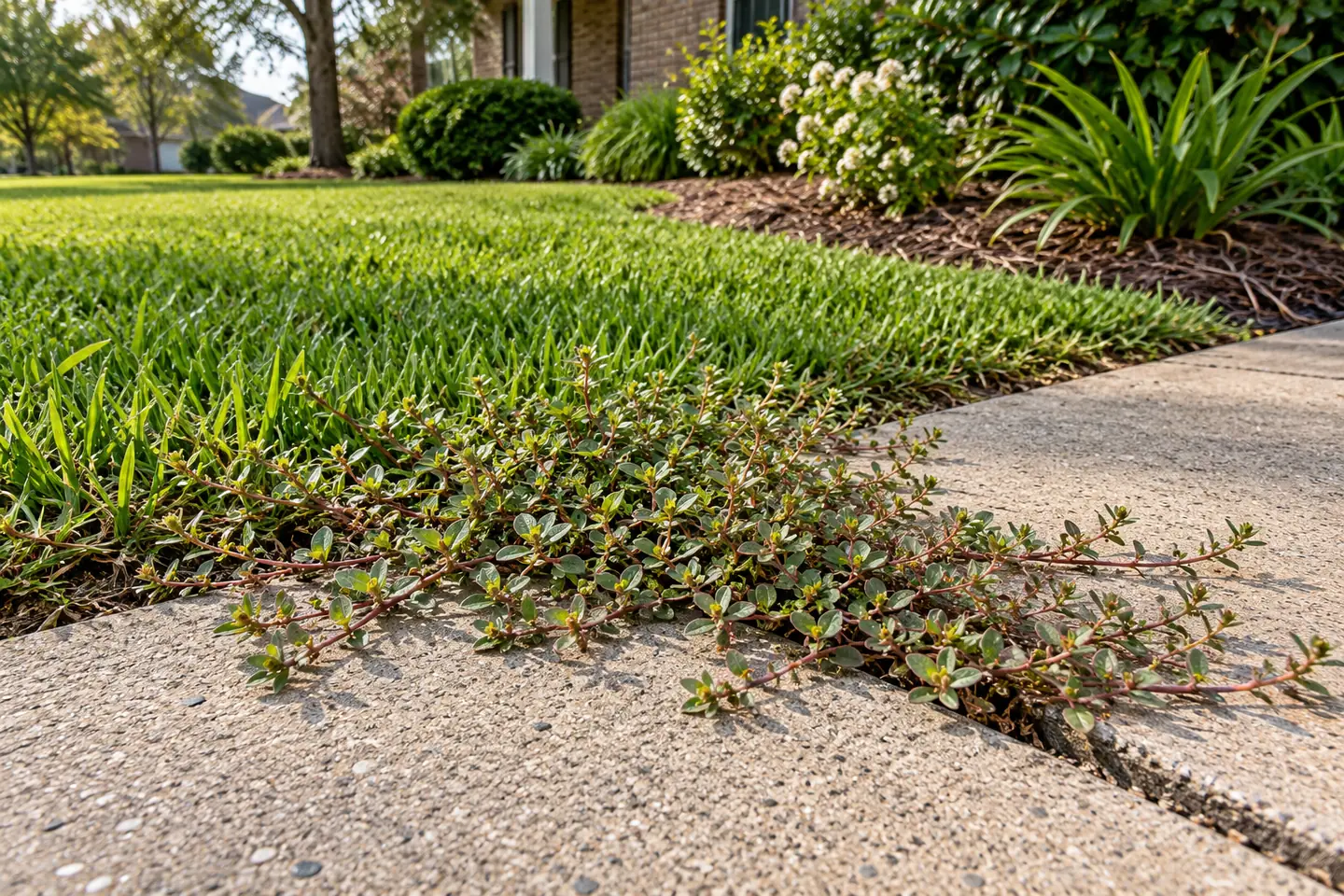
A red or purple mark in an oval leaf is useful evidence, especially alongside paired leaves and low reddish stems. It is not a requirement that every leaf display an equally dark spot. UC IPM discusses other low-growing spurges that can resemble spotted spurge. If the plant's overall arrangement does not fit, a single dark mark should not override the mismatch. Compare multiple features on the same intact branch.
UC IPM also notes milky sap from broken spurge stems and warns that the sap can irritate eyes and skin. Do not deliberately break stems with bare fingers as an identification game. A clear view of leaf pairs, stem arrangement and the mat can support an extension identification without creating unnecessary contact. If manual handling is contemplated, follow appropriate protective guidance and keep the plant away from food preparation and casual child handling.
Map the mat by surface
Divide the affected area into turf, pavement joint and planting bed. A spurge mat may bridge all three while its center occupies only one. Edging the grass can expose that distinction, but it does not automatically remove the weed from the joint. Similarly, clearing a joint does not mean seedlings in adjacent turf have been addressed. The work request should name the surface rather than relying on the broad phrase clean the edges.
For a concrete walk, identify whether growth is in a joint, alongside the slab or through a broken section. Do not request that a trimmer dig out material where the pavement condition is unknown. A maintenance task should not quietly become pavement repair or joint excavation. Where the mat crosses into ornamental plants, identify those plants before any removal or weed-control method is selected. The boundary on the ground matters even when the weed ignores it.
Small seedlings and mature mats need separate attention
A large mat attracts the eye, but the smaller plants around it are worth locating too. LSU describes prolific seed production, and UC IPM emphasizes addressing new plants before seed production. That makes the search around a mature mat useful. Inspect nearby open joints and thin lawn spots rather than assuming the large center is the whole issue. Record newly observed plants without claiming that you can tell exactly when their seeds arrived.
After work, distinguish a surviving branch attached to the old center from separate seedlings nearby. Both may look like the weed returning, but they describe different observations. A useful follow-up note says where each appears. Do not interpret the annual life cycle as a one-visit clearance guarantee. The current plant and future emergence from seed are different parts of the problem, and a freshly bare joint does not reveal every seed it contains.
Mowing height cannot reach every flat stem
A spurge mat lying beneath the grass tips can remain after the lawn is evenly maintained. UC IPM specifically describes mowing as ineffective for controlling low-growing spurges. This is a plant-height mismatch, not automatic evidence that someone missed a strip. Look at the cut grass and the surviving mat separately. If the grass is even while the low branches persist, the next question concerns the weed rather than another pass over the same turf.
Repeatedly cutting lower to reach the mat can also change the intended grass finish without resolving the plant at its center. Keep the turf's maintenance needs attached to the turf. A mat in concrete joints may never enter the mower's path at all. Naming that difference helps choose the right task: grass edging, manual weed work or a separate management discussion. One piece of equipment should not be expected to accomplish every task at the sidewalk boundary.
Read exposed soil as a separate lawn condition
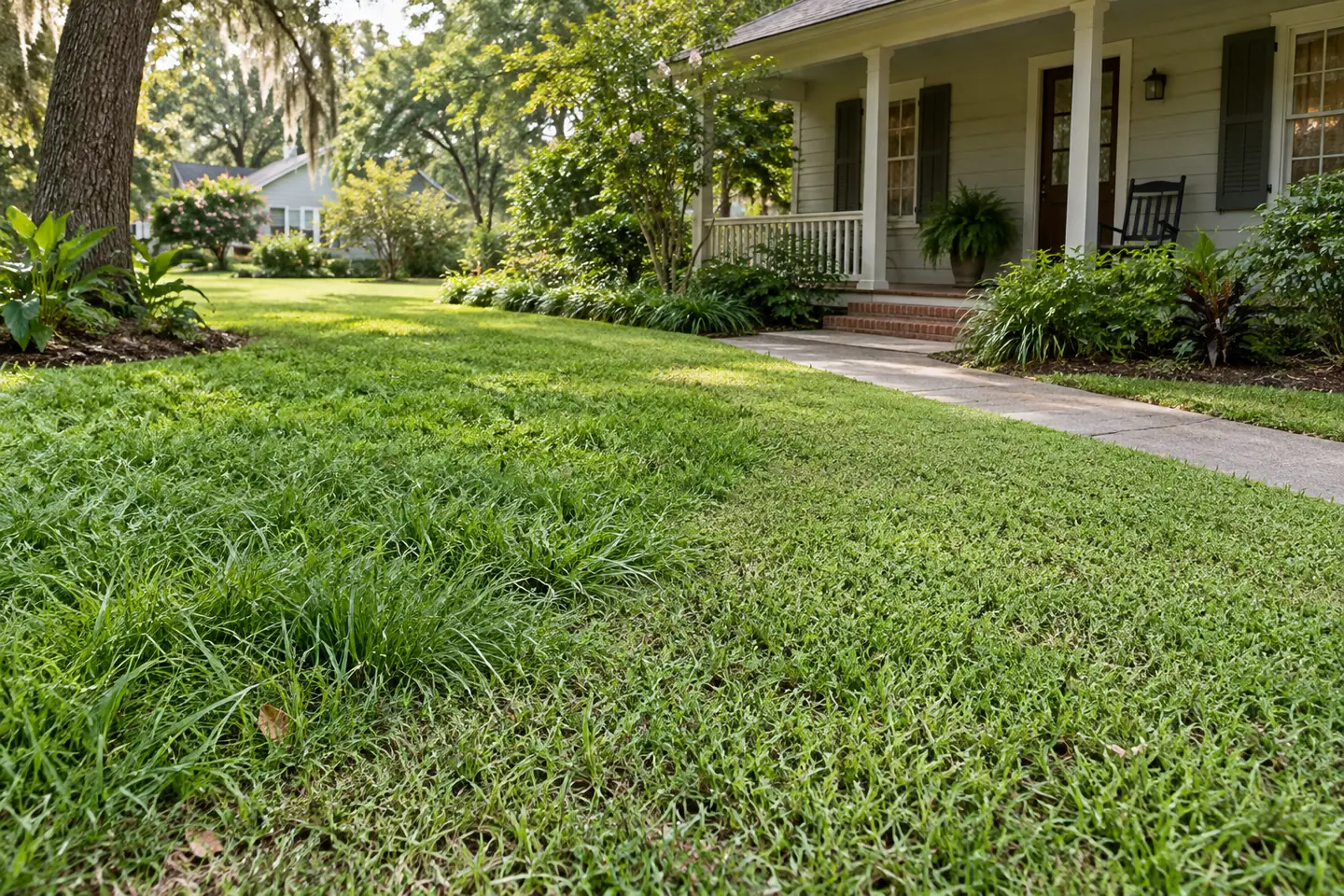
If many small spurge plants occupy the same open lawn strip, note the amount of desired grass between them. Is the strip worn by a regular route, shaded by stored objects or bare beside the pavement? These observations may guide a later turf assessment. They do not establish a soil diagnosis. Spurge's ability to grow in difficult openings does not prove that every affected spot has the same underlying problem.
An orderly surface can still contain a sparse turf edge. Removing the visible mat may reveal that condition more clearly rather than instantly producing a filled-in lawn. Before work, decide whether the immediate goal is a clean boundary or an assessment of the thin strip as well. Those goals can be discussed together, but neither should be assumed from the other. A weed removed from a gap does not become replacement grass.
Keep fragments and cleanup destinations visible
If manual work is agreed, discuss where removed material will go instead of leaving it in a pile across the lawn edge. A pile can hide surviving stems and make the final check difficult. Do not brush an unidentified mat into a garden bed simply because the pavement looks cleaner afterward. Cleanup should leave the affected center visible enough to assess, with the surrounding desired plants and surfaces protected.
The same care applies when comparing before and after views. Check the former center, the farthest branches and nearby small plants independently. A mat removed from the sidewalk may still be present beneath grass just beyond the edge. Conversely, a few separate seedlings should not be described as an untouched giant mat if that is no longer the condition. A precise review helps resolve the actual remaining task without turning every green speck into an exaggerated complaint.
Match the edge task to the actual mat position
Picture three spurge-like mats beside one walkway. One starts in a concrete joint and extends over the slab. Another sits in a bare lawn opening just beyond the grass edge. A third lies beneath the lowest leaves of an ornamental. Their flat shape may look similar, but their locations create different work questions. The first needs a joint-specific scope, the second exposes the condition of the lawn opening, and the third requires protection of the ornamental.
An edging pass could make the whole walkway look neater while leaving all three centers present. That is why a finish review should locate the centers again. Do not judge removal from the straightness of the grass line or the disappearance of the longest branches alone.
- Joint center: distinguish vegetation work from damage, filler or repair needs in the paving.
- Turf-opening center: inspect the desired grass that would remain if the mat were reduced.
- Ornamental overlap: identify the desired plant before any handling or product decision.
- Multiple small centers: record separate plants rather than assuming one large radiating mat.
These location-based distinctions keep a low weed from turning a simple edge request into unspecified work across every surface. They also give the owner a practical way to describe what is still present after the visible boundary has been tidied.
Ask for the edge result you actually want
A useful Happy Grass request distinguishes the grass line from the spurge-like mat and identifies whether joints or beds are included. Mention any desired ground cover intertwined with it. For weed-control options, confirm identification, the site and available scope before choosing an approach. Product suitability depends on the exact setting and current label; this guide does not prescribe one. Research about broader lawn practices does not add fertilization, aeration, overseeding or pest control to Happy Grass's services.
Call 504-339-3571 and ask for Happy for requests around Harvey, Marrero, Gretna, Algiers, Belle Chasse and Westwego. Explain whether the priority is a straight grass edge, clear pavement joints or review of recurring low mats. The little reddish branches can be easy to miss from standing height. Putting their actual location into the request makes the difference between a vague cleanup instruction and a practical, reviewable lawn visit.