
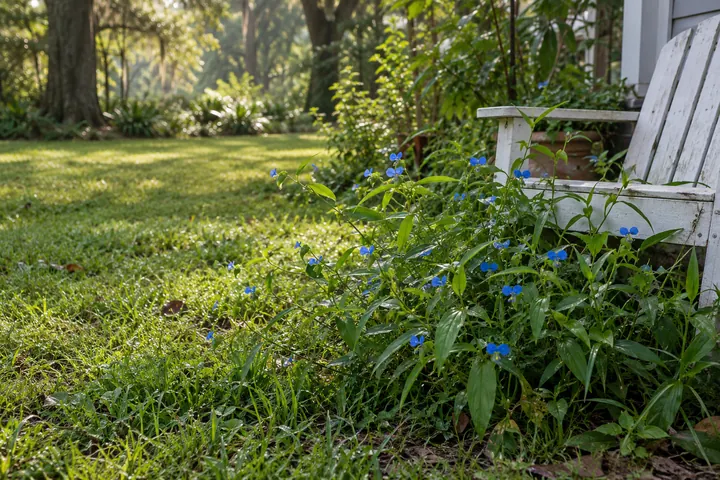
Keep the scientific candidate with the common name
Dayflower is a useful starting word, but it does not settle which plant a person means. Keep the candidate Commelina diffusa with a spreading-dayflower inquiry and retain the source being used for the comparison. That helps prevent an illustration or advice about a related dayflower from quietly replacing the actual question. Give the yard example its own fixed label before choosing the final name.
Missouri State's identification account describes spreading stems, alternate pointed leaves with parallel veins and blue flowers held in boat-shaped spathes. Its species comparison emphasizes the absence of a lower white petal and a spathe open at both ends, alongside fine hairs on leaf-sheath margins. These are details to show on an actual example. Two bright blue marks in a distant photograph do not establish all of those relationships.
The boat is part of the flower record
The spathe is the small supporting structure around the flower, not the whole leaf nearest it. Start with an intact side view that includes the flower and that structure together. Keep a wider image showing where they join the selected stem. If a neighboring leaf covers the base, explain the obstruction rather than drawing the expected boat shape around an unclear area.
A second angle can be useful because the end nearer the stem may be hidden in the first view. Label the angle actually shown. Do not call the spathe open at both ends when only one end can be seen. This is a question about readable structure, not a requirement to produce a perfect textbook photograph. A qualified reviewer can explain which additional view would help when the existing record is incomplete.
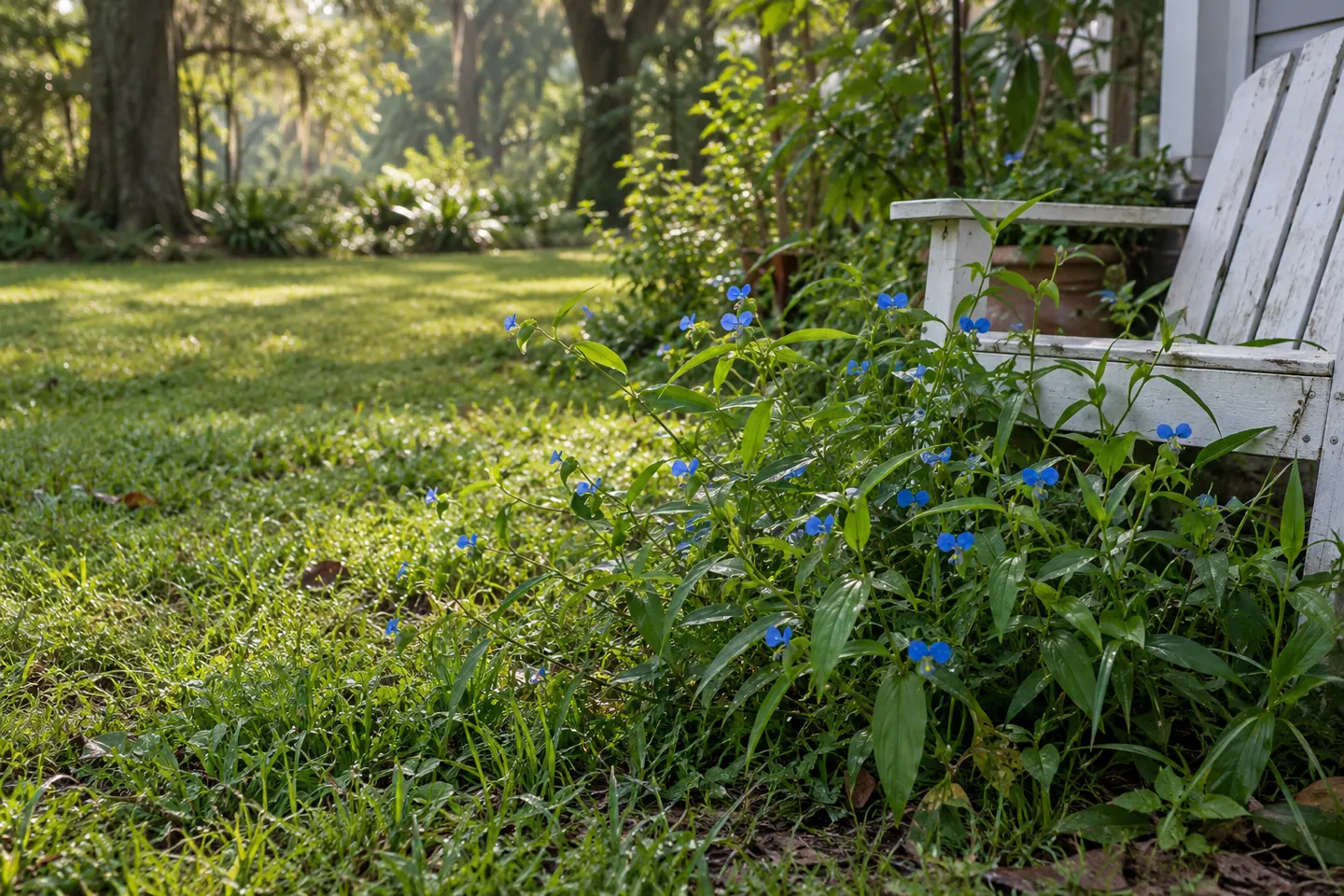
An absent lower white petal requires an unobstructed view
The source's comparison makes the lower part of the flower important. A flower seen only from above may conceal that area. Record whether the relevant lower position is visible, partly covered or outside the image. Missing from this photograph is different from shown to be absent on the intact flower. Keep that distinction in the caption even when the blue upper parts seem very familiar.
Avoid removing or rearranging parts to make the example resemble an expected species. If the flower was already damaged, keep that condition explicit and include another intact example under a separate label when available. A partly damaged flower cannot support the same absence conclusion as a readable intact one. The reviewer needs the actual observation history rather than a polished picture whose limitations have been hidden.
Parallel veins do not make every lawn plant a grass
The primary account places dayflowers in the spiderwort family and describes their parallel-veined leaves. A narrow pointed blade can therefore be useful evidence without proving that the plant is a grass. Show the blade, its sheath and the flowering structure as parts of one connected example. A distant green strip beside the turf can conceal a different kind of plant entirely.
For a homeowner, the practical improvement is to describe a pointed leaf attached to the blue-flowered stem rather than simply calling it grass. That description leaves room for a qualified identification. It also gives Happy a clearer understanding of the mixed lawn edge. A mowing discussion should not rely on every green blade in a photograph being the same turfgrass or having the same place within the agreed maintenance area.
Follow the leaf sheath without borrowing a neighboring blade
A leaf blade may overlap the supporting stem or pass behind another plant. Keep the junction visible where possible and use a short stretch of stem to orient it. If the fine sheath-margin detail is not resolved, record it as unknown. A sharp photograph of the blade tip cannot answer a question about a different area near the attachment.
Keep each close crop with its original frame. If another example supplies a clearer sheath view, label that change openly instead of presenting the collection as one fully documented individual. The comparison can still be useful when its limits are explicit. Quietly combining the best blue flower, leaf blade and sheath from several plants creates an apparently complete specimen that nobody actually observed together.
Distinguish a low stem route from several overlapping plants
A sprawling patch may have many crossing stems. Choose one route that can be followed and mark any point where it disappears under the turf or another leaf. Do not infer a continuous connection across the entire green area merely because the plants look alike. Number a second readable example separately and show where it lies in the border.
A simple map can identify the chair side, the paving edge and the maintained turf. Keep that map separate from the plant's hidden connections. It is enough to show where the observations were made and which area you want reviewed. A precise-looking outline drawn around one supposed sprawling individual can mislead when the photograph only establishes several disconnected visible sections.
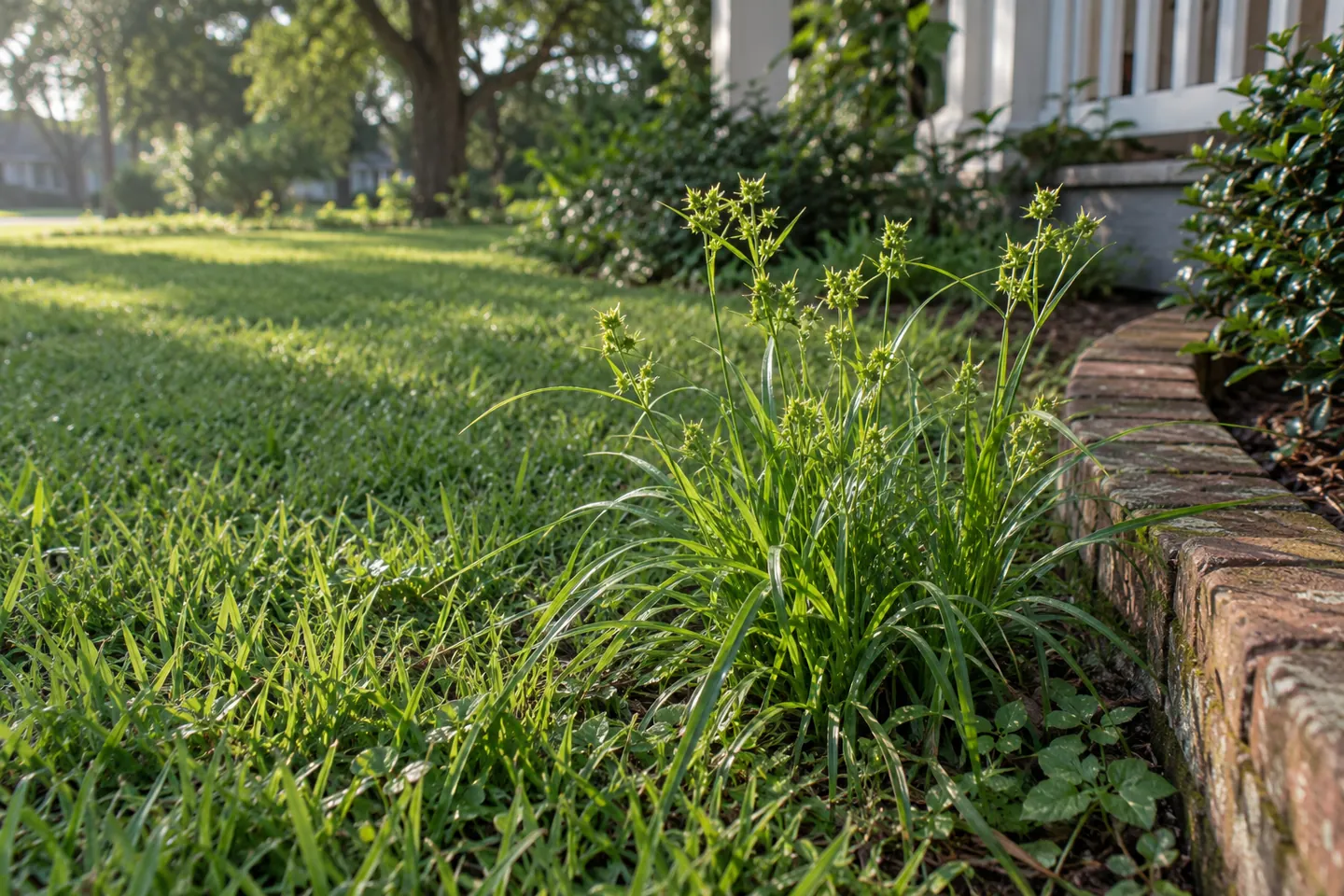
Similar blue flowers still need separate example labels
If more than one kind of blue-flowered plant appears in the yard, photograph each connected example independently. A side-by-side flower comparison can be helpful, but it should not erase the origin of the supporting leaves and bracts. Keep the same label through the overview, flower detail and stem view. This lets a reviewer explain a difference without having to reconstruct an unlabeled album.
Read another source's scientific name before importing its comparison or management discussion. Common names may be used loosely in ordinary conversation, and a related dayflower can have a different combination of structures. The useful question is which description matches the actual evidence, not which familiar phrase appears most often in search results. A corrected name should be saved beside the original observation rather than replacing its history.
A damp-looking border does not explain every stem
Describe a current water condition independently of the candidate plant. A shaded chair-side strip may look damp in one image, but the photograph cannot establish the water source, how long it remained wet or whether an underground connection is present. Keep actual observations and known watering or rainfall dates factual. Leave an unobserved cause open instead of assigning it to the plant's presence.
The same care applies to loose fragments. A piece resting on the ground is not a demonstrated rooted plant or proof that equipment moved it there. If detached material is part of the concern, preserve its location and any known origin in a separate record. A possible biological pathway does not supply a complete account of what happened at a particular home.
State what belongs on each side of the lawn border
A blue-flowered plant may be in a bed, in turf or crossing the line between them. Identify those surfaces in an ordinary overview. Decide whether a particular area is intentionally being kept and communicate that boundary before routine work is arranged. A candidate name does not tell a provider whether the homeowner wants the whole patch reviewed, a defined portion left alone or simply a tidier line beside it.
Confirm which mowing, edging, weed-eating or blowing is being discussed for the included area and what visible result belongs to that work. Routine lawn help does not imply a separate plant-treatment or removal service. A shorter top and a clear boundary should be judged against the actual agreement rather than an assumption that every stem, seed or future plant will be permanently absent.
Keep the final question small enough to answer
Ask whether the readable lower flower area, boat-shaped spathe and connected leaf evidence support spreading dayflower or leave a related candidate unresolved. Mention exactly which end of the spathe is hidden if that is the missing detail. A focused question is easier to review than a broad request to identify every green part in the whole yard from one distant photograph.
Save the answer with the source and date. If a later observation supplies the missing angle, add it under the original example label when continuity is known. Otherwise call it another comparison. This preserves a useful record while allowing the conclusion to improve, and it keeps the practical lawn conversation anchored to a clear chair-side area rather than an uncertain name.
- Include the supporting boat-shaped structure with the flower.
- Mark a hidden lower-petal position as unresolved.
- Keep parallel-veined leaves connected to their flowering stem.
- Label related blue-flowered examples separately.
- Define what is included and what is being kept at the border.
Talk through the chair-side border with Happy
Call 504-339-3571 and ask for Happy. Describe the marked lawn area, current access and the mowing, edging, weed-eating or blowing you want discussed. Confirm the actual scope and availability before arranging a visit.