
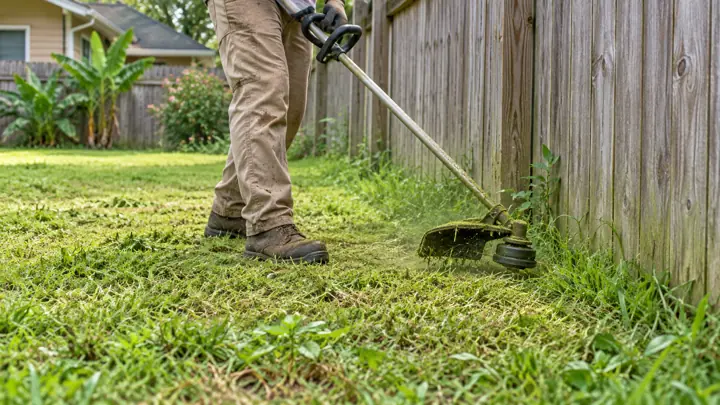
For the grass the mower cannot reach.
The mower handles the broad areas. The small spaces are a different story. Grass beside fence posts, around obstacles or along tight boundaries can leave a lawn looking half-finished when those details are ignored.
Let Happy give those little corners some lawn love, too. Weed-eating is part of our Westbank lawn-maintenance services.
Weed-eating is another name for string trimming. The job is to reduce suitable growth in agreed areas, with attention to access and the things that need protecting. Tell Happy which awkward spots bother you most.
A couple of clear pictures are a good way to show the difference between ordinary trimming and a larger overgrowth problem.
Trimming is a different step from edging
People often use edging and weed-eating to describe the same finished look, but they are not identical tasks. Edging defines an appropriate hard-surface boundary, such as a sidewalk. Trimming reaches grass where a mower cannot sensibly pass. A lawn maintenance visit may include both.
That distinction helps you ask for the result you want. If the sidewalk line is neat but long grass remains around the fence, the missing step is not necessarily another pass along the concrete.
Describe the location and the growth rather than only naming a tool. Happy can review which part belongs in the quote.
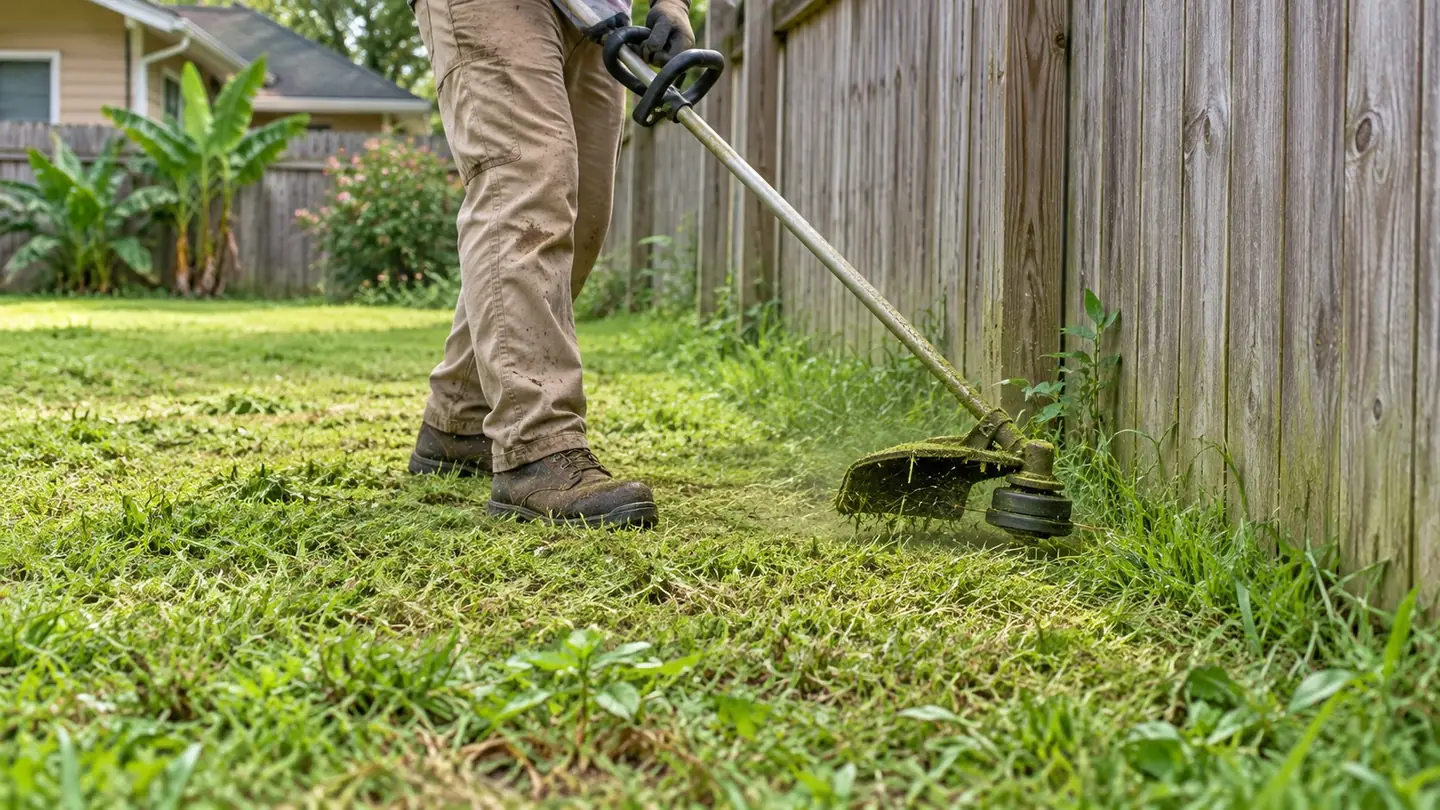
Fence lines need more than a quick glance
A straight fence may look simple from a distance, but the work can change along its length. Loose wire, damaged boards, posts, old debris and plants growing through the fence all affect the approach.
Dense growth may hide objects that are not apparent from a broad photo.
Before requesting service, look for obvious loose items from a safe position and tell Happy what you know. Do not assume that vines, saplings or woody growth are ordinary grass.
If the fence itself is unstable, say so. Lawn maintenance is not a repair of the boundary structure.
Protect trunks, roots and delicate plants
Tree bases and landscape plants deserve deliberate clearance. Direct contact from trimming equipment can harm bark or other materials, particularly around younger trees. Exposed roots, low garden lighting and thin irrigation components also need to be identified before work starts.
Show Happy the areas you care about and discuss whether a buffer should be left. The desired outcome is controlled growth around a protected feature, not contact with the feature itself.
If you have newly planted shrubs, a vegetable patch or a sensitive border, include that in the instructions rather than expecting someone to recognize every plant from a distance.
Top growth and roots are not the same problem
Trimming can make tall grass around an obstacle look more manageable, but it does not necessarily remove the plant that produced it. Regrowth is part of why weed-eating is normally treated as ongoing maintenance.
A string trimmer should not be described as a permanent weed-removal system.
If you want a different kind of weed-control approach, discuss it separately. Happy Grass offers weed control to discuss, but the method, target plants and instructions need to be explained for your property. Never assume that a request for trimming authorizes a chemical treatment, or that a treatment includes all trimming.
Make the first visit easier to assess
- Photograph the full fence line or obstacle area.
- Add closer views where growth is tallest or most tangled.
- Point out cables, irrigation parts and fragile fixtures.
- Move portable objects out of the intended work area.
- Tell Happy where pets are kept and how access is arranged.
- Mark areas to leave untouched and explain why they need clearance.
If the yard has been neglected, the initial request may involve more than routine maintenance. Hidden debris, dense vines and inaccessible spaces can change whether the work can be accepted.
Happy needs the current condition, not an old photo from before the grass became tall.
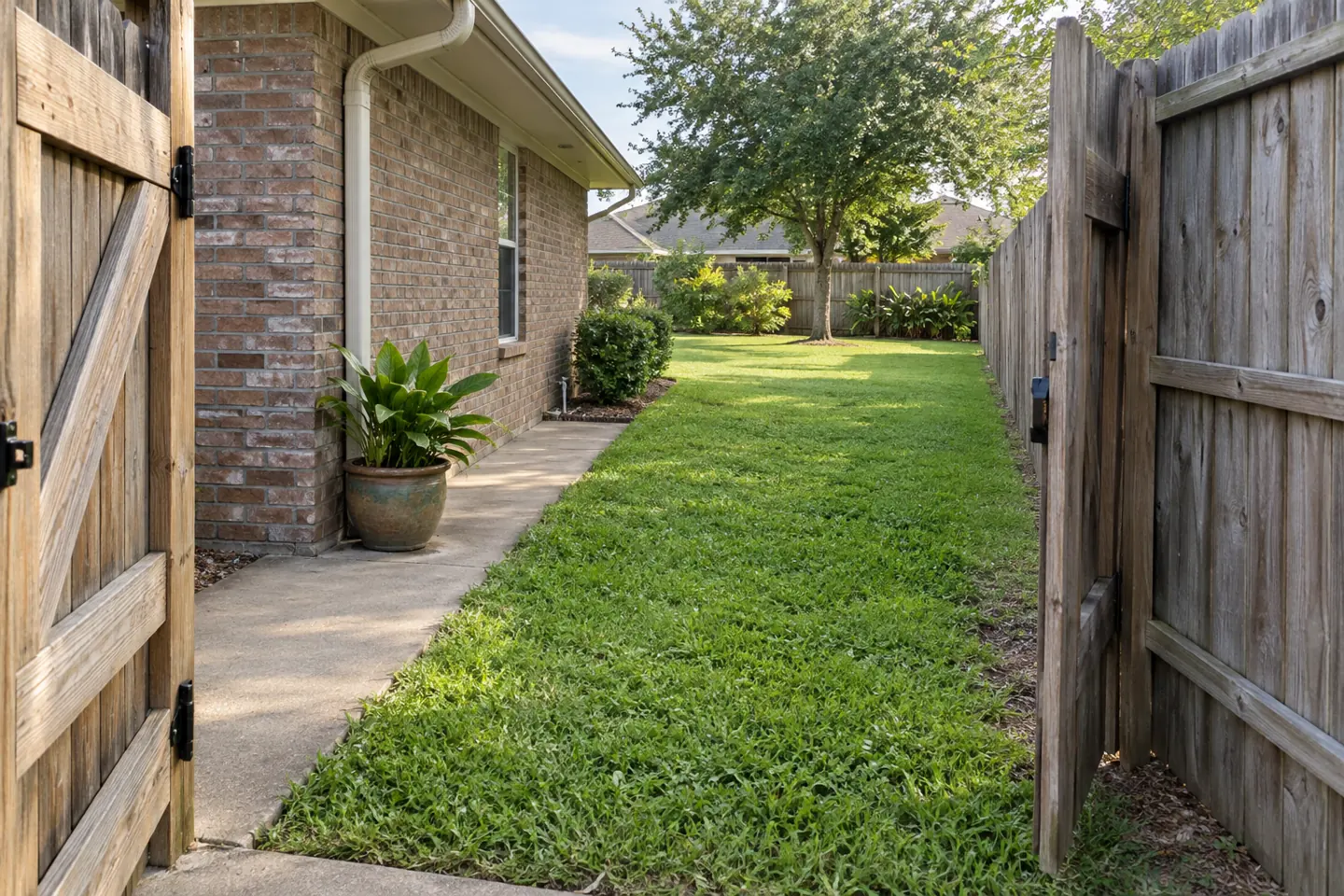
A smaller yard can still have more details
Lot size alone does not describe trimming work. A broad open lawn may have relatively few obstacles, while a compact yard can contain multiple beds, fences, posts and narrow sections.
The time needed to maintain those details is part of what a property-specific quote should consider.
Show the route to the backyard as well as the lawn itself. A narrow passage, a tight turn or a blocked gate can change the practical setup.
If certain areas can only be entered through a separate access point, explain that before a visit is scheduled.
Finish with the right combination of services
For many customers, trimming is most useful alongside mowing, edging and blowing the agreed paved areas. The four tasks work toward the same overall appearance, but each needs to be part of the agreed scope. Bagging and heavier cleanup are additional details to discuss where relevant.
Request the combined option if that is what you want, then mention anything unusual about the property. Happy Grass’s listed coverage includes Harvey, Marrero, Gretna, Algiers, Belle Chasse and Westwego. Send your trimming request or call (504) 339-3571 and ask for Happy.
Give the little corners their moment
Take a look at the yard after the broad mowing areas are done. Which pieces still look taller or less tidy?
A patch beside a post, a narrow strip along a fence and growth near a fixed obstacle may each need a closer conversation. Naming them individually helps Happy understand where the finishing work is needed.
You don’t have to photograph every square foot. One broad view can show the relationship between the lawn and the obstacles. Then use a closer view for an area where the growth or access is unusual.
The point is to make the property understandable, rather than send a large collection of pictures that all show the same easy-to-reach lawn.
Some things near the grass deserve a heads-up
Small features can disappear in a wide picture. Mention irrigation parts, low garden edging, decorative lights, thin fence materials and newly planted areas. Tell Happy what you want left alone, especially where the boundary between lawn and planting isn’t obvious.
A clear instruction before the visit is much more useful than expecting someone to recognize every detail from a distance.
If a line or fixture is damaged or loose, explain that too. Trimming isn’t a repair for the object beside the grass. You may need to arrange the repair separately or agree that the affected area will be skipped.
Keeping the conversation specific helps protect the finish you want and avoids treating all growth as though it sits in the same open conditions.
When a fence line is more than a trimming request
The same applies to a passage that has become a storage area. Moving household belongings, clearing unknown debris and trimming growth are separate tasks to discuss. Don’t count on them all being included because they appear in the same photo.
It’s fine to ask; the important thing is to agree on what the visit can cover.
Make trimming part of your happy-lawn routine
If the open lawn is being maintained but the awkward spots keep bothering you, bring them into the recurring plan. Tell Happy which areas need attention alongside mowing and which should be left alone.
If you only want help with a particular section, describe that clearly when asking about availability.
A little attention in the right places can make the work feel more complete. Send a few pictures to Happy and point out the corners you’d love to stop worrying about. Let’s give those small spaces a proper place in the lawn conversation.
Agree the stopping points around delicate features
A request to trim the fence line should identify more than the fence itself. A young plant growing through that line, a loose tie near a post and a thin plastic drain beside the grass all affect the approach. Walk the accessible edge before the visit and send photographs of those specific places. Do not expect a string trimmer to distinguish an intended plant from unwanted growth solely from its position against the fence.
The useful agreement describes the growth to maintain and the features to leave alone. If a strip cannot be reached without contact with a delicate object, discuss an intentional margin instead of asking for every stem to disappear. Where household preparation will create access, confirm who will do it and what happens if it is incomplete. An owner who plans to move a planter should also check that no loose saucer, wire support or small stake remains hidden behind it. Those details make a trimming request much clearer than simply asking the yard to look tight.
- Identify plants that must remain, even if they resemble the surrounding growth.
- Show fragile hardware and exposed or uncertain cables.
- Confirm the boundary around each feature that stays in place.
- Describe any narrow strip that needs a separate access review.