
The first decision is a preference
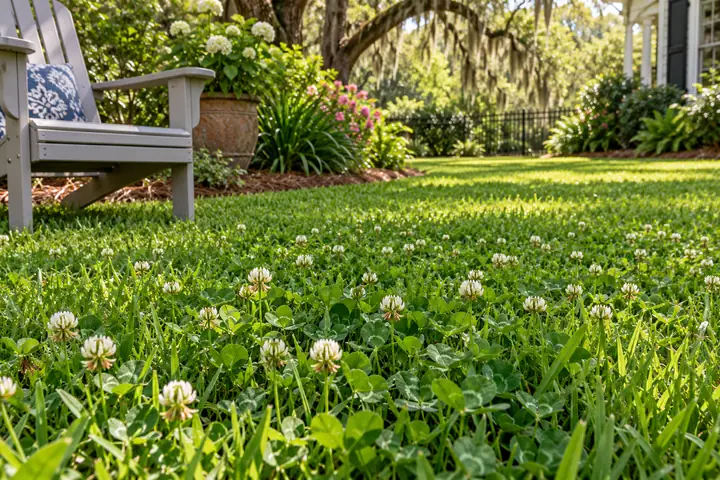
White clover can delight one household and frustrate another. A small white-flowered patch beside a garden chair may be welcome, while the same plant across a formal grass panel may interrupt the appearance its owner wants. Begin with that preference instead of assuming that every clover leaf requires removal. The useful lawn plan is the one that describes the intended use and finish of your particular space.
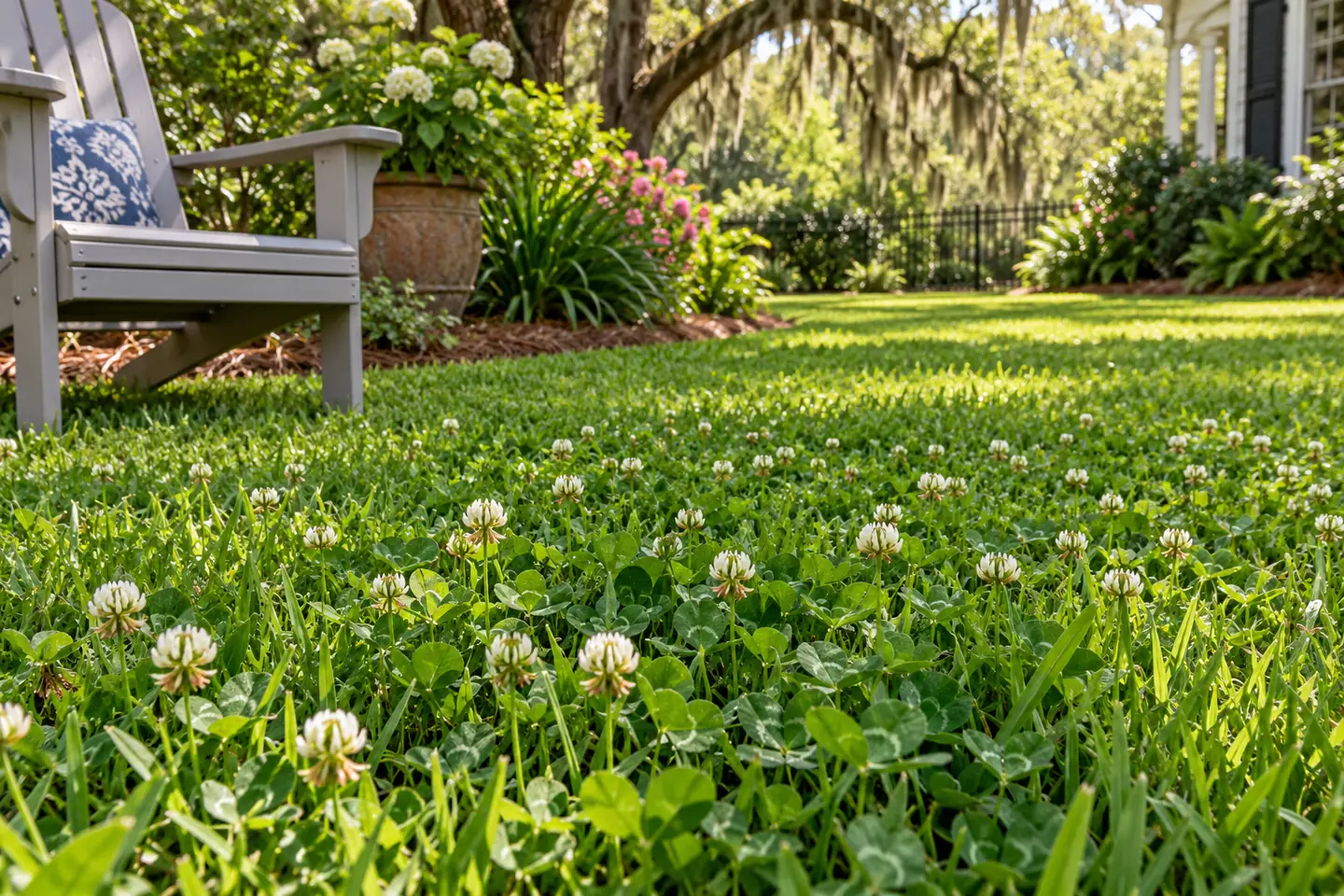
LSU AgCenter identifies white clover as a perennial with three oval leaflets, often marked with a pale band, and rounded white flower heads that may show pink. It can root at stem nodes as well as reproduce through seed. The low growth helps explain why clover leaves can remain after flower stalks have been cut. Flowers, foliage and intended turf therefore need separate attention when deciding what the next maintenance visit should accomplish.
Confirm clover before choosing a clover policy
Three leaflets do not settle every identification. Yellow woodsorrel also has three leaflets, but they are distinctly heart-shaped and its flowers are yellow with separate petals. White clover has rounded oval leaflets and a clustered flower head. Look at leaves and flowers attached to the same plant where possible. A yellow flower from another weed lying beside clover can create a misleading combination if you inspect the patch too casually.
If the plants are not flowering, compare leaflet shape and the trailing growth rather than relying on the phrase three-leaf weed. Keep an uncertain identification open. A household decision to retain clover should not accidentally protect an unrelated plant just because both have three leaflets. Likewise, a request to remove clover should not become permission to remove every low broadleaf near the garden. Name the patch and its boundary as well as the plant.
Separate flower preference from foliage preference
Some owners like the low green leaves but want flower stalks reduced in a frequently used area. Others specifically want a flowering patch. These are different maintenance outcomes. Write down which matters to you. A cut that removes flowers may meet the first preference while disappointing the second, even though the crew maintained the same physical area. Neither outcome can be judged fairly unless the flower preference was made clear beforehand.
Flowering also changes over time, so a retained patch is not a promise of constant blooms. Its appearance between visits may differ from the photograph that inspired the request. Consider whether you are comfortable with that variation before choosing a flower-focused area near a prominent entrance. A realistic preference might be to retain the low clover patch and review flower management seasonally, rather than expecting one fixed look throughout every week of the year.
Pollinators belong in the use discussion
LSU's discussion of whether to control clover explains that its flowers provide nectar and pollen for pollinators. That benefit can be part of the decision to retain a patch. It does not automatically decide the use of every lawn area. A flower patch and the route where people regularly walk barefoot raise different practical questions. Consider the household's actual activities and choose the patch location accordingly.
For example, a retained area beside a viewing chair could be separated from the direct gate-to-patio route. The point is not that one layout guarantees safety or a certain number of insects. It is that deliberate placement makes the preference understandable. Do not promise a sting-free lawn after mowing flowers or assume that all insect activity comes from clover. Maintenance can address the agreed vegetation, while personal health concerns require appropriate individual advice.
Draw a retained area that can be maintained clearly
Use permanent features to define where clover is welcome. A strip bounded by a bed edge and the patio is easier to describe than a vague request to leave some flowers somewhere. If the intended boundary crosses an open lawn, show it on a yard sketch before the visit. Avoid loose wire or small hard markers that could become equipment hazards. A photograph with a drawn line can communicate the preference without adding an obstacle.
Think about the transition as well as the center. Do you want a closely maintained grass route around the retained patch, a continuous mixed surface or a more distinct ground-cover area? Those choices affect what tidy means at the edge. A ragged transition might be unacceptable even to someone who likes the flowers. Defining the transition prevents a retained patch from being mistaken for an accidental missed section during a later service review.
Green coverage and grass coverage answer different questions
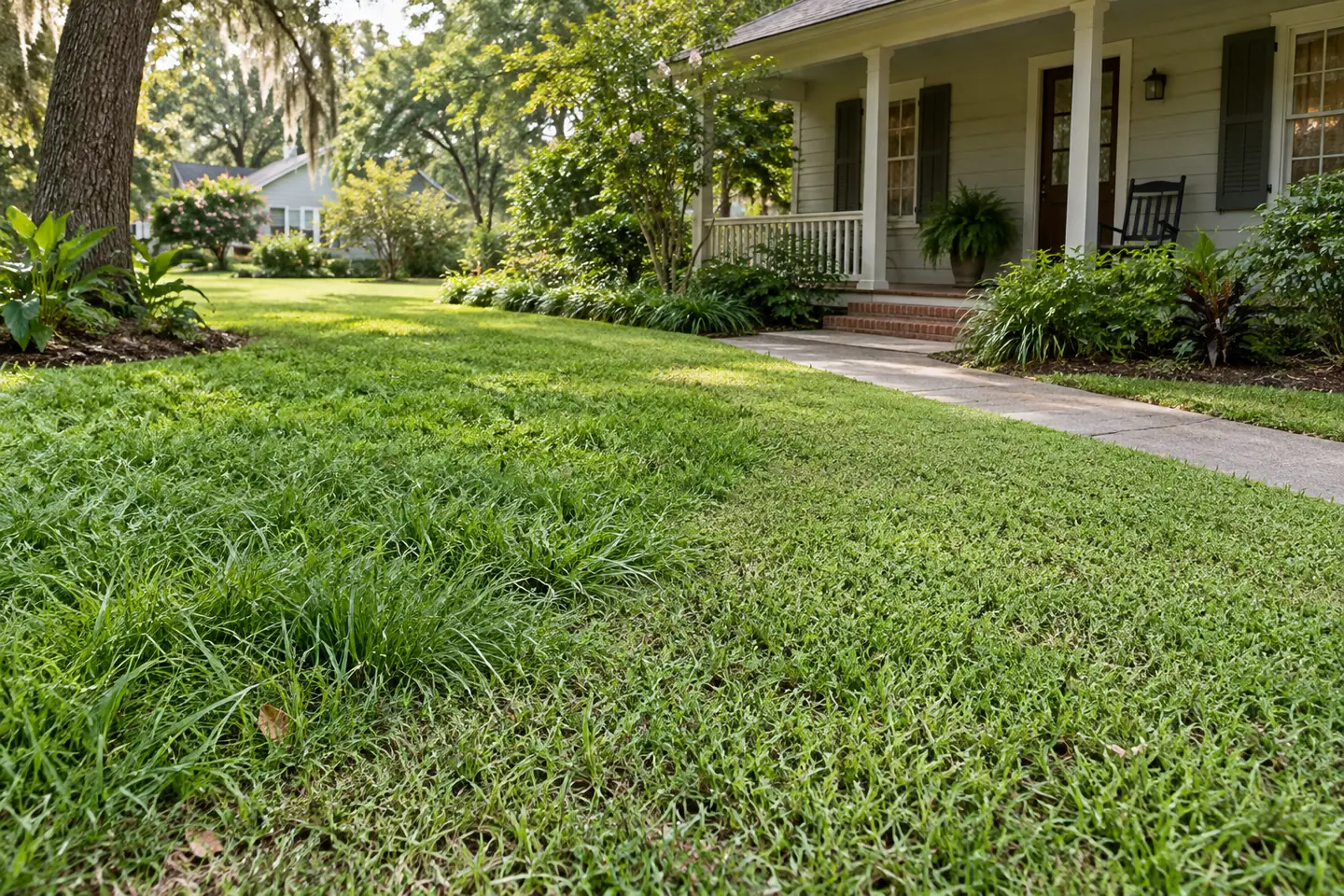
White clover can form a dense low patch. Look through it at a few representative points to see whether the desired grass is continuous, sparse or absent. If the goal is a turf-focused lawn, this observation matters before removal is discussed. Reducing clover may reveal open ground rather than a ready-made grass surface. The plan for the unwanted plant and expectations for the remaining lawn should not be collapsed into one promise.
For an intentionally mixed lawn, the same inspection can support a different choice. You may be comfortable with clover supplying much of the cover in one area. Say that explicitly rather than describing the whole yard as a uniform grass lawn. An honest plant mix gives Happy a clearer starting point for maintenance. It also makes future comparisons more useful because the retained component is part of the intended result rather than an unexplained exception.
Do not turn a clover patch into a soil prescription
LSU discusses white clover's association with low nitrogen fertility, but a plant patch alone is not a soil test. Avoid choosing a fertilizer amount merely because pale-marked leaflets are present. A sound soil and turf assessment requires the appropriate evidence and the needs of the desired grass. The visual patch can raise a question; it cannot supply every answer about soil conditions, past applications or the right next input.
This boundary matters for service expectations too. Happy Grass does not offer fertilization, aeration, overseeding or pest control. General extension information about maintaining dense turf should not be read as a new service menu. If a turf-focused goal requires advice beyond mowing and available weed-control scope, identify that need separately. Doing so keeps a useful clover conversation from becoming an assumed package of soil work that nobody actually agreed to provide.
Compare leaf area, flower area and grass route separately
After maintenance, check the retained boundary first. Then compare flower stalks and the adjoining grass route. These observations can move independently: flowers may be fewer while the clover leaf area stays similar, or the walking route may be neatly cut while the retained patch is still flowering. A single statement that the clover looks different does not explain which outcome changed. Reviewing the three parts makes feedback more actionable.
If the patch extends beyond the chosen area, identify the new location rather than asking for all clover to be removed without reconsidering the retained center. Conversely, if the household's preference changes, say so directly. A previous instruction to protect flowers should not remain in force silently after the owner decides on a different use. Clear updates are especially useful when another household member discusses the lawn on a later visit.
Test the preference with a yard-use sketch
Before deciding to keep or remove clover, sketch an ordinary day in the yard. Draw the gate route, a seating area and any regularly used open space. Then place the actual clover patch on that sketch. This is a preference exercise, not a landscape design certificate. It helps reveal whether the household likes the flowers where they actually grow or likes the idea of flowers somewhere else.
Consider a patch that reaches both the garden chair and the main route. Retaining all of it, retaining only the chair-side portion and preferring turf throughout are three legitimate choices. Each produces a different instruction for the edge and flowers. Choose the one that matches the space rather than asking a crew to infer the owner's philosophy about clover.
- A viewing patch can prioritize retained flowers within an agreed boundary.
- A frequently used route can have its own maintenance instruction independent of the nearby patch.
- A turf-focused panel needs an honest look at how much grass remains beneath clover.
- A mixed-cover area should be described as intentional so future visits do not treat it as an accidental omission.
Review the sketch when household use changes. Moving the chair or changing the main route can change the preferred boundary even when the clover itself has not spread.
Make the choice easy to understand
A useful request might retain the white-flowered patch beside the chair, maintain the gate route as grass and ask for a separate discussion about clover outside that boundary. This communicates a landscape preference rather than a universal opinion about weeds. It leaves room for the actual turf condition and available service scope to be reviewed. You do not need to defend liking clover or disliking it; you need a plan that matches the space.
For Happy Grass requests in Harvey, Marrero, Gretna, Algiers, Belle Chasse or Westwego, call 504-339-3571 and ask for Happy. Explain the retained area, flower preference and main walking route. If removal is the goal, confirm that separately and identify the grass you want preserved. A happy mixed lawn begins with a deliberate choice, clear boundaries and a shared idea of what the maintained result should look like.