
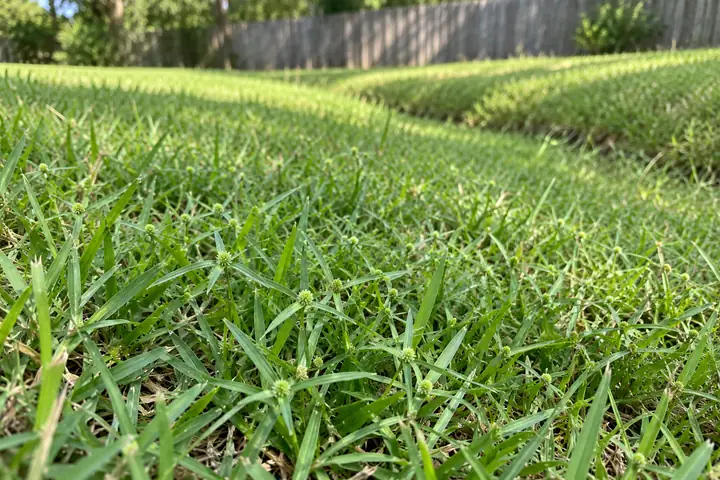
A fine mat can blend in until the lawn is cut
A patch may look like a slightly different grass until its fine texture and small round green heads catch the eye. Green kyllinga is one possible explanation. Start by looking at the plant's arrangement instead of treating the whole patch as ordinary turf. Does it form a continuous finer layer, and do the little heads belong to that layer? These observations help separate a sedge-like mat from the intended grass and from unrelated plants nearby.
LSU AgCenter describes green kyllinga as a warm-season perennial sedge that can form dense mats and tolerate low mowing. It spreads by seed and underground rhizomes. These traits explain why a maintained surface can still contain the plant. An even height is not evidence of a uniform turf species, and a low cut is not proof that a spreading perennial has been removed. The mat's boundary deserves attention as well as its tallest shoots.
Connect a round head to its own stalk
Look for a small round green flower head with leaflike bracts radiating directly below it. UC IPM describes this head on a triangular flowering stalk. Trace that stalk into the fine-leaved growth at its base. A loose green seed head lying on the surface is less useful because it may have been moved from another place. Keep the head, stalk and foliage connected in the observation wherever possible.
Do not identify every small round head as kyllinga without checking the rest of the plant. Other sedges and lawn plants can create superficially similar shapes. A reference comparison should include the overall mat and leaf texture, not just a close crop of one green ball. If recent mowing removed the heads, describe that limit and use intact foliage for an initial review rather than assuming the absence of heads rules kyllinga out.
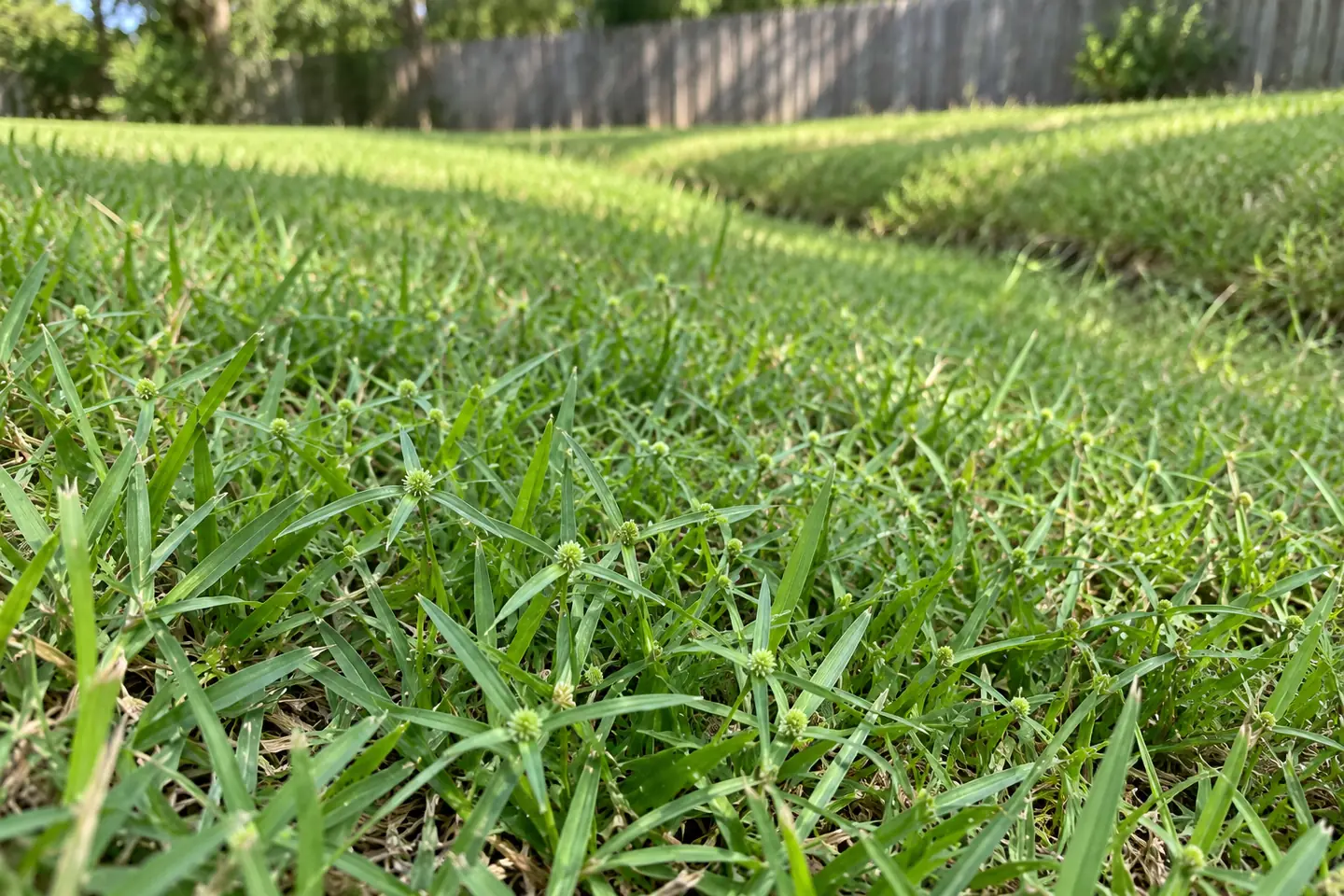
Compare the mat with upright nutsedge shoots
UC IPM distinguishes green kyllinga's finer enlarging patches and small round heads from the generally wider-leaved nutsedges with more open flower structures. Underground, kyllinga has rhizomes but lacks nutsedge tubers. These differences matter because the common description nutgrass can hide several plants. A shared sedge appearance does not establish one species or a universal management method.
If the area contains both a fine mat and scattered taller bright shoots, record both forms. They may be different plants occupying the same moisture pattern. Do not combine a kyllinga-like head from the mat with a separate nutsedge-like leaf and call the mixture one specimen. A simple location note for each form keeps identification coherent. The useful aim is an accurate target, not the fastest possible plant name for everything green in the corner.
Read the spreading edge, not only the center
An established mat can be dense enough that its middle changes little in a wide photograph. Inspect the transition where fine leaves meet desired turf. Look for small outlying groups and for a change in the texture beyond the previously observed edge. A boundary sketch can show whether the mat is becoming denser within its old footprint or appearing in new locations. Those are different changes and should be described separately.
Use fixed landscape features as references. A line drawn on a photograph near the walk, swale or fence can be enough; loose markers among fine leaves are unnecessary. Do not assume the surface boundary shows the exact underground extent. The map describes visible growth. That honest limit still makes it useful for an assessment and prevents a later inspection from relying on a vague memory that the patch used to be about this big.
Rhizome fragments deserve a handling discussion
UC IPM notes that chopped rhizome sections can produce new plants. This makes casual chopping, soil movement and equipment cleanup relevant questions before work. If a dense mat is to be disturbed, ask how material will be handled rather than assuming it can be scattered across the rest of the lawn. A cleanup that improves one surface should not unknowingly redistribute live plant material into another growing area.
This is a reason for a considered procedure, not proof that every fragment establishes or that equipment caused every patch. Keep the claim tied to what is known. If soil has already been moved, describe its source and destination without inventing an infestation history. If no such work occurred, do not manufacture one. A practical maintenance discussion can address handling precautions while leaving the wider origin question unresolved.
Mowing tolerance changes the appearance review
Because kyllinga can persist under low mowing, another shorter cut is not automatically a solution to the fine mat. Check the desired grass finish separately from the mat's continued presence. A smooth same-day surface may later become uneven as the plants grow at different rates. Record that timing rather than treating every later change as an untouched spot left during the visit. The distinction makes a review more accurate and easier to resolve.
Flower heads may also be shortened while the fine foliage remains. Do not judge plant removal only by whether the little green heads are visible afterward. Look at the low texture and mapped boundary. A management plan needs a defined goal and follow-up, while ordinary mowing has a different endpoint. This guide does not promise that cutting prevents all seed formation or eliminates the rhizome system beneath the patch.
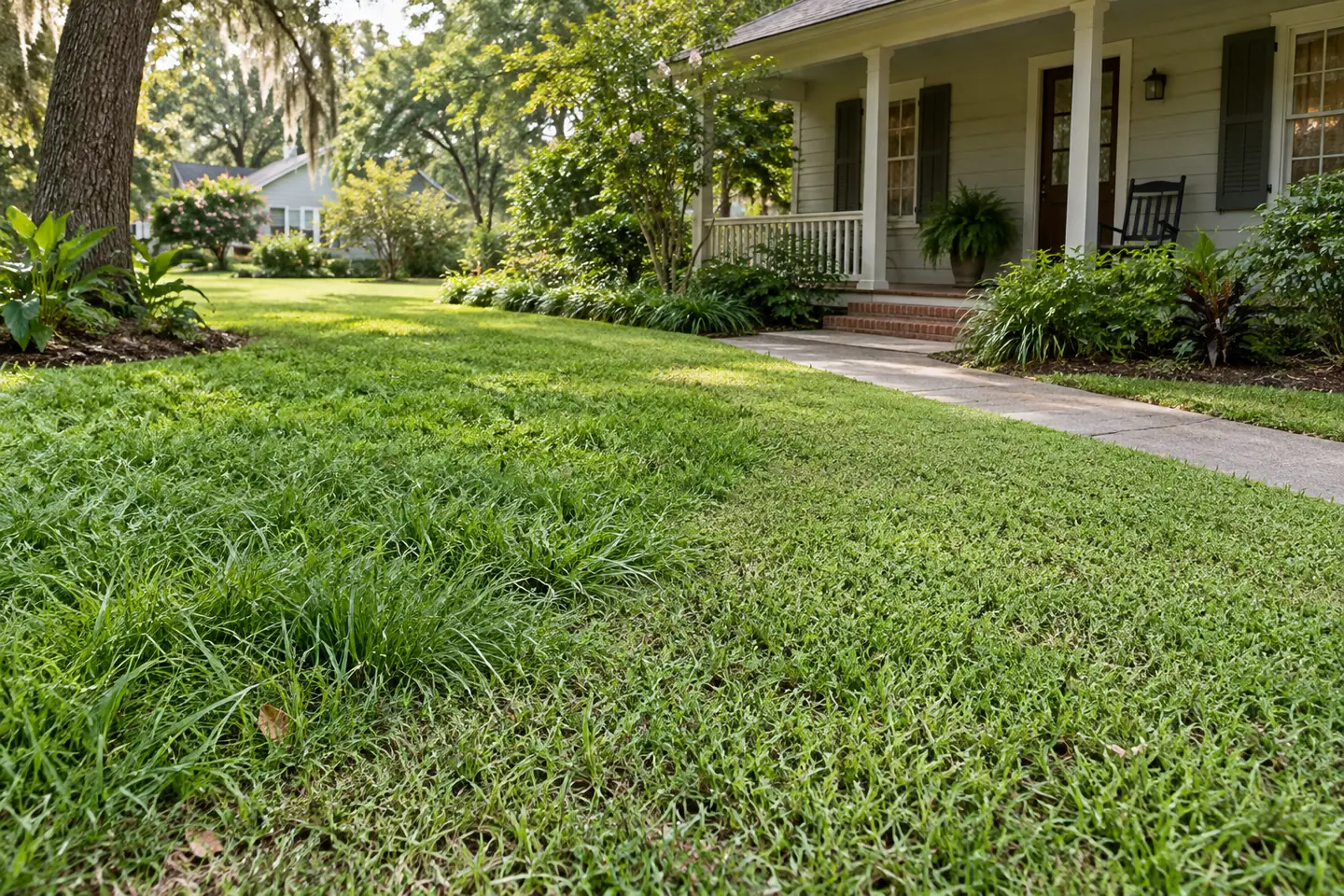
Wet-area observations need their own evidence
LSU associates green kyllinga with low wet areas. That makes moisture worth recording, but the plant alone cannot explain a drainage system. Note when the surface holds water, whether irrigation reaches it and whether the same area stays soft after adjacent lawn dries. These are useful observations for an appropriate assessment. Avoid concluding that a particular pipe, grade or neighbor's runoff is responsible without separate evidence.
If the mat follows a swale, distinguish maintaining vegetation from altering the swale. Do not fill or block a flow route to make an unwanted plant less visible. A water-management question deserves the right assessment. The maintenance request can still identify a known soft-ground route concern without claiming to correct the landscape's drainage. Keeping plant identity, water observations and equipment access separate prevents one green patch from becoming a collection of unsupported diagnoses.
Check what desired turf remains through the fine layer
A kyllinga-like mat may blend so thoroughly with the lawn that the amount of intended grass is unclear. Inspect natural openings and the transition at several points. Is the turf continuous within the fine layer or concentrated around its outside edge? This distinction matters before discussing removal. Reducing a dense unwanted cover may reveal sparse areas rather than leave an instantly complete grass surface.
For example, a narrow fine-textured strip beside a walk differs from a broad mat through the main lawn panel. The first may be a localized boundary question; the second may require a more substantial assessment of the desired turf. Neither should be described automatically as a simple missed mowing strip. Explain the actual distribution so the next decision matches the scale and the lawn condition that will remain afterward.
Follow the fine-textured seam across the lawn
A kyllinga-like mat can first appear as a seam of finer vegetation beside a walk or swale. Inspect along the seam, not only at the place with the most obvious round heads. A head-free section may still share the same low texture, while another section may contain a visibly different plant. Record those distinctions rather than treating an entire green line as one confirmed species.
Compare a continuous mat with isolated small groups beyond it. The mat shows the established visible footprint; outliers may define where a closer identification check is needed next. Do not assume their underground connection. If management is discussed, a map showing both forms is more useful than one photograph cropped tightly around a green head.
- Dense seam: record its ends at fixed landscape features.
- Head-bearing section: connect the head, stalk and fine foliage in one view.
- Head-free section: record texture without claiming that missing flowers settle identity.
- Isolated group: preserve its own location and plant details.
After mowing, repeat the texture and boundary check before drawing conclusions from missing heads. The comparison can show a maintained surface while keeping the persistent-mat question visible. It also avoids counting every new tall shoot near the seam as kyllinga when a second sedge or grass may be present.
Coordinate observation and available work
Tell Happy about the fine mat, round heads, outliers and any known wet-ground conditions. If the target is not confirmed, say kyllinga-like rather than presenting a guess as a diagnosis. Ask separately about available weed-control scope and material handling if disturbance is contemplated. A specific product or removal approach needs the plant, intended turf, site and current directions checked. General advice for another region is not a complete plan for your yard.
Happy Grass serves requests around Harvey, Marrero, Gretna, Algiers, Belle Chasse and Westwego. Call 504-339-3571 and ask for Happy. Fertilization, aeration, overseeding and pest control are not offered. The useful result is a clear distinction between maintaining the lawn's appearance and managing a persistent fine-leaved sedge. Those little round heads are a starting clue, while the mat, its edge and the desired grass tell the rest of the maintenance story.