
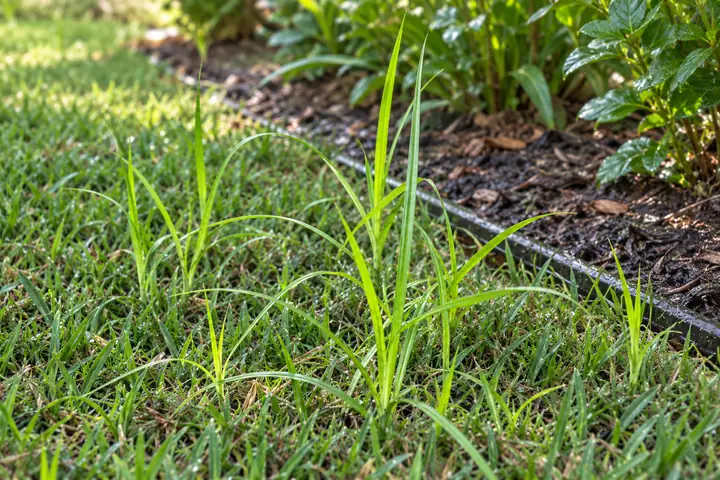
Bright shoots can outpace the lawn around them
A lawn looks evenly maintained, then bright upright shoots rise above it between visits. Nutsedge is one possible explanation, but the color and speed alone do not identify the plant. Start by comparing its leaves and base with the intended turf. If the tall points belong to a different plant, they need a different description from ordinary grass that was left uncut. The same-day finish and later mixed-plant growth are separate observations.
LSU AgCenter describes yellow nutsedge as a perennial sedge with narrow shiny pointed leaves and triangular stems. It is often called nutgrass, but it is not a true grass. UC IPM explains that nutsedges can grow more upright and faster than surrounding turf. That contrast helps explain the familiar uneven appearance between cuts. It does not prove that every bright blade is nutsedge or that a scheduled visit was performed incorrectly.
Look at the base and leaf arrangement
An intact plant gives more information than a single leaf tip. Look for the arrangement of leaves at the base and the structure of a flowering stalk where present. The triangular-stem clue applies to sedges, but a folded leaf can itself feel angular, so do not confuse the two structures. A close photograph should show what is being examined. If the base is hidden within dense turf, say so rather than forcing an identification.
Use reliable extension images alongside your own plant views. The website's editorial scene provides context, not a scientific specimen key for your yard. If the plant lacks the expected combination of features, keep the name open. A fast-growing grass, another sedge and nutsedge can create similar porch-level impressions. The exact target matters before a weed-control decision, especially when the desired lawn contains more than one grass texture.
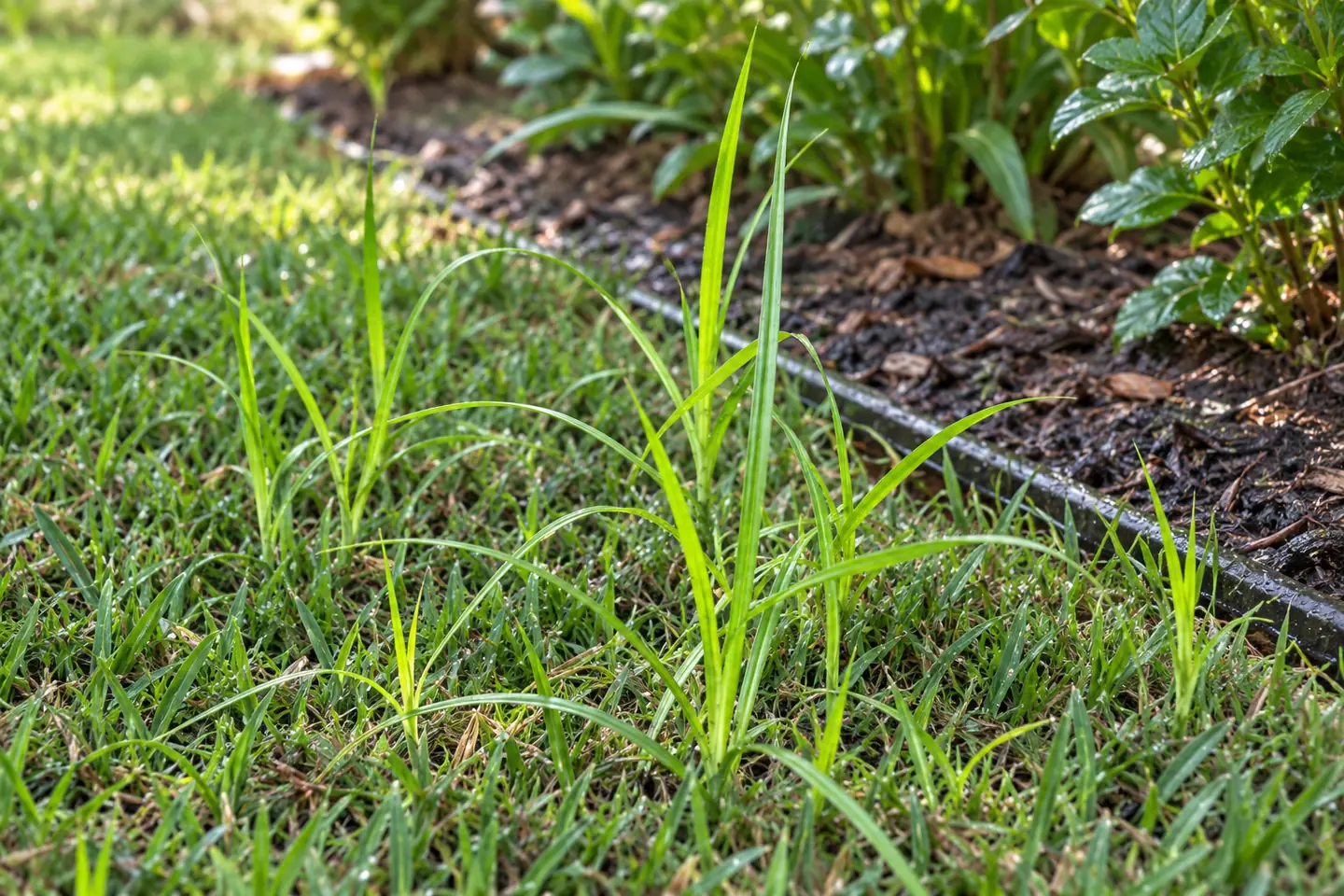
Yellow and purple nutsedge are not named by leaf color alone
LSU notes yellow nutsedge's yellow to light-brown flower clusters. Purple nutsedge has a different flower appearance, and UC IPM explains differences in their underground tuber arrangement. These distinctions show why the brightest green shoot is not automatically the yellow species. Leaf color varies with light and camera settings and should not carry the whole identification. Include an attached flower cluster if one is present and can be viewed safely.
Do not excavate a lawn or taste underground structures to settle the name. A qualified identification can determine what evidence is appropriate. For an initial maintenance request, it is enough to describe upright sedge-like shoots and preserve clear views. The useful goal is to avoid choosing management for a guessed species, not to turn an ordinary yard inspection into a digging project that disturbs the grass and unknown underground features.
Tubers explain why tops are only part of the story
Nutsedges form underground tubers on rhizomes. Those structures can support renewed shoots, so removing or shortening visible leaves does not establish that the whole plant system is gone. This is the central distinction behind the guide. A shorter lawn can be a genuine improvement in appearance while underground persistence remains unresolved. The words cut down and removed should not be treated as equivalent when reviewing a perennial sedge.
If manual work or another management approach is discussed, ask what the task is intended to address and how it will be followed up. Do not assume a single pulled shoot represents every underground structure nearby. Likewise, do not assume each later shoot proves that the exact same top was missed. A clear review separates the original visible shoots, later growth and the agreed plan for the persistent plant.
Build a regrowth record that answers the right question
Take a same-day view after maintenance and another when the upright contrast becomes noticeable. Record the elapsed interval without turning it into a universal growth rate. Compare the intended turf and sedge-like shoots separately. This helps distinguish an uneven finish on the service day from later differential growth. Both deserve an honest description, but they call for different follow-up questions.
For example, an even surface followed by scattered bright shoots is different from an untouched strip already tall immediately after work. Describe which happened. Avoid a claim that the entire lawn regrew overnight when the visible change is a limited set of upright plants. A specific record makes it easier to discuss whether the next step concerns mowing frequency, identification or separate weed management rather than repeating the same general complaint.
Moisture history is useful without proving a leak
Nutsedges favor wet conditions, yet UC IPM notes that established plants can persist under more ordinary moisture conditions. A patch does not prove a currently leaking sprinkler. Record actual water observations: a puddle after irrigation, a strip that stays soft after adjacent turf dries or an outlet that visibly wets the same place. These details can prompt an appropriate irrigation or drainage assessment without treating the weed itself as a pipe detector.
Keep rainfall and irrigation events separate in the notes. A patch beside a downspout may respond differently from one beside a sprinkler. If no unusual wetness has been observed, say that too. Do not invent a moisture problem merely to fit a plant profile. The maintenance route still needs review if ground is known to be soft, but that access concern and the species identification should remain distinct parts of the request.
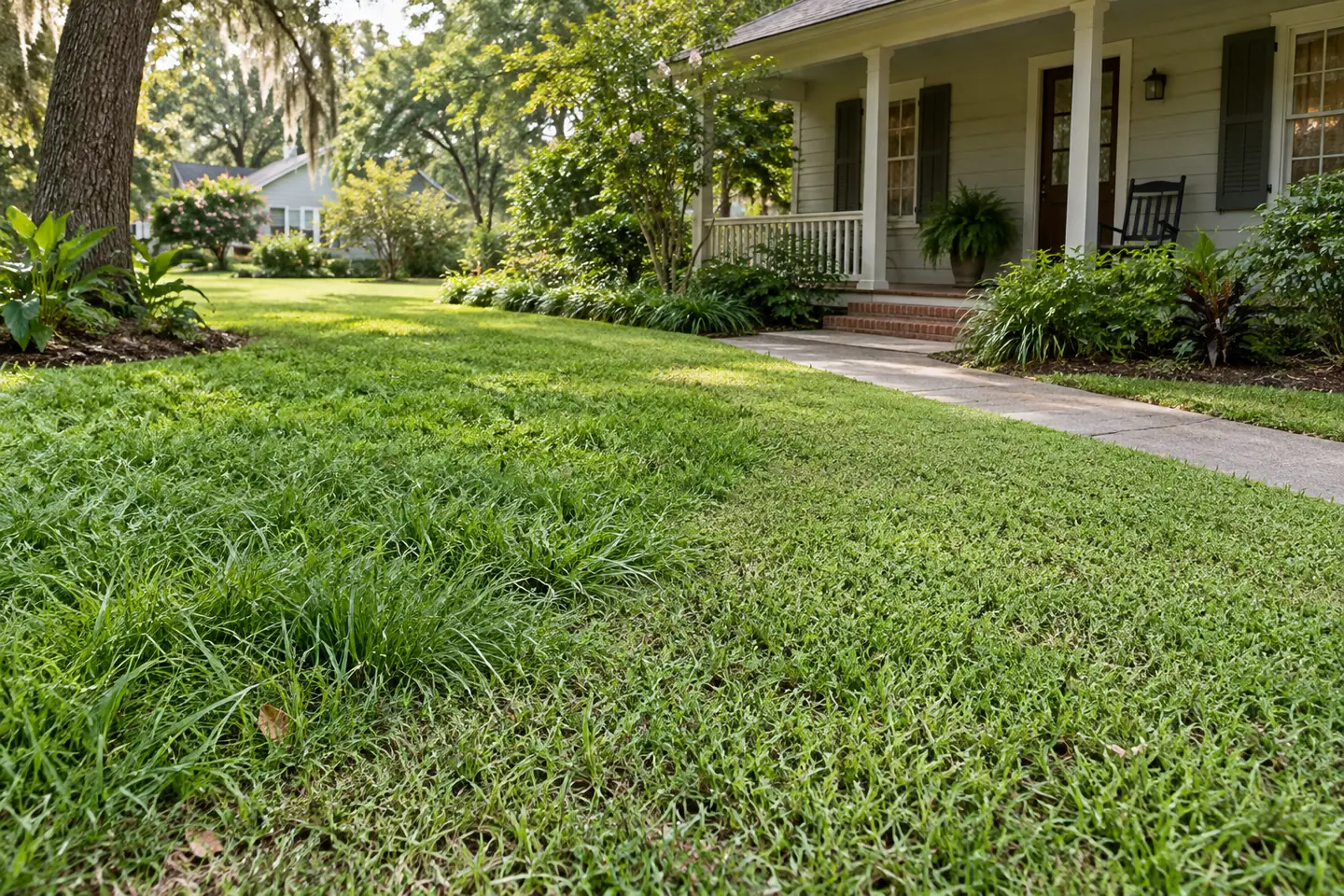
Map individual shoots and denser groups differently
Scattered upright plants across otherwise continuous turf present a different pattern from a dense band beside a bed. Mark those forms separately. A count of every shoot is unnecessary, but a sketch showing scattered plants versus a concentrated patch helps an assessment focus. Do not draw one giant infestation boundary around the entire lawn just because a few shoots occur far apart. Describe the visible distribution without inventing underground connections.
The same approach helps follow-up. New shoots beyond the original visible area, more shoots within it and taller growth from existing locations are different observations. Record whichever is actually seen. A change in density may matter even when the patch outline stays similar. A changed outline may matter even when the tallest tip looks the same. Looking at distribution prevents height alone from becoming the only measure of a persistent sedge problem.
Compare nutsedge with a fine kyllinga mat
Green kyllinga can grow in similar settings, but UC IPM distinguishes its finer mat-like growth and small round heads from the more open flower clusters of nutsedges. Kyllinga has rhizomes without nutsedge's tubers. This is a useful reason to look beyond the phrase sedges have edges. A shared triangular-stem clue does not make every sedge the same target or justify the same management assumption.
If the lawn contains both upright shoots and a finer continuous mat, describe both forms. They may require separate identification. Do not collect a round head from the mat and attach its description to the tallest unrelated shoot. Features should stay connected to their plant and location. A coherent identification record is more helpful than a long list of plant names chosen from an internet search of bright green lawn weeds.
Read the timing without inventing a growth-rate guarantee
Use the service day as the first observation, then record when upright shoots become noticeable. Note whether the change involves scattered leaves, a dense band or an expanding set of locations. The interval describes your observation under those conditions; it is not a promised biological rate for every lawn. Weather, the desired turf and the plant mix can change the contrast.
Compare a bright shoot among darker grass with a uniformly taller lawn. The first may be differential plant growth; the second may be a broader mowing-frequency question. If both occur, record both. This avoids using one sedge-like tip as evidence that every blade in the yard was left too long or using the sedge explanation to dismiss a genuine turf-height concern.
- Even same-day turf: preserve the baseline before later shoots dominate the view.
- Scattered upright leaves: map their distribution rather than only the tallest example.
- Dense band: include the boundary and actual water observations.
- Round-headed fine mat nearby: document it separately for a kyllinga comparison.
The useful outcome is a record that supports the right next question. It can distinguish maintenance timing, plant identification and site assessment without pretending that a phone photograph has measured tubers or diagnosed an irrigation fault.
Keep the next task realistic
Tell Happy where the upright shoots occur, when they become noticeable after a cut and whether unusual water conditions have actually been observed. Identify the grass you want maintained if known. Confirm available weed-control scope separately from ordinary mowing, edging and blowing. This guide does not prescribe a product or guarantee that a one-time top removal exhausts underground growth. Any specific approach needs the target, turf, site and current label or qualified guidance checked.
For requests around Harvey, Marrero, Gretna, Algiers, Belle Chasse and Westwego, call 504-339-3571 and ask for Happy. Fertilization, aeration, overseeding and pest control are not offered. A useful nutsedge conversation treats the bright tips as evidence worth examining, not an automatic verdict on the last lawn visit. The goal is an even maintained lawn and a clear separate decision about the upright plant that keeps standing out.