
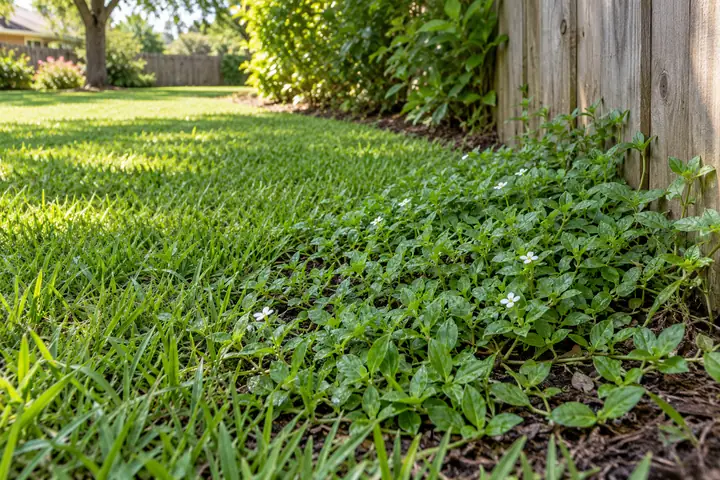
A low mat can be the main issue
Some lawn weeds announce themselves by standing tall. Virginia buttonweed can cause a different puzzle: the lawn has been cut, yet a broadleaf carpet still threads through the grass. Looking only at the tips misses the issue. Start by examining whether the patch consists of connected leafy stems close to the soil. The maintained height and the amount of desired turf inside that carpet are two separate things to assess.
LSU AgCenter describes Virginia buttonweed as a warm-season perennial that favors moist conditions and can spread through both seed and stem fragments. Its low growth tolerates mowing. These traits explain why it deserves its own conversation instead of being treated as ordinary grass that simply grew too quickly. A tidy cut can be real, while the persistent broadleaf mat is also real. One observation does not cancel the other.
Read leaves, flowers and growth habit together
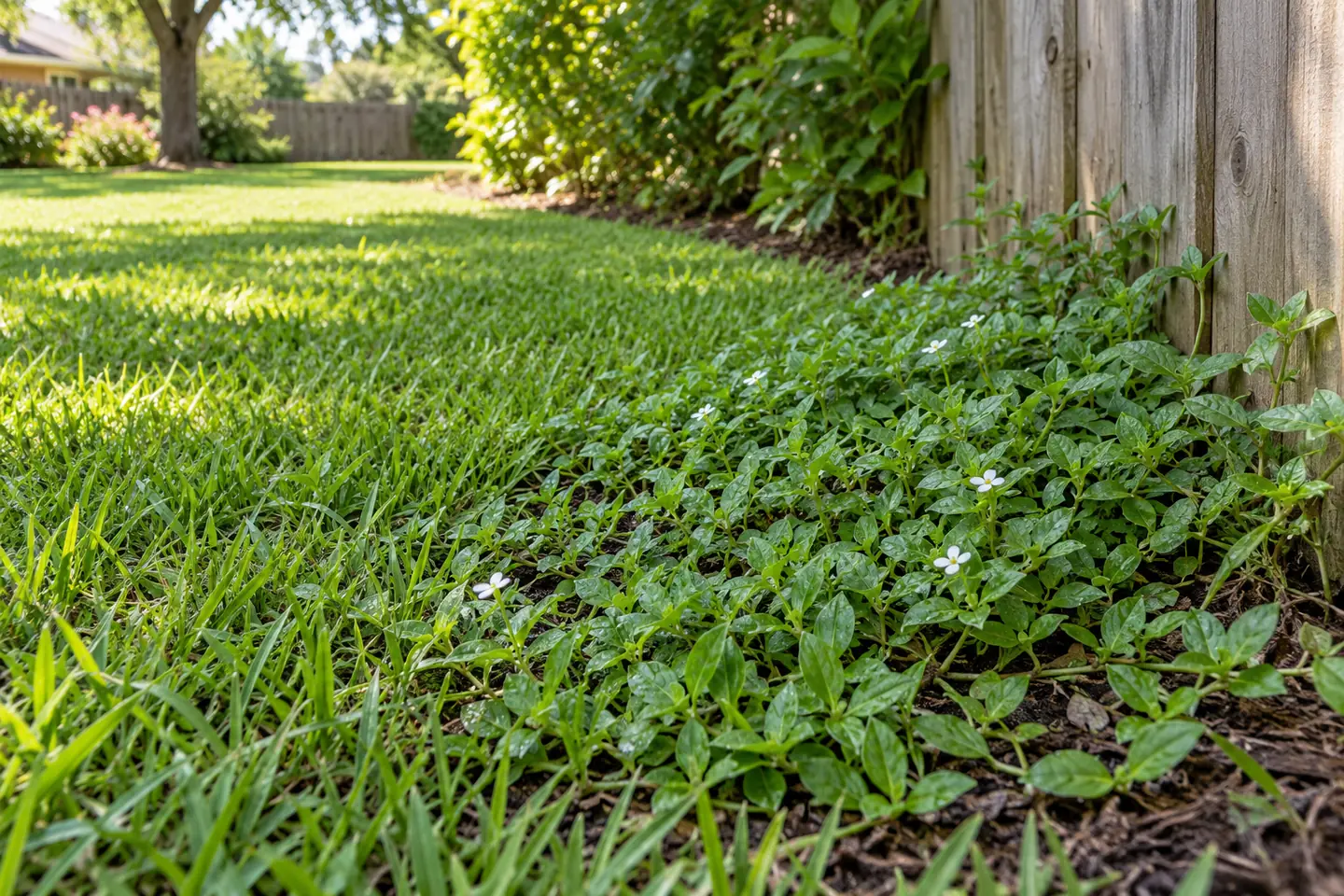
Look for leaves occurring opposite each other along the stem and small white flowers with four petals. Follow an intact stem through the patch so the leaves and flower you compare belong to the same plant. A white bloom from an unrelated lawn weed can sit above a buttonweed-like mat and create a misleading combination. Pairing features on one stem is more reliable than assembling an identification from several nearby plants.
The University of Georgia's buttonweed bulletin describes its low spreading growth, opposite leaves and white star-like flowers. Its photographs are useful references when a flower is present. If the lawn has just been cut and no flowers remain, the absence of blooms does not rule the plant out. Ask for identification help using intact stems and the overall growth pattern. Do not choose a management approach solely because one small white flower looked familiar.
Find out how much grass remains beneath the mat
At several points, look between the broad leaves for the intended turf. Is grass visible throughout, only around the outside or in isolated pockets? Record those differences on a simple patch sketch. The area occupied by visible buttonweed and the area occupied by surviving desired grass are not necessarily identical. This distinction helps explain why reducing the weed may reveal an uneven surface rather than an immediately complete lawn.
Avoid pulling the carpet apart just to make the inspection dramatic. A view at a natural opening or outer edge may be enough to establish that grass is sparse. If the center cannot be assessed without disturbance, say so. The useful question is what condition needs further review, not whether you can expose every stem in one afternoon. Keep any future turf-recovery discussion separate from the immediate mowing finish.
Treat fragments as plant material, not harmless confetti
LSU notes that stem fragments can propagate Virginia buttonweed and can be moved during mowing. That makes fragment handling worth discussing before work starts. Identify where the mat is concentrated and ask how the mowing sequence and equipment cleanup will be handled for that area. Do not assume that blowing chopped material from the patch into a planting bed is equivalent to simply clearing ordinary dry leaves from a walkway.
The concern does not mean every fragment will establish or that equipment explains every later patch. It means fragments should be considered in the work plan. If a mat has already been pulled or trimmed, describe where that material was placed. Avoid dragging it across unaffected lawn for a tidier-looking pile. The aim is to reduce unnecessary movement while keeping claims modest: a careful cleanup procedure is not proof that all future spread has been prevented.
Map isolated plants separately from a continuous carpet
A few scattered stems at the outer edge tell a different story from a thick connected mat at the center. Mark the core and any separated groups independently. This helps a later review distinguish reduced density, outward spread and newly noticed outliers. One large circle around the entire back lawn hides those differences and makes every future comparison sound like either complete success or total failure.
Use recognizable fixed points, such as the porch step and fence corner, rather than loose markers left in the mowing path. Include a note where the plant crosses into a bed or paving joint. Surface boundaries matter for scope, even if they do not establish biological containment. A patch touching three surfaces may need three work decisions. It should not become an assumed whole-property treatment because one side of the mat touches grass.
Moist ground needs an observation, not an automatic diagnosis
Buttonweed's preference for moist conditions makes wetness relevant, but the plant cannot tell you whether a grade issue, irrigation practice or rainfall pattern is responsible. Note when water is visible and whether the ground has previously supported equipment without marking. A site can look green and level while still being unsuitable for the usual route that day. Tell the person planning the visit about actual softness rather than using the weed's name as a substitute.
If the patch follows a swale, preserve the distinction between maintaining vegetation and altering water flow. Do not fill, dig or block a drainage route merely to make the mat easier to cut. A drainage question requires the appropriate assessment. Happy Grass's maintenance discussion can identify a route concern without claiming to solve the site's water movement. Keeping those responsibilities clear protects both the intended lawn finish and the function of the landscape.
A perennial patch needs a useful review period
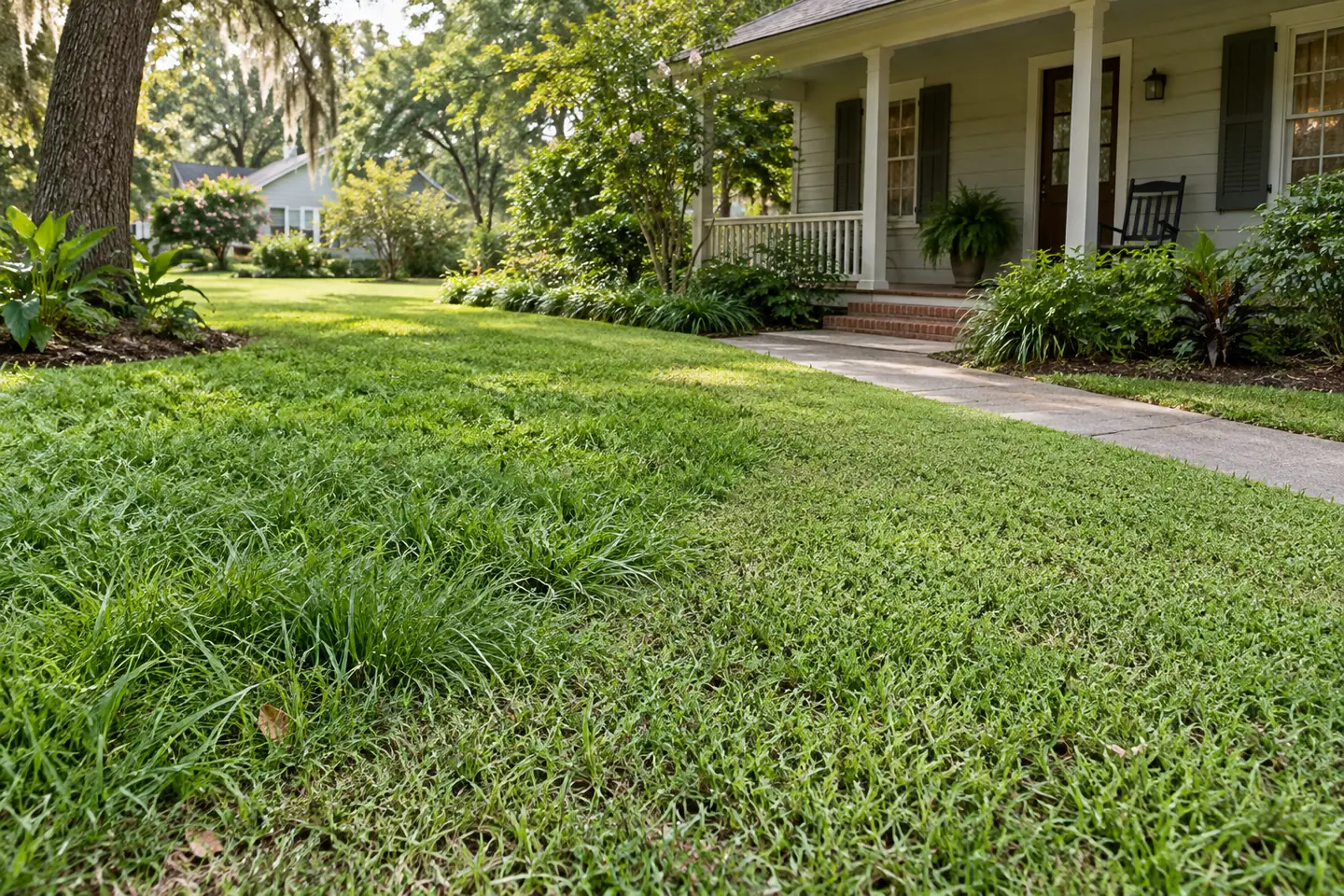
A photograph immediately after mowing mostly records height and cleanup. A later observation can show where broad leaves remain and whether the mat's boundary has changed. Agree on which of those outcomes is being reviewed. If only mowing was purchased, persistent buttonweed is a separate management question. If a specific weed-control plan was agreed, use its stated follow-up process rather than inventing a new deadline from the first flush of green leaves.
Do not equate a temporary color change with complete removal of a perennial plant. Similarly, do not judge an entire plan from one surviving leaf without considering the target and review conditions that were agreed. LSU and UGA describe buttonweed as a difficult weed requiring an appropriate management approach. That background supports realistic expectations; it does not authorize an unspecified product, guarantee or sequence of treatments for your particular lawn.
Keep the intended turf in the decision
A mat through St. Augustinegrass is not the same treatment setting as a mat through another turf species or among ornamentals. Identify what you want to preserve before considering a product or removal method. Where the grass itself is mixed or uncertain, resolve that uncertainty first. The word lawn on a package or estimate is not enough detail to establish suitability for every desired plant in the affected area.
Manual work also needs a defined endpoint. Does it mean removing visible stems from a small edge, reviewing an established carpet or addressing plants tangled through a bed? Those tasks have different limits. A large mat can leave open ground when disturbed, and open ground is not instant replacement turf. Discuss that consequence before selecting work based only on the appeal of seeing the broad leaves gone at the end of the visit.
Compare a mat center, a stem outlier and loose material
A dense center with few visible grass blades raises a different question from one leafy stem extending beyond the old patch. The center concerns the condition of the remaining turf and the scale of the established mat. The outlier concerns the visible distribution beyond it. Loose cut material on paving concerns cleanup and handling. All three may occur after the same visit, but combining them into one statement about bad mowing makes the review less precise.
For a useful check, start where the original white flowers and paired leaves were observed. Then inspect the outer mapped locations and the cleanup destination. Do not infer that every separated green piece is attached or that every attached stem has rooted at each point. Record the connection where visible and leave hidden connections open.
- A connected leafy stem shows surviving visible plant growth.
- A separate small plant requires its own identification and location note.
- Loose pieces on a hard surface show a cleanup issue without proving new establishment.
- A broad open area after disturbance shows a surface condition that needs its own expectation.
This comparison makes room for partial changes to be described honestly. A mat may be less dense while outliers remain, or the surrounding grass may be tidier while the plant-management question is still unresolved.
Give the buttonweed question its own place in the request
A clear request identifies the low mat, its core and outliers, any white four-petaled flowers and the surfaces it crosses. Mention loose fragments already present and any wet-ground route concern. Then state whether the immediate aim is ordinary lawn maintenance, identification before work or a separate weed-control discussion. This keeps the plant's unusual persistence from disappearing inside a general instruction to mow everything short.
For Happy Grass requests in Harvey, Marrero, Gretna, Algiers, Belle Chasse and Westwego, call 504-339-3571 and ask for Happy. Confirm available weed-control scope separately from recurring mowing. Fertilization, aeration, overseeding and pest control are not offered. Let the goal be a readable, maintained lawn with an honest plan for the buttonweed question, rather than expecting one neat cut to settle every root, stem and seed beneath that green carpet.