
Keep annual sedge as a candidate, not a label for every sedge
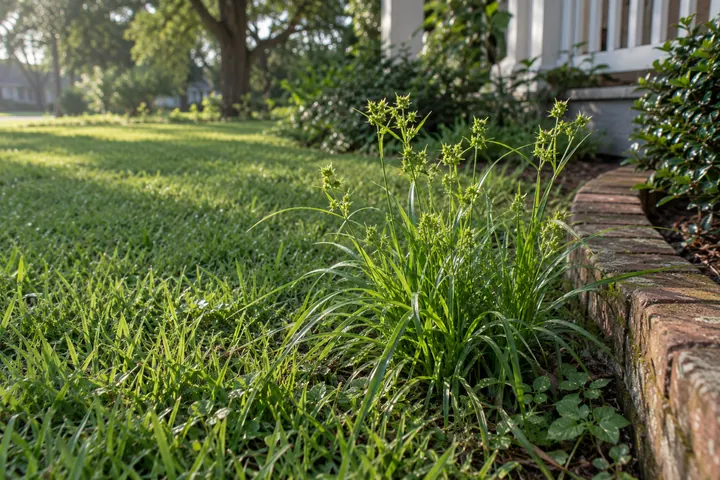
The word annual in a plant's common name has a specific role. It should not be applied to every sedge-like shoot in the lawn merely because the homeowner first noticed it this year. Choose one readable clump, give it a fixed location label and preserve its head and leaf evidence. The label remains useful for a lawn discussion even while the plant's exact name is being reviewed.
NC State's annual sedge account identifies Cyperus compressus as a true annual. It describes a clumpy appearance and conspicuous flattened green spikelet clusters with a toothed outline. The profile lists no tubers for this species. These are comparison features, not an invitation to infer an entire underground structure from a shiny leaf. A candidate name and an observed belowground finding are different kinds of evidence.
Begin with the whole head before enlarging a tooth
A close crop of one pointed edge can be difficult to orient. Show the head, its supporting stalk and enough surrounding leaves to connect it to the marked clump. Then add a closer view of the outline if the detail is readable. The wider photograph gives the tooth question somewhere to fit rather than leaving an isolated green shape that could belong to another structure.
Keep an original frame beside any cropped copy and use matching labels when they show the same head. If the close detail comes from another example, state that change openly. A qualified reviewer can use several comparisons honestly when their origins are clear. Quietly borrowing the sharpest edge from another clump can make the record appear complete without documenting the actual combination of features on one plant.
Flattened shape needs an orientation record
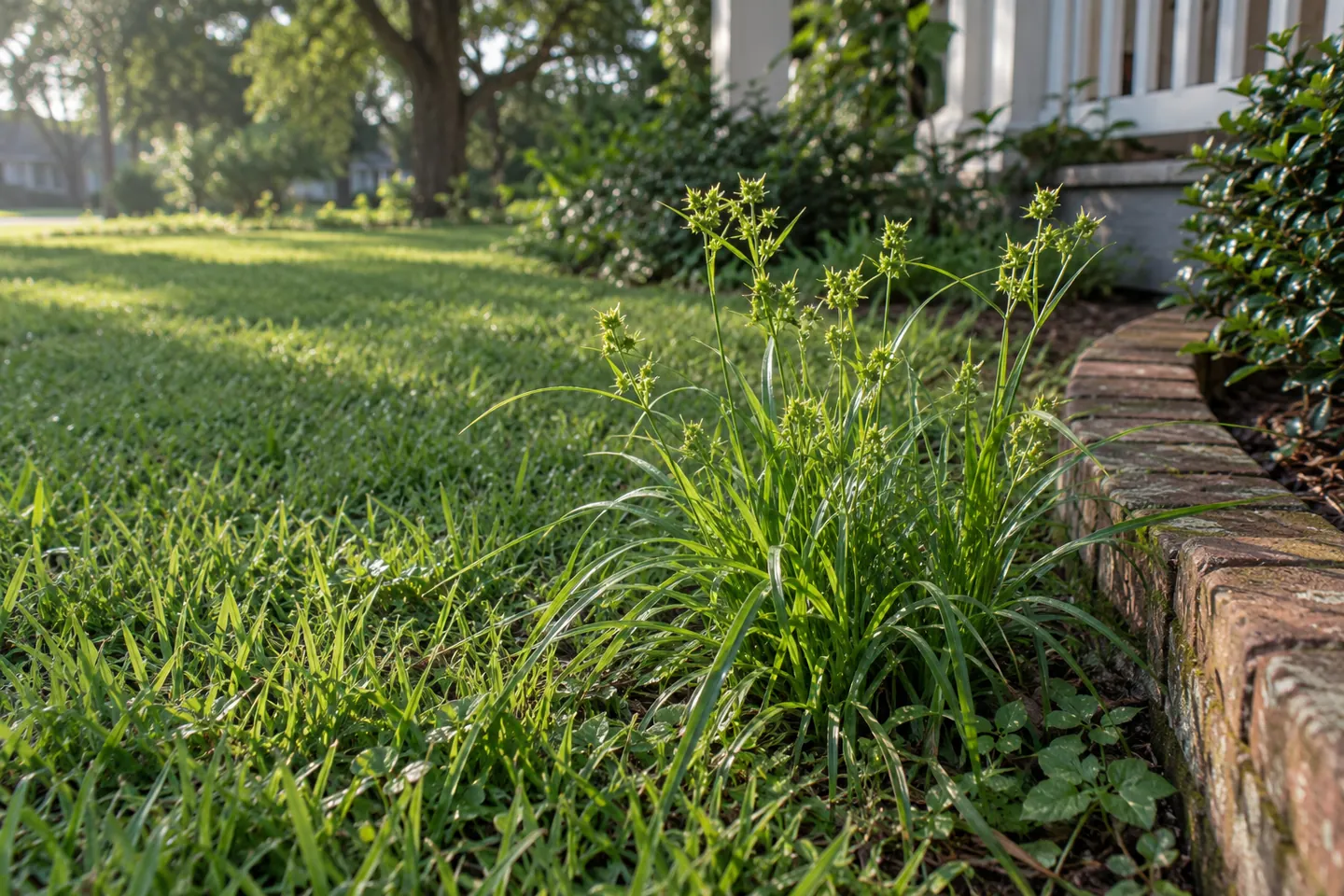
A flat structure can look narrow when viewed from its edge and broader when viewed from its face. If shape is central to the inquiry, preserve both useful angles of the same intact head. Explain the viewpoint rather than treating the changed outline as a change in the plant. A single silhouette may not show which surface the camera recorded.
Do not compress, spread or arrange the head to create the expected flattened appearance. If handling changed the structure before a later image, keep that history explicit. The useful evidence is the intact arrangement the reviewer can interpret. A neat-looking demonstration can remove the very context needed to decide whether the head actually supports the annual sedge comparison or needs another candidate considered.
Keep the head tied to the clump beneath it
Several glossy shoots may overlap near a border. Trace the supporting stalk toward its own base where possible and show the lower leaves that can actually be connected. Do not assume that the largest nearby clump supplied the most readable head in the photograph. If turf hides the route, label the relationship uncertain rather than drawing a line through an unseen connection.
Number another head separately when it provides a clearer comparison. The reviewer may find that one view is stronger while another lacks the necessary orientation. The location map should retain both examples without merging them into a single imagined individual. This lets the identification improve while keeping the practical work area beside the curved brick border easy to recognize.
A grass-like leaf does not finish the group question
Narrow leaves can make a sedge resemble turf or a weedy grass from across the yard. The NC State account discusses the triangular stems characteristic of sedges, but a routine lawn inquiry does not require breaking an unidentified shoot to stage a cross-section. Preserve an intact readable view and ask a qualified reviewer which additional evidence is appropriate when the group remains uncertain.
Keep the group question separate from the exact species question. A reviewer might be able to support a sedge comparison while leaving annual sedge unconfirmed. Preserve that distinction in the answer. The useful result is the conclusion supported by the available evidence, not the most precise name that can be fitted to a general photograph of shiny upright leaves.
No tubers in a species profile is not a surface observation
The reference's tuber entry describes the named species. It does not prove that a particular clump in your yard has no tubers, especially while its identity remains provisional. A photograph of the top cannot establish complete absence of an unseen structure. Do not present that absence as something you personally checked unless the relevant evidence was actually observed and appropriately documented.
If someone supplies detached underground material, retain its collection history and example label. A loose object found near a clump is not automatically connected to that plant. Ask a reviewer what evidence would be useful rather than digging merely to complete a guessed internet checklist. The surface inquiry can still be organized clearly while the belowground question remains open.
A clumpy appearance does not measure the number of individuals
One conspicuous tuft can contain overlapping shoots whose lower connections are hidden. Show the visible outline and describe it as a clump without claiming a precise individual count. If several tufts are separated by turf, mark their locations separately. This practical map can be useful even when the full biological footprint of each example is not known.
Use fixed reference points such as the brick curve, a paving joint or a bed corner. A map based on those features remains understandable if the candidate name is revised. Avoid giving exact patch dimensions from an angled image with no scale. If a measurement is needed for the work discussion, state the endpoints and method so it describes a location rather than an invented underground system.
A damp setting does not prove a drainage defect
The extension account discusses sedges in wet settings while acknowledging that they can occur in other conditions. Do not turn a candidate plant's presence into a diagnosis of this particular yard. Record visible water, surface softness and known rainfall or watering history separately. A dry-looking surface today and a wet observation on another date can both belong in the record without forcing one explanation.
For routine work, a current access concern can matter regardless of the species name. Show it directly in an ordinary overview and describe the practical question. A head close-up should not be expected to communicate an unassessed drainage-repair request. Happy can discuss the marked lawn area while any separate water-source or property-condition question remains clearly outside the identification conclusion.
First notice is not the plant's life history
A homeowner may first see the head when it rises above the lawn. That does not establish when the clump began or prove that every nearby shoot has the same life cycle. Keep first notice, the first readable head photograph and any later observations as distinct dated events. Leave the earlier timeline unknown when no checks were made.
Regional descriptions of emergence timing should remain in their source context rather than becoming an exact West Bank calendar promise. A later image of another head in the same area can be a useful comparison, but it should not silently replace the original example's history. Preserve whether the same marked stalk was revisited and which features changed or were no longer available after routine work.
Define the raised-head concern and the low-lawn concern separately
One request may concern the conspicuous green heads, while another concerns the clump's different texture at the border. State which effect you want reviewed from the ordinary walkway view. A close photograph cannot define whether the included area is one tuft, a short strip or the whole lawn. Mark the intended boundary before discussing the routine finish.
Confirm the mowing, edging, weed-eating or blowing proposed for that area. A shorter visible top is not proof that every hidden part or future seed is gone. A later remaining low leaf should be evaluated against the work actually agreed rather than an unstated complete-removal promise. The candidate species does not create a separate treatment or soil-correction service by itself.
Send a head-centered record that can be reviewed
Include the ordinary border view, an attached head overview and a second orientation of that same head when available. Add the lower connection only to the extent it can actually be followed. Ask whether the flattened toothed arrangement supports annual sedge and which feature remains necessary if it does not. A focused gap gives a reviewer a useful next step.
- Show the complete head before enlarging its edge.
- Label face and edge views of the same structure.
- Keep a provisional sedge-group answer separate from a species conclusion.
- Do not infer unseen tuber absence from a surface image.
- Preserve actual dates, water observations and the routine work boundary.
Review the glossy clump with Happy
Call 504-339-3571 and ask for Happy. Describe the marked lawn area, current access and the mowing, edging, weed-eating or blowing you want discussed. Confirm the actual scope and availability before arranging a visit.