
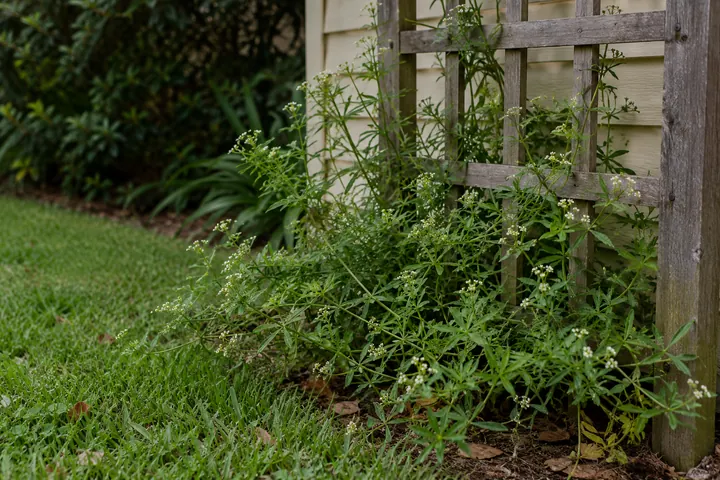
Give one stem a route through the tangle
Begin with a readable section rather than trying to explain the whole patch in one photograph. Follow a stem through a few visible attachments and mark where it disappears behind other growth. A simple location label such as bare-trellis example makes that section easy to discuss. The label does not need to contain a final species name to be useful.
UC's gallery describes Galium aparine with weak square stems, leaves in whorls often containing six to eight members, tiny curved prickles and small pale flowers. Its paired fruit may carry hooked hairs, although the account also allows hairless fruit. These details support a connected comparison. The common names stickywilly or cleavers do not make an attachment test on clothing or a pet necessary for identifying an unfamiliar yard plant.
Count one leaf whorl rather than a whole crowded image
A whorl concerns leaves attached around one point on the stem. Two nearby nodes can merge in an overhead photograph and create an inflated count. Show the selected node with enough stem above and below it to separate it from its neighbors. State how many attachments are actually readable and which portions remain hidden behind overlapping leaves.
An incomplete view should not be converted into a precise complete count. If four attachments can be seen while the far side is obscured, record those four visible connections and the limitation. Do not exclude every candidate whose full reference count is larger. A qualified reviewer can explain whether another angle is needed. The useful record tells that person what the photograph establishes, not what the expected description encouraged you to assume.
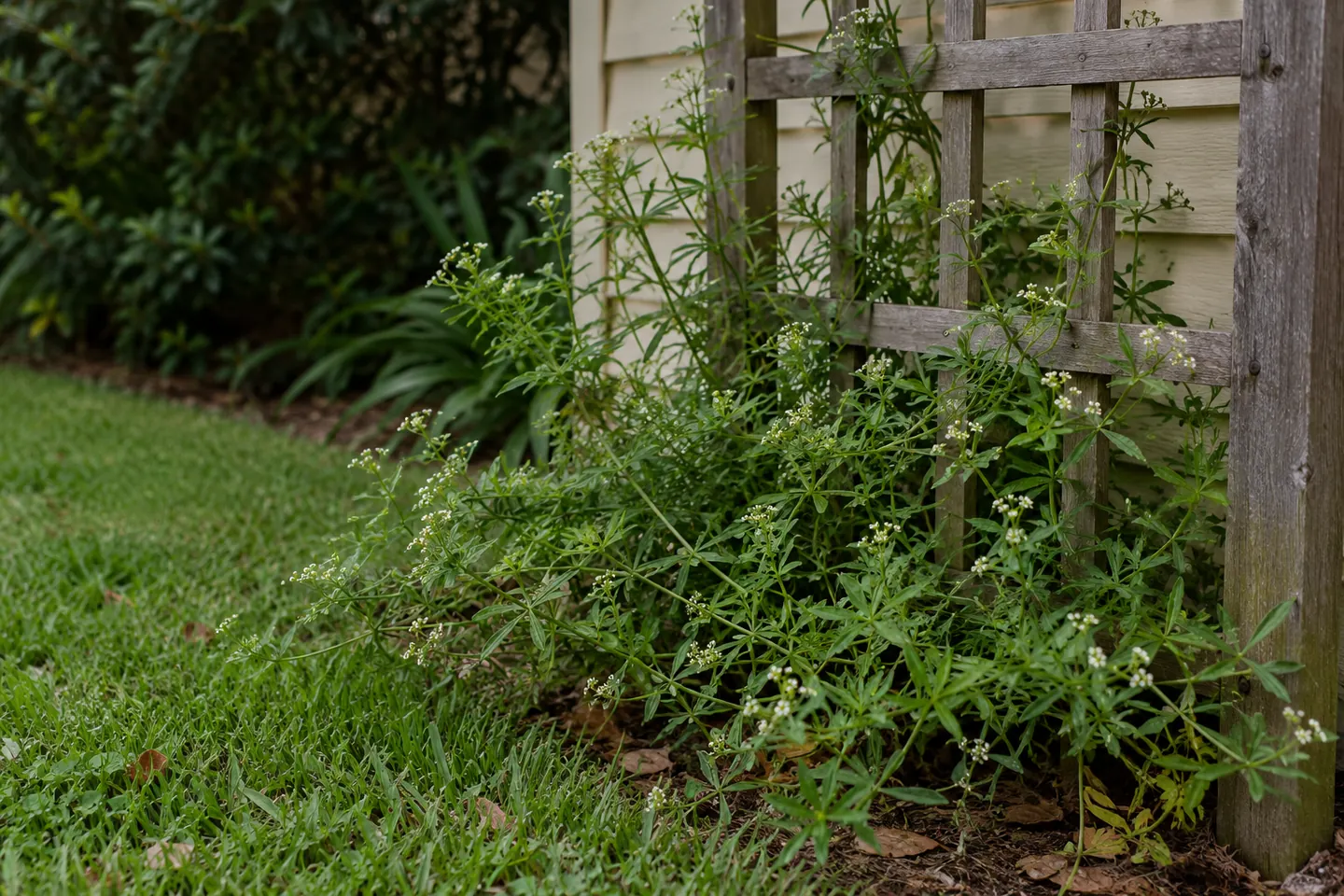
Keep the whorl on the stem that carries the other features
A clear leaf ring near the trellis may belong to a different stem from the nearest pale flower or paired fruit. Trace their supporting route where possible. Keep the overview alongside the close details so another person can follow which section supplied them. The strongest evidence is not necessarily the sharpest isolated picture; it is the picture whose relationship to the marked example is understandable.
Number a second example separately when it provides a clearer view. A comparison can remain useful without being merged into the first plant. Quietly combining the best whorl, flower and fruit from several places creates an apparently complete individual that nobody documented. A reviewer should be able to say that one relationship is supported while another remains unresolved, and the file labels should make that distinction easy to preserve.
A loose tangle is not proof of damage to its support
The plant may rest against a trellis, lean over turf or lie across another leaf. Describe the visible contact before assigning a consequence to it. A single photograph cannot establish that the support has been damaged or explain the condition of every plant beneath the tangle. Keep any separate property concern tied to its own observations rather than importing it from the candidate weed's reputation.
For a practical lawn discussion, show the whole area from an accessible viewpoint. Identify the turf strip, trellis base and any intended keep planting. The access and work-boundary questions can matter even while the exact plant remains under review. Happy should not have to infer a trellis repair, bed renovation or special removal request from a close picture of narrow leaves.
Do not stage a sticky-plant demonstration
The source's prickles and hooked hairs help explain the common-name discussion. They are not an instruction to rub an unidentified plant on clothing or place it against an animal. A clear close view and an accurate note about an observation already made are more useful for a routine inquiry. Ask a qualified reviewer which additional evidence is appropriate if the available structures cannot be resolved.
If loose plant material was found on clothing or elsewhere, record where and when it was noticed without assuming a complete origin. That object may be useful for comparison, but it does not automatically connect to the marked trellis-side example. Keep its handling history separate. A possible way material can move does not establish how a particular object traveled or which plant supplied it.
Paired fruit needs its own attachment record
Two small bristly objects can look like a pair merely because they lie together. Show the intact attachment when asking about the paired-fruit description. Include an angle that resolves the two-part outline and its supporting stalk. If the image cannot show the connection, label the relationship uncertain instead of completing it from the candidate profile.
Remember that the UC account allows variation in the fruit's hair covering. Do not use a blurred surface or an expectation of hooks as a substitute for a readable observation. A close image may show the outline while leaving its surface detail unknown. Let those two findings remain separate. This gives the reviewer an honest basis for deciding whether the example supports the candidate or needs another comparison.
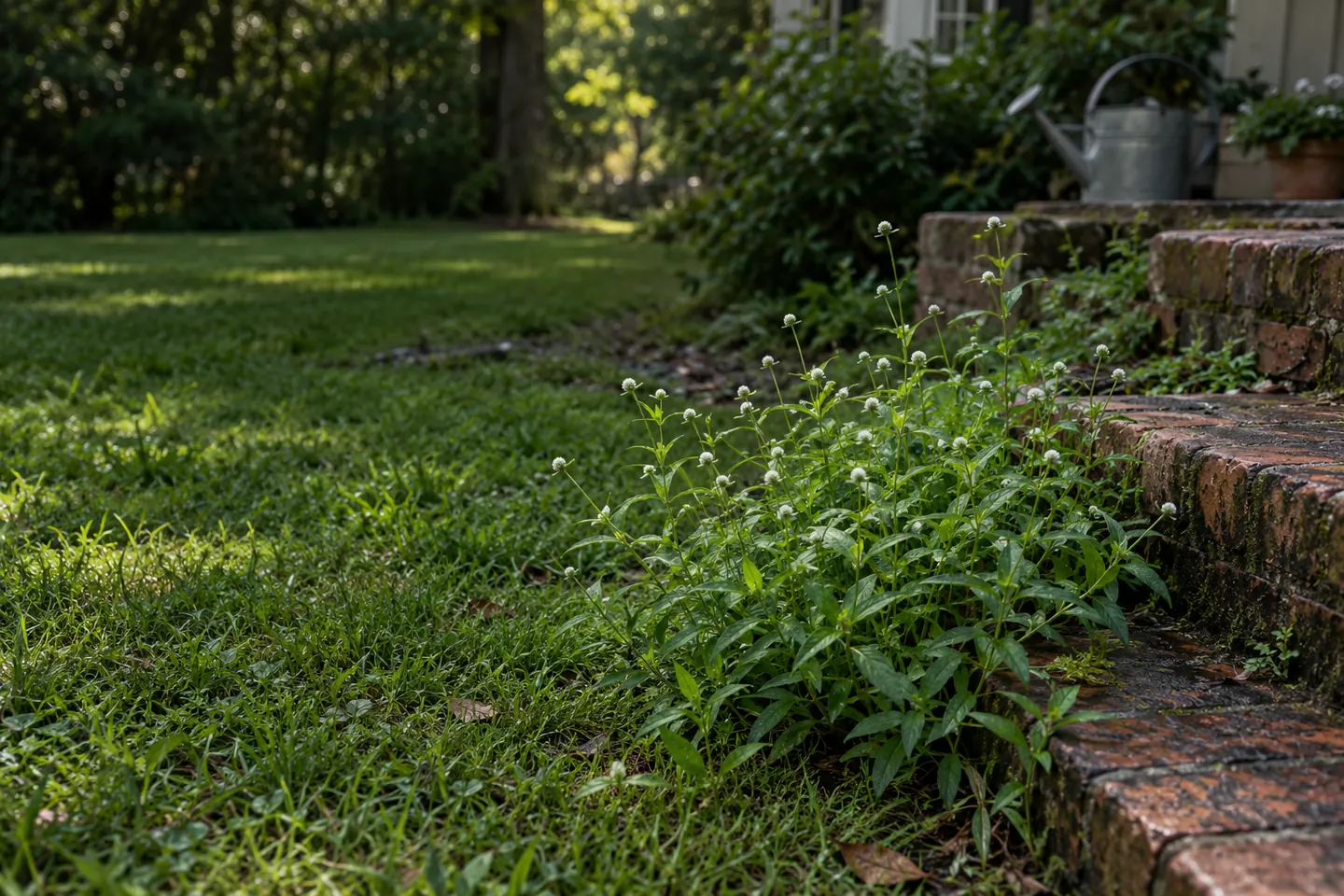
Compare another whorled plant without reducing the answer to one number
Field madder appears among the gallery's related comparisons. If another whorled example is present in the yard, preserve it as a separate record with its flower position and overall habit. A single uncertain count should not become the whole identification. The reviewer needs to know how much of each node was visible and whether the attached flowering structures were actually followed.
Use a short comparison note that names the observed difference rather than announcing a winner. One example may have a longer loose stem route while another appears as a compact low patch; those are useful descriptions of the actual views. They are not by themselves final species determinations. Keeping the records separate allows a qualified answer to improve without forcing every similar-looking plant into the same label.
Treat regional life-cycle information as context
UC discusses winter- and summer-annual behavior in its regional account. Keep that background separate from the exact history of a West Bank trellis strip. Record when the marked example was seen and which structures were present. If nobody checked the area earlier, the emergence date remains unknown. A first photograph of a tangle is not proof that it developed entirely since the last routine lawn visit.
Save any known maintenance date as its own event. If later work changes the stems, keep the earlier images that show useful connections. Do not replace them with a different example simply because it still has fruit. The current appearance and the earlier identification evidence can both remain relevant when their dates and origins are preserved honestly.
Define the included lawn strip before discussing a finish
The tangle may cross between turf and a bed that is intended to remain. Mark the included area and explain any keep boundary before routine work is arranged. A candidate plant name does not tell Happy which side of the line belongs in the lawn request. An ordinary overview with fixed reference points can communicate that boundary much better than a tight whorl photograph.
Confirm which mowing, edging, weed-eating or blowing is proposed and what visible result belongs to the agreed operations. Tidying raised or loose-looking growth should not become an unstated guarantee that every seed or hidden stem has been eliminated. A later record should compare the actual included strip with the agreed task while preserving any unresolved identification or belowground question as a separate matter.
Keep a node diagram distinct from the work map
If the photograph is difficult to discuss, make a small sketch of the selected node showing only the attachments you can trace. Give that node one label and put a question mark on its obscured side. Keep the sketch beside the source image. It is a navigation aid for the conversation, not independent evidence that a hidden attachment exists. A reviewer should still be able to inspect the original without relying on the drawing's interpretation.
Use a different set of labels for locations along the trellis. One dot on the work map can represent the whole example, while the node sketch describes a small part within it. Keeping those scales separate prevents a count of leaf attachments from being confused with a count of plants or work areas. If the reviewer asks about a second node, give it another label rather than silently moving the first label to a clearer place. The record can then show exactly which uncertainty the additional view resolved.
Send a route, a node and a connected structure
A focused first packet can contain an overview, a readable stem route, one labeled whorl and an attached flower or fruit detail when available. Explain exactly where the route becomes hidden. Ask whether the connected evidence supports catchweed bedstraw and which additional view would help if it does not. This gives a reviewer something specific to answer without requiring a confident common-name claim.
- Separate one node from the next before counting leaves.
- Keep fruit and flowers tied to their supporting stem.
- Label loose collected material with its actual origin.
- Avoid staged attachment tests on clothing or animals.
- Show the lawn-work boundary independently of the tangled plant.
Review the trellis-side strip with Happy
Call 504-339-3571 and ask for Happy. Describe the marked lawn area, current access and the mowing, edging, weed-eating or blowing you want discussed. Confirm scope and availability before arranging a visit.